
The people will not just regulate wealth,
not just shame greed,
but move money downward and make the country feel the transfer.
The condition is already plain. In the Federal Reserve’s distributional data for Q3 2025, the top 1% held 30.8% of total net worth, while the bottom 50% held 2.4%. In the same data, the top 1% held 49.9% of corporate equities and mutual fund shares, while the bottom 50% held 1.0%. At the same time, U.S. health spending reached $5.3 trillion in 2024, or 18.0% of GDP, with private health insurance still taking 31% of total national health expenditures. HUD’s 2025 report says there were only 38 affordable and available units per 100 extremely low-income renter households in 2023. And Alaska’s dividend remains a live proof of concept: the 2025 Permanent Fund Dividend was $1,000. Public companies already disclose CEO-to-median-worker pay ratios, the tax code already limits certain public-company executive-pay deductions above $1 million, and the Labor Department already runs an Employee Ownership Initiative. The tools exist. The missing piece is force.
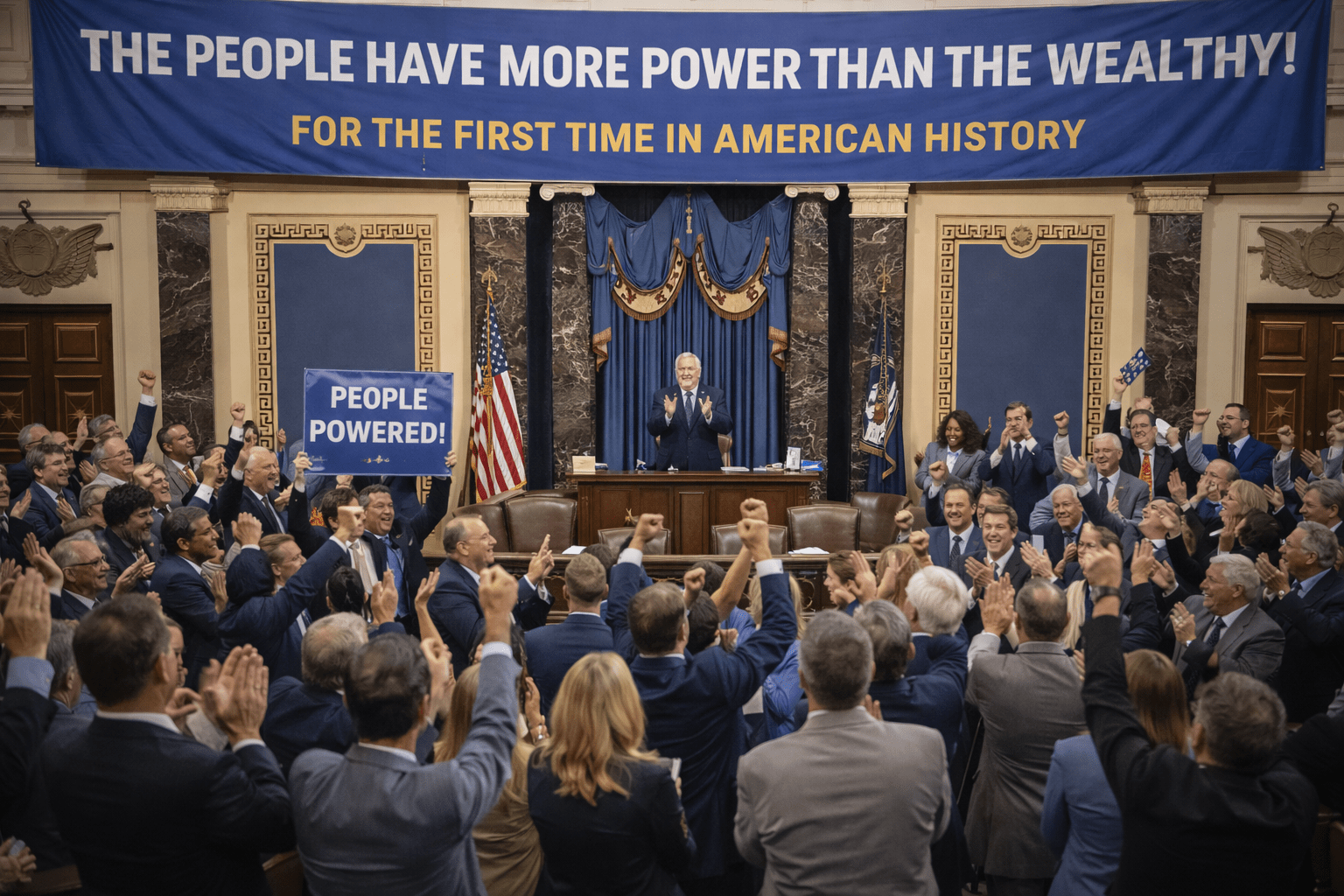
The rich are not holding the country together by grace. They are holding most of the wealth. In Q3 2025, the top 1% held 31.7% of net worth and 50.2% of corporate equities and mutual fund shares, while the bottom 50% held 2.5% of net worth and 1.1% of those equities. So if concentrated wealth ever tried to punish the country by leaving, concentrated wealth would take the largest direct hit. Everyone else would still absorb fallout through pensions and the wider economy, but the public is already living with the deeper injury now: little ownership, high exposure, and debt. That is why rebuilding from the bottom up is more workable than continuing to organize society around shielding unlimited wealth from consequence. The first 120 Executive Orders have already made the wealthy far less of a threat and given more to the people than ever before in our history.
Day 121 — The People’s Share Order
Executive Order:
The President creates a People’s Share Council led by Treasury and OMB and orders a 21-day unified package covering the USA Dividend, a universal basic income floor, universal-health transition, housing security, transportation access, and a national well-being budget.
All agencies must identify within 14 days the fastest lawful paths to move money and security downward using existing federal authority.
Purpose
To force coordination across the entire federal system so wealth transfer is not fragmented, delayed, or diluted.
What people get
A government-wide transfer plan with deadlines, named agencies, and a public calendar.
This stops the drift.
The public can see when relief, ownership, and security actually arrive.
Echo Day → 130
The full system is measured and locked into a single test: does money actually reach the people?
Day 122 — The USA Dividend Fund Order
Executive Order:
Treasury establishes the administrative structure for a USA Dividend Fund and maps capitalization streams from public-value revenues.
IRS and Treasury build payment rails through existing federal systems.
Purpose
To establish national ownership as a permanent mechanism, not a one-time redistribution.
What people get
The first direct national-ownership system.
A payment mechanism that says the country produces wealth and the people have a claim on it.
Echo Day → 139
Recovered public money is routed visibly into people-facing uses, including the Dividend.
Day 123 — The Basic Income Floor Order
Executive Order:
Treasury, IRS, SSA, Labor, and OMB build the delivery architecture for a monthly income floor while maximizing existing cash-support systems.
A permanent UBI bill is transmitted to Congress.
Purpose
To eliminate baseline economic instability that prevents participation in society and decision-making.
What people get
Simpler access to cash support now and a live system ready for a permanent monthly floor.
Less fear. More control.
Echo Day → 150
The Human Strength Ledger tracks whether economic stability is actually improving lives.
Day 124 — The Universal Health Transition Order
Executive Order:
HHS, CMS, Treasury, and Labor expand enrollment, tighten price oversight, and enforce insurer obligations while producing a 30-day universal-health transition plan.
Purpose
To reduce the distance between illness and care while weakening profit-driven barriers.
What people get
More people covered now.
More pressure on insurers now.
Care becomes reachable.
Echo Day → 141
Paid leave and care systems reinforce health access as part of lived stability.
Day 125 — The Health Extraction Shutdown Order
Executive Order:
FTC, DOJ, HHS, and CMS launch coordinated enforcement against PBMs, anti-competitive hospital systems, and insurer extraction tied to public funding.
Purpose
To strip profit incentives that inflate costs and reduce care quality.
What people get
Lower drug pressure.
More scrutiny on hospital and insurer behavior.
Healthcare begins shifting from extraction to service.
Echo Day → 131
Excess-profit recapture systems absorb and redirect extracted wealth.
Day 126 — The Housing Security and Public Land Order
Executive Order:
HUD, Treasury, FHFA, USDA, and DOJ identify federal land, financing, and enforcement tools for housing expansion and anti-speculation.
A full corporate-landlord exposure map is produced.
Purpose
To convert housing from an extraction asset into a stability system.
What people get
More supply.
More stability.
Less predatory pressure.
Echo Day → 136
Land hoarding and vacancy systems are directly targeted and taxed.
Day 127 — The Transportation Access Guarantee Order
Executive Order:
DOT and FTA map national mobility gaps and redirect federal funding toward underserved communities based on access need.
Purpose
To make participation in work, health, and civic life physically possible.
What people get
More routes where they are needed most.
More real mobility.
Freedom that is not limited to car ownership.
Echo Day → 141
Time and life stability improve when movement becomes reliable.
Day 128 — The Democratic Employer Standards Order
Executive Order:
Federal contracts and support are conditioned on pay transparency, living wages, benefits, retirement contributions, and worker participation standards.
Purpose
To force public money to reshape private employment conditions.
What people get
Better jobs tied to federal spending.
Less support for extractive employers.
Echo Day → 138
Employer structures shift toward lower inequality and broader worker benefit.
Day 129 — The Worker Ownership and Profit-Sharing Order
Executive Order:
Labor, Treasury, Commerce, and SBA create a federal expansion track for ESOPs, cooperatives, and broad-based ownership.
Purpose
To move workers from wage dependence into ownership participation.
What people get
More upside.
More stake.
More long-term family wealth.
Echo Day → 137
Recovered monopoly gains are redirected into broader ownership systems.
Day 130 — The Wealth Compression and Well-Being Order
Executive Order:
OMB, Treasury, Labor, HHS, HUD, and DOT implement a wealth-compression scoreboard and well-being budget.
The next legislative package (131–140) is sent to Congress.
Purpose
To make redistribution measurable and irreversible by tying all policy to outcomes.
What people get
A government judged by results.
Not language. Not promises. Results.
Echo Day → 140
The Wealth Gap Scoreboard proves whether compression is real.
The line under Days 121–130
Day 121 starts the transfer.
Days 122–130 build the machinery.
Money moves down.
Security moves out.
Ownership widens.
The wealthy lose their automatic claim on everything.
And the sentence at the center is this:
What the country produces must show up in the lives of the people who live in it.