
The Readers Court

readers court logo image features a courtroom gavel and title

The Readers Court is where psychological thriller stories put power on trial. Each case begins with a human breaking point, then exposes the system beneath the harm: law, money, procedure, corporations, courts, hospitals, algorithms, landlords, employers, and institutions that protect themselves first. Every case asks the same brutal question: what is the right thing to do?

The Readers Court

The Scholarship That Was Not Renewable

Exhibit A — Case #005 | The Scholarship That Was Not Renewable

The acceptance letter arrived on a Thursday afternoon in April, folded inside a cream-colored envelope so thick it looked less like mail than something official enough to alter the shape of a life.

Sarah Kim found it propped against the fruit bowl on the kitchen table when she came home from school. Her mother had placed it there on purpose, centered carefully on the scratched wood as though the table itself should understand what it was being asked to hold.

The Scholarship That Was Not Renewable

For a moment Sarah only stood in the doorway with her backpack hanging from one shoulder.

The kitchen was small and warm from the rice cooker. A pan was drying beside the sink. Light from the window over the counter fell across the envelope and picked out the university crest pressed into the paper in deep blue ink. NORTHFIELD UNIVERSITY. The letters looked expensive. Permanent. The kind of name that belonged on old stone and library walls and brochures with students in wool coats carrying books across bright green lawns.

Her mother came in from the hallway wiping her hands on a dish towel.

“Well?” she said.

Sarah looked at the envelope again. “You opened my mail?”

“I did not.” Her mother nodded toward it. “I brought it inside. That is not the same thing.”

“You know the email already came.”

“I know.” Her mother pulled out a chair and sat down. “The email is not this. Sit.”

Sarah laughed despite herself. “You’re acting like it’s a court summons.”

“Maybe it is,” her mother said. “Maybe it summons you out of this house.”

There was enough nervousness in the room already that the joke landed softly and then disappeared.

Sarah sat.

She slid one finger beneath the flap and opened the envelope slowly so the paper would not tear. Even that felt important. She removed the letter and unfolded it across the table.

The paper was heavy. It made a faint, expensive sound.

She read the first line out loud because her mother was staring at her face instead of the page.

“Dear Sarah Kim, we are pleased to offer you admission to Northfield University for the fall semester.”

Her mother pressed the dish towel to her mouth.

Sarah kept reading. Her voice was steady until she reached the section farther down the page, set apart in bold type.

Presidential Merit Scholarship

Full tuition coverage for four years.

She stopped.

For a second neither of them said anything.

Then her mother sat down harder than she meant to and let out one sharp breath that sounded almost like a laugh and almost like crying.

“Oh my God,” she said.

Sarah looked at the words again to make sure they were still there. Full tuition coverage for four years. Four years. Not one year with renewal possible. Not partial aid. Not some hopeful arrangement that depended on phone calls and appeals and prayers and forms spread across the kitchen table. Four years.

Her mother reached across and touched the lower corner of the letter with two fingertips.

“Read it again.”

Sarah did.

By the time her father came home, the letter was still lying in the same place. He set a plastic grocery bag on the counter, loosened his work boots with the back of one heel, washed his hands, and only then came to the table.

He smelled faintly of cardboard dust and cold air from the loading docks.

Her mother handed him the letter without speaking.

He read more slowly than either of them had. Line by line. Then he went back and read the scholarship section again.

“Four years?” he said.

“That’s what it says.”

He nodded once, the way he did when measuring something in his head.

“That’s a good school.”

Sarah smiled. “Yeah.”

He looked at her then, not at the letter.

“You wanted this one.”

“I did.”

He placed the page carefully back on the table. “Then this changes things.”

That night her mother bought a small cake from the bakery near the bus stop. It was too sweet and the frosting stuck to the roof of Sarah’s mouth, but nobody cared. Her father cut the slices too large. Her younger brother asked whether Northfield had famous people there. Her mother told him to stop talking with his mouth full. Sarah took a picture of the letter and the cake and the cheap paper plates and the three of them crowding into the frame because the kitchen was too narrow to step back any farther.

Later, before bed, her father slid the letter into a clear plastic sleeve and placed it inside the blue accordion file where the family kept passports, tax records, medical bills, and the apartment lease.

“Don’t leave that lying around,” he said.

“I wasn’t going to.”

He shut the file. “Some papers mean what they say. You keep those close.”

All summer the letter became the object around which the house quietly reorganized itself.

Her mother started collecting things for the dorm in patient, practical installments: two towels from a discount store, a desk lamp still in its box, a navy blanket folded at the foot of Sarah’s bed, adhesive hooks, laundry pods, a plastic caddy for the communal bathroom. Her father found a used mini-fridge through a man at work whose daughter had just graduated. Her brother wrote NORTHFIELD on the side of a cardboard moving box in crooked block letters with a black marker and then decorated the corners with stars until Sarah made him stop.

On some evenings Sarah would remove the letter from the plastic sleeve and read it again for no reason except to feel the shape of it in her hands.

Full tuition coverage for four years.

The words did not feel like money.

They felt like a door opening.

Northfield was the kind of place she had only seen in brochures and online campus tours. Ivy twisting up stone walls. Wide lawns cut so cleanly they looked unreal. Laboratories with glass walls. A library that looked more like a cathedral than a building people actually entered with backpacks and coffee. At orientation, when she first walked through the main quad beneath late-summer sun and heard the bells from the old clock tower strike the hour, she felt the strange double-sensation of having arrived somewhere completely new and somewhere she had already visited a hundred times in private.

In the admissions office, a smiling administrator reviewed her paperwork across a polished desk.

“You’ve done extremely well,” the woman said. “The Presidential Scholarship is one of our most competitive awards.”

Sarah signed where she was told to sign. Enrollment forms. Housing. Meal plan. Registration acknowledgments. Then the administrator passed her one more page.

“This is the annual scholarship compliance agreement,” she said. “Standard requirements.”

Sarah scanned the page. Maintain minimum GPA requirements. Remain enrolled full time. Avoid disciplinary violations.

Nothing about it worried her. Those were the rules of serious life, the ones she had already been living by for years.

She signed.

When she stepped back outside, she held the folder against her chest and stood for a moment in the late August heat while students and families passed across the quad carrying bedding and lamps and unopened boxes. Her future had weight now. It could be carried.

Freshman year was harder than she had imagined and better.

The classes moved fast. Professors assumed you had done the reading and then assumed you had gone beyond it. The engineering students she met during orientation became her study group by accident after one long evening in the library when everyone remained at the same table past midnight and nobody wanted to surrender the outlet near the window.

They argued over formulas and laughed over bad campus pizza. They learned which classrooms had the best heat in winter and which vending machines stole your money. Sarah discovered that she loved the clean logic of difficult problems, the moment when confusion began to give way and the structure inside something finally revealed itself.

She also learned how to stretch every dollar that was not tuition. She worked ten hours a week shelving books at the library. She skipped overpriced coffee. She called home on Sundays while folding laundry in the basement of her residence hall. Her mother always asked whether she was eating enough. Her father always asked about classes. Her brother once held up a half-finished science project to the phone camera and said, “When you come home, you have to fix this part because Mom says it looks stupid.”

At the end of the first year Sarah’s GPA was 3.52.

She checked the scholarship requirements again just to be safe.

More than enough.

When she came home for the summer, the apartment seemed smaller than she remembered and more precious for that reason. The air conditioner rattled in the living room window. The kitchen table still carried its old scratches and water rings. Her room had become a place between departures, with dorm bins stacked in the corner and a Northfield sweatshirt hanging from the chair.

The family had survived a difficult winter. Her mother’s medical bills from an emergency procedure had taken months to pay down. Her father had picked up overtime at the warehouse after a supervisor retired, and for the first time in a long while there was less panic attached to the mailbox and the end of each month.

They were not comfortable. They were breathing.

That August, three days before move-in, the apartment filled again with the ordinary hopeful clutter of departure. Extra notebooks. A mattress topper rolled tight with twine. New pens. A cheap blue rug her mother insisted would make the dorm room “look less temporary.” Two storage bins sat by the front door. Her father checked the car twice to see what would fit in the trunk and what would need to ride on the back seat. Her brother kept sneaking granola bars into different bags as though Northfield existed in a wilderness without stores.

On the morning they were supposed to leave, Sarah woke before everyone else.

The apartment was quiet except for the refrigerator hum and the occasional hiss from the building pipes. Gray morning light lay across the living room. She made coffee, sat at the kitchen table, and opened her laptop to print her class schedule and confirm that her student account was clear before they drove out.

The blue accordion file was already on the table because her mother had taken it out the night before. Inside were all the important papers: dorm assignment, health forms, ID documents, and the original scholarship letter in its plastic sleeve. Sarah slid the letter halfway out and looked at it while the laptop loaded.

Full tuition coverage for four years.

Her father came into the kitchen pulling on his belt. “You’re up.”

“Couldn’t sleep.”

He glanced toward the stacked boxes near the door and smiled in the tired, private way he did when he was pleased but did not want to make too much of it. “Big day.”

Sarah nodded. “I’m just printing a few things.”

He poured himself coffee and went back to the bedroom to finish dressing.

A notification appeared on the student portal.

Scholarship Status Update.

Sarah clicked it without concern. She assumed it was the routine renewal confirmation for second year, one more administrative page to clear before classes started.

Instead a red banner filled the screen.

Additional eligibility verification required under revised institutional funding guidelines.

She frowned and opened the linked document.

The language was dense and sterile. Following a routine financial compliance review. Restructured under updated institutional policy. Continuing financial eligibility. Revised threshold.

Sarah read the page once without understanding it. Then again.

She clicked deeper into the portal and found the financial aid tab. The scholarship amount for the upcoming year had changed. Not reduced a little. Not adjusted. Changed.

She opened the family-income review summary and saw where the difference had entered the system. Her father’s overtime from the previous year. The extra shifts that had paid off hospital bills and kept collection notices from spreading across the table. That number now sat inside the university’s calculations as evidence that the family crossed a new line.

Sarah’s hands went cold.

She opened the billing page.

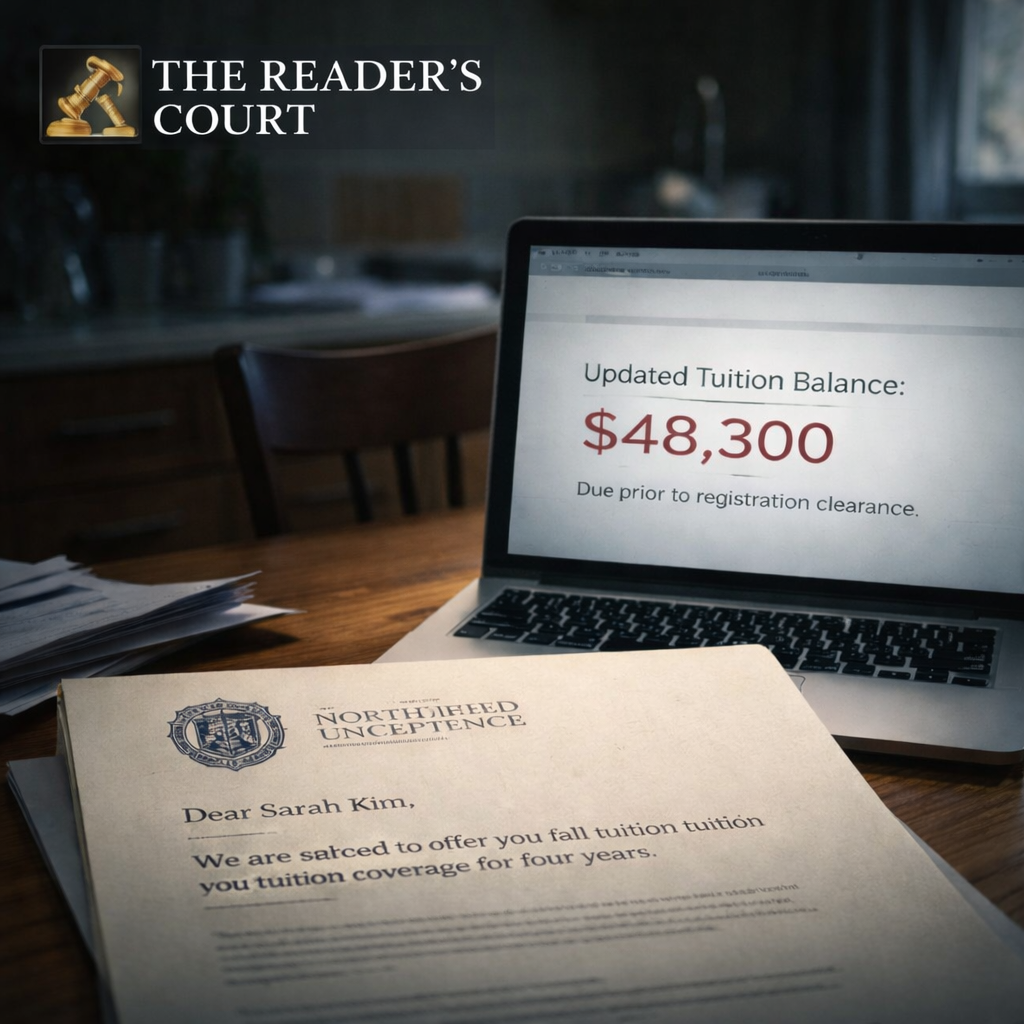
Updated Tuition Balance: $48,300

Due prior to registration clearance.

For several seconds the room seemed to lose sound. The refrigerator still ran. Water still moved somewhere inside the walls. But everything felt farther away, as if the kitchen had drawn back from her and left her sitting alone under a bright hard light.

Her mother came in carrying folded towels. “I found the second set,” she said. “The blue ones, not the white. White gets ruined in those laundry rooms.”

Sarah did not answer.

Her mother set the towels down. “What is it?”

Sarah lifted the original letter from the table with one hand and turned the laptop slightly with the other.

Her mother stepped closer.

On the screen the number remained fixed and flat and impossible.

Her father came back into the room buttoning his cuff. “You ready to start loading?”

Neither of them looked at him.

He saw their faces and stopped.

Sarah placed the acceptance letter beside the laptop so the two documents lay next to each other on the kitchen table, almost touching. The cream-colored page with the blue crest. The white screen with the red banner.

Four years on one side.

Forty-eight thousand three hundred on the other.

And then the system, at last, finished saying what it meant.

Become a member of the Dossier.
Support my writing.

The Question | The Scholarship That Was Not Renewable

Sarah did what she was told to do.

She earned the grades. She kept the scholarship conditions. She stayed enrolled full time. She avoided trouble. She completed her first year with room to spare above the required GPA.

The university also did what it told her it would do, at least long enough for her to organize her life around it. It offered four years. It let her move in, study, work, belong, and build a future on the strength of that promise.

Then the family’s circumstances improved slightly, not because they became wealthy, but because her father worked more hours to pay off medical debt.

So the same system that had helped bring her there now used that narrow improvement to reopen the deal.

The question is not whether the number on the screen was real.

The question is how a promise that felt moral to the family became conditional to the institution the moment the institution found a reason to protect itself.

The Autopsy

A scholarship like Sarah’s is presented to the student as recognition, reward, and opportunity. Inside the institution, it is also a financial instrument. Universities use scholarships to attract desirable students, shape the freshman class, improve academic standing, and influence who says yes. The student experiences honor. The institution manages revenue.

That promise sits inside a larger structure the student never sees. Many universities are carrying bond obligations, construction debt, lender agreements, donor expectations, payroll burdens, and enrollment targets that must be met every year. When those pressures tighten, the institution looks for places where cost can be moved, narrowed, reclassified, or shared.

Aid is one of the most efficient places to do that. A scholarship can be described as generous in public and conditional in policy. A promise can be framed broadly at the front end and reviewed narrowly once the student is already inside the system. Annual compliance language, revised eligibility screens, and institutional-policy clauses create room for the school to change what the family believed had already been settled.

Notice what the review measured. It did not ask what is the right thing after a family has organized a child’s future around a four-year offer. It asked whether the institution could now shift more of the burden back onto the family without violating its own procedures. The father’s overtime was not read as sacrifice. It was read as available capacity.

No individual employee needs to be malicious for this to happen. Admissions can say the original offer was accurate when issued. Financial aid can say the policy changed. University counsel can say the review complied with signed agreements. Lenders can say they never made the decision about Sarah Kim. Each part remains respectable inside its own boundary.

Beneath all of it is the wealth-protection layer. Debt service must be paid. Liquidity must be protected. Credit relationships must remain stable. Expansion plans, payroll, operating margins, and institutional reputation must survive. When those priorities collide with a family’s understanding of a promise, the institution does not ask who is most vulnerable. It asks what protects the institution.

The Reader’s Verdict

Sarah kept her side of the agreement.

The university kept the wording, but not the promise.

Integrity disappeared the moment four years became something the school could advertise with confidence and revise with procedure.

Morality disappeared when a father’s extra shifts, worked to erase medical debt, were converted into evidence that his daughter could bear a bill the family was never meant to carry.

Decency disappeared when the institution waited until she belonged to the place before informing her she could no longer afford to remain there.

No one had to shout.
No one had to lie.
The forms were updated. The numbers were reviewed. The burden was moved.

The school did not ask what is the right thing.

It asked whether the cost could be transferred without violating policy.

That is how Sarah’s future was withdrawn.

—Mark Bertrand
The Reader’s Court
When systems break people’s lives, the truth must be told.
Join the fight.
Connected evidence

Related Case Files

The investigation does not end at the bottom of the page.
The Readers Court

The Flight That Was Not Authorized

Exhibit A

The flight that was not authorized. Marcus Ellison had spent the last three Saturdays building a bridge with his daughter on the dining table. He was about to discover something about being a father he never imagined.

By the end of the first afternoon, the table had become a workbench. The salt shaker had been pushed aside to make room for rulers, graph paper, and a box of thin balsa strips that felt weightless in the hand and expensive enough to make you careful. A bottle of wood glue sat beside Lena’s cereal bowl. Dental floss, of all things, had been promoted from bathroom item to structural material. Marcus had laughed when she first brought it out.

The Flight That Was Not Authorized

“You’re building a bridge,” he told her. “Not fixing your teeth.”

“It’s tension support,” Lena said without looking up. “You said tension matters.”

He had said that. He was a structural engineer. He had spent half his life calculating load paths, stress points, fatigue patterns, and the thousand unseen compromises that kept real things standing after weather and time got their hands on them. He was used to bridges as numbers, reports, inspections, lawsuits waiting to happen if somebody ignored a crack too long.

Lena had turned the whole thing back into something clean.

She was twelve years old and serious in a way that made adults lower their voices around her. Not timid. Not fragile. She simply treated ideas as if they deserved respect. When she concentrated, the tip of her tongue touched the corner of her mouth. When she was uncertain, she tapped one fingernail against her thumbnail three times and went quiet. Marcus had learned to leave silence alone when she was working through something. It usually meant she was getting somewhere.

The first design collapsed under its own weight before the glue dried. The second held, but only because Marcus quietly braced one side with his hand while Lena added the next support and pretended not to notice his intervention. On the third attempt, she stopped copying examples from the packet and began drawing her own angles.

“What if the force doesn’t hit one place?” she asked.

“It never hits one place,” Marcus said.

She stared at the sketch a while longer. “Then why do these all look like it does?”

“Because most people build the version they already recognize.”

That made her smile.

The finished bridge rose from the cardboard base like something both delicate and stubborn. Three parallel supports. A triangular truss system. Fine strands of dental floss pulled tight where compression alone might fail. It looked improbable until you picked it up and felt how rigid it had become.

Marcus had turned it in his hands under the kitchen light and let out a low whistle.

“You know this is actually clever.”

Lena’s smile had appeared slowly, as if she did not trust praise until it survived a second look. “You sound surprised.”

“I am surprised,” he said. “I thought I was helping with a school project. Apparently I live with competition.”

Two weeks later that bridge won the regional science competition.

Tomorrow morning, Lena was supposed to fly to Denver for the national finals.

It would be her first time on an airplane.

That fact had changed the apartment all by itself.

Her backpack had been packed and repacked three times. The small toolkit she insisted on bringing had been reduced, under Marcus’s supervision, to what airport security would tolerate: a plastic ruler, spare adhesive strips, index cards, a pencil case, and a folded notebook containing every measurement, revision, and load test she had run at the dining table. Three pencils lay in the side pocket, sharpened to identical points. Her sneakers had been set by the front door. Her sweatshirt, the blue one she always wore when she was nervous, had already been folded over the back of a chair.

The bridge itself sat in a cardboard transport box lined with cut bath towels so it would not shift during the trip. Lena had written THIS SIDE UP on all four sides in block letters, then drawn little arrows as if the universe needed extra instruction.

The apartment was small enough that anticipation gathered in it quickly. The kitchen opened straight into the dining area, and the dining area bled into the living room without apology. A narrow hallway led to two bedrooms and a bathroom with a fan that clicked every few seconds like an old turn signal. The radiator hissed and knocked when the heat came up. The windows let in a draft near the corners no matter what Marcus did with weather stripping. In the evening, the city glowed up through the glass in diluted orange and white.

He loved the place because Lena had learned herself there.

He had made pasta for dinner because it was quick and because neither of them had much appetite. Excitement did that. The plates were still in the sink. A mug ring marked the edge of the table. A thin hardened streak of glue remained near one corner where a support beam had slipped during construction. Marcus had once meant to sand it away. Now he left it there on purpose. It felt like proof that something mattered in this room.

Lena carried the bridge box from the table to the sofa and set it down as if placing a sleeping animal.

“Don’t put anything on top of it,” she said.

“I wasn’t planning to.”

“You put your jacket on things.”

“I do not put my jacket on things.”

She gave him the look she used when he was arguing against evidence already accepted by the court.

Marcus raised one hand. “Fine. I put my jacket on things.”

“That’s what I thought.”

He smiled and turned back to the kitchen counter where the printed boarding passes lay beneath his wallet. He had printed them because paper felt more real than a phone screen. Maybe that was his age. Maybe it was the engineer in him. Digital things changed too easily. Paper at least had the decency to remain what it was until somebody tore it in half.

Two boarding passes. Two names.

Marcus Ellison.
Lena Ellison.

Departure: 6:10 AM.

He picked them up and checked the gate again, though he already knew it. They were to leave the apartment at 3:45, park in economy, ride the shuttle, find the terminal, and buy an outrageously priced airport muffin Lena would be too excited to finish. He had mapped the morning down to ten-minute increments. She liked plans. He liked being the kind of father who had one.

From the living room Lena called, “Do you think they’ll do the weight test again?”

“At nationals?” he said.

“Yes.”

“That’s the point of a bridge.”

She appeared in the doorway. “I know what the point is. I mean, how much weight.”

Marcus leaned against the counter. “Enough to make everybody nervous.”

“That’s not a number.”

“It’s the number they use when they want to separate the serious people from the people whose bridge only looked good on the table.”

She thought about that. “Mine looked good on the table.”

“Yours also survived being treated like a bridge.”

That satisfied her.

He filled the kettle and set it on the burner. Lena did not like coffee and claimed tea made her feel older, which meant she liked tea when no one said that out loud. The apartment settled into evening sounds: radiator knocking, kettle beginning to murmur, a muffled siren several blocks away, footsteps passing in the hall outside their door.

“Can I bring the notebook in my backpack and also keep it in my hands?” Lena asked.

“You only have two hands.”

“I know, but at the airport.”

“You’re worried they’ll lose it?”

She nodded.

He understood. The notebook was not schoolwork to her. It was the record of the thing. Measurements in pencil. Tiny diagrams. Arrows. Corrections. A coffee stain from the Saturday she worked through lunch without realizing it. The page where she wrote FAILED HERE after the second model collapsed, then underlined HERE twice.

“You can carry it until we get on the plane,” he said. “After that, backpack.”

She accepted this as a fair ruling.

The kettle began its quiet hiss. Marcus poured hot water into two mugs and dropped the tea bags in. Steam lifted between them. Outside, the winter sky had gone the color of old sheet metal, and in the reflection on the window he could see the apartment behind him: the narrow kitchen, the hanging light, his daughter near the sofa, the bridge box between the two of them like an object already halfway to another life.

He thought, not for the first time, how strange it was that the biggest moments arrived looking small.

Not dramatic. Not scored with music. Just a Tuesday kitchen. A cardboard box. Two mugs. A flight before sunrise. A girl who had made something strong enough to carry more than anybody expected.

His phone vibrated on the counter.

He glanced at it automatically, expecting a fraud alert, a work email, a reminder from the airline about baggage policy. Instead he saw the airline logo and the words:

Travel Status Update

Marcus picked up the phone and opened the app.

The page loaded more slowly than it should have. A spinning circle. A flicker. Then a banner he had never seen before filled the top of the screen.

TRAVEL STATUS: SECURITY REVIEW

He frowned.

From the living room Lena said, “What is it?”

He did not answer right away. He tapped the screen once, then again. The itinerary opened for half a second and vanished.

“Probably nothing,” he said. “Maybe a system thing.”

He hated how quickly the lie came out. Not because he meant to deceive her for long, but because parents developed that tone so easily. The voice that tried to put a blanket over uncertainty before the child could feel the cold.

The screen refreshed.

A new message appeared where the boarding information had been.

Your reservation is temporarily restricted pending government security review.

Marcus stared at it long enough for the tea to steep too dark.

Lena had come back into the kitchen without his noticing. She followed his eyes to the phone, then to his face.

“What does restricted mean?”

“It probably means they need to verify something.”

“About the flight?”

“Maybe about me.”

“Did you do something?”

The question was clean, not accusing. Children still believed cause belonged before effect.

Marcus set the mug down. “No.”

That much came out hard and certain.

He opened the email that had landed a few seconds earlier. Government seal at the top. Formal language below. He had seen enough official notices over the years to recognize the cold texture of one immediately: no person speaking, no person listening, only a process announcing itself.

He read the first lines once. Then again.

He felt his chest tighten in a way that had nothing to do with fear and everything to do with recognition. Not of the words themselves. Of the shape of the thing. The administrative shape. The kind that could alter a life before anyone involved had spoken to a human being.

“Dad?”

Lena was close enough now that he could smell her shampoo. Green apple. The same one since she was eight.

He turned the phone slightly away from her, not enough to hide it, only enough to delay it.

“Let me make a call,” he said.

“Are we still going?”

“Yes,” he said, because he needed that to remain true for at least one more second.

He called the airline. A recorded voice thanked him for his patience and informed him that due to high call volume his wait time exceeded forty minutes. He hung up before the music began. He opened the airline app again. He opened the email again. He checked the time. He looked at the paper boarding passes still lying on the counter, unchanged, as if ink had authority the phone lacked.

Lena reached out and picked them up carefully by the edges.

“These still work,” she said.

Her voice was not childish in that moment. It was hopeful in a way that was harder to bear.

Marcus looked at the passes in her hand. White cardstock. Black lettering. Seat numbers. Gate. Departure time. Evidence of a tomorrow morning that had existed ten minutes ago.

The app refreshed by itself.

The banner disappeared.

In its place, in plain block text, the system wrote what it had decided.

BOARDING PASS INVALID.

Marcus looked at the phone.

Then at the printed passes in Lena’s hands.

Then back at the phone.

For a second nothing in the room moved. Not the kettle. Not the radiator. Not even Lena.

The bridge box waited beside the sofa.

The backpack stood by the door.

And on the counter, beside the cooling tea, the future changed its wording.

Become a member of the Dossier.
Support my writing.


The Question

A twelve-year-old girl built a bridge strong enough to reach the national finals.

Her father bought the tickets, packed the bag, printed the boarding passes, and prepared to take her to the airport before dawn. No crime had been committed. No violence had occurred. No accusation had been tested in front of a judge. No human being had sat across from Marcus Ellison and asked the simplest question available to any decent society: what is the right thing here?

Yet the trip was stopped anyway.

Not because anyone proved he was dangerous. Not because anyone established intent. Not because anyone showed that a father taking his daughter to a science competition had done anything wrong.

The system intervened before wrongdoing. Before explanation. Before context. It treated resemblance as enough.

So what exactly had been protected in that kitchen when the screen changed and the boarding pass ceased to belong to them?


The Autopsy

The answer begins with a simple institutional preference: large systems do not wait for certainty when uncertainty carries financial and political risk.

Air travel sits inside overlapping layers of security, government authority, private contracting, data analysis, insurance exposure, and public liability. When those layers are

linked to predictive systems, the standard quietly changes. The old question was whether a person had done something wrong. The new question is whether a person resembles a pattern that would be expensive, embarrassing, or catastrophic to ignore.

That shift matters because resemblance is easier to scale than proof.

Proof requires investigation, time, trained judgment, and accountability. Resemblance requires data, models, thresholds, and a protocol for freezing movement until the institution feels safe again. One system is built for human beings. The other is built for volume.

Once that logic takes hold, innocence stops being a shield. It becomes an administrative inconvenience. A person may be entirely harmless and still be treated as a tolerable false positive, because the burden of delay falls on the citizen while the protection from blame stays with the institution.

That is where decency begins to leave the room.

A father taking his daughter to a science competition presents one human question: what is the right thing to do? Look at the facts. Make a call. Preserve the child’s opportunity unless there is a real and immediate reason not to.

But the system is not asking that question.

The system is asking a different one: what action best protects the airport, the airline, the agency, the contractor, the insurer, the procurement chain, and the officials who will answer for a failure after the fact? Under that question, overreaction is safer than restraint. Delay is cheaper than responsibility. Cancellation is cleaner than discretion.

This is why such systems do not need villains.

The airline employee who cannot override the flag is following protocol. The agency that triggered the review is following protocol. The contractor that built the model is following the rules written into the contract. The insurer that prefers broad intervention to narrow judgment is protecting exposure. Everyone involved can say, truthfully, that procedure was followed.

And procedure is the point.

The deeper protection is not really about one flight. It is about institutional continuity. Aviation networks are expensive. Security failures are politically explosive. Lawsuits are expensive. Public scandal is expensive. The machinery of modern risk management is built to absorb personal harm if that harm helps prevent institutional vulnerability.

In plain terms, concentrated wealth prefers systems that can stop a harmless man instantly over systems that require human review before action. Human review costs money. Human discretion creates liability. Human mercy is difficult to standardize. Automated suspicion is faster, cheaper, and easier to defend in a hearing room after something goes wrong somewhere else.

So the father and daughter become acceptable collateral.

Not because anyone hates them. Not because anyone singled them out with personal malice. They are collateral because the system is not designed to honor their moment. It is designed to reduce institutional exposure at scale. That is a different moral universe.

By the time Marcus Ellison’s phone says BOARDING PASS INVALID, the essential decision has already been made. A model generated suspicion. A process converted suspicion into restriction. A network of institutions accepted that conversion because it protected them more effectively than it protected him.

The human loss is real. The child misses her flight. The father cannot explain himself to a machine. A once-in-a-lifetime opportunity narrows in real time.


The Reader’s Verdict

The father did not need to be guilty.

He only needed to resemble something expensive.

The daughter did not need to matter.

Her bridge, her work, her first flight, her one morning to stand in a national room full of possibility—none of that entered the calculation.

The screen did not ask what is the right thing.

It asked what protects the institution.

That is why no one had to be cruel.

No one had to raise a voice.
No one had to lie.
No one had to break the rules.

The rules were enough.

The system did not fail.

It simply answered the question it was designed to answer.

And in systems designed to protect institutional power and wealth, integrity, decency, and morality rarely appear in the calculation.

—Mark Bertrand
The Reader’s Court
When systems break people’s lives, the truth must be told.
Join the fight.

Connected evidence

Related Case Files

The investigation does not end at the bottom of the page.
The Readers Court

A Treatment That Was Not Approved

Exhibit A: Case #003 | A Treatment That Was Not Approved

In case #003 a treatment that was not approved, we open in the oncology ward, which always smelled faintly of disinfectant and overheated plastic. Dr. Elena Navarro had worked long enough inside hospitals that she no longer noticed the smell until she stepped outside at the end of a shift and realized the world contained other air. Inside, everything carried the same sterile undertone. The curtains, the floors, the elevator walls, the bright disposable gloves in their boxes. It was as if the building were trying to scrub away the fact that sick people came there frightened and left changed, and that not all of them left standing up.

Exhibit A: Case #003 A Treatment That Was Not Approved

That morning the corridor was still half-dark in the way hospitals often were before the full machinery of the day began. Nurses moved in soft shoes. Monitors pulsed. Someone somewhere laughed too loudly, the sound clipped short by a closing door.

Navarro stood outside Room 614 with a tablet in one hand and a paper cup of coffee in the other. The coffee had already gone lukewarm. She had meant to drink it an hour earlier while reviewing scans, but Martin Hale’s images had kept her at the screen.

Fifty-eight years old. Metastatic disease. First-line treatment initially responsive, then not. Latest imaging worse than expected.

The new scan sat open before her now, grayscale and merciless. She had stared at it long enough to know the truth before the report confirmed it. The tumor had not merely continued. It had learned. It had shifted around the first attack and kept growing.

She looked through the small window in the door before going in.

Martin Hale was awake, propped against two pillows, his reading glasses low on his nose. He was holding a cream-colored envelope in both hands, studying it as if the paper itself required concentration. On the rolling tray beside him sat a plastic cup of melting ice, a folded cardigan, and the invitation that had come in that envelope three months ago and had not left the room since.

Navarro knew the invitation by now. His daughter, Sophie, had brought it the week he was admitted. Heavy stock, raised lettering, a pale green border. Formal enough to suggest the bride wanted the day to mean something. Casual enough to suggest she knew her father would laugh at anything too ornate. Martin had kept it on the tray table through bloodwork, scans, fevers, nausea, and one long frightening night when his oxygen had dipped low enough to bring half the floor running.

He had shown it to Navarro on her second day with him.

My girl’s getting married on the twenty-sixth, he had said. I just need to still be myself when I get there.

Not alive. Not stable. Not present in some technical sense.

Myself.

Navarro pushed open the door.

Martin looked up and smiled in the reflexive, lopsided way of a man determined not to greet his doctor like a condemned prisoner greeting a priest.

“That face again,” he said. “I preferred the one from Tuesday.”

“Tuesday’s face had better coffee.”

“That explains it.”

He set the invitation back on the tray table with more care than he used when handling almost anything else in the room. Even the gesture made clear what the paper had become. Not stationery. Not sentiment. Proof of a future that still existed if he could just stay inside it long enough.

“How are you feeling?” Navarro asked.

“That depends who’s asking. If it’s you, tolerable. If it’s my daughter, valiant. If it’s the billing department, excellent.”

Navarro smiled despite herself and pulled the chair closer to the bed. Martin had that effect on people. He did not perform bravery. He simply refused to let illness become the most interesting thing about him.

He had a carpenter’s hands, broad across the knuckles and permanently marked by old cuts. Sophie had once told Navarro that her father could repair anything in a house except the things people actually called repairmen for. He had built her bed frame when she was ten, her bookshelves when she was fourteen, and the cedar table in her first apartment after college because she could not afford one worth owning. There was, apparently, still a dent in one of the table legs from the night he dropped a clamp and swore so violently the downstairs neighbor banged on the ceiling with a broom.

“Your wife around?” Navarro asked.

“Went downstairs to fight a vending machine. She said she was buying yogurt, but the machine looked at her wrong, so now it’s a matter of principle.”

“And Sophie?”

“Meeting the florist. Or interrogating the florist. Depends how the morning’s going.”

The mention of Sophie put a different light in his face. Not softer exactly. More alert. As if even now some part of him remained in motion toward the life waiting outside the room.

Navarro rested the tablet on her lap. There was no gentle version of the scan. No elegant phrasing that turned progression into inconvenience.

“The latest imaging came back.”

Martin watched her, the humor still in place but quieter now. “And?”

“The current treatment isn’t holding the disease the way we wanted.”

He let out a breath through his nose and glanced toward the window, where morning light pressed weakly against the glass. “That’s doctor language for bad.”

“Yes.”

He nodded once. He did not ask whether she was sure. Sick people with long weeks behind them often developed a brutal efficiency around bad news. Denial cost energy. Energy had to be spent carefully.

“Is there another move?” he asked.

Navarro leaned forward. “There may be.”

That changed the air between them instantly. Not relief. Relief was too large a word. But hope, when it entered a hospital room, was physical. It altered posture. It sharpened the eyes. It made both people sit differently.

“There’s a newer drug combination,” she said. “I reviewed the study this morning. It targets the cancer through a different pathway. It’s not magic, and I won’t insult you by pretending it is. But the data are promising for patients in your situation.”

Martin’s gaze shifted to the invitation on the tray table, then back to her. “Promising is better than hopeless.”

“It is.”

“How soon?”

“As soon as we get authorization.”

He gave a small laugh, though there was no joy in it. “There’s always a gatekeeper.”

“The treatment is outside our current standard pathway,” Navarro said. “Not experimental. Not unsafe. Just newer than the hospital’s official protocol. That means I need approval.”

“From insurance?”

“From the review system first. Then, if necessary, a human board.”

Martin tilted his head. “And you think it can help.”

“I do.”

He looked down at his hands, then over at the invitation again. The card had slipped partly out of its envelope. Sophie Hale and Daniel Mercer request the honor of your presence. Martin had shown Navarro that line once and said he disliked the phrase honor of your presence because it sounded like something written for a duke. Then he had gone quiet and traced the edge of the paper with his thumb.

Now he said, “My daughter keeps asking if I want to sit during the ceremony.”

“And?”

“And I told her if I sit, she’ll remember me sitting. So no.”

He lifted his eyes to Navarro’s face.

“Better odds than doing nothing?”

“Yes,” she said.

“That seems like a remarkably easy decision.”

“It would be,” Navarro said, “if the decision were mine.”

For the first time that morning, real irritation crossed his face. Not fear. Not self-pity. A cleaner anger, the kind reserved for unnecessary obstacles.

“When do you send it?”

“Now.”

He nodded. “Then go send it.”

Navarro stood and took the tablet back into her hands. At the door she paused.

“Martin.”

“Yeah?”

“I would not be doing this if I didn’t think it mattered.”

He gave her a tired version of his crooked smile. “That’s why I like you, Doctor. You don’t sell false hope. You sell expensive hope with paperwork.”

In the corridor, the ward had fully awakened. Breakfast trays rattled. A transporter pushed an empty wheelchair past the nurses’ station. Someone’s monitor started chiming and was silenced almost immediately.

Navarro set the coffee aside and opened the authorization portal.

She had filled out enough of these requests to move through the fields quickly. Diagnosis codes. Prior treatment history. Current progression. Rationale for non-standard therapy. Supporting literature. She attached the imaging report, then the published study she had read before dawn, then a separate note in which she explained the practical reality no form ever asked for directly: the patient’s disease was moving quickly, and delay itself carried risk.

On the right side of the screen, a small digital clock read 8:17 a.m.

She hit submit.

A progress bar appeared.

Processing.

Navarro folded her arms and watched the bar inch across the screen. She knew the mechanics well enough. The request would be checked against internal protocol tables, insurer coverage logic, formulary rules, institutional cost thresholds, and pathway compliance. It would not know Martin Hale’s voice, or the way he looked at that invitation, or the simple stubborn dignity with which he had decided that his daughter should remember him standing.

The bar reached the end.

REQUEST DENIED.

The words appeared in a white box with a thin red border.

Beneath them, smaller and colder, the explanation loaded.

Treatment not authorized under current protocol guidelines.
Proposed regimen falls outside approved institutional care pathway.
Escalation to human review available upon request.

Navarro stared at the screen long enough to feel the first pulse of disbelief give way to anger. Not surprise. She knew this happened. She knew the architecture. She knew exactly how a treatment could be promising, rational, and medically defensible while still being blocked by the machine that stood between recommendation and care.

She tapped the escalation button immediately.

A second screen opened. Additional justification required. She entered it. Attached the study again. Added the phrase rapid clinical deterioration. Submitted once more.

The system processed faster this time, as if eager to be rid of her.

Human review requested.
Estimated review time: 72 hours.

Navarro did the calculation before she meant to.

Three days.

Three days in a healthy week was paperwork. Three days in a narrowing treatment window was theft.

She stood motionless at the nurses’ station while the ward moved around her. Two nurses discussed potassium levels in low voices. A man in housekeeping replaced a trash bag with practiced snaps of the wrist. At the far end of the corridor, sunlight had begun to strike the polished floor, turning it momentarily beautiful.

Through the open door of Room 614, she could see Sophie had arrived while she was in the system. She stood beside the bed in a camel-colored coat, one hand holding up a strip of pale green ribbon while Martin studied it with comic seriousness.

“I’m telling you,” Sophie said, “eucalyptus is not a personality.”

“It is if you charge enough for it,” Martin replied.

She laughed and leaned down to kiss his forehead. The gesture was so quick and natural it almost hurt to witness. On the bed beside him lay a tuxedo swatch book, a folded sheet of seating notes, and the invitation still on the tray table under the plastic water cup so it would not slide away.

It was all there. The future in paper form. The ordinary human assumption that if something mattered enough, the world would make room for it.

Navarro picked up the tablet and walked toward the room.

Sophie looked up first. The smile in her face changed before a word was spoken. Families learned doctors’ expressions the way sailors learned weather.

“What happened?” she asked.

Navarro came to the bedside. Martin’s eyes moved from her face to the tablet in her hand and stayed there.

“The initial request was denied,” she said.

Sophie frowned. “Denied by who?”

“The authorization system. I’ve already escalated it for human review.”

“How long?”

Navarro did not want to answer. The truth was too bureaucratic for the room.

“Seventy-two hours.”

Sophie stared at her. “You mean three days?”

“Yes.”

Martin sat very still. Then he looked at the invitation on the tray table, at the thick cream paper he had carried through every bad hour of the last month, and finally back to the tablet.

“So,” he said quietly, “the computer says no.”

Navarro did not try to soften it. She turned the screen toward him.

On the glass, bright and unmistakable, the message waited where the system had left it.

REQUEST DENIED.

Become a member of the Dossier.
Support my writing.


The Question

Martin Hale did not ask for a miracle. He asked for a treatment his physician believed had a reasonable chance to help him while there was still time for it to matter.

Nothing about the request was reckless. The disease was real. The deterioration was real. The treatment was supported by evidence. The doctor was not guessing. The patient was not gaming the system. A father was trying to remain himself long enough to stand at his daughter’s wedding.

And yet the first real answer did not come from the physician, or from a committee of specialists, or from anyone standing in that room with a pulse and a conscience. It came from a screen.

The treatment had medical logic behind it. The patient had urgency behind it. The physician had judgment behind it. But the system had protocol behind it.

So what, exactly, was being decided?

If the human question was, What gives this man his best chance while time remains, then why was the governing answer something narrower, colder, and infinitely easier to administer?


The Autopsy

What happened to Martin Hale was not unusual. In modern hospital systems, treatment approval often

passes through layered authorization structures before care can begin. Those structures exist to standardize decisions, manage cost exposure, reduce liability, and enforce alignment between physicians, institutions, and payers.

The first layer is often automated because automation is efficient. A physician submits a request. The system compares the proposed treatment against approved pathways, formulary rules, coverage contracts, utilization controls, and internal compliance tables. If the treatment falls outside those preloaded lanes, the default answer is often denial or escalation.

That denial is rarely framed as a moral choice. It is framed as a procedural one. The system is not saying the physician is foolish. It is saying the request does not fit the authorized architecture through which care is meant to move.

Human review exists, but even that fact reveals the hierarchy. The patient’s need does not automatically control the timeline. The institution’s process does. If the review takes seventy-two hours, then seventy-two hours becomes clinically meaningful whether the patient can afford that delay or not.

This is where integrity, decency, and morality begin disappearing from the calculation. Not because anyone in particular becomes monstrous, but because the operative question changes. The physician asks, What gives this person the best chance? The system asks, What treatment can be justified inside approved pathways with acceptable financial and legal exposure?

That distinction matters because hospital pathways do not exist in a vacuum. They are built in relation to insurer reimbursement, institutional budgeting, committee adoption schedules, pharmacy controls, documentation burdens, and downstream liability. A newer therapy may be rational and promising, but if it has not yet been absorbed into the official pathway, it represents friction. Friction costs money. Friction creates risk. Friction weakens institutional predictability.

And predictability is one of the system’s highest values.

The wealth-protection layer sits there quietly, often unspoken. Insurers protect themselves from paying outside approved structures. Hospitals protect themselves from unreimbursed care, inconsistent precedent, and protocol drift. Administrators protect the institution from decisions that may be defensible medically but expensive structurally. Everyone can say they followed policy, because they did.

No villain is required. The doctor may care deeply. The nurse may be furious. The reviewer may even agree in principle. But the design of the system favors institutional stability over human urgency. It protects the machinery first, then asks the patient to survive the delay.


The Reader’s Verdict

Nothing malfunctioned.

The doctor saw a man.

The system saw an unauthorized expense moving outside approved channels.

That is how wealth protects itself.

It cannot remain supreme in a society governed by decency, morality, and integrity, because those things ask a different question.

Not what protects the institution.

What is the right thing to do?

So the system removed that question entirely.

And once that happens, the denial is no longer tragic to the institution.

Only efficient.

—Mark Bertrand
The Reader’s Court
When systems break people’s lives, the truth must be told.
Join the fight.

Connected evidence

Related Case Files

The investigation does not end at the bottom of the page.