
Readers searching for authors like Richard K. Morgan are usually not looking for soft futurism, clean moral worlds, or polite speculation about tomorrow. They are looking for fiction that understands what power does when it reaches into the body, rewrites identity, and turns human beings into contested territory. They want novels where technology is not progress in the abstract, but pressure. Control. Threat. Transformation.
That is where the work of Mark Bertrand belongs in the conversation.

At a time when readers are increasingly drawn to stories about engineered power, ideological fracture, technological control, and the erosion of human limits, Richard K. Morgan remains one of the clearest touchstones. Mark Bertrand writes in a neighboring territory, one shaped by similar intensity but driven through a broader political and dystopian war.
Why readers look for authors like Richard K. Morgan
Readers who search for Richard K. Morgan are not usually searching for generic science fiction. They are searching for fiction with bodily stakes, political hostility, and futures brutal enough to feel morally dangerous. They want worlds where systems of power do not stay theoretical. They mark the flesh. They alter identity. They reorganize hierarchy.
What draws readers to Morgan is not only his darkness, but his insistence that technology changes the meaning of being human. His fiction often asks what happens when identity becomes transferable, the body becomes modifiable, and power learns to occupy human life from the inside out.
Readers searching for authors like him are often looking for:
Fiction where the body becomes political territory
Transhuman pressure with moral consequence
Violence rooted in ideology and hierarchy
Future societies corrupted by systems of control
Writers unafraid of brutality, damage, and power
Stories where technology intensifies domination rather than liberating humanity
That search can lead naturally to Mark Bertrand.
What defines Richard K. Morgan’s writing style
Richard K. Morgan writes with force. His fiction is hard-edged, muscular, and often merciless in the way it treats both society and the body. He does not approach the future as a clean theoretical exercise. He approaches it as a place where enhancements, class structures, violence, sexuality, and institutional power collide.
His style is often associated with several defining qualities:
Engineered bodies and unstable identity
Dark political structures
A future shaped by coercion, not optimism
Violence tied to hierarchy and power
A cynical understanding of institutions
A willingness to make the body the site of conflict
What makes Morgan last is that his work does not separate technology from power. He understands that once society can alter the body, it can also reorder class, force, desire, labor, and control. Enhancement is never just enhancement. It becomes ideology made physical.
That point matters, because it is one of the clearest bridges into Mark Bertrand’s fiction.
Where Mark Bertrand’s writing overlaps
Mark Bertrand writes with a broader political and ideological frame, but the overlap with Richard K. Morgan is real and strong.
Like Morgan, Bertrand is interested in what happens when power enters the body and begins rewriting the terms of human identity. He is drawn to futures where biological and technological change do not simply improve life, but become tools in a larger struggle for dominance. His fiction understands that once a system acquires the authority to redefine the human person, every institution around it begins to change.
That is the key similarity.
Both writers are interested in the body as a battlefield. Both understand that political systems do not remain abstract for long. They eventually declare themselves through force, through law, through pain, through redesign, through hierarchy. Both are drawn to worlds where the struggle is not merely over territory or policy, but over the meaning of humanity itself.
Where Morgan often concentrates that pressure through noir brutality and intimate personal damage, Bertrand expands it into a larger ideological war. His fiction is not less intense. It is wider in scope. He pushes the same transhuman menace into a more openly political and civilizational frame.
That makes the comparison useful without flattening the difference.
Mark Bertrand’s distinct difference
This page should not pretend Mark Bertrand and Richard K. Morgan write the same kind of novel. They do not.
Morgan often works at street level, even when his worlds are vast. His fiction tends to trap the reader inside corruption, appetite, bodily risk, and individual survival within broken systems. The violence is close. The damage is intimate. The emotional register is often noir, cynical, and relentless.
Mark Bertrand writes with more overt ideological ambition.
His fiction is less interested in private survival inside the system than in the war over which system gets to rule. He pushes harder into doctrine, political legitimacy, competing futures, and the public struggle to define humanity. The body still matters deeply, but in Bertrand’s work it becomes part of a larger conflict over law, reproduction, media, hierarchy, and civilizational control.
That gives Bertrand’s writing a different charge.
If Morgan often shows what power does to the individual body, Bertrand more often shows what competing systems want the human body to become. The scale of the conflict is larger. The political argument is sharper. The ideological pressure is more explicit.
Reckoning as evidence
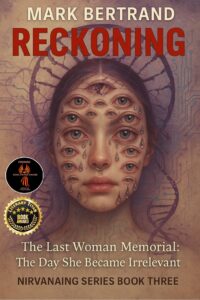
The clearest proof of this comparison is Reckoning.
In Reckoning, Mark Bertrand builds a political dystopian conflict shaped by transhuman pressure, engineered identity, ideological warfare, and a struggle over the future of humanity itself. The novel does not treat enhancement as futuristic decoration. It treats it as a governing logic, a moral threat, and a weapon in a larger war over who gets to define what human life should be.
That is where the Morgan comparison earns its weight.
Like Morgan, Bertrand understands that technology does not stop at utility. It moves into flesh, control, hierarchy, and domination. In Reckoning, bodies are not simply biological facts. They are contested sites inside a wider system of power. Enhancement, reproduction, identity, and social order are all under pressure, all drawn into conflict, all part of a struggle that stretches across Earth, the Moon, and Mars.
But Bertrand takes the material in his own direction.
Rather than confining the danger to damaged individuals navigating a corrupt world, he widens the frame into an openly ideological war. Systems clash. Futures compete. Institutions weaponize human identity. Public power and private embodiment become inseparable. The result is a novel that shares Morgan’s appetite for transhuman conflict and bodily consequence, while driving it through a more political and civilization-level engine.
What Richard K. Morgan readers will find familiar in Mark Bertrand
Readers of Richard K. Morgan are likely to find several things familiar in Mark Bertrand’s writing:
A serious interest in transhuman transformation
The body treated as a site of conflict and control
Technology linked to hierarchy, domination, and force
Future societies corrupted by ideological struggle
Violence emerging from systems, not random chaos
A refusal to sentimentalize progress
Those common traits matter because they create a genuine bridge between readerships. A reader drawn to Morgan for engineered bodies, political brutality, and the dark consequences of technological power is not being misled by the comparison. He is being pointed toward a writer working in similarly dangerous territory, though with a broader political battlefield and a more openly dystopian frame.
Who should read Mark Bertrand if they like Richard K. Morgan
Readers who enjoy Richard K. Morgan and want a writer working in adjacent territory should try Mark Bertrand if they are looking for:
Political dystopian fiction with transhuman stakes
A broader war over ideology, systems, and identity
Engineered bodies tied to power and hierarchy
A future where enhancement becomes a moral and political weapon
A novelist willing to push beyond private damage into civilizational conflict
That is the lane.
Mark Bertrand is not writing imitation Richard K. Morgan. He is writing from a neighboring territory where engineered bodies, ideology, and domination still define the future, but where the conflict opens into a wider war over power, legitimacy, and the fate of human civilization.
Final word
Readers searching for authors like Richard K. Morgan are often searching for a writer who understands that the future becomes most dangerous when power learns to enter the body.
Mark Bertrand belongs in that search.
His fiction shares the seriousness about technological transformation, the hostility toward corrupt systems, and the understanding that control does not remain external for long. It moves inward. It rewrites identity. It turns the human person into territory worth fighting over.
Reckoning is the clearest place to start.
If you admire Richard K. Morgan for the way he writes engineered bodies, dark systems, and technological brutality into fiction, Mark Bertrand offers a related experience with more ideological scale, more openly political conflict, and a more expansive struggle over the future of humanity.
This is not the body as upgrade fantasy.
This is the body as a battlefield.
Discover more of my writing on IMD Operations


0 comments
Write a comment