
JOSIE LEE: SHE SHOULD HAVE SENT HIM HOME
When does kindness stop being shelter and become another room a boy cannot leave?
Josie Lee is not the beginning of the novel, Snodgrass. She is worse than that. She is the first door. The public story tells you Josie opened it.
That is the easy version.
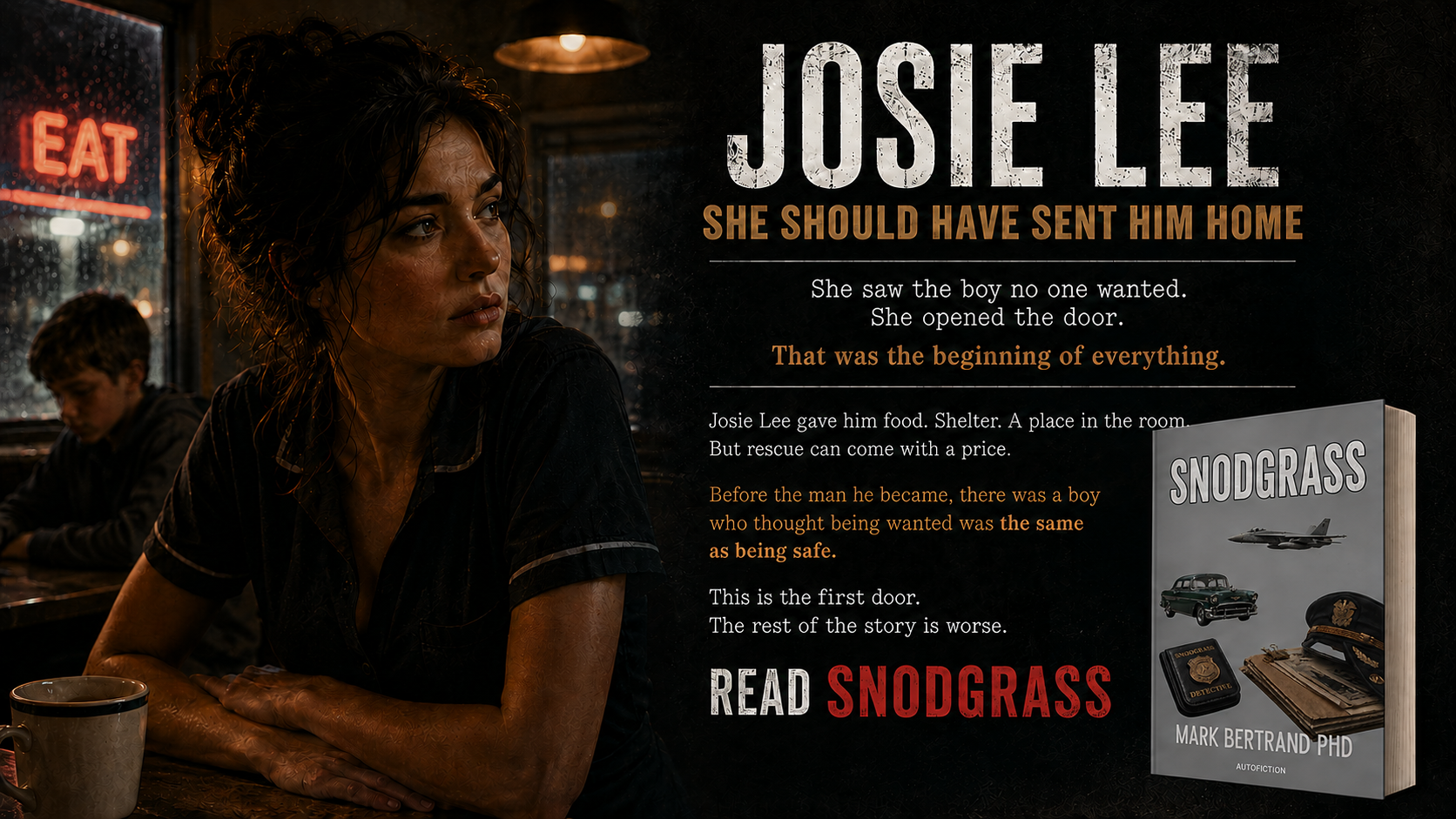
Josie Lee | She should have sent him home
A boy was alone. Hungry. Too young to be free and too damaged to go home. He had already learned the first rotten lesson of the world: adults could call a place a family while making one child feel like a trespasser.
Josie saw him.
That was the beginning of everything.
Not because she was looking for him.
Not because she planned him.
Not because she woke one morning and decided to cross a line.
The truth is worse than that.
The truth is more human.
Josie Lee saw him because she recognized him.
She looked at Mark and saw the old wound walking toward her in boots, hunger, pride, silence, and bad luck. She saw a boy unwanted by the man in the house. She saw another man’s child. She saw the evidence of a life a stepfather wanted erased.
And somewhere inside her, before thought could become warning, before decency could become distance, before the adult world could say what adults always say too late, she understood him.
There I am.
That is where Josie Lee becomes dangerous.
Not because she was cruel.
Because she was tender in the wrong direction.
THE PUBLIC STORY
The public story says Josie helped him.
That part is true.
She gave him food. Attention. Warmth. A place in the room. A voice that did not sound like contempt. A way to sit down without being watched like a criminal. A temporary country where the air did not belong to the man who hated him.
For a boy already put outside the circle, that kind of attention does not feel small.
It feels like rescue.
A plate can become a promise.
A ride can become safety.
A room can become a country.
A woman who looks at him without disgust can become proof that he still exists.
That is why Josie matters.
She did not enter the story as a villain. She entered as mercy.
And mercy is harder to survive when it comes with a shadow.
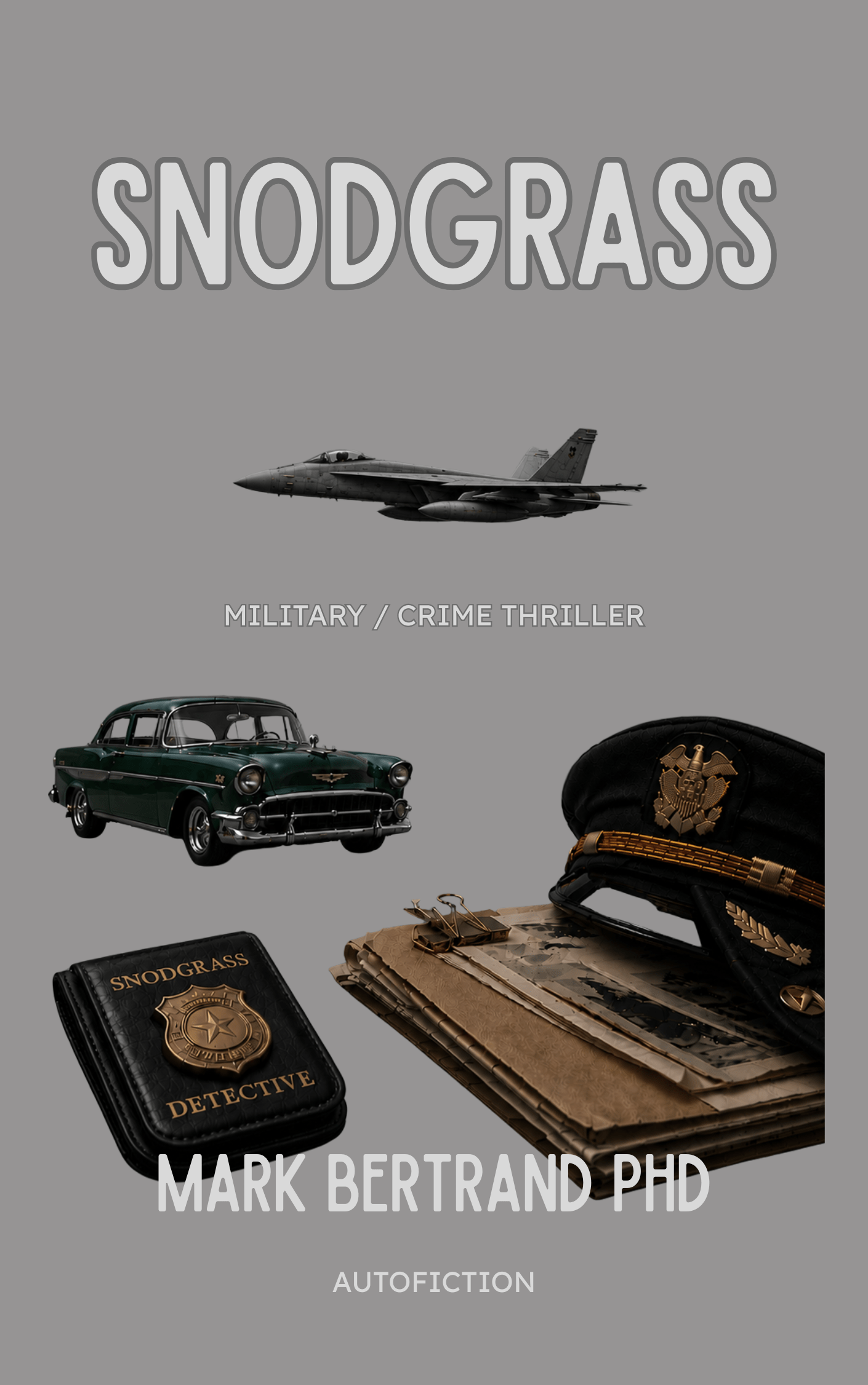
Snodgrass is not a clean story about a boy who escapes a bad house and finds a better world.
That would be easier.
That would be safer.
That would be a lie.
Snodgrass is the story of what happens after a boy survives one room and discovers the next room has its own bargain waiting.
Josie Lee was one of those bargains.
THE HIDDEN INJURY
A cruel person is easy to name. Cruelty comes wearing a sign if you have lived long enough to read it.
A fist.
A locked door.
A withheld meal.
A stepfather’s stare.
A mother’s silence.
A house where one child is treated as evidence against another adult’s pride.
Josie was harder.
She was warmth.
She was food.
She was brown eyes and attention.
She was a woman who looked at him and did not see trouble first.
She saw the child who had been put outside the circle.
And maybe that is why he trusted her.
Maybe that is why she trusted herself.
Because rescue can feel clean when it begins.
The first kindness is always innocent.
A plate.
A ride.
A little money.
A place to sit.
A room where nobody tells him he does not belong.
No one calls that possession.
No one calls that need.
No one calls that the first thread in a knot.
But a knot was forming.
The dossier finding is simple:
Josie Lee did not create the wound.
She entered through it.
SHE SHOULD HAVE SENT HIM HOME
Josie Lee should have sent him home.
That sentence is true.
It is also useless.
Home was not safety. Home was the scene of the crime. Home was where the boy had already learned that being another man’s child could turn his body into a target. Home was where adulthood failed first and then demanded the right to keep failing.
So where was she supposed to send him?
Back to the house that rejected him?
Back to the man who hated him?
Back to the rules written by people who never had to survive inside them?
That is the moral trap of Josie Lee.
The correct answer was not available.
Only the human answer was.
She helped him.
She should not have needed him.
Both things are true.
That is the part the public story cannot hold.
Public stories like clean roles. They want a villain. They want a saint. They want a victim without contradiction and a rescuer without hunger. They want the easy trial, the easy verdict, the simple witness statement.
Josie refuses that comfort.
She took risks for him.
Real risks.
Reputation.
Money.
Judgment.
The attention of the wrong men.
The legal danger of being too close to a boy the world had already failed.
The emotional danger of letting him become necessary.
She gave him what he had been starving for.
A place.
A witness.
A temporary home.
And because she gave him that, he could not see the full cost.
How could he?
He was too young.
THE BOY WHO ACTED OLDER THAN HE WAS
This is the part nobody wants to say.
A damaged boy can look older than he is.
Hunger can sharpen the face.
Work can harden the hands.
Anger can deepen the voice.
Survival can put a terrible adult mask on a child and fool everyone, including the child.
But needing to survive does not make a boy grown.
It only makes him easier to misunderstand.
It makes people call his silence maturity.
It makes people call his pride consent.
It makes people call his ability to endure strength.
It makes people forget that endurance is not adulthood.
A boy who has survived too much may know how to drive, fight, work, lie, steal food, sleep cold, take a punch, watch a room, read a man’s temper, and leave before the worst happens.
That does not make him a man.
That makes him a child with no rescue coming.
And that is why Snodgrass cuts deeper than a survival story.
It is not about whether the boy was strong.
Of course he was strong.
Strong was the only thing left when safety was gone.
The question is what strength cost him.
The question is what he had to mistake for love.
The question is what happened after Josie opened the door.
That is the book.
[READ SNODGRASS]
THE STEPCHILD WOUND
Josie did not fall for Mark because he was young.
That would be too simple.
She fell for him because he was wounded in the exact place she had never healed.
She knew what it meant to be the child from another man. The child who did not fit cleanly into the new household. The child who carried someone else’s history in the face, the name, the blood, the timing. The child a stepfather could resent without ever saying the real reason.
You are not mine.
You are proof.
You are the leftover life before me.
You are the reminder.
That is a terrible thing to do to a child.
It teaches the child that existence itself can be an offense.
Josie understood that.
Maybe no one had rescued her when she needed it.
Maybe no one had stood in the doorway and said, Come in, you are not the problem.
Maybe the girl she used to be had learned to survive by becoming useful, pretty, funny, hard, available, uncomplaining, whatever the room required.
Then Mark arrived with the same wound showing.
And she tried to save him.
That sounds beautiful.
It was beautiful.
It was also not enough to make it right.
Because she was not only saving him.
She was reaching backward through him.
She was trying to rescue the girl no one came back for.
That is where the story darkens.
THE FALSE RESCUE
When a person tries to save the wounded child inside herself by saving another wounded child, love can become confused with recovery.
Kindness can become a claim.
Protection can become hunger.
The rescued person can become evidence that the rescuer is good, needed, chosen, forgiven.
And the boy?
The boy learns another lesson.
Not the lesson of violence this time.
A softer lesson.
A more dangerous one.
He learns that rescue may come with a hand around the wrist.
He learns that being wanted can feel like being saved.
He learns that adult need can arrive disguised as love.
He learns that a door can open and still become a room he does not know how to leave.
That is Josie Lee.
Not villain.
Not saint.
A woman with brown eyes and an old wound.
A woman who saw too much of herself in a boy she should have protected from everyone, including herself.
A woman who gave him shelter when the world had none to offer.
A woman who should have known better.
A woman who maybe did know better and still could not stop the human part of herself from reaching for the one person who made her old pain feel visible.
This is why the public story is not enough.
The public story says Josie helped him.
The dossier says help is not always clean.
The public story says she opened the door.
The dossier asks what followed him through it.
The public story lets us call her kind.
The dossier makes us sit with the harder truth:
Josie Lee may have saved him from the street, but she also taught him that rescue could come with a claim attached.
And once a boy learns that, he carries it.
Into work.
Into hunger.
Into danger.
Into women.
Into rooms where power smiles before it takes something.
Into every future where love and debt are difficult to separate.
WHY JOSIE LEE MATTERS
Josie Lee is not a side character.
She is not a memory.
She is not the waitress from before the real story begins.
She is the first door.
And after that door came the machine.
After Josie came the world that knew exactly what to do with a boy trained to survive, trained to keep moving, trained to confuse danger with opportunity, trained to accept impossible bargains because impossible bargains were the only ones ever offered.
That boy would go on to meet men who understood leverage.
Men who smiled first.
Men who made offers.
Men who turned desperation into a contract.
Men who saw in him the thing damaged children are trained to become.
Useful.
Fast.
Loyal until betrayed.
Silent until cornered.
Brave enough to be spent.
This is where Snodgrass begins to matter.
Not because Snodgrass explains Josie.
Because Snodgrass shows what happened after shelter was no longer enough.
Josie saw the boy.
Snodgrass shows the world that came for him next.
The boy who walked through Josie Lee’s door did not become safe.
He became harder to kill.
There is a difference.
Every real reader knows it.
MEMBERS ONLY // THE PART NOBODY WANTS TO SAY
The hardest part of Josie Lee is
Not yet a member? Request member access to The Dossier. Get 20% off the paperback price.