
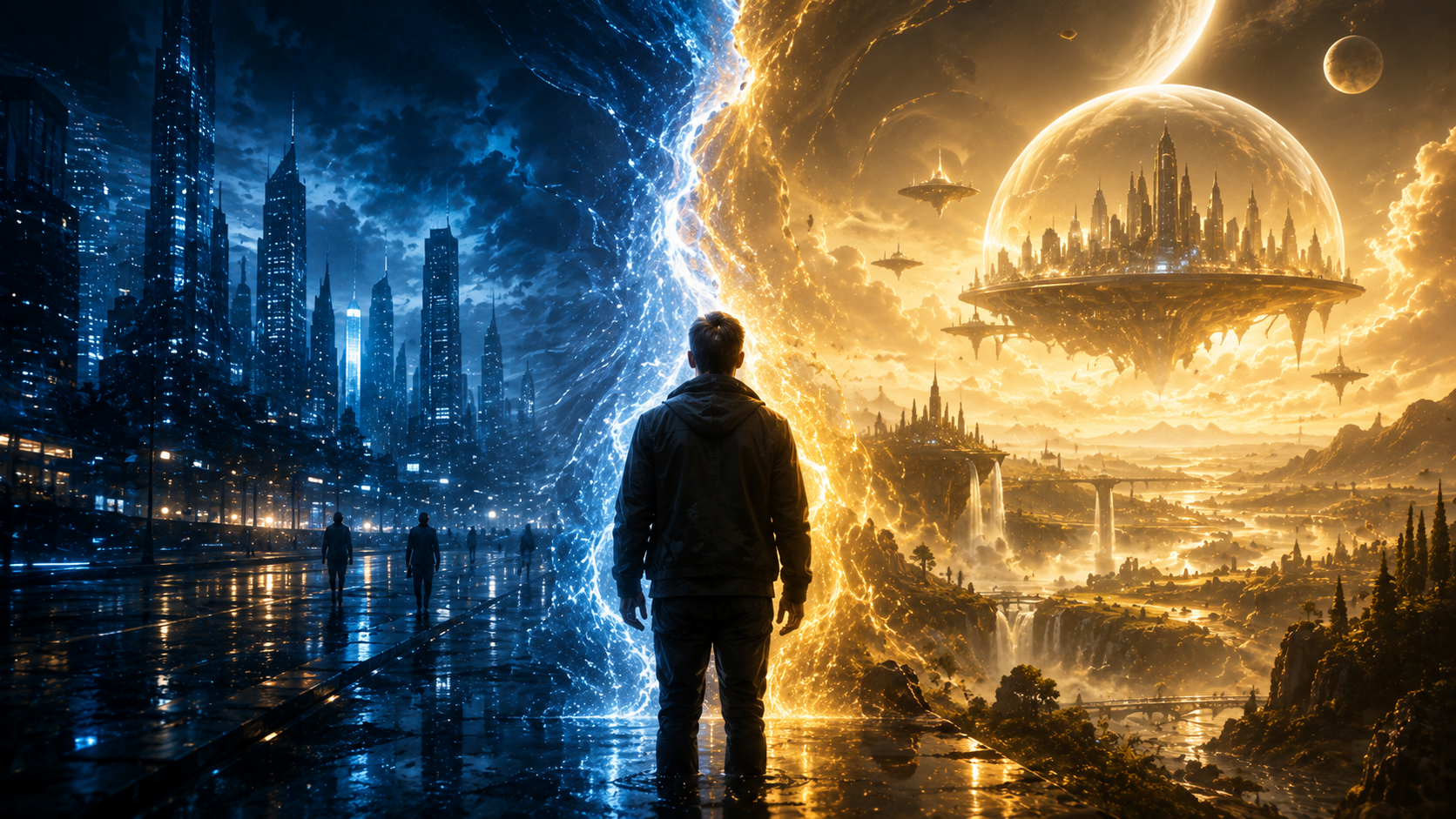
Why Readers Search for Books Like Dark Matter
Readers who love books like Dark Matter are not only looking for another science fiction novel.
They are looking for that particular shock of recognition that happens when a story takes one impossible idea and turns it into a personal crisis. Dark Matter begins with a terrifying question: what if the life you are living is not the only life you could have lived? Jason Dessen wakes into a reality where his wife is not his wife, his son was never born, and his ordinary life has been replaced by something extraordinary and horrifying. Penguin Random House describes Dark Matter as a mind-bending psychological thriller about choices, paths not taken, and the lives we dream of claiming.
That is why the novel moves so fast. The science is big, yet the wound is intimate. The multiverse is not used as decoration. It becomes a pressure chamber for regret, love, identity, ambition, and terror.
The reader keeps turning pages because the question is not merely, “How does this impossible science work?”
The question is: what makes a life yours?
That is the emotional key. A book like Dark Matter needs more than quantum mechanics, parallel worlds, or clever plot turns. It needs a protagonist whose mind and heart are forced into crisis. It needs science that threatens the soul. It needs movement. It needs consequences. It needs the reader to feel that reality itself has become unstable.
That is where Starzel enters the conversation.
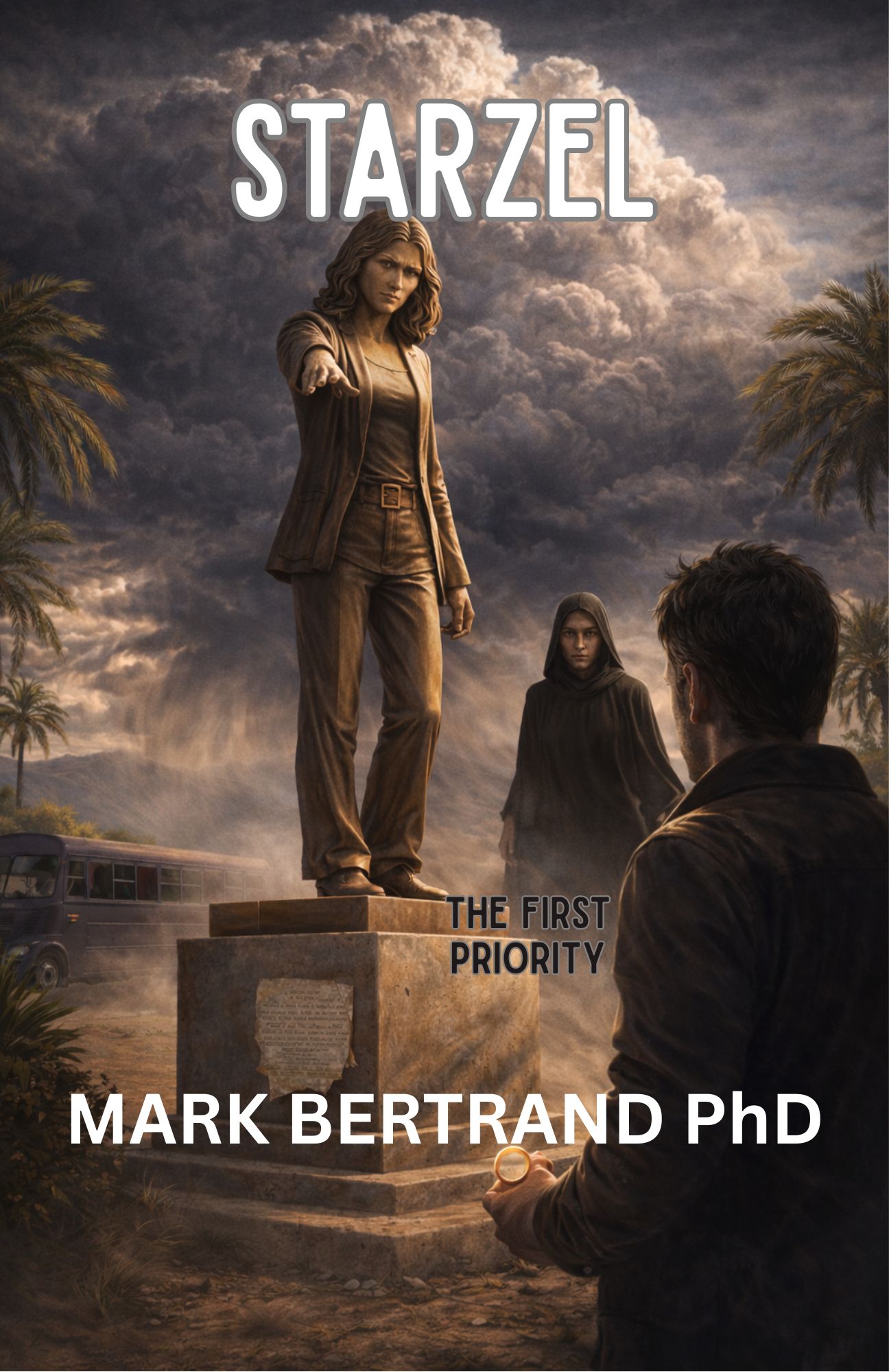
If You Loved Dark Matter, Read Starzel
Starzel belongs beside Dark Matter because it understands that the best speculative thrillers are not about the machine, the portal, the code, or the theory.
They are about what happens to a person when the truth of reality becomes too large to survive unchanged.
In Dark Matter, Jason Dessen is torn from one version of his life and forced into a series of realities that challenge his identity, his choices, and his love for his family. In Starzel, Eulǝr begins from the opposite direction. He is not an ordinary man pulled into the extraordinary. He is a highly enhanced Syganoid from Planet Forty-Four, raised inside a civilization of advanced minds, sixteen senses, organoid intelligence, and domed cities floating above a poisonous gas planet. His life is built on superiority, order, and a spiritual-scientific understanding of existence. Then he discovers something has gone wrong inside the code of the universe itself.
That difference makes the comparison fascinating.
Dark Matter asks what happens when an ordinary man discovers alternate versions of the life he might have lived.
Starzel asks what happens when an extraordinary being discovers that the universe itself may be broken, humanity may be doomed, and his own understanding of reality may not be enough to repair it.
Both novels move through speculative science with thriller force. Both use reality as a battlefield. Both understand that love, identity, and choice are not soft emotional subjects. They are the deepest engines of suspense.
The High-Concept Hook: Reality Is Not Stable
The genius of Dark Matter is its simplicity. A man is taken. He wakes somewhere impossible. Everything he thought was stable becomes questionable. The plot is clean, sharp, and relentless because the premise attacks the reader’s most private fear: what if the life I chose is only one door among millions?
Starzel offers the same destabilizing pleasure on a wider cosmic scale.
Eulǝr is the keeper of the Universe Code. At first, the idea almost sounds absurdly grand. Then the story makes it personal. His world, his mother’s legacy, the fate of humanity, and the spiritual structure of existence begin to converge around missing data. Reality is not merely mysterious. It has been altered. Something has been erased. Something essential to humanity’s moral and spiritual survival has gone missing.
That gives Starzel the same kind of reader propulsion that makes Dark Matter so addictive.
The reader is not merely wondering what happens next. The reader is wondering what is real, what has been changed, who can be trusted, and what the protagonist will become under the pressure of the impossible.
That is the heart of books like Dark Matter. They do not simply bend reality. They make reality accuse the character.
The Emotional Engine: Love as the Ultimate Test
One reason Dark Matter works so well is that its emotional core is not buried under the science. Jason wants his life back. He wants his wife. He wants his son. The multiverse matters because love gives it meaning. Without that emotional anchor, the story would become an intellectual puzzle. With it, the novel becomes a pursuit, a rescue mission, and a reckoning.
Starzel moves with a similar emotional architecture, though it expands the idea into something stranger and more philosophical.
Eulǝr comes from a world where love is understood as being rather than doing. On Planet Forty-Four, love is not merely romance, possession, marriage, sex, family, or performance. It is a condition of existence. Humanity, by contrast, has turned love into activity, transaction, anxiety, ritual, and social structure. This gives Starzel a deeper thematic blade. The novel is not asking only whether love survives reality breaking apart. It is asking whether love may be the missing law that reality requires.
That makes Starzel especially strong for readers who loved the emotional seriousness of Dark Matter.
The reader who responded to Jason’s desperate need to return to his family may find Eulǝr’s journey even more expansive. The stakes begin with missing code and cosmic disorder, then move toward the problem beneath all problems: whether humanity has lost the moral and spiritual capacity to survive itself.
The Character Movement: From Certainty to Disorientation
A great mind-bending thriller needs a protagonist who begins with assumptions.
Jason Dessen begins with a life he understands. He knows his home, his marriage, his regrets, and his compromises. Then the story tears all of that away. His identity becomes unstable because the world refuses to confirm who he is.
Eulǝr begins with a different kind of certainty. He believes he understands humanity. He believes Syganoid life is superior. He believes his intelligence, senses, and technology give him a privileged view of existence. He looks at Earth as a dangerous, primitive, suffering planet. He thinks he is prepared.
He is not.
That is the delicious movement inside Starzel. Eulǝr does not merely travel from one place to another. He travels from superiority into vulnerability. From theory into consequence. From cosmic responsibility into personal fear. From advanced knowledge into the humiliating discovery that knowing more does not always mean understanding better.
That is exactly the sort of character pressure readers want after Dark Matter.
The best speculative thrillers do not reward intelligence without cost. They test intelligence. They corner it. They force the protagonist to learn that reality is never solved only by being clever.
The Thriller Movement: Science With Pursuit Energy
Many science fiction novels have fascinating ideas. Fewer have pace.
Dark Matter is loved because it does not pause too long in explanation. The scientific premise keeps producing danger. Every discovery opens another threat. Every answer creates a worse question. The novel feels like a chase through existence.
Starzel offers a broader, more world-rich version of that movement.
Eulǝr’s mission sends him from Planet Forty-Four toward human-occupied worlds, into transport systems, corrupt social structures, surveillance, violence, distorted law, and a future Earth fractured by ideology and war. The plot does not remain in a laboratory or philosophical chamber. It moves. It throws Eulǝr into courts, transport ships, hostile cities, strange allies, and moral traps.
That matters for readers searching for books like Dark Matter.
They do not want abstract science fiction. They want the idea to move through the body. They want danger, pursuit, reversals, confusion, and revelation. They want the science to create scenes, not lectures.
Starzel does that by turning its cosmic premise into a journey through broken civilizations. The missing data is not just a mystery. It is a fuse.
The Theme: Choices, Consequences, and the Fragile Self
Dark Matter is unforgettable because it turns the fantasy of other lives into a nightmare. Most people have imagined the road not taken. Another career. Another lover. Another city. Another version of themselves who became richer, braver, more famous, more fulfilled, more dangerous.
The novel understands that this fantasy is not innocent. To imagine another life is to question the value of the life already lived.
Starzel approaches choice from a more metaphysical direction. Eulǝr’s choices ripple through code, history, consciousness, and human fate. Small actions may have consequences he does not understand. Knowledge becomes dangerous. Intervention becomes morally unstable. The line between helping humanity and damaging humanity becomes harder to see.
That is a powerful next step for readers who enjoyed Dark Matter.
In Dark Matter, choice creates alternate realities.
In Starzel, choice threatens the structure of reality itself.
Both books understand that identity is not fixed. It is tested by decision. It is revealed under pressure. A person becomes known not by what he believes in comfort, but by what he does when the universe stops protecting him.
The Reader Experience: Wonder, Fear, and Intellectual Pleasure
The reader who loves Dark Matter usually wants three pleasures at once.
First, the thrill of the impossible.
Second, the emotional urgency of a character trying to recover what matters.
Third, the intellectual pleasure of a story that makes the mind participate.
Starzel satisfies that appetite in its own distinctive way. It has futuristic science, biological computing, enhanced perception, wormholes, dystopian political structures, fractured Earth nations, spiritual codes, and cosmic stakes. Yet its best appeal is not just invention. It is the way those inventions press against Eulǝr’s interior life.
The reader is invited to wonder not only what the universe is made of, but what consciousness is for.
That is the higher shelf where Starzel belongs.
It is not only a book for readers who want science fiction technology. It is for readers who want the technology to disturb philosophy, identity, morality, and the meaning of love.
Why Starzel Is the Best Next Read After Dark Matter
A reader finishing Dark Matter may want another book that delivers the same kind of immediate rush. That is understandable. The pace, the premise, the emotional hook, the reality-bending suspense—all of it creates a hunger for more.
Yet the best next book is not always the one that repeats the same trick.
The best next book is the one that takes the same reader desire and opens a larger door.
That is what Starzel does.
It gives the Dark Matter reader a mind-bending science fiction thriller where reality is unstable, science is dangerous, identity is under attack, and love may be the only thing powerful enough to make existence meaningful. It moves from alternate-life anxiety into cosmic repair. It moves from one man trying to get home to one being trying to save humanity from erasure.
The scale is larger.
The philosophy is deeper.
The world is stranger.
The emotional question remains beautifully familiar.
What matters when reality itself cannot be trusted?
For readers who loved Dark Matter, Starzel is not merely another science fiction novel. It is a next-level speculative thriller about consciousness, broken worlds, dangerous knowledge, and the possibility that the universe cannot be saved by intelligence alone.
It may require love.
Final Recommendation
Read Starzel if you loved Dark Matter for its reality-bending premise, emotional urgency, scientific imagination, and relentless pressure on identity. Read it if you want a speculative thriller where the fate of one person and the fate of humanity become inseparable. Read it if you want science fiction that does more than ask what is possible.
Starzel asks what is true.
And once that question opens, there is no easy way back.


0 comments
Write a comment