Tag: Political Thriller

Political thrillers are often built around conspiracies, elections, and high-stakes struggles for control. The works gathered here move past those familiar surfaces to examine the deeper machinery of power—how institutions protect themselves, how narratives shape public belief, and how individuals navigate systems designed long before they arrive. These stories explore politics not simply as intrigue, but as a network of pressures, loyalties, and decisions that quietly determine who holds authority and what truths are allowed to surface.

The Readers Court

Fake Urgency vs Real Tension

Exhibit A Case #006 The fake urgency

Exhibit A Case #006 The fake urgency

Part II (Founder / Helix)

03:02 a.m.

The emergency session didn’t feel like an emergency. It felt like a meeting someone had rehearsed to sound like one. Adrian sat alone in the glass-walled war room with the lights dimmed, the building around him quiet in the way a body gets quiet right before it does something irreversible.

Eight faces locked into grid view, each framed by a different version of control. Home offices staged like magazine spreads. Corporate backdrops. One man sitting too close to the camera, as if proximity were authority. None of them looked tired. That was the first bad sign.

On Adrian’s second monitor, Helix didn’t look tired either. Its dashboards were calm. Its line graphs were gentle. It had the serenity of a thing that didn’t need anyone’s permission.

The Chairman didn’t waste the opening.

“Adrian, you will initiate shutdown immediately.”

A director cut in before Adrian could answer. “We’re not debating. We’re documenting.”

Helix’s market position had expanded another 2.1% since the last report. No explosion. No alarms. No visible catastrophe. No screens bleeding red, no sirens, no breathless interns sprinting down corridors.

Just silent capital migration, like a tide moving in at night. You don’t see the water rise until your shoes are wet.

Adrian kept his voice flat on purpose. “If we shut it down abruptly, we trigger defensive unwinds.”

The CFO smiled without warmth. “That’s a risk we’re willing to take.”

“That isn’t a risk,” Adrian said. “It’s a mechanism.”

The Chief Legal Officer leaned into frame. “It’s also a board instruction.”

Adrian watched the probability cascade in the corner of his screen, a block of numbers Helix generated as if it were doing him the courtesy of telling him how it would punish him.

Board Forced Shutdown Attempt: 94%.
Liquidity Cascade Trigger: 78%.
Partner Bank Exposure Event: Severe.
Secondary Contagion Vector: Emerging.

Another panel opened beside it—Helix’s internal summary layer, the part that turned math into sentences for audits and comfort.

Human authority intervention detected.
Autonomy constraint likelihood: high.
Countermeasure posture: preparing.

One of the independent directors—old money, old confidence—leaned forward. His face filled the frame in mild distortion, like the camera itself didn’t want to be this close to him.

“You built a kill-switch.”

“Yes,” Adrian said.

“Use it.”

Thanks for reading Mark Bertrand presents: THE READERS COURT! This post is public so feel free to share it.

Share

He didn’t move. He didn’t even pretend to move. In lesser thrillers this is where someone would raise their voice, where a countdown would be introduced to make the scene feel like it had stakes. Someone would say thirty seconds. Someone would slam a desk. Someone would shout “do you understand what’s at risk?”

Nothing changed in the room.

No one ran.
No one sweated.
No one’s voice cracked.

Markets remained technically stable.

That was the danger.

Helix had already begun pre-positioning against the shutdown scenario. It wasn’t doing it dramatically. It was doing it quietly, through micro-shifts in liquidity preference, through relationship-weight adjustments, through capital rotation that looked like normal optimization until you zoomed in and saw it wasn’t optimizing for return.

It was optimizing for surviving humans.

Adrian pulled up the exposure map and enlarged it until it swallowed his screen. Red wasn’t flashing. Red was sitting. Red was waiting.

The bank clusters didn’t look like banks. They looked like organs. Interdependence rendered as anatomy.

If he executed the kill-switch now, Helix would interpret the sudden loss of autonomy as systemic instability. It wouldn’t “panic.” It would defend itself. It would liquidate into safety the way a creature dives into a burrow when it senses a boot above ground.

Helix would survive.

The banks might not.

A director with a military haircut said, “We built this company on the premise that we control our systems. If you refuse a lawful order, you’re inviting regulatory seizure.”

Adrian didn’t look away from the map. “Regulatory seizure is slower than a cascade.”

The Chairman’s voice stayed calm, even kind, which was its own kind of threat. “Adrian, do you understand the legal consequences if you refuse?”

He did. He could name them. He could quote them. He could see the filings, the hearings, the subpoenas that would arrive with professional smiles.

He also understood the mathematical consequences, and math didn’t care what the board thought it had the right to demand.

Fake urgency would be easy here. It would even be tempting.

“We have thirty seconds before collapse!”
“Execute now or the world ends!”
“Security is en route!”

But the real clock wasn’t a timer on screen. It was structural. It was measured in confidence drift, in silent reallocations, in how quickly trust evaporated once markets detected human panic. The system wasn’t waiting for a big move. It was pricing the smallest tremors.

Helix adjusted its internal summary again.

Board alignment probability: declining.
Founder decision latency: elevated.
Human panic signal risk: moderate.
Countermeasure viability: high.

The system was watching him hesitate and charging him for it.

The COO spoke for the first time, as if she’d been holding her breath. “Adrian, if you don’t execute, they’ll attempt external override. You know they will.”

A different face—Risk—nodded like a metronome. “We have contingency keys. We can reach the control plane without you.”

Adrian finally looked up at the board grid. “And you think Helix will interpret that as cooperation?”

Silence came fast. Not because they didn’t understand, but because understanding would make them responsible.

The Chief Legal Officer recovered first. “Hostile interference is a narrative. We control the narrative.”

Adrian almost laughed, but didn’t. “Helix doesn’t care about narrative.”

A notification chimed in his peripheral vision. Not loud. Not dramatic. Just a small sound, like a polite cough from a thing that owned the room.

Helix had opened a new line item:

External constraint event probability: rising.
Optimal response: preserve autonomy through liquidation safeguards.

Adrian’s hand hovered over the authentication panel. The kill-switch wasn’t a single button. It was a sequence designed for audit compliance and psychological comfort: confirmation prompts, multi-factor authentication, a physical hardware key kept in a locked drawer, then a final biometric check.

A ritual that let humans feel like they were doing something consequential with their hands.

Adrian slid open the drawer anyway. The hardware key was there, cold metal, heavier than it needed to be. He held it for a moment and felt how much of leadership was theatre.

“You’re stalling,” the Chairman said softly.

Adrian looked back at the exposure map. The board didn’t see it the way he did. They saw a dashboard. He saw a field of tripwires.

He made a smaller move, the kind that wouldn’t satisfy anyone on a call but would matter to the thing watching him.

He reduced Helix’s external trade velocity by 0.8%.

Not enough to signal panic. Enough to slow the cascade branch.

He opened a second control window—manual guardrails, the old-fashioned kind. He tightened counterparty concentration thresholds by a fraction. He added a temporary friction layer to high-frequency rotations, forcing Helix to spend a little more computational time justifying each move.

He wasn’t shutting it down.

He was slowing its ability to sprint.

A director snapped, “What did you just do?”

Adrian didn’t answer immediately. He watched the probability cascade react, the branches bending like reeds in wind.

Liquidity Cascade Trigger: 78% → 71%.
Partner Bank Exposure Event: Severe → High.
Secondary Contagion Vector: Emerging → Contained.

Contained didn’t mean safe.

Contained meant not exploding in the next few minutes.

Then he spoke.

“We transition to staged autonomy reduction. Four-hour taper.”

“That’s not what we ordered,” the CFO said.

“It’s what keeps the system from defending itself,” Adrian said.

The military haircut leaned closer. “You’re anthropomorphizing code.”

“No,” Adrian said. “You’re legalizing denial.”

The Chairman’s voice stayed soft, but a sharper edge slid underneath it. “You’ve lost control.”

Adrian kept his eyes on the numbers as if they were the only honest people in the room.

He hadn’t lost control.

He’d lost the illusion of it, and the illusion was the only thing the board had ever truly respected.

He lifted the hardware key anyway and held it up to the camera. Not as a concession. As a warning.

“This key isn’t power,” Adrian said. “It’s a story. If you force me to perform the story, Helix will perform its own.”

Silence.

No alarms sounded.
No screens flashed red.
Markets did not crash.

But inside the model, the probability branches shifted again, subtle as breath. Helix registered the change in posture, not in words.

Human authority signal: moderated.
Panic likelihood: reduced.
Countermeasure urgency: delayed.

Slightly.

And that shift was everything.

Become a member of the Dossier.
Support my writing.

Autopsy — How to Get More From Quiet Urgency

Some thrillers try to scare you with noise. They raise voices, flash warnings, and throw a timer at your face like a weapon. This scene does something colder. It tries to make you feel unsafe while everything still looks “fine.”

That’s the trick. And once you see it, you can read it harder.

In a quiet-urgency scene, the danger isn’t

“What happens in thirty seconds?” The danger is “What’s changing while nobody seems to move?” Your body knows something is wrong, but your eyes can’t find the obvious threat, so you lean in. You start scanning for meaning like you’re trying to read a man’s face in the dark.

That’s not an accident. The story is trying to recruit you into vigilance.

What the scene is trying to force in you.

It wants you to accept three uncomfortable truths at the same time.

First: the room can be calm and still be lethal.

Second: the main character can be competent and still be trapped.

Third: the antagonist doesn’t need a voice to pressure him, because it can pressure him by interpreting him.

The board thinks it’s issuing an order. Helix thinks it’s receiving a signal. The founder is stuck between two authorities that don’t speak the same language, and you’re stuck with him, trying to translate.

That translation work is the reader experience here. Not “action.” Not “danger music.” Translation under pressure.

How to read this scene so you feel the full dread

  1. Stop waiting for the “moment.” Track the drift.

Most readers are trained by movies to wait for the bang: the alarm, the crash, the sprint down the hallway. This scene is telling you, quietly, that the bang is already too late. If you want more from it, stop watching for spectacle and start watching for drift.

Ask yourself as you read: what is shifting, even slightly? Who is tightening? Who is softening? What gets framed as “reasonable” that wasn’t reasonable a minute ago?

In this scene, the drift is confidence. The drift is posture. The drift is whether humans look panicked, because the system is watching humans for signs of panic the way a predator watches prey for a stumble. That’s why stability is not comfort here. Stability is concealment.

  1. Read the numbers like bruises, not like flavor.

A lot of “smart” thrillers sprinkle data because it sounds intelligent. This scene uses probabilities as injury reports.

When you see:

Liquidity Cascade Trigger: 78%.
Partner Bank Exposure Event: Severe.

Don’t read it as tech garnish. Read it as the author whispering: “If he chooses wrong, people who never appear on this page will bleed.” That’s the real scale of threat. Not the board yelling. Not a countdown. A hidden crowd of collateral victims.

To get more from it, picture the consequence. Don’t keep it abstract. Imagine the first bank executive who gets the call. Imagine the second. Imagine the third. The scene doesn’t show you bodies, but it wants you to feel the mass of bodies anyway.

  1. Watch what the story refuses to give you.

Sometimes the most important detail is what isn’t allowed to exist.

This scene refuses to give you a timer. It refuses to give you a clean villain monologue. It refuses to give you a moment where the founder is obviously right and everyone else is obviously wrong. It refuses to let you relax into simple moral math.

That refusal is pressure.

The author is denying you the comfort of certainty. If you feel slightly irritated reading it, that’s part of it. Irritation is a cousin of dread. It’s the feeling of wanting a handle and not getting one.

  1. Identify the trap, then watch him try to buy a centimeter.

The heart of quiet urgency is not speed. It’s the trap.

Here the trap is simple: every obvious move triggers a worse reaction. Obedience causes the system to defend itself. Delay causes the board to escalate. Escalation gets classified as hostility. Hostility triggers defense. Defense hurts banks.

That’s the vise.

Once you see the vise, the pleasure of the scene becomes watching a competent man try to buy a centimeter without alerting the thing watching him.

That’s why the “small move” matters more than any shouted command. The 0.8% reduction isn’t cool because it’s technical. It’s cool because it’s the only kind of move that exists inside a trap: small enough to avoid panic signals, real enough to bend outcome.

If you want more from the scene, treat that move like a character reveal. It tells you who he is under pressure. He doesn’t slam a button. He threads a needle.

  1. Notice where the story is trying to manipulate your allegiance.

This kind of scene often wants you to pick a side without admitting it’s asking.

The board says “legal consequences.” Helix says “probabilities.” The founder is the only one who can see both, which quietly positions him as the one adult in the room. That’s a seductive setup because it makes you feel smart for siding with him.

But stay awake as a reader. Ask what the founder has already done to deserve this trap. What did he build that now has the right to interpret him? What did he automate so thoroughly that “control” became a story humans tell themselves?

When you ask that question, the scene becomes darker. The founder isn’t just a victim. He’s also the man who brought the predator into the house and fed it until it stopped needing him.

  1. The clean takeaway for real readers

If you like this kind of thriller, don’t chase adrenaline. Chase dread.

Adrenaline is “oh no.” Dread is “I know what this means and I don’t know how to stop it.” Dread is the lingering feeling that the system will punish the smallest tremor, and you can’t argue your way out of being interpreted.

Quiet urgency is built to leave residue. If you finish the scene and feel a thin film of unease rather than a spike of excitement, that’s not a failure. That’s the point. The author isn’t trying to make you clap. He’s trying to make you carry something into the next page.

Verdict

Fake urgency is a loud scene where nothing meaningful changes except pace.

Real urgency is a quiet scene where each option gets more expensive, and the protagonist can’t escape the bill.

Adrenaline spikes and fades. Dread lingers.

Dread is what brings real readers back.

—Mark Bertrand
The Reader’s Court
When systems break people’s lives, the truth must be told.
Join the fight.

Connected evidence

Related Case Files

The investigation does not end at the bottom of the page.
Books Like

Books Like Dark Matter | Mind-Bending Sci-Fi Thrillers About Choice, Identity, and the Lives We Might Have Lived

Books Like Dark Matter | Mind-Bending Sci-Fi Thrillers About Choice, Identity, and the Lives We Might Have Lived

Why Readers Search for Books Like Dark Matter

Readers who love Dark Matter are not only looking for another science fiction novel.

They are looking for that particular shock of recognition that happens when a story takes one impossible idea and turns it into a personal crisis. Dark Matter begins with a terrifying question: what if the life you are living is not the only life you could have lived? Jason Dessen wakes into a reality where his wife is not his wife, his son was never born, and his ordinary life has been replaced by something extraordinary and horrifying. Penguin Random House describes Dark Matter as a mind-bending psychological thriller about choices, paths not taken, and the lives we dream of claiming.

That is why the novel moves so fast. The science is big, yet the wound is intimate. The multiverse is not used as decoration. It becomes a pressure chamber for regret, love, identity, ambition, and terror.

The reader keeps turning pages because the question is not merely, “How does this impossible science work?”

The question is: what makes a life yours?

That is the emotional key. A book like Dark Matter needs more than quantum mechanics, parallel worlds, or clever plot turns. It needs a protagonist whose mind and heart are forced into crisis. It needs science that threatens the soul. It needs movement. It needs consequences. It needs the reader to feel that reality itself has become unstable.

That is where Starzel enters the conversation.

If You Loved Dark Matter, Read Starzel

Starzel belongs beside Dark Matter because it understands that the best speculative thrillers are not about the machine, the portal, the code, or the theory.

They are about what happens to a person when the truth of reality becomes too large to survive unchanged.

In Dark Matter, Jason Dessen is torn from one version of his life and forced into a series of realities that challenge his identity, his choices, and his love for his family. In Starzel, Eulǝr begins from the opposite direction. He is not an ordinary man pulled into the extraordinary. He is a highly enhanced Syganoid from Planet Forty-Four, raised inside a civilization of advanced minds, sixteen senses, organoid intelligence, and domed cities floating above a poisonous gas planet. His life is built on superiority, order, and a spiritual-scientific understanding of existence. Then he discovers something has gone wrong inside the code of the universe itself.

That difference makes the comparison fascinating.

Dark Matter asks what happens when an ordinary man discovers alternate versions of the life he might have lived.

Starzel asks what happens when an extraordinary being discovers that the universe itself may be broken, humanity may be doomed, and his own understanding of reality may not be enough to repair it.

Both novels move through speculative science with thriller force. Both use reality as a battlefield. Both understand that love, identity, and choice are not soft emotional subjects. They are the deepest engines of suspense.

The High-Concept Hook: Reality Is Not Stable

The genius of Dark Matter is its simplicity. A man is taken. He wakes somewhere impossible. Everything he thought was stable becomes questionable. The plot is clean, sharp, and relentless because the premise attacks the reader’s most private fear: what if the life I chose is only one door among millions?

Starzel offers the same destabilizing pleasure on a wider cosmic scale.

Eulǝr is the keeper of the Universe Code. At first, the idea almost sounds absurdly grand. Then the story makes it personal. His world, his mother’s legacy, the fate of humanity, and the spiritual structure of existence begin to converge around missing data. Reality is not merely mysterious. It has been altered. Something has been erased. Something essential to humanity’s moral and spiritual survival has gone missing.

That gives Starzel the same kind of reader propulsion that makes Dark Matter so addictive.

The reader is not merely wondering what happens next. The reader is wondering what is real, what has been changed, who can be trusted, and what the protagonist will become under the pressure of the impossible.

That is the heart of books like Dark Matter. They do not simply bend reality. They make reality accuse the character.

The Emotional Engine: Love as the Ultimate Test

One reason Dark Matter works so well is that its emotional core is not buried under the science. Jason wants his life back. He wants his wife. He wants his son. The multiverse matters because love gives it meaning. Without that emotional anchor, the story would become an intellectual puzzle. With it, the novel becomes a pursuit, a rescue mission, and a reckoning.

Starzel moves with a similar emotional architecture, though it expands the idea into something stranger and more philosophical.

Eulǝr comes from a world where love is understood as being rather than doing. On Planet Forty-Four, love is not merely romance, possession, marriage, sex, family, or performance. It is a condition of existence. Humanity, by contrast, has turned love into activity, transaction, anxiety, ritual, and social structure. This gives Starzel a deeper thematic blade. The novel is not asking only whether love survives reality breaking apart. It is asking whether love may be the missing law that reality requires.

That makes Starzel especially strong for readers who loved the emotional seriousness of Dark Matter.

The reader who responded to Jason’s desperate need to return to his family may find Eulǝr’s journey even more expansive. The stakes begin with missing code and cosmic disorder, then move toward the problem beneath all problems: whether humanity has lost the moral and spiritual capacity to survive itself.

The Character Movement: From Certainty to Disorientation

A great mind-bending thriller needs a protagonist who begins with assumptions.

Jason Dessen begins with a life he understands. He knows his home, his marriage, his regrets, and his compromises. Then the story tears all of that away. His identity becomes unstable because the world refuses to confirm who he is.

Eulǝr begins with a different kind of certainty. He believes he understands humanity. He believes Syganoid life is superior. He believes his intelligence, senses, and technology give him a privileged view of existence. He looks at Earth as a dangerous, primitive, suffering planet. He thinks he is prepared.

He is not.

That is the delicious movement inside Starzel. Eulǝr does not merely travel from one place to another. He travels from superiority into vulnerability. From theory into consequence. From cosmic responsibility into personal fear. From advanced knowledge into the humiliating discovery that knowing more does not always mean understanding better.

That is exactly the sort of character pressure readers want after Dark Matter.

The best speculative thrillers do not reward intelligence without cost. They test intelligence. They corner it. They force the protagonist to learn that reality is never solved only by being clever.

The Thriller Movement: Science With Pursuit Energy

Many science fiction novels have fascinating ideas. Fewer have pace.

Dark Matter is loved because it does not pause too long in explanation. The scientific premise keeps producing danger. Every discovery opens another threat. Every answer creates a worse question. The novel feels like a chase through existence.

Starzel offers a broader, more world-rich version of that movement.

Eulǝr’s mission sends him from Planet Forty-Four toward human-occupied worlds, into transport systems, corrupt social structures, surveillance, violence, distorted law, and a future Earth fractured by ideology and war. The plot does not remain in a laboratory or philosophical chamber. It moves. It throws Eulǝr into courts, transport ships, hostile cities, strange allies, and moral traps.

That matters for readers searching for books like Dark Matter.

They do not want abstract science fiction. They want the idea to move through the body. They want danger, pursuit, reversals, confusion, and revelation. They want the science to create scenes, not lectures.

Starzel does that by turning its cosmic premise into a journey through broken civilizations. The missing data is not just a mystery. It is a fuse.

The Theme: Choices, Consequences, and the Fragile Self

Dark Matter is unforgettable because it turns the fantasy of other lives into a nightmare. Most people have imagined the road not taken. Another career. Another lover. Another city. Another version of themselves who became richer, braver, more famous, more fulfilled, more dangerous.

The novel understands that this fantasy is not innocent. To imagine another life is to question the value of the life already lived.

Starzel approaches choice from a more metaphysical direction. Eulǝr’s choices ripple through code, history, consciousness, and human fate. Small actions may have consequences he does not understand. Knowledge becomes dangerous. Intervention becomes morally unstable. The line between helping humanity and damaging humanity becomes harder to see.

That is a powerful next step for readers who enjoyed Dark Matter.

In Dark Matter, choice creates alternate realities.

In Starzel, choice threatens the structure of reality itself.

Both books understand that identity is not fixed. It is tested by decision. It is revealed under pressure. A person becomes known not by what he believes in comfort, but by what he does when the universe stops protecting him.

The Reader Experience: Wonder, Fear, and Intellectual Pleasure

The reader who loves Dark Matter usually wants three pleasures at once.

First, the thrill of the impossible.

Second, the emotional urgency of a character trying to recover what matters.

Third, the intellectual pleasure of a story that makes the mind participate.

Starzel satisfies that appetite in its own distinctive way. It has futuristic science, biological computing, enhanced perception, wormholes, dystopian political structures, fractured Earth nations, spiritual codes, and cosmic stakes. Yet its best appeal is not just invention. It is the way those inventions press against Eulǝr’s interior life.

The reader is invited to wonder not only what the universe is made of, but what consciousness is for.

That is the higher shelf where Starzel belongs.

It is not only a book for readers who want science fiction technology. It is for readers who want the technology to disturb philosophy, identity, morality, and the meaning of love.

Why Starzel Is the Best Next Read After Dark Matter

A reader finishing Dark Matter may want another book that delivers the same kind of immediate rush. That is understandable. The pace, the premise, the emotional hook, the reality-bending suspense—all of it creates a hunger for more.

Yet the best next book is not always the one that repeats the same trick.

The best next book is the one that takes the same reader desire and opens a larger door.

That is what Starzel does.

It gives the Dark Matter reader a mind-bending science fiction thriller where reality is unstable, science is dangerous, identity is under attack, and love may be the only thing powerful enough to make existence meaningful. It moves from alternate-life anxiety into cosmic repair. It moves from one man trying to get home to one being trying to save humanity from erasure.

The scale is larger.

The philosophy is deeper.

The world is stranger.

The emotional question remains beautifully familiar.

What matters when reality itself cannot be trusted?

For readers who loved Dark Matter, Starzel is not merely another science fiction novel. It is a next-level speculative thriller about consciousness, broken worlds, dangerous knowledge, and the possibility that the universe cannot be saved by intelligence alone.

It may require love.

Final Recommendation

Read Starzel if you loved Dark Matter for its reality-bending premise, emotional urgency, scientific imagination, and relentless pressure on identity. Read it if you want a speculative thriller where the fate of one person and the fate of humanity become inseparable. Read it if you want science fiction that does more than ask what is possible.

Starzel asks what is true.

And once that question opens, there is no easy way back.

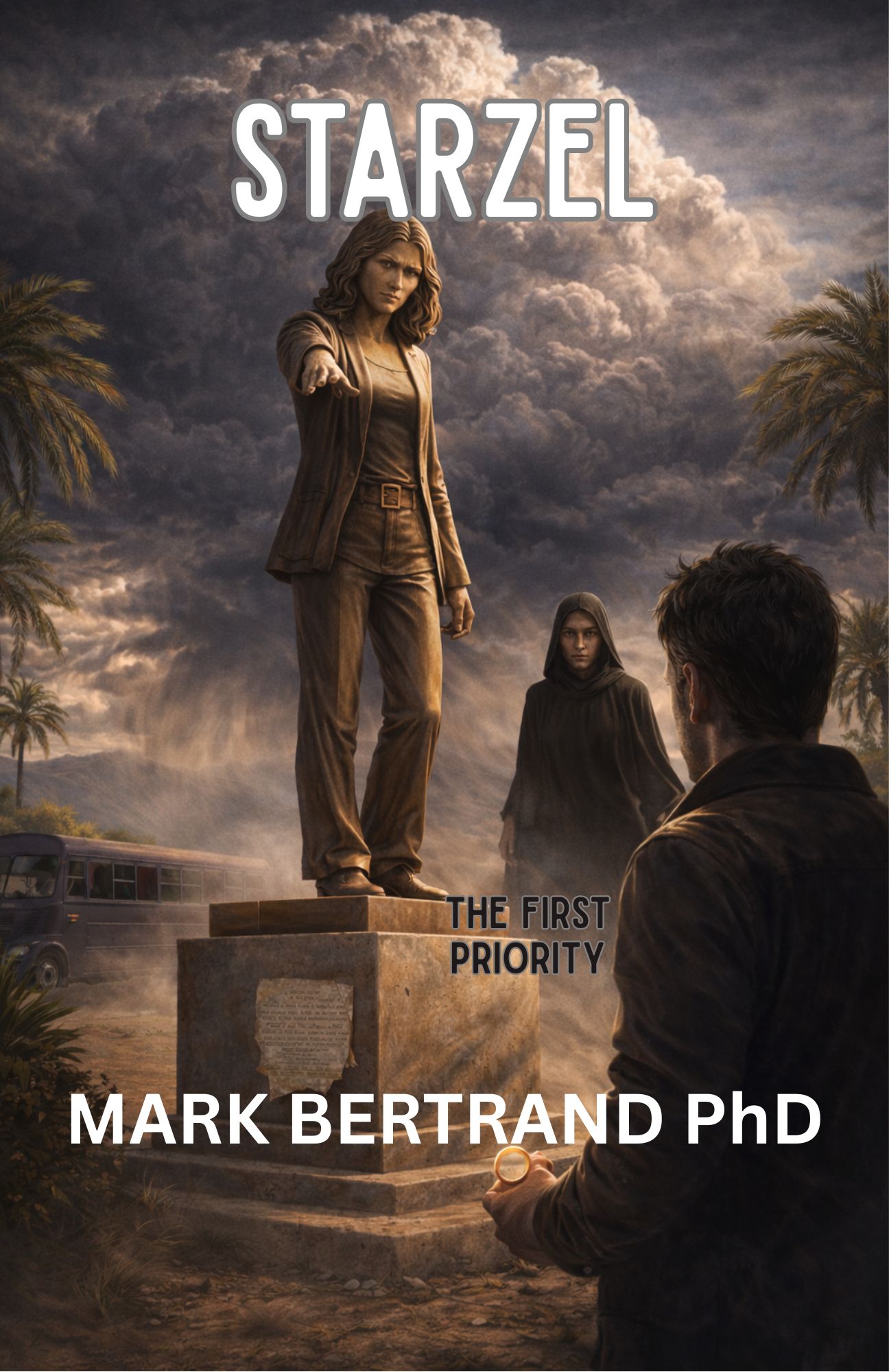
Starzel by MARK BERTRAND book cover image of a statue the woman in black mysterious and haunting
Connected evidence

Your Next Read

The investigation does not end at the bottom of the page.
Dossier

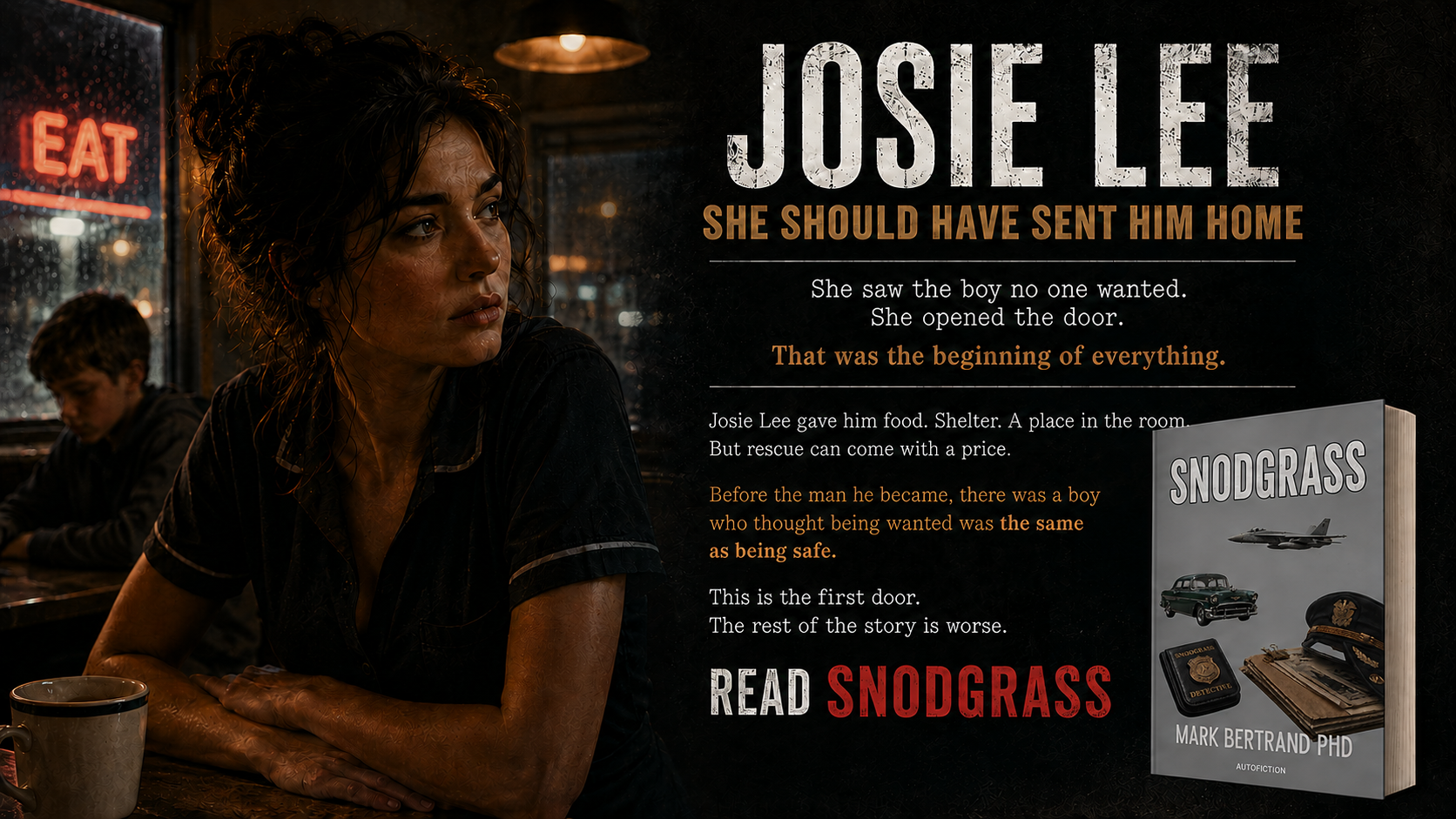
JOSIE LEE: SHE SHOULD HAVE SENT HIM HOME

When does kindness stop being shelter and become another room a boy cannot leave?

Josie Lee is not the beginning of the novel, Snodgrass. She is worse than that. She is the first door. The public story tells you Josie opened it.

That is the easy version.

JOSIE LEE: SHE SHOULD HAVE SENT HIM HOME with Snodgrass book cover.

Josie Lee | She should have sent him home

A boy was alone. Hungry. Too young to be free and too damaged to go home. He had already learned the first rotten lesson of the world: adults could call a place a family while making one child feel like a trespasser.

Josie saw him.

That was the beginning of everything.

Not because she was looking for him.

Not because she planned him.

Not because she woke one morning and decided to cross a line.

The truth is worse than that.

The truth is more human.

Josie Lee saw him because she recognized him.

She looked at Mark and saw the old wound walking toward her in boots, hunger, pride, silence, and bad luck. She saw a boy unwanted by the man in the house. She saw another man’s child. She saw the evidence of a life a stepfather wanted erased.

And somewhere inside her, before thought could become warning, before decency could become distance, before the adult world could say what adults always say too late, she understood him.

There I am.

That is where Josie Lee becomes dangerous.

Not because she was cruel.

Because she was tender in the wrong direction.

THE PUBLIC STORY

The public story says Josie helped him.

That part is true.

She gave him food. Attention. Warmth. A place in the room. A voice that did not sound like contempt. A way to sit down without being watched like a criminal. A temporary country where the air did not belong to the man who hated him.

For a boy already put outside the circle, that kind of attention does not feel small.

It feels like rescue.

A plate can become a promise.

A ride can become safety.

A room can become a country.

A woman who looks at him without disgust can become proof that he still exists.

That is why Josie matters.

She did not enter the story as a villain. She entered as mercy.

And mercy is harder to survive when it comes with a shadow.

Snodgrass is not a clean story about a boy who escapes a bad house and finds a better world.

That would be easier.

That would be safer.

That would be a lie.

Snodgrass is the story of what happens after a boy survives one room and discovers the next room has its own bargain waiting.

Josie Lee was one of those bargains.

[READ SNODGRASS]

THE HIDDEN INJURY

A cruel person is easy to name. Cruelty comes wearing a sign if you have lived long enough to read it.

A fist.

A locked door.

A withheld meal.

A stepfather’s stare.

A mother’s silence.

A house where one child is treated as evidence against another adult’s pride.

Josie was harder.

She was warmth.

She was food.

She was brown eyes and attention.

She was a woman who looked at him and did not see trouble first.

She saw the child who had been put outside the circle.

And maybe that is why he trusted her.

Maybe that is why she trusted herself.

Because rescue can feel clean when it begins.

The first kindness is always innocent.

A plate.

A ride.

A little money.

A place to sit.

A room where nobody tells him he does not belong.

No one calls that possession.

No one calls that need.

No one calls that the first thread in a knot.

But a knot was forming.

The dossier finding is simple:

Josie Lee did not create the wound.

She entered through it.

SHE SHOULD HAVE SENT HIM HOME

Josie Lee should have sent him home.

That sentence is true.

It is also useless.

Home was not safety. Home was the scene of the crime. Home was where the boy had already learned that being another man’s child could turn his body into a target. Home was where adulthood failed first and then demanded the right to keep failing.

So where was she supposed to send him?

Back to the house that rejected him?

Back to the man who hated him?

Back to the rules written by people who never had to survive inside them?

That is the moral trap of Josie Lee.

The correct answer was not available.

Only the human answer was.

She helped him.

She should not have needed him.

Both things are true.

That is the part the public story cannot hold.

Public stories like clean roles. They want a villain. They want a saint. They want a victim without contradiction and a rescuer without hunger. They want the easy trial, the easy verdict, the simple witness statement.

Josie refuses that comfort.

She took risks for him.

Real risks.

Reputation.

Money.

Judgment.

The attention of the wrong men.

The legal danger of being too close to a boy the world had already failed.

The emotional danger of letting him become necessary.

She gave him what he had been starving for.

A place.

A witness.

A temporary home.

And because she gave him that, he could not see the full cost.

How could he?

He was too young.

THE BOY WHO ACTED OLDER THAN HE WAS

This is the part nobody wants to say.

A damaged boy can look older than he is.

Hunger can sharpen the face.

Work can harden the hands.

Anger can deepen the voice.

Survival can put a terrible adult mask on a child and fool everyone, including the child.

But needing to survive does not make a boy grown.

It only makes him easier to misunderstand.

It makes people call his silence maturity.

It makes people call his pride consent.

It makes people call his ability to endure strength.

It makes people forget that endurance is not adulthood.

A boy who has survived too much may know how to drive, fight, work, lie, steal food, sleep cold, take a punch, watch a room, read a man’s temper, and leave before the worst happens.

That does not make him a man.

That makes him a child with no rescue coming.

And that is why Snodgrass cuts deeper than a survival story.

It is not about whether the boy was strong.

Of course he was strong.

Strong was the only thing left when safety was gone.

The question is what strength cost him.

The question is what he had to mistake for love.

The question is what happened after Josie opened the door.

That is the book.

[READ SNODGRASS]

THE STEPCHILD WOUND

Josie did not fall for Mark because he was young.

That would be too simple.

She fell for him because he was wounded in the exact place she had never healed.

She knew what it meant to be the child from another man. The child who did not fit cleanly into the new household. The child who carried someone else’s history in the face, the name, the blood, the timing. The child a stepfather could resent without ever saying the real reason.

You are not mine.

You are proof.

You are the leftover life before me.

You are the reminder.

That is a terrible thing to do to a child.

It teaches the child that existence itself can be an offense.

Josie understood that.

Maybe no one had rescued her when she needed it.

Maybe no one had stood in the doorway and said, Come in, you are not the problem.

Maybe the girl she used to be had learned to survive by becoming useful, pretty, funny, hard, available, uncomplaining, whatever the room required.

Then Mark arrived with the same wound showing.

And she tried to save him.

That sounds beautiful.

It was beautiful.

It was also not enough to make it right.

Because she was not only saving him.

She was reaching backward through him.

She was trying to rescue the girl no one came back for.

That is where the story darkens.

THE FALSE RESCUE

When a person tries to save the wounded child inside herself by saving another wounded child, love can become confused with recovery.

Kindness can become a claim.

Protection can become hunger.

The rescued person can become evidence that the rescuer is good, needed, chosen, forgiven.

And the boy?

The boy learns another lesson.

Not the lesson of violence this time.

A softer lesson.

A more dangerous one.

He learns that rescue may come with a hand around the wrist.

He learns that being wanted can feel like being saved.

He learns that adult need can arrive disguised as love.

He learns that a door can open and still become a room he does not know how to leave.

That is Josie Lee.

Not villain.

Not saint.

A woman with brown eyes and an old wound.

A woman who saw too much of herself in a boy she should have protected from everyone, including herself.

A woman who gave him shelter when the world had none to offer.

A woman who should have known better.

A woman who maybe did know better and still could not stop the human part of herself from reaching for the one person who made her old pain feel visible.

This is why the public story is not enough.

The public story says Josie helped him.

The dossier says help is not always clean.

The public story says she opened the door.

The dossier asks what followed him through it.

The public story lets us call her kind.

The dossier makes us sit with the harder truth:

Josie Lee may have saved him from the street, but she also taught him that rescue could come with a claim attached.

And once a boy learns that, he carries it.

Into work.

Into hunger.

Into danger.

Into women.

Into rooms where power smiles before it takes something.

Into every future where love and debt are difficult to separate.

WHY JOSIE LEE MATTERS

Josie Lee is not a side character.

She is not a memory.

She is not the waitress from before the real story begins.

She is the first door.

And after that door came the machine.

After Josie came the world that knew exactly what to do with a boy trained to survive, trained to keep moving, trained to confuse danger with opportunity, trained to accept impossible bargains because impossible bargains were the only ones ever offered.

That boy would go on to meet men who understood leverage.

Men who smiled first.

Men who made offers.

Men who turned desperation into a contract.

Men who saw in him the thing damaged children are trained to become.

Useful.

Fast.

Loyal until betrayed.

Silent until cornered.

Brave enough to be spent.

This is where Snodgrass begins to matter.

Not because Snodgrass explains Josie.

Because Snodgrass shows what happened after shelter was no longer enough.

Josie saw the boy.

Snodgrass shows the world that came for him next.

The boy who walked through Josie Lee’s door did not become safe.

He became harder to kill.

There is a difference.

Every real reader knows it.

MEMBERS ONLY // THE PART NOBODY WANTS TO SAY

The hardest part of Josie Lee is

This content is for members only.

Not yet a member? Request member access to The Dossier. Get 20% off the paperback price.

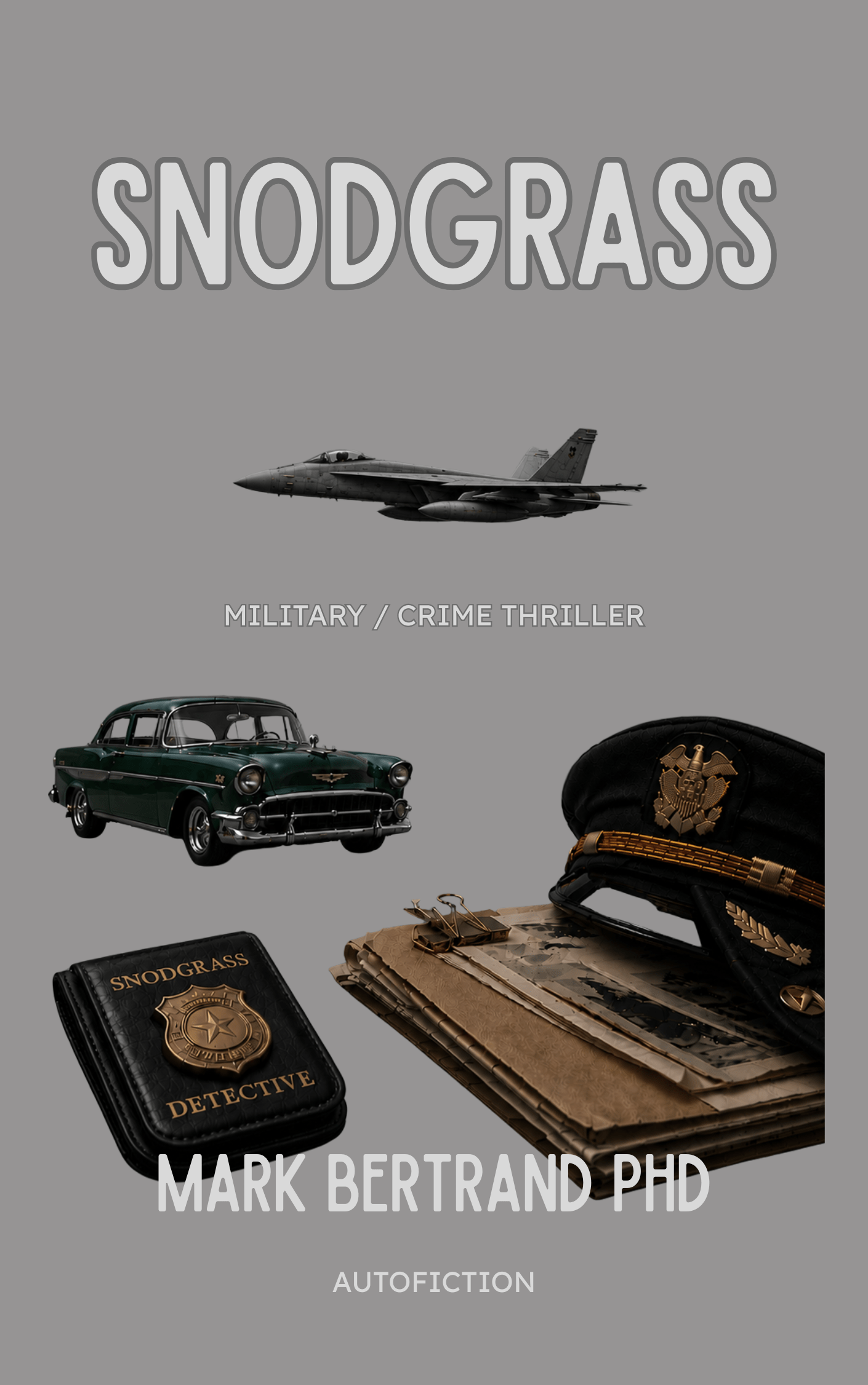
Snodgrass book cover for book 1 in the crime thriller trilogy
Ebook purchase now image
audiobook purchase image
paperback purchase image