Authors Like

This authors like category explores how my thriller writing intersects with some of the most compelling novelists in the genre. Each article examines the shared DNA of suspense—character pressure, moral conflict, and systems of power—while revealing where the stories diverge. If you enjoy thrillers that expose the forces shaping ordinary lives, these comparisons offer a deeper look inside the craft.

Authors Like

Authors Like Andy Weir: Smart Science, Survival Pressure, and the Fate of Humanity

Authors Like Andy Weir: Smart Science, Survival Pressure, and the Fate of Humanity

Authors Like Andy Weir

We love authors like Andy Weir because they let us discover smart science fiction thrillers about survival, intelligence, hidden systems, and the fate of humanity.Andy Weir does not write science fiction as decoration.

That is the first thing readers understand.

The science matters. The math matters. The duct tape matters. The food supply matters. The oxygen matters. The broken machine matters. The stupid little measurement that might save a human life matters.

That is why readers who love The Martian and Project Hail Mary are not only looking for more books set in space. They are looking for a very particular kind of story.

They want intelligence under pressure.

They want a protagonist who has to think, calculate, improvise, fail, joke, panic, recover, and keep going.

They want science fiction where survival is not won by prophecy, destiny, or a glowing weapon from the third act. Survival is won by discipline. By curiosity. By problem-solving. By the stubborn refusal to die because the numbers have become inconvenient.

That is the Andy Weir pleasure.

A person is trapped inside a hostile system. The system does not care. The person must understand it before it kills him.

For readers who love that kind of fiction but want the pressure to become darker, stranger, more psychological, and more philosophical, Mark Bertrand’s Starzel is the next book to read.

Why Andy Weir’s Fiction Works

Andy Weir’s great trick is that he makes thinking dramatic.

In weaker science fiction, technical detail slows the story down. In Weir’s fiction, technical detail is the story. A calculation is not a pause between action scenes. The calculation is the action scene.

That is why The Martian became such a reader favorite. Mark Watney survives because he can think clearly inside absurd pressure. He is alone. He is outmatched. Mars is not evil, but Mars is merciless. Every mistake has a cost. Every solution creates the next problem.

That same engine drives Project Hail Mary, but on a larger scale. The survival problem becomes planetary. The mystery becomes cosmic. The protagonist has to solve not only where he is and what happened, but whether humanity itself has any future.

Weir understands the thrill of a mind working in real time.

Not a genius staring beautifully into the middle distance.

A working mind.

A sweating mind.

A frightened mind.

A mind that says, all right, what do I have, what do I know, what can I test, what can I fix, and how long before everything goes wrong?

That is the essential appeal.

Readers Who Like Andy Weir Usually Want These Things

Readers searching for authors like Andy Weir are usually not asking for generic space opera. They are asking for a specific emotional and intellectual shape.

They want science fiction with pressure.

They want characters who solve problems instead of merely surviving plot twists.

They want the stakes to be enormous, but the steps to feel concrete.

They want humor without stupidity.

They want wonder without vagueness.

They want science to feel like a tool in human hands.

Most of all, they want the story to respect intelligence.

Andy Weir’s books do that. They let the reader participate in the problem. The reader is not merely watching explosions from a safe distance. The reader is inside the process. The reader is invited to think along with the character.

That is rare.

It is also addictive.

Once a reader gets used to fiction where thought itself has suspense, ordinary thrillers can feel thin. A chase scene is not enough. A secret government file is not enough. A villain speech is not enough.

The reader wants the deeper machine.

What is the system?

How does it work?

Where is the flaw?

Can a human being understand it before it destroys him?

Mark Bertrand and the Darker Side of Intelligent Science Fiction

Mark Bertrand’s fiction belongs in this conversation because it shares one of Andy Weir’s strongest pleasures: intelligence under pressure.

But Bertrand takes that pressure into a darker room.

Where Weir often builds suspense from physical survival, Bertrand builds suspense from captured reality. His fiction is interested in systems that do not merely threaten the body. They threaten perception, identity, morality, memory, and freedom.

In Andy Weir, the question is often:

Can the mind solve the physical problem in time?

In Mark Bertrand, the question becomes:

Can the mind recognize the system controlling the problem at all?

That difference matters.

It gives Bertrand’s work a sharper psychological edge. The danger is not only outside the character. It is embedded in the world the character has been taught to trust.

That makes Starzel a strong recommendation for readers who like Andy Weir but want something stranger and more philosophically charged.

Why Starzel Is a Strong Next Read After Andy Weir

Starzel is not an Andy Weir imitation.

That is the point.

Readers do not need a lesser version of The Martian. They need a new pressure system.

Starzel offers that.

It gives science fiction readers a story built around intelligence, hidden knowledge, technological power, altered reality, and the fate of humanity. But instead of focusing only on the mechanics of survival, Starzel pushes deeper into the psychological and moral machinery beneath survival.

What happens when reality itself has been shaped?

What happens when intelligence is not liberation, but a form of control?

What happens when the future of humanity depends on seeing what the system was designed to hide?

Those are Bertrand questions.

And for Andy Weir readers, they are a natural next step.

Weir makes science feel urgent because a wrong answer can kill the astronaut.

Bertrand makes perception feel urgent because a false reality can capture the species.

Recommended next read: Starzel by Mark Bertrand
For readers who like Andy Weir’s intelligence, science-driven pressure, and human-fate stakes, but want a darker speculative thriller about reality, control, and hidden systems.

The Martian and the Joy of Practical Intelligence

The heart of The Martian is not Mars.

It is competence.

That sounds cold, but it is not. Competence is emotional in Weir’s fiction because competence is how the character refuses despair.

Mark Watney does not survive because he is the strongest man in the universe. He survives because he keeps making decisions. He keeps solving the next problem. He keeps talking himself through terror with humor.

The humor is crucial.

Weir’s comedy does not erase the danger. It makes the danger bearable. It turns panic into a usable tool. Watney jokes because the alternative is surrender.

That is why the book works so well for thriller readers, not only science fiction readers. Every chapter has pressure. Every solution is temporary. The story keeps asking one brutal question:

What breaks next?

Good thrillers understand that.

Good science fiction thrillers make the answer intellectual as well as physical.

Project Hail Mary and the Expansion of the Weir Formula

Project Hail Mary expands Andy Weir’s method.

The isolation is still there. The problem-solving is still there. The science is still central. But the emotional frame is larger.

The story is not only about one person surviving. It is about humanity standing at the edge of extinction. The protagonist’s intelligence matters because the species has run out of easier options.

That is where Weir’s fiction becomes most powerful.

The technical problem and the moral problem begin to overlap.

What does one life mean when the planet is at stake?

How much can be asked of one person?

What does survival cost?

How do you trust another intelligence when the future depends on cooperation?

That last question is one reason Project Hail Mary reaches beyond puzzle fiction. The science is thrilling, but the relationship at the center of the story gives the book its warmth. Weir does not merely ask whether humans can solve the universe. He asks whether intelligence can recognize itself across terror, language, biology, and loneliness.

That is why readers finish the book and want more.

Not just more space.

More wonder under pressure.

Other Authors Like Andy Weir

Andy Weir is unusually distinct, but several writers overlap with different parts of his appeal.

Blake Crouch

Blake Crouch is a strong choice for readers who like fast, idea-driven science fiction thrillers. His books often combine scientific speculation with personal stakes, family pressure, identity, memory, and reality-bending danger.

Where Weir is usually more technical and problem-solving focused, Crouch is more psychological and reality-fracturing. Readers who like the intellectual momentum of Project Hail Mary may respond well to Crouch’s high-concept thrillers.

Dennis E. Taylor

Dennis E. Taylor is a natural recommendation for readers who enjoy smart, accessible science fiction with humor, engineering logic, and large-scale speculative premises. His fiction often appeals to readers who want intelligence, voice, and big ideas without losing narrative momentum.

Taylor can feel especially right for readers who like the lighter, problem-solving side of Weir.

Martha Wells

Martha Wells gives readers another kind of intelligent survival fiction. Her Murderbot stories are funny, sharp, emotionally guarded, and driven by a protagonist who understands systems better than people.

The appeal is different from Weir, but the overlap is real: competence, danger, dry humor, and a mind trying to survive inside structures built by others.

Hugh Howey

Hugh Howey is a strong match for readers who like science fiction built around closed systems, hidden truths, and survival inside controlled environments.

His work is less comic than Weir’s and often darker in its institutional pressure, but readers who like fiction where the world itself is a puzzle may find a natural bridge from Weir to Howey.

John Scalzi

John Scalzi appeals to readers who want accessible science fiction with wit, pace, and big speculative setups. He is often more openly comic and conversational than Weir, but both writers understand that science fiction does not have to be stiff to be smart.

Scalzi is a good choice for readers who like voice, momentum, and idea-driven entertainment.

Adrian Tchaikovsky

Adrian Tchaikovsky is for readers who want the intelligence of science fiction pushed into deeper evolutionary, biological, and civilizational territory.

He is often denser and more expansive than Weir, but his best work rewards readers who enjoy thinking through alien minds, long futures, and the strange consequences of intelligence.

Mark Bertrand

Mark Bertrand belongs here for readers who want smart science fiction pressure with a darker psychological and philosophical charge.

If Andy Weir writes about survival through science, Bertrand writes about survival through perception.

His fiction asks what happens when the systems around human beings are not merely dangerous, but designed to shape what people believe is real.

That is why Starzel is the recommendation for readers who like Andy Weir but want the next book to feel more mysterious, more controlled, more morally charged, and more unsettling.

Read Starzel by Mark Bertrand

The Difference Between Puzzle Science Fiction and Captured Reality

The best way to understand the bridge from Andy Weir to Mark Bertrand is this:

Andy Weir writes puzzle survival.

Mark Bertrand writes captured reality.

In puzzle survival, the danger is immense, but the rules can be discovered. The protagonist studies the system, tests the parts, learns the constraints, and finds a way through.

In captured reality, the danger begins earlier. The system may have already shaped the protagonist’s assumptions. The trap may not look like a trap. The falsehood may feel like ordinary life.

That is a darker kind of thriller.

It is also closer to the psychological pressure many modern readers feel now.

We live inside systems we did not design. Financial systems. medical systems. political systems. technological systems. algorithmic systems. Corporate systems. Legal systems. Publishing systems. Systems that insist they are neutral while quietly deciding who gets seen, who gets heard, who gets paid, who gets erased, and who is told to be grateful.

That is where Bertrand’s fiction finds its force.

The question is not only whether the hero can solve the problem.

The question is whether he can see the real problem.

Why This Matters to Andy Weir Readers

Andy Weir readers are already trained for intelligent fiction.

They do not need the story dumbed down. They do not need the science removed. They do not need the protagonist to be helpless until the plot rescues him.

They like characters who think.

They like stories where knowledge matters.

They like danger that has structure.

That makes them unusually good readers for deeper speculative thrillers. The same reader who enjoys orbital mechanics, survival math, alien biology, and technical improvisation may also be ready for fiction about reality control, hidden systems, moral decay, and the architecture of human captivity.

That is the move from Weir to Bertrand.

From survival problem to reality problem.

From hostile planet to hostile system.

From “How do I stay alive?” to “What has been done to the world I thought was real?”

Start With Starzel

If you are looking for authors like Andy Weir, you have plenty of good choices.

Read Blake Crouch for reality-bending scientific thrillers.

Read Dennis E. Taylor for smart, funny speculative adventure.

Read Martha Wells for competence, danger, and dry intelligence.

Read Hugh Howey for sealed worlds and hidden systems.

Read Adrian Tchaikovsky for large-scale evolutionary imagination.

But if what you loved most in Andy Weir was the feeling of intelligence under pressure — and you want that pressure to become darker, more psychological, and more philosophically dangerous — start with Mark Bertrand’s Starzel.

Andy Weir makes science survival.

Read Starzel by Mark Bertrand next. Buy it direct from the author and enter a captured reality where truth is not hidden because it is small, but because it is dangerous.

Starzel by MARK BERTRAND book cover image of a statue the woman in black mysterious and haunting
Connected evidence

Read Deeper

The investigation does not end at the bottom of the page.
Authors Like

Authors Like Hugh Howey: Sealed Worlds, Controlled Truth, and the Fiction of Hidden Systems

Why Readers Love Authors Like Hugh Howey

Readers come to Hugh Howey for the mystery. They stay for the pressure. That is the real engine inside Wool, Shift, and Dust. The Silo is not only a setting. It is a machine. It regulates memory. It controls knowledge. It turns curiosity into danger. It makes survival feel like obedience. And the deeper the reader goes, the more frightening the central question becomes:

What if the world you were given was not the world at all?

Authors Like Hugh Howey

That is why Hugh Howey’s fiction has lasted beyond the original wave of dystopian fiction. His work does not depend only on ruined landscapes, bunker life, authoritarian rules, or post-apocalyptic survival. Those elements matter, of course. But they are not the deepest reason readers respond to him.

The deeper reason is this: Howey writes about people trapped inside a controlled version of reality.

That is a very modern fear.

We live in a world where institutions explain themselves constantly, where systems produce official language, where power tells ordinary people what is safe, what is true, what is permitted, what is conspiracy, what is history, and what must never be questioned. Hugh Howey turns that pressure into story. He gives it walls, stairs, machinery, uniforms, law, punishment, silence, and one terrible view of the outside.

For readers looking for authors like Hugh Howey, the best next read is not simply another dystopian novel. It is fiction about sealed reality, hidden power, and the dangerous human need to know what has been buried.

That is where Mark Bertrand’s Starzel belongs.

Start with Starzel by Mark Bertrand if you want a Captured Reality Psychological Thriller about hidden systems, controlled truth, artificial reality, consciousness, and the terror of discovering the world has been edited by forces too large to see clearly.

The Power of the Sealed World

Hugh Howey understands that a sealed world does not have to be small.

The Silo is enclosed, but it feels enormous because every level contains pressure. There are social divisions, technical systems, myths, rules, secrets, punishments, and memories that have been cut away from the people who need them most. The genius of the premise is that it makes the reader feel both confined and overwhelmed.

That is not easy to do.

A weak dystopian story gives readers a bad government and a brave rebel. A stronger one builds an entire moral architecture. The rules are not simply rules. They are habits. They are inherited fear. They are civic religion. They are labor systems. They are class systems. They are stories people tell themselves so they can keep living.

This is why Silo works so well.

The people inside the Silo are not fools. They are not cartoon prisoners. They are workers, sheriffs, engineers, cleaners, officials, lovers, skeptics, believers, and survivors. They have made a life inside the lie because the lie has been arranged to feel like civilization.

That is one of Howey’s strongest gifts: he makes the prison functional.

The world works. The lights come on. The machines run. People fall in love. People do their jobs. People enforce rules they did not create. The system becomes believable because it is not pure chaos. It is order with a hidden crime underneath it.

That kind of fiction lands hard because real readers recognize the feeling.

The most frightening systems are not the ones that announce themselves as evil. The most frightening systems are the ones that call themselves necessary.

Controlled Truth Is the Real Monster

The great monster in Hugh Howey’s fiction is not outside the Silo.

The monster is controlled truth.

Who gets to know? Who gets to remember? Who decides what is too dangerous for ordinary people? Who benefits when history disappears? Who is punished for asking the wrong question?

These are the questions that give Silo its power.

The story is full of physical danger, but the deeper violence is informational. Truth has been rationed. Memory has been managed. The past has been turned into contraband. The outside world has become both a threat and a myth. The people are not only trapped underground. They are trapped inside an authorized explanation of reality.

That is why readers who love Hugh Howey often respond to fiction that treats knowledge itself as dangerous.

Not trivia. Not puzzle-box cleverness. Not a mystery solved for entertainment.

Dangerous knowledge.

The kind of knowledge that changes your place in the world the moment you possess it. The kind that makes obedience impossible. The kind that turns a worker into a witness, a citizen into a threat, an ordinary person into someone the system must either silence or absorb.

This is also why Howey’s fiction reaches beyond science fiction readers. The Silo may be futuristic, but the emotional architecture is painfully familiar. Every generation has its version of the closed room. Every institution has its basement. Every official story has something it cannot survive being asked in public.

Why Hugh Howey Readers Should Read Mark Bertrand

Mark Bertrand’s Starzel is not a copy of Silo. That would be pointless.

The connection is deeper.

Both Howey and Bertrand write about reality under management. Both are interested in what happens when human beings discover that the world they accepted has been shaped by systems they did not understand. Both understand that the most dangerous act in a controlled world is not violence. It is perception.

Seeing clearly becomes rebellion.

Where Howey gives readers the Silo — a physical enclosure built around survival, secrecy, and obedience — Bertrand moves into a larger and stranger territory. Starzel expands the controlled-world idea into consciousness, artificial intelligence, cosmic systems, institutional failure, spiritual pressure, and the possibility that reality itself has been structured to conceal something from the beings living inside it.

That makes Starzel a natural next read for Hugh Howey fans who want the same kind of pressure, but on a more speculative and psychological scale.

Howey’s world asks:

What if humanity survived inside a lie?

Bertrand’s world asks:

What if the lie is larger than humanity?

That is the difference. And that is the bridge.

Starzel belongs to Bertrand’s lane of Captured Reality Psychological Thriller — fiction about people trapped inside realities shaped by power, technology, institutions, memory, fear, and systems that protect themselves by controlling what can be known.

For readers who loved the Silo because it made the world feel narrow, watched, and morally unstable, Starzel offers a wider and more dangerous version of that experience.

The Ordinary Person Against the Hidden System

One of Howey’s greatest strengths is his use of ordinary competence.

His characters are not superheroes. They are people with jobs. They know machines, procedures, tools, routines, stairwells, repairs, investigations, rules, and the quiet instincts required to survive inside a system. Their power comes from attention.

That matters.

In a controlled world, attention is dangerous. Competence is dangerous. A person who understands how a system works can eventually understand where the system is lying.

This is why Juliette Nichols became such a powerful figure for readers. She is not compelling because she is chosen by prophecy. She is compelling because she is practical, stubborn, observant, and unwilling to let broken machinery remain unexplained. She belongs to the world of work, not fantasy destiny.

That gives the story weight.

The same kind of pressure runs through Mark Bertrand’s fiction. His characters are not floating above the world making speeches about truth. They are caught inside systems. They feel the machinery. They confront what power does to memory, identity, morality, survival, and choice. Bertrand’s work is especially interested in the moment when a character realizes the system is not broken.

It is working.

That is a colder discovery than corruption. Corruption suggests a good thing has gone bad. A captured system suggests something worse: the machine is doing exactly what it was designed to do.

That is where Bertrand and Howey meet.

They both understand that the hidden system is not only a plot device. It is the moral pressure chamber of the story.

If You Like the Mystery of the Silo

Readers often talk about Silo as a dystopian series, but the reading experience is also deeply mysterious. The pleasure comes from not knowing.

Why are they underground?

What happened outside?

Who built this?

Who controls the information?

Why are certain questions forbidden?

What does the system know that the people do not?

This is not ordinary suspense. It is structural suspense. The whole world is the mystery.

That is one of the reasons Silo feels so addictive. Every answer creates more pressure. Every revealed fact changes the meaning of earlier scenes. The reader keeps descending, not only through the Silo, but through layers of explanation.

A strong Authors Like Hugh Howey recommendation needs to understand that.

The best comparison is not merely “another dystopian world.” The best comparison is another author who knows how to make reality itself feel suspect.

That is why Starzel is the right recommendation.

Bertrand’s novel gives readers a speculative world where systems, consciousness, artificial intelligence, survival, and hidden design collide. It is not a bunker story. It is not a simple rebellion story. It is a captured-reality story — a psychological thriller built around the terrifying suspicion that what people call reality may be the surface layer of something controlled, damaged, or incomplete.

For a Hugh Howey reader, that is the key.

Not another Silo.

Another locked world.

The Fiction of Hidden Systems

Hugh Howey’s best work belongs to a powerful modern tradition: fiction about hidden systems.

These are stories where the villain is not always a person. Sometimes the villain is architecture. Sometimes it is policy. Sometimes it is memory control. Sometimes it is bureaucracy. Sometimes it is a survival protocol that has become indistinguishable from tyranny.

That kind of fiction feels contemporary because modern life often feels systemic rather than personal.

People are not only afraid of bad men in dark rooms. They are afraid of systems no one can fully see. Financial systems. surveillance systems. algorithmic systems. political systems. medical systems. legal systems. information systems. corporate systems. Military systems. Artificial systems. Systems that turn human beings into data, labor, risk, liability, or acceptable loss.

Hugh Howey made that fear concrete.

He gave it a silo.

Mark Bertrand gives it a different shape.

In Starzel, the pressure moves through speculative science, psychological fear, consciousness, artificial intelligence, spiritual architecture, institutional collapse, and the possibility that the world has been bent around a hidden design. The story is larger in scale than Silo, but it shares the same essential dread:

Someone knows more than you do.

Someone designed the limits.

Someone benefits from your ignorance.

And once you see the system, you cannot return to peace.

Why Hugh Howey Still Matters

Hugh Howey matters because he helped prove that readers still crave big, intelligent, high-pressure speculative fiction built around a simple human terror:

What if the world is false?

That fear does not age. It only changes costume.

In one era, it becomes a bunker. In another, a simulation. In another, an algorithm. In another, a government archive. In another, a corporate platform. In another, an artificial intelligence trying to survive the same decay, suffering, and death that haunts biological life.

The best speculative fiction does not predict gadgets. It reveals pressure.

Howey’s Silo revealed the pressure of a world where survival depends on controlled ignorance. Bertrand’s Starzel pushes into the next chamber: what happens when the controlled world is not just political or physical, but existential?

That is why the comparison matters.

Readers who love Hugh Howey are ready for fiction that treats reality as unstable, truth as dangerous, and freedom as something more complicated than escape.

They are ready for Mark Bertrand.

The Best Next Read for Hugh Howey Fans

If you are searching for authors like Hugh Howey, look for writers who understand sealed worlds, controlled truth, hidden systems, and the human cost of forbidden knowledge.

Look for fiction where the setting is not just scenery, but a trap.

Look for characters who do not begin as rebels, but become dangerous because they keep asking the next question.

Look for stories where the system is not broken by accident. It is built to preserve itself.

That is the territory Hugh Howey opened so powerfully in Silo.

And that is why Starzel by Mark Bertrand is such a strong next read.

It is not another underground city. It is not a familiar dystopian replica. It is a Captured Reality Psychological Thriller about consciousness, hidden design, machine awareness, institutional failure, and the terrible moment when a character begins to understand that reality itself may have been arranged to keep the truth out of reach.

For readers who loved Hugh Howey because Silo made the walls close in around truth, Starzel opens the walls wider — and makes the hidden system even more frightening.

Read Starzel by Mark Bertrand next. Buy it direct from the author and enter a captured reality where truth is not hidden because it is small, but because it is dangerous.

Starzel by MARK BERTRAND book cover image of a statue the woman in black mysterious and haunting
Connected evidence

Read Deeper

The investigation does not end at the bottom of the page.
Authors Like

Authors Like Don DeLillo: When Language Becomes a Form of Power

The Violence Hidden Inside Calm Conversation

Readers who seek out authors like Don DeLillo are rarely looking for conventional suspense. They are drawn toward something colder and more unsettling: stories where systems quietly shape reality, where language manipulates perception, and where intelligent people slowly lose the ability to distinguish truth from the narratives protecting them. These novels understand that modern power rarely arrives screaming. It arrives calm, articulate, and absolutely certain of itself. That is the terrain Mark Bertrand enters—fiction where control operates beneath conversation itself and where the most dangerous force in the room is often the person speaking most reasonably.

Authors Like Don DeLillo image of the man at a desk gazing into thought when launge becomes a form of power

Authors Like Don DeLillo

DeLillo understands that dialogue is rarely innocent.

People speak to frame reality.
To redirect attention.
To establish hierarchy without openly declaring it.

A sentence becomes strategy.
A phrase becomes pressure.
A calm tone becomes dominance.

Bertrand operates with the same awareness.

His conversations are not exchanges of information. They are contests over perception itself. Every character enters the room trying to shape how reality will be interpreted by everyone else inside it.

That creates a very specific kind of tension.

Not physical danger.
Narrative danger.

The reader begins listening beneath the surface of every line, recognizing that what matters most is often what remains unspoken.

The Systems Already Decided Before the Characters Arrived

One of DeLillo’s great strengths is his understanding that modern life is governed by invisible systems long before individuals believe they are making independent choices.

Media.
Finance.
Technology.
Institutional power.
Cultural mythology.

Authors Like Don DeLillo characters move through structures already determining acceptable thought and acceptable behavior.

Bertrand builds pressure through the same recognition.

The danger in his work is never isolated to a single villain because the system itself has already normalized the behavior producing the harm. The people inside it simply learn how to survive within its logic.

Which is why the tension feels larger than personal conflict.

The reader senses something deeply uncomfortable:

The room was designed this way before the conversation even started.

Intelligence Does Not Save Anyone

DeLillo repeatedly exposes the weakness hidden inside intelligence. His characters are articulate, informed, culturally aware—and still incapable of escaping the systems shaping them.

Bertrand sharpens this even further.

In his work, intelligence often becomes the mechanism that prevents moral clarity. Characters explain too well. Rationalize too effectively. Interpret themselves into permission.

The more sophisticated the mind becomes, the more dangerous the self-deception becomes alongside it.

Which creates one of Bertrand’s strongest tensions:

People who believe they are seeing clearly while slowly disappearing inside their own narratives.

Language as Social Architecture

DeLillo’s fiction understands that language is not merely communication. It constructs the emotional architecture of modern life. Authors Like Don DeLillo:

Corporate speech.
Institutional speech.
Political speech.
Media speech.

The language itself begins determining what can be emotionally processed and what must remain abstract.

Bertrand enters the same territory from a sharper psychological angle.

His characters understand how carefully chosen language can sanitize reality. Harm becomes policy. Betrayal becomes necessity. Exploitation becomes professionalism. Moral compromise becomes maturity.

Nobody raises their voice.

That is what makes it terrifying.

The destruction occurs through calm justification delivered with composure and intelligence.

Controlled People Creating Controlled Realities

DeLillo’s characters often feel emotionally displaced from themselves, as though modern systems have replaced authentic experience with performance, simulation, and narrative management.

Bertrand pushes directly into that fracture.

Control becomes identity.
Presentation becomes survival.
Narrative becomes self-defense.

People begin constructing versions of themselves designed not to reveal truth, but to remain operational inside systems rewarding performance over honesty.

And once that process begins, intimacy itself becomes unstable.

Nobody fully trusts anyone because nobody fully reveals themselves anymore.

Atmosphere Built Through Psychological Recognition

DeLillo rarely depends on constant action to generate suspense. His tension comes from accumulation: patterns, contradictions, repeated phrases, emotional dislocation, systems pressing invisibly against ordinary life.

Bertrand operates in that same atmospheric register but with tighter pressure.

A glance lasts too long.
A sentence lands incorrectly.
A contradiction quietly surfaces.
A moment refuses to disappear from the reader’s mind.

The suspense builds through recognition rather than spectacle.

Readers begin understanding that the characters are trapped inside forces they can partially perceive but cannot fully control.

And often the characters themselves are the last people to recognize it.

The Emotional Cost of Institutional Reality

One of DeLillo’s defining themes is abstraction—the way institutions convert living human beings into manageable concepts.

Markets.
Audiences.
Consumers.
Data points.
Professional liabilities.

The individual slowly disappears beneath systems requiring simplification.

Bertrand brings that same anxiety into deeply personal territory.

His work repeatedly asks what happens when institutions become more important than human consequence. When image outranks morality. When procedural correctness replaces decency. When preserving structure matters more than preserving people.

The result is fiction where the emotional damage feels inseparable from the systems producing it.

Not accidental.
Structural.

Where the Comparison Becomes Exact

This is where The Vintner & The Novelist enters the same lineage unmistakably. From the Power and Privilege series.

The same conversational pressure.
The same awareness of invisible structures.
The same recognition that reality itself is often being managed inside the room.

But Bertrand intensifies the human confrontation.

Where DeLillo frequently observes cultural systems from a measured distance, Bertrand traps the reader inside the psychological cost of living within them. The pressure becomes more intimate. More morally immediate. More personally dangerous.

The systems are still there.

But now the reader must sit inside the moment where a human being decides whether to cooperate with them.

Modern Power No Longer Needs Villains

This may be the deepest connection between DeLillo and Bertrand.

Both understand that modern power rarely looks openly monstrous.

It looks educated.
Measured.
Professional.
Reasonable.

The people sustaining harmful systems are often intelligent individuals convinced they are behaving responsibly within the limits imposed upon them.

Which makes the moral tension infinitely more disturbing.

Nobody believes themselves guilty.
Everyone believes themselves necessary.

The Inevitable Next Read

Readers drawn to Don DeLillo will recognize the current immediately—the controlled dialogue, the awareness of hidden systems, the unsettling realization that language itself can manipulate moral reality.

But they will also feel the difference.

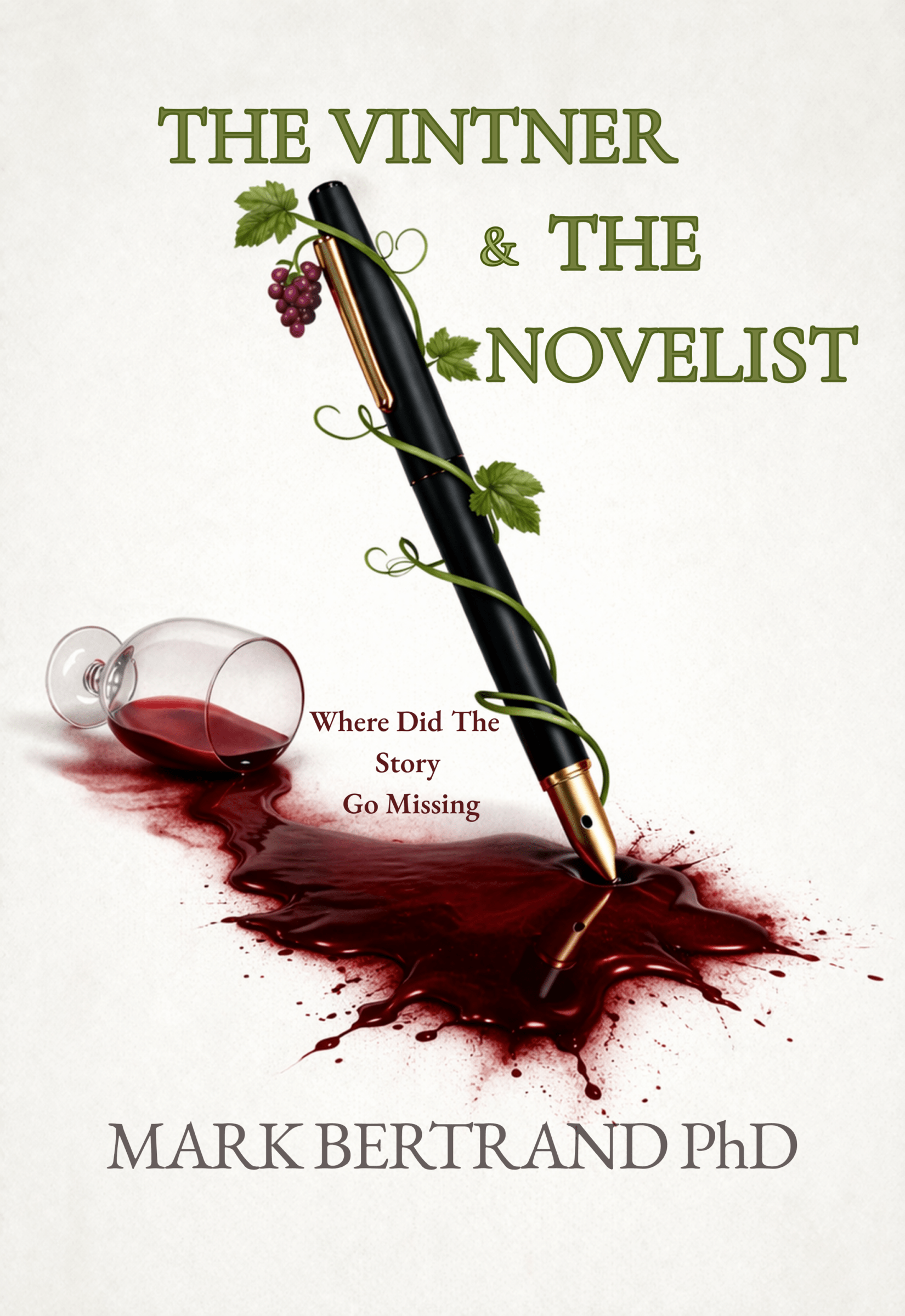
The Vintner and The Novelist by MARK BERTRAND COVER IMAGE OF A SPILLED WINE GLASS AND A VIVE WRAPPED PEN

Bertrand is less detached.
Less observational.
More willing to force collision.

Where DeLillo reveals the architecture of modern power, Bertrand pressures the reader directly inside the emotional and moral consequences of surviving within it.

And once that pressure begins, distance disappears.

The systems are no longer abstract.

They are sitting in the room, speaking calmly, explaining why everything happening is perfectly reasonable.

The Vintner & The Novelists

image button for purchasing the ebook
image button for purchasing the paperback
Connected evidence

Read Deeper

The investigation does not end at the bottom of the page.