
Psychological thriller books where the villain does not merely manipulate the mind. He manipulates the world the mind is forced to survive.
A Captured Reality Psychological Thriller Booksis a psychological thriller built around a brutal modern fear:
What if the world is not merely confusing?

What if it has been arranged that way?
Not by accident. Not by madness. Not by supernatural force.
By money.
By law.
By corporations.
By institutions.
By algorithms.
By inherited power.
By social obedience.
By people who understand that controlling reality is more useful than controlling a single person.
Captured Reality Psychological Thriller
The old psychological thriller often began inside the mind. A damaged memory. A hidden motive. An unreliable narrator. A marriage full of secrets. A killer with a pattern. A detective chasing what everyone else missed.
Those stories still have power.
But the world changed.
Today, the deepest psychological pressure often does not come from one unstable person. It comes from the world around the person becoming unstable on purpose.
The bank follows procedure.
The court follows procedure.
The company follows procedure.
The algorithm follows procedure.
The institution follows procedure.
The powerful person remains protected.
The ordinary person is told the damage is normal.
That is captured reality.
That is the modern mindfuck.
What Is a Captured Reality Psychological Thriller?
A Captured Reality Psychological Thriller is a story where reality itself has been bent by power.
The character is not merely trapped in a bad situation. The character is trapped inside a version of the world designed to make truth difficult to prove, resistance costly, and obedience look like sanity.
The danger does not always arrive with violence.
Sometimes it arrives as a policy.
A denial.
A contract.
A delay.
A lawsuit.
A medical decision.
A platform rule.
A corporate memo.
A family story everyone agreed not to question.
A legal process that calls itself neutral while protecting the person who caused the harm.
In this kind of psychological thriller, the fear is not simply that someone is lying.
The fear is that the lie has become the official record.
Why the Old Psychological Thriller Tropes No Longer Feel Dangerous Enough
For years, psychological thrillers leaned on familiar engines:
the missing woman
the broken detective
the secret diary
the isolated house
the final twist
the charming psychopath
the unreliable narrator
the last hidden clue
the marriage that was not what it seemed
Some of those still work when the writing is sharp.
But many of them have lost force because real life has become stranger, colder, and more organized than the old tropes.
Today’s reader lives in a world where the most powerful villains do not need to hide in basements. They sit on boards. They own platforms. They buy influence. They fund policy. They delay justice. They capture institutions. They use legal language as camouflage.
The modern villain does not always need to murder the body.
He can exhaust the person.
Bankrupt the person.
Discredit the person.
Erase the person from the system.
Make the person look unstable for noticing the trap.
That is more frightening than a masked stranger because it feels recognizable.
A knife in the dark is old fear.
A polite institution destroying a life while insisting nothing improper occurred is modern dread.
The New Villain: CEO, Oligarch, Institution, Algorithm
Captured Reality Psychological Thrillers understand that the villain has evolved.
Not disappeared.
Evolved.
The villain may be a CEO who never raises his voice.
A billionaire who reshapes civic life without appearing on the street.
A company that harms thousands through procedure.
A court that protects wealth through delay.
A platform that controls visibility.
An algorithm that makes judgment look mathematical.
A family that weaponizes respectability.
A social class that calls its own violence normal.
These villains do not always look monstrous because the modern world has trained people to mistake polish for decency.
The suit helps.
The title helps.
The institution helps.
The language helps.
The wealth helps most of all.
That is why captured reality works so well inside psychological thriller fiction. The pressure is intimate, but the force behind it is enormous. The character feels the damage personally, while the machinery causing the damage remains abstract, protected, and difficult to confront.
The result is psychological pressure with real-world weight.
Captured Reality Is Not Conspiracy Fiction
A Captured Reality Psychological Thriller is not simple conspiracy fiction.
Conspiracy fiction often asks:
Who is secretly controlling everything?
Captured reality asks something harder:
What if no one has to control everything because the system already rewards the people doing the damage?
That is the difference.
The terror is not always a hidden room full of masterminds.
The terror is a culture where everyone knows what is happening, but each person has a reason not to say it.
The lawyer does his job.
The executive protects the company.
The judge follows precedent.
The employee protects her position.
The family protects the name.
The institution protects itself.
The victim is told to be reasonable.
Nobody has to confess.
The harm continues.
That is captured reality.
Not one secret plot.
A world trained to protect power from consequence.
The Psychological Pressure of Living Inside Captured Reality
The true horror is what captured reality does to the mind.
A person begins to doubt what he knows.
Not because he is weak.
Because everything around him has been arranged to make recognition costly.
He sees the corruption, but the official language says compliance.
He feels the harm, but the record says procedure.
He knows the powerful person lied, but the institution accepts the lie.
He understands the moral injury, but the law has no category for it.
He watches ordinary people become afraid of saying obvious things because obvious things can cost them jobs, money, reputation, access, family, safety, and peace.
That is where the psychological thriller becomes deeper than suspense.
The real question is no longer:
Will the hero discover the truth?
The question becomes:
What does the truth do to a person when the world refuses to admit it?
Why Captured Reality Psychological Thrillers Matter Now
Readers are not stupid.
They can feel when a story’s danger is too small for the world they live in.
A detective with a drinking problem may still be interesting.
A secret in a marriage may still matter.
A twist can still work.
But today’s dread is larger. It is quieter. It is more civilized. It often arrives through systems that were supposedly built to protect people.
Readers recognize corporate capture.
They recognize institutional cruelty.
They recognize algorithmic control.
They recognize legal harm.
They recognize the way money turns morality into a public-relations problem.
They recognize the polished sentence that hides the ruined life beneath it.
Captured Reality Psychological Thrillers give language to that recognition.
They do not reassure the reader that the world is basically fair.
They ask what happens when it is not.
Mark Bertrand and Captured Reality Psychological Thriller Books
Mark Bertrand writes Captured Reality Psychological Thrillers for readers who want fiction with pressure, intelligence, danger, and consequence.
The novels are not built to be skimmed and forgotten.
They are built around power, identity, control, self-deception, institutional force, wealth, corruption, lawful cruelty, crime, consciousness, and the quiet violence practiced by civilized people.
The tension does not depend on spectacle.
It depends on what characters refuse to name.
And how that refusal leaks.
These books are for readers who understand that the most dangerous people are not always the loudest, ugliest, or most obvious. Sometimes the dangerous person is the one everyone respects. Sometimes the dangerous system is the one everyone obeys. Sometimes the violence is not a scene of chaos, but a clean decision made behind a desk.
That is the territory.
Captured reality.
Psychological pressure.
Human consequence.
The Three Main Doors Into Mark Bertrand’s Fiction
Nirvanaing
For readers drawn to consciousness, surveillance, identity, machine pressure, and the terror of systems that think.
The Nirvanaing series moves through speculative psychological thriller territory: divided realities, intelligence beyond the human, surveillance, control, identity, and the question of what remains personal when reality itself begins to answer back.

Married Stupid
For readers drawn to crime, loyalty, manipulation, damage, and the people who mistake control for love.
The Married Stupid series carries psychological thriller pressure into crime, masculinity, memory, consequence, and the identities people build to survive what they refuse to understand.
Enter the Married Stupid Series

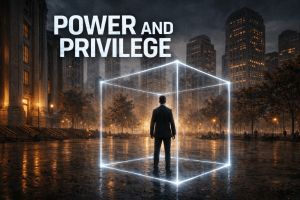
Power & Privilege
For readers drawn to wealth, authority, lawful corruption, procedure, and the human cost of protected power.
The Power & Privilege series explores the elegant violence of people who have learned how to harm others without appearing guilty.
Enter the Power & Privilege Series
Captured Reality vs. Ordinary Psychological Thriller
An ordinary psychological thriller may ask:
Who is lying?
A Captured Reality Psychological Thriller asks:
Who benefits when the lie becomes normal?
An ordinary psychological thriller may ask:
What happened?
A Captured Reality Psychological Thriller asks:
Why was the truth made so difficult to prove?
An ordinary psychological thriller may ask:
Can the hero survive the villain?
A Captured Reality Psychological Thriller asks:
Can the human being survive the reality the villain controls?
That is the difference.
The danger is not only personal.
It is structural.
It is cultural.
It is intimate and enormous at the same time.
For Readers Who Want More Than the Usual Twist
If you are tired of psychological thrillers that feel new but read the same, Captured Reality Psychological Thrillers offer a different kind of pressure.
The story may move quietly.
The danger may arrive politely.
The clue may be emotional before it is factual.
The villain may never announce himself.
The institution may appear reasonable until you see who it protects.
The ending may not rescue you from the moral problem.
That is intentional.
These books are not designed to explain themselves on first contact. They are designed to be read slowly, interpreted actively, and reconsidered after the final page.
They assume the reader notices what others miss.
They assume the reader can feel pressure before the plot names it.
They assume the reader understands that meaning is not always handed over cleanly.
Sometimes it has to be extracted.
Start Reading Captured Reality Psychological Thrillers
The best way into Mark Bertrand’s work is through the novels.
Start with the series that matches the pressure you want first:
Nirvanaing for consciousness, surveillance, identity, and machine pressure.
Married Stupid for crime, loyalty, manipulation, and psychological damage.
Power & Privilege for wealth, authority, procedure, and lawful corruption.
Start Here: Mark Bertrand’s Novels

For deeper reading, enter the Dossier.
Final Definition
A Captured Reality Psychological Thriller is a psychological thriller where the mind is under pressure because the world around it has been manipulated by power.
It is not only about madness.
It is about control.
It is not only about secrets.
It is about who gets to define the truth.
It is not only about survival.
It is about what survival costs when reality itself has been captured.