
How institutions normalize human damage is one of the defining fears of the modern thriller. The old thriller often began with a corpse, a weapon, a break-in, a missing person, a secret file, or a criminal conspiracy operating outside the public order. The modern thriller begins somewhere colder. A denial letter. A committee decision. A reclassification. A risk score. A quiet legal opinion. A polite email from someone who will never meet the person they just ruined.
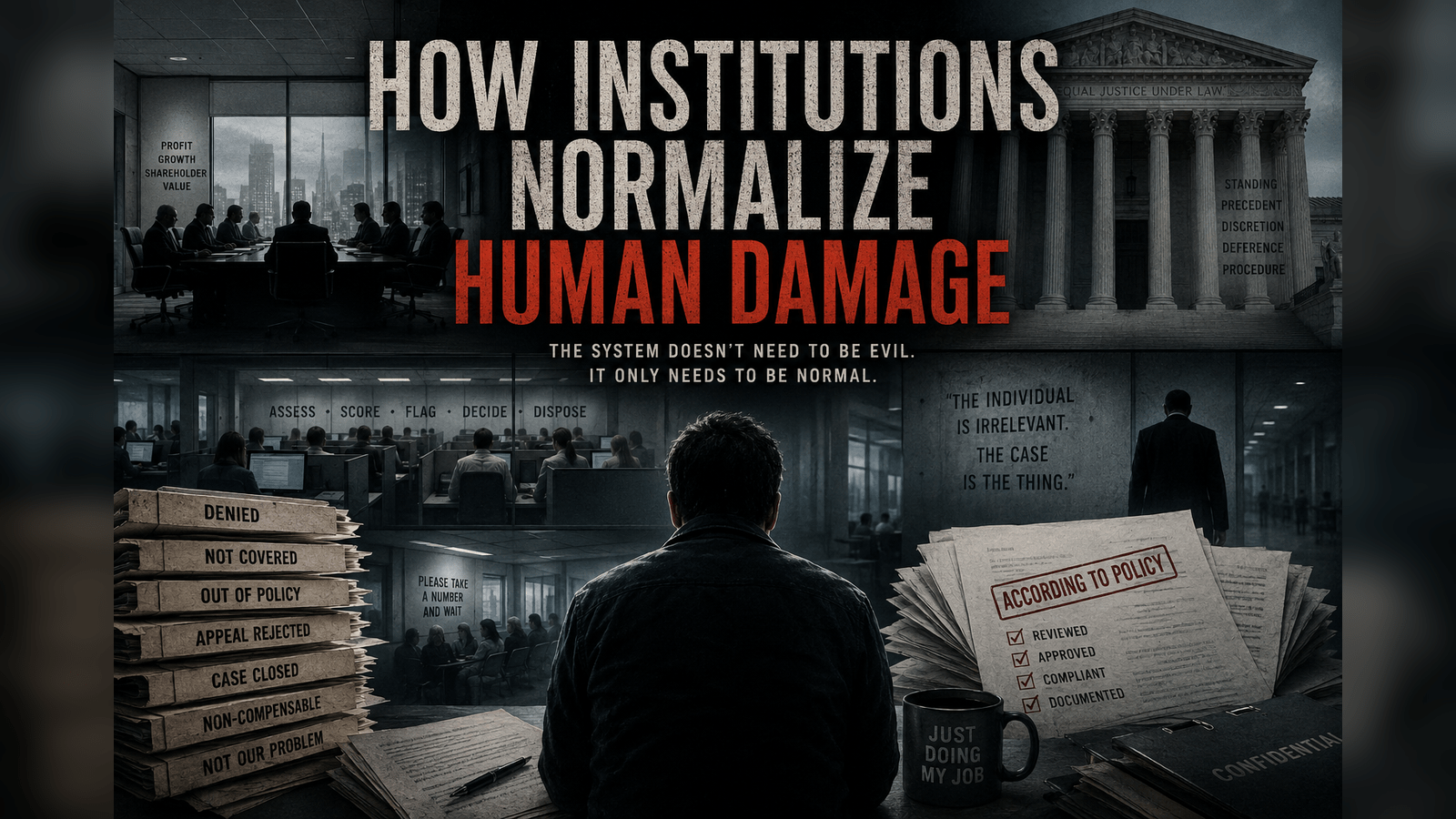
How Institutions Normalize Human Damage
That is where the fear lives now. Not in the alley. Not in the basement. Not in the abandoned house at the edge of town. The fear sits in a clean room with good lighting and approved language. It wears a badge, a lanyard, a suit, a compliance title, a judicial robe, a board credential, or a helpful customer-service smile. It does not shout. It does not confess. It does not need to hide the body because the body has been converted into a file, and the file says everything was handled correctly.
The modern thriller understands something the old thriller only approached from a distance: the most terrifying villain is not always the one who breaks the rule. Sometimes the most terrifying villain is the institution that teaches everyone to obey the rule after the rule has already been bent toward cruelty.
The Institution Does Not Begin by Killing You
The institution rarely begins with open violence. Open violence is messy. It creates witnesses. It generates moral clarity. People know what to do with a fist, a gun, a theft, a scream. They know where the injury begins. They know whom to blame.
Institutional harm is more sophisticated because it arrives disguised as necessity. It does not say, we are going to destroy your life. It says your file requires review. It says your request is outside the current policy window. It says the decision was made according to applicable standards. It says the matter has been escalated, deferred, reclassified, closed, denied, or resolved. The language is clean because the damage is not supposed to look like damage.
That is the first act of normalization. The institution does not attack the person directly. It changes the category the person belongs to. A worker becomes a cost center. A patient becomes a utilization problem. A family becomes a foreclosure unit. A citizen becomes a compliance risk. A witness becomes a credibility issue. A victim becomes an administrative burden. Once the person is renamed, the harm can proceed without anyone in the building feeling like a villain.
That is why this kind of thriller feels so much closer to contemporary life. A knife in the dark is still frightening, but a knife is at least honest about what it is. A system that ruins a person while calling the result policy is more frightening because it demands that the ruined person participate in the fiction. The victim must appeal through the same structure that injured them. They must speak in the institution’s language. They must produce evidence the institution recognizes. They must wait while the damage continues. They must remain calm so they do not become a behavioral concern.
The thriller has moved from the crime scene to the intake form because modern power learned how to make harm look procedural.
The New Villain Is Not Hiding
The great trick of institutional villainy is that it does not need secrecy in the old sense. The old conspiracy hid in locked rooms and coded messages. The new conspiracy hides in plain language. It publishes policies. It files reports. It maintains a website. It creates grievance procedures. It holds hearings. It commissions studies. It may even appoint an oversight panel, which is one of the most elegant ways power has found to delay moral action while appearing serious.
Modern thrillers work because readers already know this feeling. They know what it is to encounter an entity too large to be embarrassed. They know what it is to be answered by a system that does not care whether the answer is true, only whether it is defensible. They know the special humiliation of being harmed by something that insists it has no hands.
That is the horror. The institution does not need to deny the event happened. It only needs to deny that the event means what the victim says it means. The eviction was lawful. The firing was performance-based. The denial was data-supported. The settlement was voluntary. The death was unfortunate. The error was regrettable. The injury was non-compensable. The suffering was outside scope.
Every word moves the harm farther away from the human being who suffered it. Every word makes the institution cleaner. Every word turns moral injury into operational language.
This is where modern thrillers find their pressure. The protagonist is not merely trying to prove what happened. He is trying to keep the event morally alive after the institution has already begun embalming it in procedure.
Normalization Is a Machine for Killing Outrage
How Institutions Normalize Human Damage includes outrage, which is dangerous to institutions because outrage points back to the human being. It says this should not have happened. It says a line was crossed. It says decency was violated before anyone had time to ask whether the violation was technically allowed.
Normalization kills outrage by slowing it down. It forces the injured person into sequence: intake, review, response, appeal, reconsideration, outside counsel, procedural bar, settlement offer, confidentiality clause. By the time the process ends, the moral emergency has been drained of heat. The person has aged inside the machinery. The institution has not won because it proved innocence. It has won because the victim had to spend too much life proving that injury still mattered.
This is why procedural delay belongs in the modern thriller. Delay is not neutral. Delay can be a weapon, especially when one side has money, lawyers, staff, time, and insulation, while the other side has rent due, medical bills due, a family breaking under pressure, or a reputation being quietly poisoned. Delay lets power sit comfortably while the human being bleeds in installments.
The institution’s genius is not that it convinces everyone the harm is good. It only has to convince enough people that the harm is normal. Once harm becomes normal, no one has to approve of it. They simply have to continue working around it.
That is how a room full of decent people can participate in something indecent. No one person has to wake up and decide to become cruel. They just have to perform their role. The analyst runs the model. The manager signs the form. The attorney narrows the language. The executive accepts the recommendation. The judge defers to procedure. The press summarizes the official statement. The public gets tired. The damaged person becomes difficult, unstable, bitter, litigious, or obsessed.
Then the institution has completed the second injury. It has transformed the victim’s refusal to disappear into evidence against them.
The Cleanest Systems Produce the Dirtiest Outcomes
There is a special kind of terror in systems that look clean from the outside. Modern thrillers understand that surfaces matter. The glass headquarters. The polished hearing room. The quiet court corridor. The online portal. The carefully designed dashboard. The corporate mission statement. The letterhead. The black robe. The sealed file.
These surfaces reassure the public that order exists. They create aesthetic legitimacy. They tell everyone watching that the people in charge are competent, serious, and restrained. Against that backdrop, the injured person often looks like the disorder. He is emotional. He interrupts. He refuses to accept the answer. He keeps bringing up the dead wife, the ruined business, the foreclosed house, the erased account, the stolen future, the thing the system has already renamed and filed away.
This reversal is one of the darkest engines in modern fiction. The institution causes disorder, then prosecutes the human being for displaying it.
The reader feels the trap because the reader knows how appearance works. A furious person in a lobby looks like a problem. A calm official behind a desk looks like authority. The modern thriller turns that visual grammar inside out. It asks: what if the angry man is the only sane person in the room? What if the polite official is the instrument of violence? What if the neatness is not proof of innocence, but proof that the harm has been practiced long enough to become elegant?
That is why institutional thrillers do not need constant explosions. Their explosions are moral. The blast happens when the reader realizes the system will not break character. It will not admit what it is. It will continue to speak calmly while the person in front of it disappears.
The Language of Normalized Harm
Every institution that normalizes human damage develops a vocabulary. The vocabulary is never accidental. It exists to protect the people doing harm from the emotional meaning of the harm itself.
People are not fired. Positions are eliminated. Families are not made homeless. Assets are recovered. Patients are not denied care. Coverage is limited under plan terms. Workers are not underpaid. Compensation is aligned with market conditions. Communities are not poisoned. Environmental impact remains within acceptable thresholds. The poor are not abandoned. Services are optimized. The vulnerable are not targeted. Risk exposure is reduced.
The modern thriller hears the violence inside the euphemism.
That matters because language is often the first cover-up. Before anyone destroys evidence, intimidates a witness, buries a report, or calls a senator, someone changes the words. Misconduct becomes error. Theft becomes adjustment. Bribery becomes access. Cruelty becomes efficiency. Cowardice becomes legal strategy. Death becomes outcome.
Once the words are changed, the moral field changes. People respond differently to “denied life-saving treatment” than they do to “coverage limitation.” They respond differently to “wage theft” than they do to “payroll discrepancy.” They respond differently to “bought judge” than they do to “ideological judicial pipeline.” The thing itself may remain ugly, but the official name puts gloves on it.
This is one of the reasons modern thrillers have become more psychologically interesting. The central fight is not only for survival. It is for naming rights. Whoever controls the name controls the room. Whoever controls the room controls the record. Whoever controls the record controls what reality will be allowed to become.
Why Modern Protagonists Feel More Trapped
The classic thriller protagonist could run, chase, fight, decode, shoot, escape, expose. Those tools still exist, but the modern protagonist often faces a more humiliating problem: the enemy does not need to chase him because the world has already accepted the enemy’s version of events.
He cannot simply prove that something happened. He has to prove that the thing was wrong in a culture trained to confuse legality with morality. He has to prove that procedure can be corrupt even when followed. He has to prove that a signed document can be coercive. He has to prove that consent can be manufactured. He has to prove that an algorithm can carry the bias of the men who funded, designed, trained, deployed, and protected it. He has to prove that respectable people can be dangerous precisely because respectability gives them cover.
That is a more adult fear than the old fear of being hunted by a man in the shadows. It is the fear of being hunted by a conclusion already written before the meeting begins.
This is the pressure that gives modern thrillers their suffocating quality. The protagonist keeps finding rooms where the outcome is hidden inside the process. He walks into the bank, the court, the hospital, the company office, the school board, the municipal hearing, the insurance review, the arbitration, the deposition, the HR meeting, or the platform appeal, and he senses the same thing every time: the decision has already been morally laundered.
The reader stays with him because the reader recognizes the shape of that trap. Not the exact facts, necessarily. The shape. The sensation of speaking to a wall that has been trained to answer.
The Institution Teaches Its People Not to Feel
Institutions normalize harm by distributing responsibility so widely that no individual feels the full weight of the outcome. This is not a flaw in the machinery. It is one of the machinery’s central protections.
The person who designs the policy does not meet the victim. The person who applies the policy did not design it. The person who enforces the decision did not apply it. The person who defends the decision did not enforce it. The person who benefits from the decision can say he relied on professionals. Everyone touches a small clean piece of the harm. No one holds the whole bloody object.
That fragmentation is dramatic gold because it creates a villain with no single face and many faces at once. A thriller can give us a CEO, judge, attorney, analyst, lobbyist, banker, board member, consultant, investigator, or public official. But the deepest antagonist is the structure that allows each of them to say: I was only doing my part.
This is how ordinary people become useful to indecent outcomes. Not because they are monsters, but because the institution rewards emotional distance. The employee who asks too many human questions becomes inefficient. The lawyer who sees the person too clearly becomes a liability. The judge who treats the result as morally obscene instead of procedurally narrow becomes unpredictable. The manager who hesitates becomes soft. The executive who admits harm creates exposure.
So everyone learns the same lesson. Do not see too much. Do not say too much. Do not feel too much. Do not name the thing in language that might make the room responsible.
A modern thriller becomes powerful when it forces one character to feel what the institution has trained everyone else not to feel.
The Corporate Body Has No Conscience
The corporation is one of the great thriller inventions of modern life, even when the book is not officially about business. It is a legal body without a human body. It can act, own, sue, lobby, donate, acquire, destroy, delay, intimidate, settle, and outlive the people it damages. It can express values without possessing virtues. It can apologize without shame. It can promise reform without memory.
This does not mean every corporate story is a cartoon about greed. The better modern thriller understands that corporate harm often works through respectable incentives. Profit is protected. Liability is managed. Growth is pursued. Risk is transferred. Costs are externalized. Careers are advanced. Bad outcomes are contained. Nobody has to cackle in a boardroom. The boardroom is frightening because no one cackles. The numbers are enough.
That is why the billionaire, the executive, the fund manager, the developer, the platform owner, the insurer, and the private-equity ghoul have become stronger thriller figures than the old masked killer. The masked killer is limited by appetite. Corporate power is limited only by what it can normalize.
The old monster had to hide the basement. The new monster buys the building, changes the zoning, hires counsel, sponsors the conference, funds the study, influences the law, and calls the result development.
That is not merely a plot device. It is the architecture of modern dread.
The Power & Privilege Series Belongs Here
Power and PrivilegeThis is why the Power & Privilege series fits so naturally inside the modern thriller conversation. These are not stories about isolated bad men doing isolated bad things in private rooms. They belong to a darker understanding of power: wealth does not merely corrupt individuals; it builds environments where corruption becomes ordinary, defensible, and difficult to prosecute morally.
Read that way, Power & Privilege is not just a series label. It is a diagnosis. It points toward a world where authority protects itself, language is used as cover, and the people most harmed by the system are told to respect the process that harmed them. The thrill does not come from asking whether someone will be caught with blood on his hands. The thrill comes from watching how clean those hands can remain while everyone else pays the cost.
That is where modern fiction earns its violence. Not by making everything louder, but by making everything more recognizable. A privileged person does not need to swing the hammer if he owns the room where the hammer is classified as a necessary tool. He does not need to threaten the witness if the witness can be priced out, discredited, exhausted, or buried. He does not need to break the law if the law has already been arranged to receive him gently.
That is what makes Power & Privilege dangerous as fiction. It understands that modern villains often do not stand outside respectable society. They are respectable society’s favorite sons.
Read the Power & Privilege series
Married Stupid and the Human Cost of Being Trapped
The Married Stupid series belongs to the same territory from a more intimate angle. Where Power & Privilege points toward class, authority, and systemic protection, Married Stupid turns the pressure inward, toward relationships, crime, consequence, and the private wreckage created when people are trapped by bad structures and worse choices.
That matters because institutional harm is never abstract to the people living under it. It enters marriages. It enters kitchens. It enters bank accounts, bedrooms, custody fights, debts, resentments, humiliations, and desperate calculations. The modern thriller works best when the large system and the private life are not separated. The public machine presses on the private nerve.
A person does not become desperate in theory. He becomes desperate because the money is gone, the house is at risk, the marriage is cracking, the lie has matured, the law is circling, the job has vanished, or the future has been narrowed to one terrible choice. Systems create pressure. People act under pressure. Then the same systems that created the pressure punish the action as if it emerged from nowhere.
That is another way institutions normalize human damage. They erase the conditions that produced the behavior. They isolate the act from the world that cornered the person. They ask what he did, but not what was done to him. They ask whether he broke the rule, but not who wrote the rule, who benefited from the rule, and who had the luxury of obeying it.
The best crime thrillers understand this. Crime is not always a departure from society. Sometimes crime is society’s pressure finally finding a human exit wound.
Read the Married Stupid series
Why This Fear Belongs to the Modern Thriller
The modern thriller is not darker because writers became more cynical. It is darker because the world taught readers to recognize more sophisticated forms of danger.
Readers no longer need a villain to say the evil part out loud. They have learned to distrust the clean version. They know a policy can be savage. They know a form can be a weapon. They know a delay can destroy. They know a settlement can silence truth. They know a judge can protect power while sounding neutral. They know a corporation can apologize in public while attacking in private. They know a system can produce ruin and then deny intent because intent has been divided across departments.
That awareness changes the genre. It changes the rhythm of suspense. The question is no longer only: who did it? The question is: how did everyone agree not to call it what it was?
That is a more unnerving mystery because the answer may not be hidden in a secret room. It may be written across budgets, incentives, memos, contracts, precedents, arbitration clauses, risk models, campaign donations, zoning boards, procurement rules, executive discretion, platform moderation, legal settlements, and institutional habits. The evidence is everywhere. The problem is that the world has been trained not to read it as evidence.
This is why the modern thriller often feels less like escape and more like recognition. It gives readers the satisfaction of seeing the machinery named. It says, you were not imagining the coldness. You were not wrong to feel that the polite answer contained violence. You were not paranoid for noticing that the official explanation made the injured person disappear.
That recognition is powerful because normalized harm depends on isolation. It wants each person to believe his injury is private, exceptional, unfortunate, and probably his fault. The thriller breaks that isolation by revealing the pattern.
The Hero’s Real Job Is Moral Recognition
In this kind of story, the hero’s job is not merely to survive. Survival is not enough. Escape is not enough. Even exposure is not always enough, because modern institutions are very good at absorbing exposure. They can survive scandal if scandal does not alter power.
The hero’s deeper job is moral recognition. He must see the harm clearly before the institution finishes renaming it. He must refuse the false terms. He must insist that the human cost remains central. He must drag the buried meaning back into the room.
That is why modern thriller protagonists are often obsessive. Their obsession is not a character flaw in the ordinary sense. It is the only sane response to a world that wants to move on before justice has even been named. The institution calls them unstable because stability, in that room, means accepting the lie.
A clean old-fashioned hero might not survive this world. The modern hero has to be more damaged, more suspicious, more intellectually dangerous. He has to understand language, leverage, evidence, shame, money, process, and timing. He has to know that the truth does not win because it is true. It wins only if someone forces it into a form power cannot quietly bury.
This is why the modern thriller protagonist is often less like a knight and more like an infection in the system. He gets inside the paperwork. He contaminates the narrative. He connects the files. He makes the official story unstable. He forces the institution to reveal the violence hidden inside its calm.
The Most Frightening Sentence in the Modern Thriller
The most frightening sentence in the modern thriller may be: everything was done according to policy.
That sentence should chill the room. It does not clear the institution. It indicts the institution. It means the harm was not an accident. It means the harm was anticipated, structured, permitted, and repeatable. It means the next person will be damaged the same way unless the rule itself is put on trial.
This is where modern thrillers become morally serious. They stop treating legality as the end of the argument. They understand that “legal” is often where the real horror begins. Legal for whom? Written by whom? Interpreted by whom? Funded by whom? Enforced against whom? Protected from whom?
The institution always wants the story to end at legality because legality is where power feels safest. The modern thriller refuses that ending. It keeps asking the question power hates most: not whether the system allowed it, but what kind of system would allow it in the first place.
That is the tradition this series belongs to. It is not about making thrillers more political in some shallow, topical sense. It is about making them more honest about where modern fear lives. Fear lives inside the rule that no one questions. Fear lives inside the process that everyone respects. Fear lives inside the room where harm becomes normal because the people with authority have agreed to call it something else.
The Final Shape of the Modern Thriller
A modern thriller does not need to abandon murder, betrayal, pursuit, conspiracy, or violence. It can still use all of those things. But beneath them, the deeper engine has changed. The genre is no longer satisfied with asking who committed the crime. It wants to know who built the conditions that made the crime profitable, deniable, repeatable, and legal.
That is why institutions have become such powerful antagonists. They do not merely threaten the body. They threaten meaning. They tell the injured person that his injury is not what he thinks it is. They tell the witness that her memory lacks standing. They tell the family that their grief is unfortunate but irrelevant. They tell the public that nothing improper occurred. They tell the record to close.
The modern thriller forces the record back open.
It says the damage happened. It says the language was part of the damage. It says the delay was part of the damage. It says the policy was part of the damage. It says the respectable people were not bystanders if their respectability helped the machine keep moving.
That is why this fear will keep driving the genre. Because readers know the monster no longer has to look monstrous. The monster can be an office, a process, a memo, a portal, a board, a court, a bank, a fund, a hospital, a platform, a legislature, a committee, a model, a signature, a silence.
The institution normalizes human damage by making the cruelty routine. The modern thriller makes it visible again.


0 comments
Write a comment