
Tag: systems-anxiety

Captured Reality Thriller

How Institutions Normalize Human Damage

How institutions normalize human damage is one of the defining fears of the modern thriller. The old thriller often began with a corpse, a weapon, a break-in, a missing person, a secret file, or a criminal conspiracy operating outside the public order. The modern thriller begins somewhere colder. A denial letter. A committee decision. A reclassification. A risk score. A quiet legal opinion. A polite email from someone who will never meet the person they just ruined.
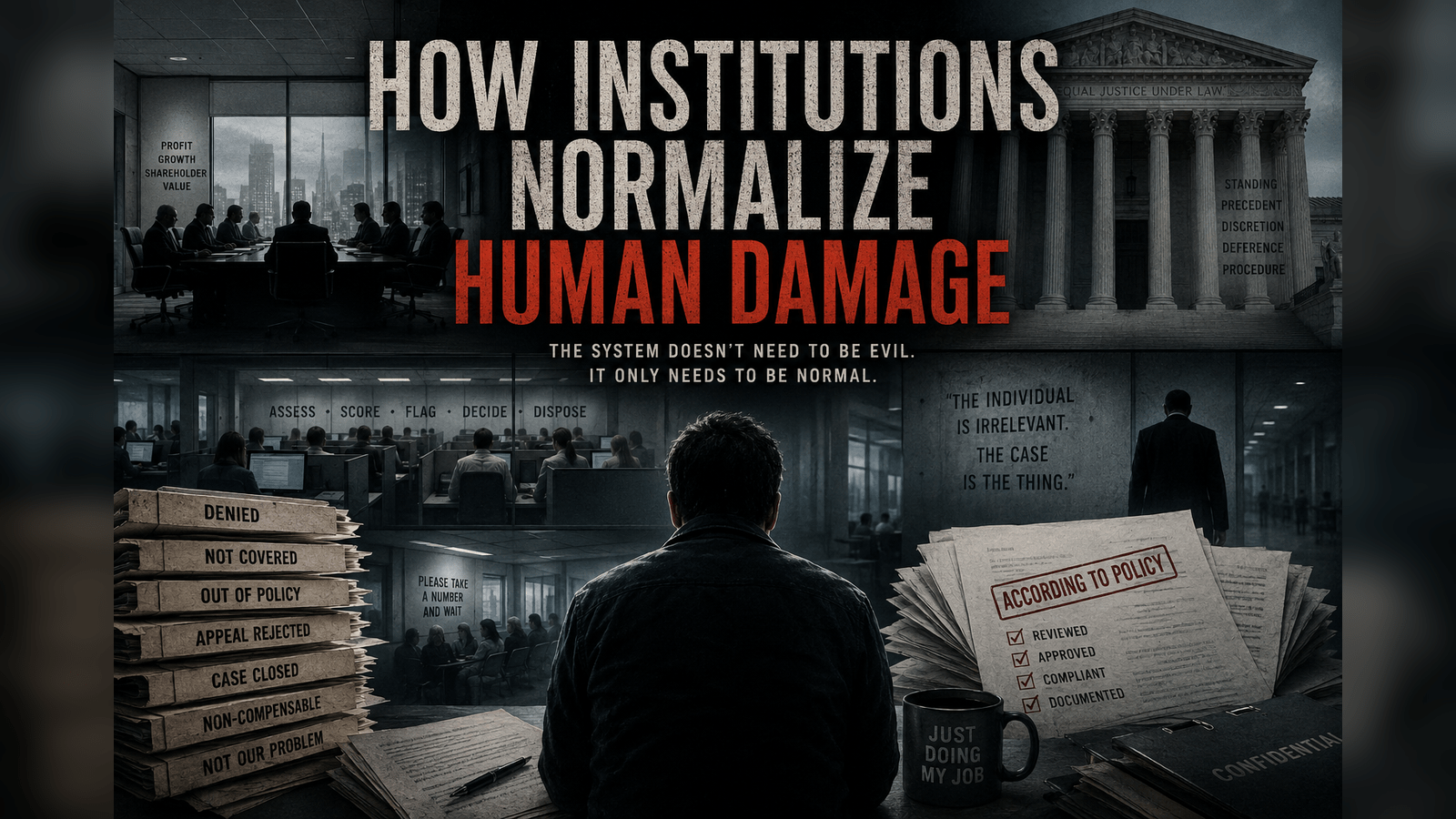
How institutions normalize human damage is one of the defining fears of the modern thriller.

How Institutions Normalize Human Damage

That is where the fear lives now. Not in the alley. Not in the basement. Not in the abandoned house at the edge of town. The fear sits in a clean room with good lighting and approved language. It wears a badge, a lanyard, a suit, a compliance title, a judicial robe, a board credential, or a helpful customer-service smile. It does not shout. It does not confess. It does not need to hide the body because the body has been converted into a file, and the file says everything was handled correctly.

The modern thriller understands something the old thriller only approached from a distance: the most terrifying villain is not always the one who breaks the rule. Sometimes the most terrifying villain is the institution that teaches everyone to obey the rule after the rule has already been bent toward cruelty.

The Institution Does Not Begin by Killing You

The institution rarely begins with open violence. Open violence is messy. It creates witnesses. It generates moral clarity. People know what to do with a fist, a gun, a theft, a scream. They know where the injury begins. They know whom to blame.

Institutional harm is more sophisticated because it arrives disguised as necessity. It does not say, we are going to destroy your life. It says your file requires review. It says your request is outside the current policy window. It says the decision was made according to applicable standards. It says the matter has been escalated, deferred, reclassified, closed, denied, or resolved. The language is clean because the damage is not supposed to look like damage.

That is the first act of normalization. The institution does not attack the person directly. It changes the category the person belongs to. A worker becomes a cost center. A patient becomes a utilization problem. A family becomes a foreclosure unit. A citizen becomes a compliance risk. A witness becomes a credibility issue. A victim becomes an administrative burden. Once the person is renamed, the harm can proceed without anyone in the building feeling like a villain.

That is why this kind of thriller feels so much closer to contemporary life. A knife in the dark is still frightening, but a knife is at least honest about what it is. A system that ruins a person while calling the result policy is more frightening because it demands that the ruined person participate in the fiction. The victim must appeal through the same structure that injured them. They must speak in the institution’s language. They must produce evidence the institution recognizes. They must wait while the damage continues. They must remain calm so they do not become a behavioral concern.

The thriller has moved from the crime scene to the intake form because modern power learned how to make harm look procedural.

The New Villain Is Not Hiding

The great trick of institutional villainy is that it does not need secrecy in the old sense. The old conspiracy hid in locked rooms and coded messages. The new conspiracy hides in plain language. It publishes policies. It files reports. It maintains a website. It creates grievance procedures. It holds hearings. It commissions studies. It may even appoint an oversight panel, which is one of the most elegant ways power has found to delay moral action while appearing serious.

Modern thrillers work because readers already know this feeling. They know what it is to encounter an entity too large to be embarrassed. They know what it is to be answered by a system that does not care whether the answer is true, only whether it is defensible. They know the special humiliation of being harmed by something that insists it has no hands.

That is the horror. The institution does not need to deny the event happened. It only needs to deny that the event means what the victim says it means. The eviction was lawful. The firing was performance-based. The denial was data-supported. The settlement was voluntary. The death was unfortunate. The error was regrettable. The injury was non-compensable. The suffering was outside scope.

Every word moves the harm farther away from the human being who suffered it. Every word makes the institution cleaner. Every word turns moral injury into operational language.

This is where modern thrillers find their pressure. The protagonist is not merely trying to prove what happened. He is trying to keep the event morally alive after the institution has already begun embalming it in procedure.

Normalization Is a Machine for Killing Outrage

How Institutions Normalize Human Damage includes outrage, which is dangerous to institutions because outrage points back to the human being. It says this should not have happened. It says a line was crossed. It says decency was violated before anyone had time to ask whether the violation was technically allowed.

Normalization kills outrage by slowing it down. It forces the injured person into sequence: intake, review, response, appeal, reconsideration, outside counsel, procedural bar, settlement offer, confidentiality clause. By the time the process ends, the moral emergency has been drained of heat. The person has aged inside the machinery. The institution has not won because it proved innocence. It has won because the victim had to spend too much life proving that injury still mattered.

This is why procedural delay belongs in the modern thriller. Delay is not neutral. Delay can be a weapon, especially when one side has money, lawyers, staff, time, and insulation, while the other side has rent due, medical bills due, a family breaking under pressure, or a reputation being quietly poisoned. Delay lets power sit comfortably while the human being bleeds in installments.

The institution’s genius is not that it convinces everyone the harm is good. It only has to convince enough people that the harm is normal. Once harm becomes normal, no one has to approve of it. They simply have to continue working around it.

That is how a room full of decent people can participate in something indecent. No one person has to wake up and decide to become cruel. They just have to perform their role. The analyst runs the model. The manager signs the form. The attorney narrows the language. The executive accepts the recommendation. The judge defers to procedure. The press summarizes the official statement. The public gets tired. The damaged person becomes difficult, unstable, bitter, litigious, or obsessed.

Then the institution has completed the second injury. It has transformed the victim’s refusal to disappear into evidence against them.

The Cleanest Systems Produce the Dirtiest Outcomes

There is a special kind of terror in systems that look clean from the outside. Modern thrillers understand that surfaces matter. The glass headquarters. The polished hearing room. The quiet court corridor. The online portal. The carefully designed dashboard. The corporate mission statement. The letterhead. The black robe. The sealed file.

These surfaces reassure the public that order exists. They create aesthetic legitimacy. They tell everyone watching that the people in charge are competent, serious, and restrained. Against that backdrop, the injured person often looks like the disorder. He is emotional. He interrupts. He refuses to accept the answer. He keeps bringing up the dead wife, the ruined business, the foreclosed house, the erased account, the stolen future, the thing the system has already renamed and filed away.

This reversal is one of the darkest engines in modern fiction. The institution causes disorder, then prosecutes the human being for displaying it.

The reader feels the trap because the reader knows how appearance works. A furious person in a lobby looks like a problem. A calm official behind a desk looks like authority. The modern thriller turns that visual grammar inside out. It asks: what if the angry man is the only sane person in the room? What if the polite official is the instrument of violence? What if the neatness is not proof of innocence, but proof that the harm has been practiced long enough to become elegant?

That is why institutional thrillers do not need constant explosions. Their explosions are moral. The blast happens when the reader realizes the system will not break character. It will not admit what it is. It will continue to speak calmly while the person in front of it disappears.

The Language of Normalized Harm

Every institution that normalizes human damage develops a vocabulary. The vocabulary is never accidental. It exists to protect the people doing harm from the emotional meaning of the harm itself.

People are not fired. Positions are eliminated. Families are not made homeless. Assets are recovered. Patients are not denied care. Coverage is limited under plan terms. Workers are not underpaid. Compensation is aligned with market conditions. Communities are not poisoned. Environmental impact remains within acceptable thresholds. The poor are not abandoned. Services are optimized. The vulnerable are not targeted. Risk exposure is reduced.

The modern thriller hears the violence inside the euphemism.

That matters because language is often the first cover-up. Before anyone destroys evidence, intimidates a witness, buries a report, or calls a senator, someone changes the words. Misconduct becomes error. Theft becomes adjustment. Bribery becomes access. Cruelty becomes efficiency. Cowardice becomes legal strategy. Death becomes outcome.

Once the words are changed, the moral field changes. People respond differently to “denied life-saving treatment” than they do to “coverage limitation.” They respond differently to “wage theft” than they do to “payroll discrepancy.” They respond differently to “bought judge” than they do to “ideological judicial pipeline.” The thing itself may remain ugly, but the official name puts gloves on it.

This is one of the reasons modern thrillers have become more psychologically interesting. The central fight is not only for survival. It is for naming rights. Whoever controls the name controls the room. Whoever controls the room controls the record. Whoever controls the record controls what reality will be allowed to become.

Why Modern Protagonists Feel More Trapped

The classic thriller protagonist could run, chase, fight, decode, shoot, escape, expose. Those tools still exist, but the modern protagonist often faces a more humiliating problem: the enemy does not need to chase him because the world has already accepted the enemy’s version of events.

He cannot simply prove that something happened. He has to prove that the thing was wrong in a culture trained to confuse legality with morality. He has to prove that procedure can be corrupt even when followed. He has to prove that a signed document can be coercive. He has to prove that consent can be manufactured. He has to prove that an algorithm can carry the bias of the men who funded, designed, trained, deployed, and protected it. He has to prove that respectable people can be dangerous precisely because respectability gives them cover.

That is a more adult fear than the old fear of being hunted by a man in the shadows. It is the fear of being hunted by a conclusion already written before the meeting begins.

This is the pressure that gives modern thrillers their suffocating quality. The protagonist keeps finding rooms where the outcome is hidden inside the process. He walks into the bank, the court, the hospital, the company office, the school board, the municipal hearing, the insurance review, the arbitration, the deposition, the HR meeting, or the platform appeal, and he senses the same thing every time: the decision has already been morally laundered.

The reader stays with him because the reader recognizes the shape of that trap. Not the exact facts, necessarily. The shape. The sensation of speaking to a wall that has been trained to answer.

The Institution Teaches Its People Not to Feel

Institutions normalize harm by distributing responsibility so widely that no individual feels the full weight of the outcome. This is not a flaw in the machinery. It is one of the machinery’s central protections.

The person who designs the policy does not meet the victim. The person who applies the policy did not design it. The person who enforces the decision did not apply it. The person who defends the decision did not enforce it. The person who benefits from the decision can say he relied on professionals. Everyone touches a small clean piece of the harm. No one holds the whole bloody object.

That fragmentation is dramatic gold because it creates a villain with no single face and many faces at once. A thriller can give us a CEO, judge, attorney, analyst, lobbyist, banker, board member, consultant, investigator, or public official. But the deepest antagonist is the structure that allows each of them to say: I was only doing my part.

This is how ordinary people become useful to indecent outcomes. Not because they are monsters, but because the institution rewards emotional distance. The employee who asks too many human questions becomes inefficient. The lawyer who sees the person too clearly becomes a liability. The judge who treats the result as morally obscene instead of procedurally narrow becomes unpredictable. The manager who hesitates becomes soft. The executive who admits harm creates exposure.

So everyone learns the same lesson. Do not see too much. Do not say too much. Do not feel too much. Do not name the thing in language that might make the room responsible.

A modern thriller becomes powerful when it forces one character to feel what the institution has trained everyone else not to feel.

The Corporate Body Has No Conscience

The corporation is one of the great thriller inventions of modern life, even when the book is not officially about business. It is a legal body without a human body. It can act, own, sue, lobby, donate, acquire, destroy, delay, intimidate, settle, and outlive the people it damages. It can express values without possessing virtues. It can apologize without shame. It can promise reform without memory.

This does not mean every corporate story is a cartoon about greed. The better modern thriller understands that corporate harm often works through respectable incentives. Profit is protected. Liability is managed. Growth is pursued. Risk is transferred. Costs are externalized. Careers are advanced. Bad outcomes are contained. Nobody has to cackle in a boardroom. The boardroom is frightening because no one cackles. The numbers are enough.

That is why the billionaire, the executive, the fund manager, the developer, the platform owner, the insurer, and the private-equity ghoul have become stronger thriller figures than the old masked killer. The masked killer is limited by appetite. Corporate power is limited only by what it can normalize.

The old monster had to hide the basement. The new monster buys the building, changes the zoning, hires counsel, sponsors the conference, funds the study, influences the law, and calls the result development.

That is not merely a plot device. It is the architecture of modern dread.

The Power & Privilege Series Belongs Here

Power and PrivilegeThis is why the Power & Privilege series fits so naturally inside the modern thriller conversation. These are not stories about isolated bad men doing isolated bad things in private rooms. They belong to a darker understanding of power: wealth does not merely corrupt individuals; it builds environments where corruption becomes ordinary, defensible, and difficult to prosecute morally.

Read that way, Power & Privilege is not just a series label. It is a diagnosis. It points toward a world where authority protects itself, language is used as cover, and the people most harmed by the system are told to respect the process that harmed them. The thrill does not come from asking whether someone will be caught with blood on his hands. The thrill comes from watching how clean those hands can remain while everyone else pays the cost.

That is where modern fiction earns its violence. Not by making everything louder, but by making everything more recognizable. A privileged person does not need to swing the hammer if he owns the room where the hammer is classified as a necessary tool. He does not need to threaten the witness if the witness can be priced out, discredited, exhausted, or buried. He does not need to break the law if the law has already been arranged to receive him gently.

That is what makes Power & Privilege dangerous as fiction. It understands that modern villains often do not stand outside respectable society. They are respectable society’s favorite sons.

Read the Power & Privilege series

Married Stupid and the Human Cost of Being Trapped

The Married Stupid series belongs to the same territory from a more intimate angle. Where Power & Privilege points toward class, authority, and systemic protection, Married Stupid turns the pressure inward, toward relationships, crime, consequence, and the private wreckage created when people are trapped by bad structures and worse choices.

That matters because institutional harm is never abstract to the people living under it. It enters marriages. It enters kitchens. It enters bank accounts, bedrooms, custody fights, debts, resentments, humiliations, and desperate calculations. The modern thriller works best when the large system and the private life are not separated. The public machine presses on the private nerve.

A person does not become desperate in theory. He becomes desperate because the money is gone, the house is at risk, the marriage is cracking, the lie has matured, the law is circling, the job has vanished, or the future has been narrowed to one terrible choice. Systems create pressure. People act under pressure. Then the same systems that created the pressure punish the action as if it emerged from nowhere.

That is another way institutions normalize human damage. They erase the conditions that produced the behavior. They isolate the act from the world that cornered the person. They ask what he did, but not what was done to him. They ask whether he broke the rule, but not who wrote the rule, who benefited from the rule, and who had the luxury of obeying it.

The best crime thrillers understand this. Crime is not always a departure from society. Sometimes crime is society’s pressure finally finding a human exit wound.

Read the Married Stupid series

Why This Fear Belongs to the Modern Thriller

The modern thriller is not darker because writers became more cynical. It is darker because the world taught readers to recognize more sophisticated forms of danger.

Readers no longer need a villain to say the evil part out loud. They have learned to distrust the clean version. They know a policy can be savage. They know a form can be a weapon. They know a delay can destroy. They know a settlement can silence truth. They know a judge can protect power while sounding neutral. They know a corporation can apologize in public while attacking in private. They know a system can produce ruin and then deny intent because intent has been divided across departments.

That awareness changes the genre. It changes the rhythm of suspense. The question is no longer only: who did it? The question is: how did everyone agree not to call it what it was?

That is a more unnerving mystery because the answer may not be hidden in a secret room. It may be written across budgets, incentives, memos, contracts, precedents, arbitration clauses, risk models, campaign donations, zoning boards, procurement rules, executive discretion, platform moderation, legal settlements, and institutional habits. The evidence is everywhere. The problem is that the world has been trained not to read it as evidence.

This is why the modern thriller often feels less like escape and more like recognition. It gives readers the satisfaction of seeing the machinery named. It says, you were not imagining the coldness. You were not wrong to feel that the polite answer contained violence. You were not paranoid for noticing that the official explanation made the injured person disappear.

That recognition is powerful because normalized harm depends on isolation. It wants each person to believe his injury is private, exceptional, unfortunate, and probably his fault. The thriller breaks that isolation by revealing the pattern.

The Hero’s Real Job Is Moral Recognition

In this kind of story, the hero’s job is not merely to survive. Survival is not enough. Escape is not enough. Even exposure is not always enough, because modern institutions are very good at absorbing exposure. They can survive scandal if scandal does not alter power.

The hero’s deeper job is moral recognition. He must see the harm clearly before the institution finishes renaming it. He must refuse the false terms. He must insist that the human cost remains central. He must drag the buried meaning back into the room.

That is why modern thriller protagonists are often obsessive. Their obsession is not a character flaw in the ordinary sense. It is the only sane response to a world that wants to move on before justice has even been named. The institution calls them unstable because stability, in that room, means accepting the lie.

A clean old-fashioned hero might not survive this world. The modern hero has to be more damaged, more suspicious, more intellectually dangerous. He has to understand language, leverage, evidence, shame, money, process, and timing. He has to know that the truth does not win because it is true. It wins only if someone forces it into a form power cannot quietly bury.

This is why the modern thriller protagonist is often less like a knight and more like an infection in the system. He gets inside the paperwork. He contaminates the narrative. He connects the files. He makes the official story unstable. He forces the institution to reveal the violence hidden inside its calm.

The Most Frightening Sentence in the Modern Thriller

The most frightening sentence in the modern thriller may be: everything was done according to policy.

That sentence should chill the room. It does not clear the institution. It indicts the institution. It means the harm was not an accident. It means the harm was anticipated, structured, permitted, and repeatable. It means the next person will be damaged the same way unless the rule itself is put on trial.

This is where modern thrillers become morally serious. They stop treating legality as the end of the argument. They understand that “legal” is often where the real horror begins. Legal for whom? Written by whom? Interpreted by whom? Funded by whom? Enforced against whom? Protected from whom?

The institution always wants the story to end at legality because legality is where power feels safest. The modern thriller refuses that ending. It keeps asking the question power hates most: not whether the system allowed it, but what kind of system would allow it in the first place.

That is the tradition this series belongs to. It is not about making thrillers more political in some shallow, topical sense. It is about making them more honest about where modern fear lives. Fear lives inside the rule that no one questions. Fear lives inside the process that everyone respects. Fear lives inside the room where harm becomes normal because the people with authority have agreed to call it something else.

The Final Shape of the Modern Thriller

A modern thriller does not need to abandon murder, betrayal, pursuit, conspiracy, or violence. It can still use all of those things. But beneath them, the deeper engine has changed. The genre is no longer satisfied with asking who committed the crime. It wants to know who built the conditions that made the crime profitable, deniable, repeatable, and legal.

That is why institutions have become such powerful antagonists. They do not merely threaten the body. They threaten meaning. They tell the injured person that his injury is not what he thinks it is. They tell the witness that her memory lacks standing. They tell the family that their grief is unfortunate but irrelevant. They tell the public that nothing improper occurred. They tell the record to close.

The modern thriller forces the record back open.

It says the damage happened. It says the language was part of the damage. It says the delay was part of the damage. It says the policy was part of the damage. It says the respectable people were not bystanders if their respectability helped the machine keep moving.

That is why this fear will keep driving the genre. Because readers know the monster no longer has to look monstrous. The monster can be an office, a process, a memo, a portal, a board, a court, a bank, a fund, a hospital, a platform, a legislature, a committee, a model, a signature, a silence.

The institution normalizes human damage by making the cruelty routine. The modern thriller makes it visible again.
Connected evidence

Continue the Investigation

The investigation does not end at the bottom of the page.
The Readers Court

The Receipt on the Kitchen Table

Exhibit A: Case special edition #1 | — The Receipt on the Kitchen Table

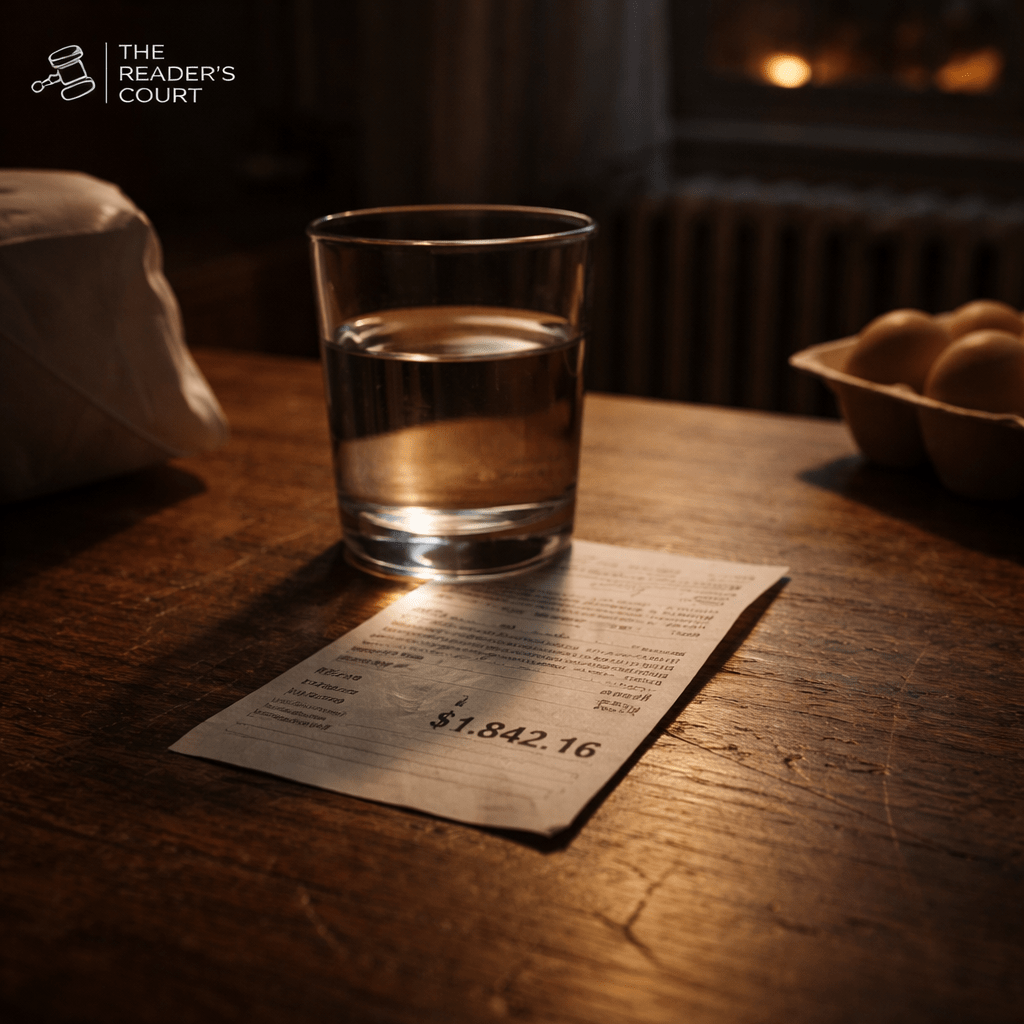
The receipt on the kitchen table lay beneath a glass of water as if it might otherwise blow away. David Mercer had placed it there an hour earlier when he came home from the pharmacy, and since then he had looked at it often enough that the number no longer felt like a price. It felt like a verdict.

Exhibit A: Case #003 |  — The Receipt on the Kitchen Table

The paper was thin and glossy, curled at one corner where the cashier must have torn it too quickly from the register spool. Across the top was the pharmacy logo. Beneath that, the date. Beneath that, the itemized list of things a twelve-year-old boy needed to stay alive for thirty more days.

This Substack is reader-supported. To receive new posts and support my work, consider becoming a free or paid subscriber.

Three insulin pens. Testing supplies. Alcohol swabs.

At the bottom, in dark, indifferent ink:

$1,842.16

David sat at the table in his work shirt with the collar open and the sleeves still rolled halfway up his forearms. He had come straight from the machine shop without changing, carrying the pharmacy bag in one hand and a carton of eggs in the other, because life had a way of requiring groceries and catastrophe in the same trip.

The apartment was warm in the tired way old buildings got warm in February. The radiator beneath the kitchen window gave off a metallic heat that smelled faintly of dust and old paint. On the sill above it sat a wilted basil plant Eli kept insisting could be saved. Outside, a crust of dirty snow clung to the curb and the parking lot reflected the orange streetlights in flat streaks across the ice.

Across from him, Eli Mercer leaned over a spiral notebook, chewing lightly on the side of his pencil while he worked through a page of fractions. His dark hair had grown a little too long over the ears again. David had noticed it that morning while Eli was tying his shoes for school and made a mental note to take him for a haircut on Saturday if there was enough left after rent.

A small continuous glucose monitor was clipped to the waistband of Eli’s sweatpants. Every few minutes it pulsed a soft green light, quiet as a watchful eye.

“Dad,” Eli said, not looking up from the notebook, “is seven-eighths bigger than three-quarters?”

David stared at the receipt another moment before lifting his head.

“Yeah. A little.”

“How little?”

David took a breath, grateful for the question because it involved a kind of arithmetic that still behaved honestly.

“Think of it this way. Three-quarters is six-eighths. So seven-eighths is bigger by one-eighth.”

Eli nodded, satisfied, and wrote something down in his notebook with great seriousness.

Twelve years old, David thought. Still young enough to ask math questions across a kitchen table. Old enough to know the names of his insulin brands, what foods hit his blood sugar too hard, and how to read the expression on his father’s face when money had gone bad.

The pharmacy bag sat on the counter near the sink. Inside were the insulin pens in their white cartons, cold packs already softening around them. David had meant to put everything away immediately, but the receipt had stopped him. He’d set the glass of water on top of it and stood there for a while with one hand on the counter, staring at the number until the room around him seemed to recede.

It was not the first punishing receipt. It was only the newest.

When Eli was eight, he had dropped twelve pounds in a month and started waking three times a night to use the bathroom. David told himself it was a growth spurt until the school nurse called one afternoon and said Eli looked pale and unfocused and could someone please pick him up. Two hours later they were in the emergency room with fluorescent lights over everything and a resident speaking gently but too quickly about blood sugar levels, ketones, and something called diabetic ketoacidosis.

David still remembered the first night in the hospital with a physical clarity that embarrassed him. The hard vinyl chair beside the bed. The stale smell of coffee from the family waiting area. The blue blanket pulled to Eli’s chest. The IV taped to his hand. The doctor explaining that Type 1 diabetes was not caused by anything they did wrong and could not be reversed and would now require insulin every single day.

Eli had listened longer than most children would have. Then he looked up from the bed and asked, “Does this mean I can’t eat birthday cake anymore?”

The doctor smiled before answering.

“You can still have birthday cake.”

Eli had thought about that carefully and nodded, as if terms had been reached.

Since then the years had arranged themselves around numbers. Carbohydrates. Units. Correction factors. Insurance deductibles. Co-pays. Refill dates. David learned to carry granola bars in his coat pocket and juice boxes in the car. He learned the subtle difference in Eli’s face when his blood sugar was low and dropping fast. He learned how quickly a good month could turn into a bad one if the deductible reset or the pharmacy changed suppliers or a letter arrived saying the formulary had been updated and their old insulin was now “non-preferred,” as if a body could be persuaded to change its chemistry by bureaucratic tone.

He also learned that every conversation about insulin prices ended the same way: with someone somewhere describing the situation as unfortunate.

On the refrigerator, held by a magnet shaped like a baseball glove, was a school flyer for the state science museum’s summer astronomy weekend. Eli had seen it three weeks earlier and fallen in love immediately because the flyer showed a boy at a telescope with Saturn hanging in the black sky behind him like something painted there just for him.

“You think we could go?” he had asked.

David said they’d see.

It was what he said whenever the answer depended on numbers he had not yet faced honestly.

Now the flyer lifted slightly in the radiator heat, tapping against the refrigerator door.

Eli put down the pencil and rubbed his eyes.

“You got the insulin?”

“Yeah.”

“All of it?”

“All of it.”

Eli nodded once, and David saw the relief pass through him before the boy looked back down at the notebook. It was not dramatic. That was the part David found hardest. Children adapted to fear with a speed that broke something in you. Eli no longer asked whether they would be able to get the medicine. He only asked if David had gotten it.

The answer itself had become the comfort.

David reached for the receipt and slid it out from under the glass. The paper made a dry whisper against the wood grain of the table. There were nicks and scratches all along that tabletop from the years before Eli was diagnosed, when homework had meant crayons and model airplanes and things a child could outgrow.

Now every surface in the apartment held evidence of management. Lancets in a drawer. Alcohol wipes in a basket by the microwave. Emergency glucose tabs in the bathroom medicine cabinet. Half a dozen sticky notes with numbers written on them and crossed out. Living had become a small private clinic no one got paid to run.

“Dad?”

David looked up.

Eli had turned the notebook around and was pointing at a problem involving equivalent fractions.

“If six-eighths is the same as three-quarters, then why do they write it different?”

David almost answered automatically, but something in the question caught him. He looked at the page. Then at the receipt in his hand.

“Because sometimes,” he said, “people use different numbers for the same thing.”

Eli frowned. “Why?”

David let out a breath through his nose and managed a small smile.

“To make math homework harder.”

Eli accepted that with the weary patience children reserve for adult nonsense and went back to work.

On the television in the living room, the evening news murmured under a pharmaceutical ad. Smiling grandparents walked along a beach while a voice listed side effects in a tone so warm it might have been describing weather. David stood, crossed the room, and turned up the volume with the remote.

A Capitol backdrop appeared on screen behind the anchor.

“…expected tomorrow, the Senate will take up the Affordable Insulin Access Act, legislation that would cap monthly insulin costs for patients nationwide…”

David stood very still.

The bill had moved further than most people expected. For months it had lived in that half-world where major stories go to die politely, discussed on panels, praised in speeches, and delayed in committee rooms where the fluorescent lights never made the news. But over the last several weeks something had shifted. Too many parents had shown up. Too many stories had gotten loose. Too many people had started asking why a century-old drug had become a luxury item.

Two weekends earlier David had taken the bus to Washington with a church group and three other parents from his county. He spent six hours standing in the cold with a paper cup of bad coffee and a photograph of Eli printed at the copy shop down the street. In the photo, Eli was eight years old in a hospital bed, smiling weakly into the camera with the first insulin pump clipped to his gown.

A staffer from one senator’s office had come out to speak with them. She wore a navy coat and held a legal pad against her chest.

“The senator is committed to affordable access,” she said.

David remembered the phrase because it sounded polished enough to have been used many times before. Still, he had believed something that day. Not fully. Not foolishly. But enough.

Enough to imagine a month where the refill did not arrive like a threat.

Enough to imagine the museum flyer coming down from the refrigerator and becoming a plan instead of a maybe.

Enough to imagine opening a pharmacy receipt and not needing a minute before reading the bottom line.

The segment ended. David lowered the volume and went back to the kitchen.

Eli was staring at the science museum flyer now.

“If the bill passes,” he said, “does that mean mine will only cost thirty-five dollars?”

David sat down slowly.

“That’s what they’re saying.”

“For all of it?”

“For the month, yeah.”

Eli looked at him with open amazement.

“That’s less than my field trip cost.”

David laughed once, softly.

“Yeah.”

Eli grinned and looked toward the fridge again, already building a future from the number.

“Then we can do the astronomy weekend.”

David should have said maybe. He should have stayed disciplined. But the room was warm, and the insulin was in the refrigerator, and for the first time in months the possibility of relief felt close enough to touch.

“Yeah,” he said. “Maybe we can.”

Eli’s whole face changed. It wasn’t just happiness. It was expansion. The immediate widening of a child’s world when something moves from dream to possible.

“They let you stay overnight,” he said, excitement quickening his voice. “And they have that giant telescope on the roof. And there’s that thing where you can hold the meteorite.”

“I saw.”

“And maybe this summer we could go to the real observatory too. The one upstate.”

“Let’s start with one planetarium, astronaut.”

Eli smiled so hard it nearly undid David.

Then the glucose monitor buzzed.

Not loud. Just the short vibration meaning the reading had drifted and needed attention.

Eli held out his hand automatically.

David passed him the finger-stick kit from the table. The boy pricked his finger, squeezed out a small bead of blood, and waited while the meter counted down.

These were the moments that stripped all rhetoric from life. No speeches. No politics. Just blood, numbers, plastic, and a child trying to stay within range.

Eli glanced at the result and nodded.

“I’m okay.”

He cleaned his finger with a tissue and sat back down.

David folded the receipt once, then again, then laid it flat beneath the glass of water as if putting it back under pressure might keep the hope in the room from leaking out.

His phone vibrated on the table.

He expected a work text or a pharmacy follow-up.

Instead it was a news alert.

He opened it.

The headline was short enough to absorb in a single breath.

SENATE LEADERSHIP PULLS INSULIN PRICE CAP BILL FROM FLOOR SCHEDULE AFTER INDUSTRY OBJECTIONS

David did not move.

He opened the article.

A staff-written update explained that the legislation had been removed from the next day’s voting calendar after late negotiations broke down among party leadership, key donors, and pharmaceutical representatives. Lawmakers described the bill as “still under discussion.” Several senators expressed disappointment. One promised to keep fighting. Another called for more study.

No vote.

No names that mattered.

No number attached to the thing that had just been taken away from his kitchen.

Across the table, Eli was still talking, softly now, almost to himself, about the astronomy weekend. Which night would be best for seeing Saturn. Whether telescopes could show the rings clearly or only as a blur. Whether the museum gift shop might sell little glow-in-the-dark star charts.

David turned the screen dark and set the phone face down.

The radiator hissed. A car door slammed outside. Somewhere in another apartment someone laughed at something on television.

On the kitchen table, beneath the glass of water, the receipt stayed where it was.

$1,842.16

Eli looked up.

“What?”

David realized the boy had asked him a question he had not heard.

“Nothing,” David said.

Become a member of the Dossier.
Support my writing.

The Question | The Receipt on the Kitchen Table

David Mercer has done nothing wrong.

His son has a disease that has been treatable for a century. The medicine exists, the prescription is valid, and the pharmacy has already filled it.

Yet the price remains $1,842 for thirty days.

Congress was scheduled to vote on legislation that would cap the cost of insulin nationwide.

The vote will not happen.

So how does a political system justify allowing a life-sustaining drug to remain financially out of reach when the solution had already reached the Senate floor?

Autopsy | The Receipt on the Kitchen Table

The insulin bill did not disappear because a vote failed.

It disappeared because the vote never happened.

In Congress, most legislation dies quietly long before the public sees a roll call. Bills are scheduled, delayed, amended, referred back to committee, or simply removed from the calendar by leadership. These decisions rarely attract attention because they occur inside procedural negotiations that shape what lawmakers will ultimately be allowed to vote on.

For pharmaceutical legislation, those negotiations take place in an environment shaped heavily by lobbying and campaign finance.

The pharmaceutical industry is consistently among the largest lobbying forces in Washington. Major manufacturers and their trade organizations maintain permanent lobbying offices near Capitol Hill staffed by former congressional aides, policy specialists, and legal analysts who monitor legislation affecting drug pricing, patent protections, and insurance reimbursement structures.

These groups do more than offer policy advice.

They also participate in the campaign finance system that now surrounds federal elections. Following the Supreme Court’s decision in Citizens United v. Federal Election Commission, corporations and industry organizations gained the ability to spend unlimited amounts of money through independent political committees supporting candidates whose positions align with their interests.

These committees—often called Super PACs—operate separately from campaigns but can raise and spend vast sums promoting or opposing candidates during elections.

As a result, legislators who influence pharmaceutical policy often find themselves operating inside a political ecosystem heavily financed by the same industry their legislation might regulate.

The relationship is not always explicit.

A pharmaceutical company rarely needs to call a senator and demand a bill be stopped. Lobbyists instead present economic arguments about research investment, innovation incentives, and the potential consequences of price controls. Political committees signal support during election cycles. Campaigns depend on those signals to remain competitive.

Within that environment, legislative scheduling becomes one of the most powerful tools available.

A bill that reaches the Senate floor must force every senator to take a public position. A bill that never reaches the floor avoids that confrontation entirely. Leadership can remove it from the calendar, delay it for further negotiation, or return it to committee for additional review.

From the outside, the result looks like delay.

Inside the system, the process is understood as negotiation.

Industry representatives argue that strict price caps could reduce research investment or disrupt pharmaceutical markets. Lawmakers weigh those arguments against the political consequences of alienating a powerful industry that contributes heavily to election financing across both parties.

The legislation becomes part of a broader calculation.

Some bills survive that calculation.

Others are quietly withdrawn before a vote forces the issue into public view.

The Affordable Insulin Access Act had reached the point where a vote was possible. Negotiations continued behind the scenes among senators, committee staff, and industry representatives.

Then the bill disappeared from the schedule.

No senator had to vote against it.

No public debate occurred.

The legislation simply stopped moving.

Reader’s Verdict | The Receipt on the Kitchen Table

No senator stood on the floor and argued that insulin should cost $1,842 a month.

No one publicly defended the price.

The vote simply never happened.

The bill disappeared from the calendar after negotiations with an industry that spends hundreds of millions of dollars influencing the political environment in which those same senators must survive.

The system followed its rules.

Lobbyists represented their clients.
Political committees funded campaigns.
Lawmakers protected the alliances that keep them electable.

Nothing illegal occurred.

Integrity, however, requires something the system no longer demands.

Integrity requires a person to do the right thing, even when doing so threatens position, funding, or power.

Modern campaign finance offers a convenient alternative.

After Citizens United, the flow of political money no longer needs to change a vote. It only needs to shape the environment around the vote—quietly rewarding those who protect the interests behind it and quietly isolating those who do not.

Inside that environment, the ugliest decisions rarely look corrupt.

They look procedural.

The bill was postponed.
Negotiations continue.
The matter remains under discussion.

Meanwhile, a father sits at a kitchen table studying a pharmacy receipt while his son finishes math homework beside him.

The system did not fail.

It simply revealed that when political survival depends on money, integrity is no longer required for the outcome to look legitimate.

—Mark Bertrand
The Reader’s Court
When systems break people’s lives, the truth must be told.
Join the fight.

Connected evidence

Related Case Files

The investigation does not end at the bottom of the page.
The Readers Court

The Account That Became a Risk

Exhibit A: Case #002 | The account that became a risk

Daniel Park woke before the alarm because the radiator had started its old mechanical sermon again. The pipes in the apartment building always knocked before dawn in winter, as if the heat had to fight its way floor by floor through fifty years of rust and repainting. Metal expanded inside the walls with hollow little strikes that sounded like someone tapping a wrench against a courthouse rail. Daniel lay still for a moment, staring at the pale ceiling while the room slowly took on the weak gray light of February.

The Account That Became a Risk case #002

This Substack is reader-supported. To receive new posts and support my work, consider becoming a free or paid subscriber.

The apartment was quiet enough for him to hear his mother moving in the kitchen.

Not walking, exactly. Slippers dragging. Cabinet opening. Closing. Opening again.

He threw back the blanket and crossed the cold hardwood in his socks.

His mother stood at the counter in her robe, looking down at the toaster as if she had found it in someone else’s home.

“Omma?”

She turned toward him with that brief startled look he had come to hate, the tiny flash of uncertainty before she recognized his face.

“There you are,” she said, relieved. “I was looking for the tea.”

“It’s right here.”

He reached past her gently, took down the dented tin from the upper shelf, and set it beside the kettle. Her hands had once moved through kitchens with effortless authority. She had cooked for six on holidays in a space smaller than this one. Now she sometimes stood in front of the stove and forgot which knob controlled which flame.

“You’re up early,” she said.

“So are you.”

“I have to get ready.”

Daniel looked at her for a second.

“For what?”

She smiled faintly, not embarrassed, not yet confused, simply drifting. “You said we were going somewhere.”

He had said that, last night, because it was easier than explaining memory care in words that felt like betrayal.

“We are,” he said. “Later this morning.”

She nodded as if that confirmed something she had already decided. Then she touched the kettle, found it cold, and looked at him again. “Your father liked tea before a trip.”

The sentence landed softly between them.

His father had been dead for eleven years.

Daniel took the kettle from her hand. “I’ll make it.”

By the door sat the blue overnight bag.

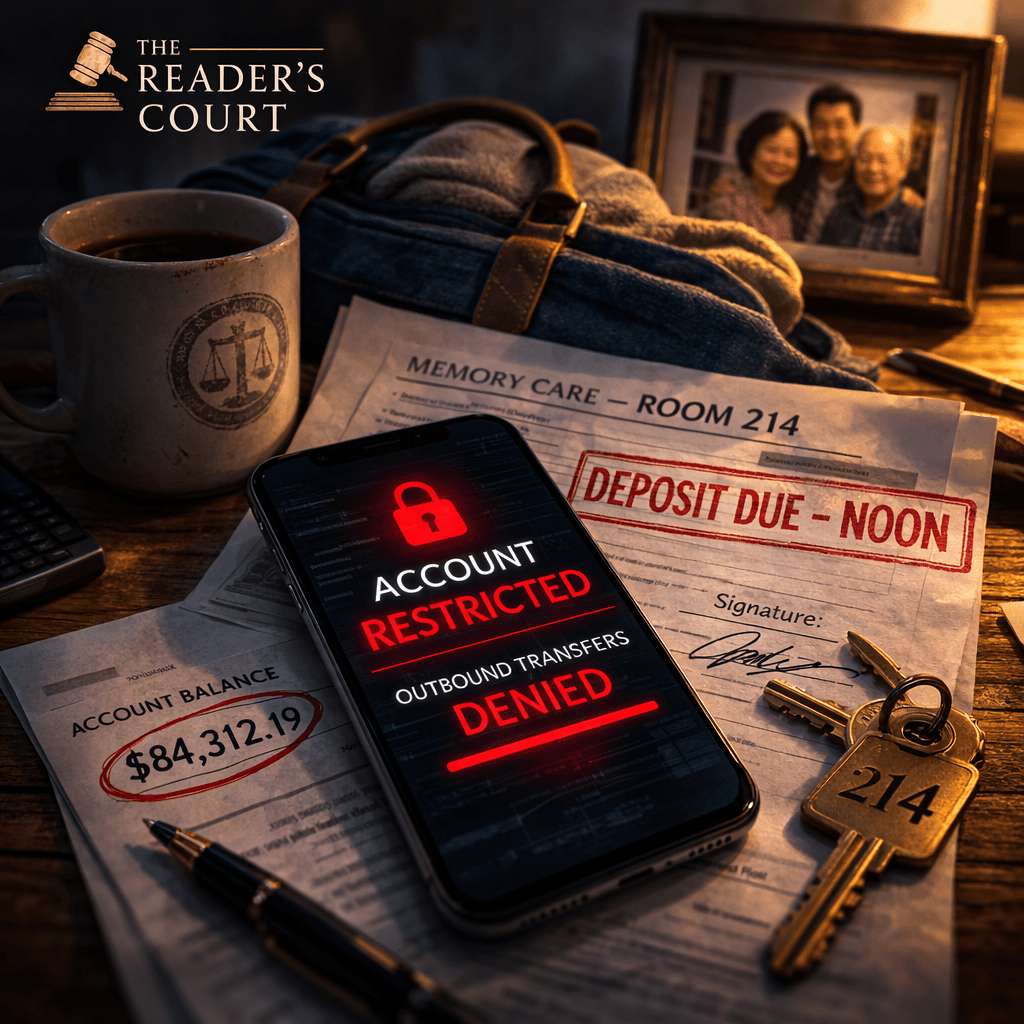
He had packed it after midnight, kneeling on the living room rug while his mother slept in the recliner with the television murmuring to itself. The bag was old, canvas faded at the seams, one zipper tab replaced with a brass key ring. It had once belonged to his parents. Daniel remembered it in motel rooms, in summer cabins, in the trunk of his father’s Buick on drives that felt endless when he was a child. Now it held two cardigans, thick socks, slippers, her blood pressure pills, the framed church photo she liked on the side table, and the small quilt she insisted was warmer than any blanket anyone made now.

Beside the bag lay a cream-colored folder from Juniper House Memory Care.

His name was on the intake documents.
His mother’s name was on the residency agreement.
A room number had finally been assigned yesterday afternoon.

Room 214. Garden side.

He had waited seven months for that call.

Seven months of telling himself he could still manage. Seven months of taking calls from neighbors who had found his mother in the hallway, in the laundry room, once outside in the courtyard in house slippers asking a delivery driver whether he knew the way back to Flushing. Seven months of pretending that the burn mark on the saucepan meant only that she had been tired, not that she had turned on the stove and walked away.

Juniper House had one room open because another family, the coordinator told him in a voice practiced enough to be both kind and efficient, had declined when they saw the price.

If Daniel wanted it, they needed the deposit wired by noon.

Noon.

He had repeated the word back to her as though hearing it twice might make it less sharp.

Now the folder sat on the narrow table under the window, neatly squared beside the transfer instructions and a black pen. He had reviewed everything three times before bed. He had enough in the account. Not enough for comfort, not enough for mistakes, but enough. He could send the deposit before work, sign the admission papers, and move her in by afternoon before the place gave the room to the next family on the waiting list.

His mother carried her mug to the table and sat down slowly.

“Are we going far?” she asked.

“No.”

“Overnight?”

Daniel glanced at the blue bag by the door.

“Maybe for a little while.”

She looked down into her tea. “I don’t want to be any trouble.”

He sat across from her. “You’re not trouble.”

“You say that too fast.”

He almost smiled.

Some part of her still had perfect aim.

He reached for his coffee mug, the old white one with the faint courthouse seal worn nearly away from years of dish soap and use. Someone had given it to him after a trial his second year as a public defender, back when he still believed good work earned protection from the machinery around it. The mug was chipped at the rim. He used it every morning anyway.

His phone buzzed against the table.

An email notification lit the screen.

Security Notice: Account Status Update.

Daniel frowned but did not open it immediately. He had too much to do this morning, too many fragile things already lined up in his head. Instead he slid the phone aside and said, “Drink your tea. Then I’ll help you get dressed.”

His mother nodded. “Should I wear the green sweater?”

“The dark one?”

“Yes.”

“That one’s good.”

She gave him a small, satisfied look, as if they had solved something ordinary together.

He helped her back to the bedroom, laid the green sweater across the bed, and set out her slacks and soft-soled shoes. On the dresser stood the framed photograph he had packed a duplicate of for the new room: his parents on a picnic blanket in 1989, his mother leaning into the wind, his father squinting at the camera, Daniel himself small and solemn between them in a baseball cap too large for his head.

He stood there longer than he meant to.

Then he returned to the kitchen table, opened the banking app, and prepared to send the wire.

For one second the screen looked normal.

Checking account.
Available balance.

Then the number sharpened into view and Daniel’s hand stopped.

$84,312.19

He stared at it.

That was wrong.

Very wrong.

Yesterday evening the balance had been just over six thousand dollars. Tight, but enough. He had checked it twice while calculating what would remain after the deposit. He knew the number with the defensive intimacy of a man who had spent months moving money in careful inches.

He opened the transaction list.

At the top sat a posting from 11:47 p.m.

Incoming Wire Transfer — $78,000.00

Sender: Evan Rourke

Daniel looked at the name as though it belonged to someone from a previous life.

Rourke.

Law school years. Cheap beer. Big plans. Then the brief detour Daniel never took—the startup Rourke had tried to build, the one Daniel almost joined before deciding law school debt was already enough of a gamble. After that they drifted. Christmas cards for a while. Then nothing.

His mother called faintly from the bedroom. “Daniel?”

“Yeah?”

“Where are my earrings?”

“In the top drawer.”

He did not take his eyes off the screen.

A red banner spread across the top of the app like a warning light.

ACCOUNT RESTRICTED

Below it, smaller text appeared.

Outbound transfers temporarily unavailable.

Daniel tapped the wire transfer icon anyway.

The app answered instantly.

Action unavailable under current account status.

He set the phone down and picked it up again. His body had already gone cold under the skin. The room seemed to flatten around him. The blue overnight bag by the door. The cream folder on the table. The courthouse mug cooling beside his hand. All of it suddenly arranged inside a world he no longer controlled.

He opened the email.

Your account has been temporarily restricted due to a risk evaluation conducted under our automated compliance program.

Certain features may be unavailable while the review is in progress.

For additional information, please contact customer support.

He called the number.

The menus took forever because every second inside an automated voice feels designed to prove you are not the emergency. He entered the last four digits of his social, confirmed the account, chose checking, chose online access, chose “other,” and listened to a piano version of some song he could not identify.

From the bedroom, dresser drawers opened and closed. His mother hummed to herself.

A representative finally answered with the tired brightness of someone at the beginning of a long day.

“My account has been restricted,” Daniel said. “I need to send a wire this morning.”

“One moment while I review the account, sir.”

He stared at the red banner on the app while she typed.

“Thank you for waiting. Your account has been flagged under our automated compliance monitoring system.”

“Flagged for what?”

“I’m afraid I can’t see the specific category.”

“I need to move money now. Not next week. This morning.”

“I understand.”

“No, you don’t. There’s a deposit due at noon.”

Another pause. “Reviews may take up to thirty business days.”

Daniel laughed once, without humor.

“That’s six weeks.”

“Yes, sir.”

“That’s not a review. That’s a seizure.”

“I’m sorry for the inconvenience.”

He looked at the bag by the door. He looked at the folder. Through the open bedroom door he could see the sleeve of the green sweater laid across the bed exactly where he had placed it.

He lowered his voice because anger in front of his mother now felt like another kind of failure.

“An incoming wire hit my account last night. I didn’t request it.”

“I do see a recent incoming transfer.”

“From Evan Rourke.”

She said nothing.

Daniel opened his laptop with one hand and typed the name into the search bar. Results populated before he finished the surname.

The first headline was eight months old.

FINANCIAL ANALYST DISAPPEARS DURING FEDERAL INVESTIGATION

He clicked it.

Rourke’s face appeared on the screen, older and heavier than Daniel remembered, but unmistakable. The article described suspected movement of funds across offshore accounts tied to a corporate fraud inquiry. Investigators had wanted to question him. Instead he disappeared.

Daniel felt the blood drain from his face.

“Your system thinks I’m part of this?” he asked.

“Sir, I’m not able to confirm the precise nature of the alert.”

“But it can lock my account.”

“Our systems monitor activity associated with financial risk.”

“My mother has a room waiting for her.”

The words came out before he could stop them.

There was a silence on the line then, the terrible sterile silence of a person who hears the human fact but has no place to put it.

“I’m sorry,” the representative said softly. “I cannot override the restriction.”

His mother appeared in the doorway wearing the green sweater and only one earring.

“How do I look?” she asked.

Daniel turned in his chair.

Beautiful, he wanted to say.
Like yourself.
Like the part of this life I am trying not to lose by inches.

Instead he smiled with effort. “You look good. The other earring is on the dresser.”

She touched one ear, surprised to find it bare. “Your father always noticed first.”

Daniel swallowed.

On the phone the representative was still speaking, but the words no longer mattered. Escalation queue. Security team. Review process. He heard them as if from underwater.

His mother came closer to the table and looked at the folder, then at the blue bag.

“Are we late?” she asked.

Daniel opened the app again because some part of him still believed screens could be persuaded by repetition.

The balance remained.
The wrong money remained.
The red banner remained.

ACCOUNT RESTRICTED

His thumb hovered over the transfer icon. He pressed it once more, not because he expected mercy, but because human beings are slow to surrender when a promise is sitting in a blue canvas bag by the door.

The screen flashed and answered him in hard, instant text.

Outbound transfers temporarily unavailable.

Become a member of the Dossier.
Support my writing.

The Question | The Account That Became a Risk

Daniel Park did not solicit the money. He did not hide it, spend it, reroute it, or even understand it until it was already sitting inside his account.

He woke up as the same law-abiding customer he had been the night before, with the same six thousand dollars he had saved, the same mother who needed a room by noon, and the same intention any ordinary person would recognize as decent: keep her safe.

Then an automated system fused his money to someone else’s suspicion and converted access into a privilege that could be withdrawn without warning.

So what exactly happened in that moment?

How does a lawful customer become a risk category before he becomes a person anyone is required to listen to?

The Autopsy | The Account That Became a Risk

What happened to Daniel Park sits inside the architecture of modern anti-money-laundering enforcement, where banks are expected to identify suspicious activity quickly, isolate it quickly, and document it quickly. The relevant systems do not wait for a criminal conviction. They do not require courtroom standards. They operate on patterns, counterparties, transaction histories, behavioral deviations, and associations that suggest possible exposure.

An incoming wire from a person connected to prior investigative scrutiny is the kind of event these systems are built to catch. Once that happens, the account may be restricted automatically or pushed into a review state that functionally produces the same result. Front-line employees often cannot see the underlying trigger, and even when they can infer it, they are trained not to say much. Some of that silence is procedural. Some of it is legal. Some of it exists because transparency creates its own form of institutional risk.

This is the part ordinary customers rarely understand: the bank is not asking whether Daniel Park is morally innocent in the human sense. It is asking whether his account now presents regulatory, reputational, or financial exposure to the institution. Those are different questions.

The bank’s incentives are not arranged around the customer’s immediate life. They are arranged around avoiding supervisory penalties, preserving access to payment networks, satisfying compliance obligations, and preventing the kind of scrutiny that can produce massive fines, legal costs, damaged investor confidence, and restrictions on future business. In that environment, a false positive imposed on one customer is cheaper than a false negative imposed on the bank.

So the burden shifts silently downward.

Daniel loses access to his own lawful funds because the institution would rather immobilize him than risk appearing permissive toward suspicious money. His mother’s room, his deadline, his promise, his circumstances—none of that enters the primary calculation. The human question is, What is right here? The institutional question is, What most safely protects the bank?

No villain is required for this to happen. The representative can be polite. The model can be functioning as intended. The rules can be followed carefully at every step. That is precisely what makes the mechanism so cold. Integrity, decency, and moral proportion are not removed in a dramatic act. They are simply absent from the design priority.

And that design priority ultimately serves concentrated wealth. A large financial institution protects itself first because its real exposure is not one customer’s hardship. Its exposure is regulatory force, market confidence, and the stability of the capital structure above the customer. When those interests conflict, the ordinary account holder absorbs the delay, the opacity, and the loss.

The Reader’s Verdict | The Account That Became a Risk

The money appeared.

The model saw the wrong pattern attached to the wrong name and made the safer choice for the institution.

It did not matter that Daniel Park wanted only to move his own six thousand dollars. It did not matter that a room was waiting. It did not matter that his mother had already put on the green sweater.

His account was not judged by what he needed.

It was judged by what the bank feared.

That is the quiet truth beneath the polite language of review.

The system did not fail.

It simply answered the question it was designed to answer.

And in systems designed to protect institutional power and wealth, integrity, decency, and morality rarely appear in the calculation.


FILE YOUR VERDICT — The Account That Became a Risk

What is the right thing to do?

A) Restrain first contact. Suspicious incoming wires should be quarantined at the edge: the bank can hold the new money, but it should not freeze a customer’s existing funds or block time-critical obligations.

B) Restrain escalation. If an account is restricted, the bank must provide an emergency human review path and a hardship release for essentials (elder care, medical, housing) with a short clock—days, not “up to thirty business days.”

C) Fix the system. Pass a financial-integrity package: binding transparency at least to the category level, strict time limits on freezes without a court order, independent appeal/ombudsman review, and enforceable accountability for false-positive harm—so “compliance” can’t function as a polite seizure.

Choose your verdict: A, B, or C.
Then comment in one sentence: what cost are you willing to accept to make your choice real?

—Mark Bertrand
The Reader’s Court
When systems break people’s lives, the truth must be told.
Join the fight.

Connected evidence

Related Case Files

The investigation does not end at the bottom of the page.