
What to Read After The Hunger Games
You did not love The Hunger Games because teenagers fought to the death.
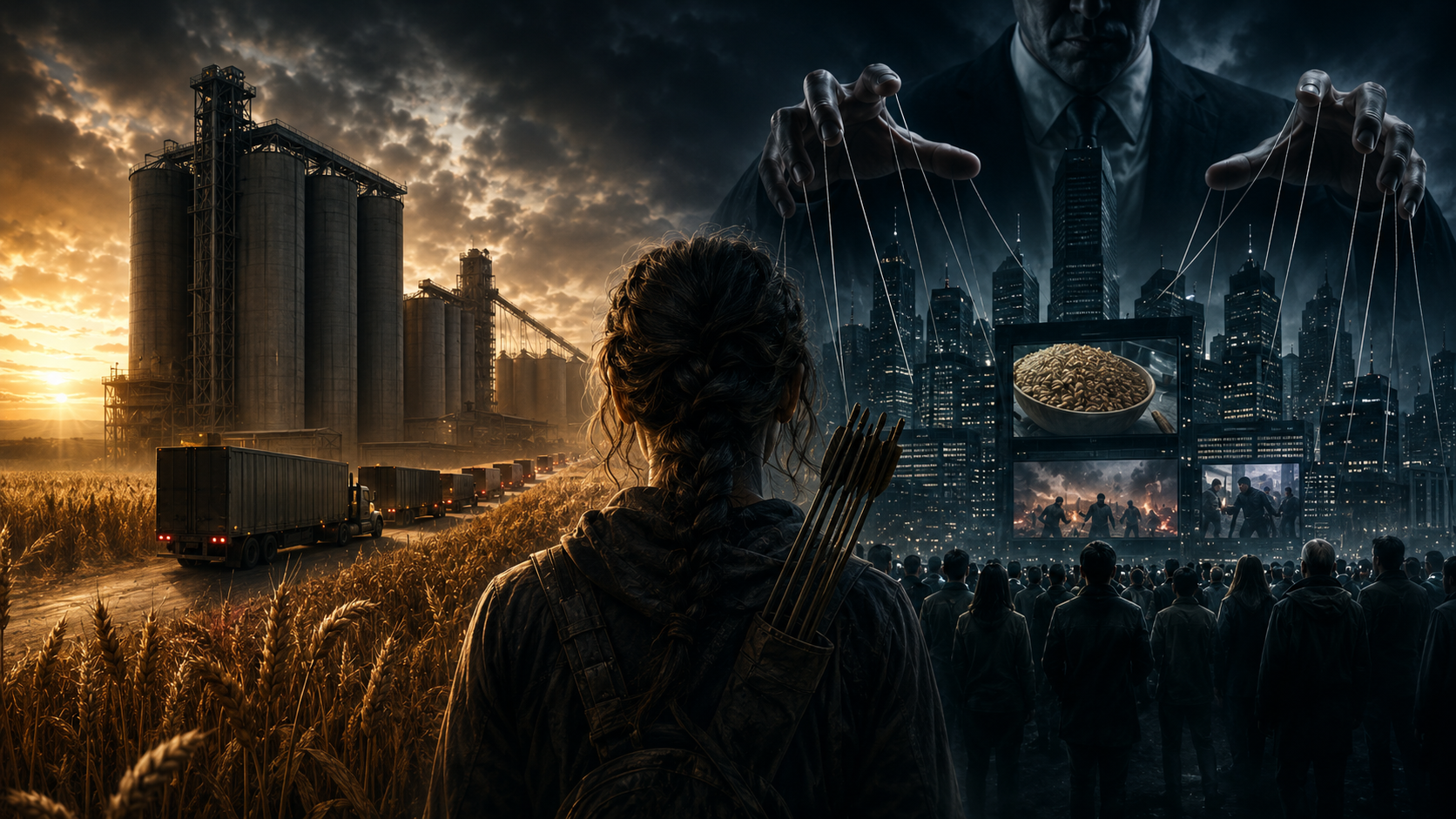
You loved it because Katniss Everdeen saw the obscenity everyone else had been trained to accept.
The starving districts produced everything. The Capitol consumed everything. Children were selected as payment for an uprising their grandparents had already lost. Their terror became entertainment. Their deaths sold costumes, interviews, sponsorships, betting, gossip, and national unity.
President Snow did not merely punish rebellion.
He made the defeated participate in their own humiliation.
That is the poison inside The Hunger Games. The arena is only where the poison becomes visible.
The real horror is Panem itself: a society in which wealth has captured food, law, media, medicine, transportation, history, and hope. The Capitol does not have to convince the districts that it is good. It only has to convince them that resistance is impossible.
Then Katniss lifts the berries.
For one moment, the machine does not know what to do.
That is why readers still search for what to read after The Hunger Games. They are not merely looking for another dystopian competition. They want the feeling of watching power encounter a human being it cannot completely predict, purchase, frighten, or control.
They want another story in which the system finally becomes afraid.
What Readers Actually Want After The Hunger Games
Most recommendation lists misunderstand the assignment.
They offer another tournament. Another chosen teenager. Another ruined city divided into factions. Another authoritarian government with severe architecture and immaculate uniforms.
Those books may reproduce the scenery.
They do not always reproduce the wound.
The deepest power of The Hunger Games comes from the relationship between personal survival and institutional evil. Katniss cannot simply defeat a villain. Every choice she makes is absorbed by the Capitol, edited for television, converted into propaganda, and sold back to the population as approved emotion.
Her love becomes programming.
Her grief becomes spectacle.
Her defiance becomes a marketable costume.
Even the rebellion eventually discovers that Katniss is more useful as a symbol than as a person.
That is the experience readers are trying to recover: not merely resistance, but the terrifying realization that powerful institutions can consume resistance too.
The Best Books to Read After The Hunger Games
The strongest next reads should not imitate the Games. They should deepen the questions Suzanne Collins placed beneath them.
What happens when survival itself becomes political?
What happens when institutions manufacture scarcity and then demand gratitude for distributing what they withheld?
What happens when rebellion acquires executives, publicists, sponsors, and strategic objectives?
What happens when the people promising liberation begin calculating how much one human life is worth to the cause?
And what happens after the visible dictator is gone—but the machinery that made him possible remains?
Those are the books worth reading next.
Some will take you into other authoritarian societies. Some will explore engineered poverty, surveillance, political theater, or resistance compromised by its own appetite for power. The best of them will not simply give you another Capitol.
They will show you why the Capitol keeps returning under different names.
The Capitol Did Not Disappear. It Went Private.
The most frightening difference between Panem and the modern world is not that Panem is more brutal.
It is that Panem is easier to recognize.
Its power has a face. Its soldiers wear uniforms. Its borders are visible. Its districts know they are occupied. Its citizens understand that President Snow is their enemy, even when they are too frightened to say so.
Modern power is less considerate.
It arrives through employment contracts, health-insurance networks, debt scores, food prices, recommendation systems, housing shortages, private surveillance, campaign financing, and terms of service nobody has the power to negotiate.
There is no annual Reaping because selection never stops.
The algorithm decides who receives the interview.
The insurer decides who receives treatment.
The lender decides who may own a home.
The platform decides whose anger will be amplified, whose evidence will disappear, and which version of reality will reach the public first.
The billionaire does not need to stand on a balcony and declare himself ruler.
He owns the balcony.
He owns the cameras pointed toward it.
He owns the network carrying the speech.
He finances both candidates standing beneath it.
He owns the company supplying food to the crowd and the software identifying anyone who leaves before the applause.
That is the modern arena.
No cannon announces the dead. They disappear into bankruptcy, eviction, untreated illness, addiction, despair, incarceration, and lives spent working without ever becoming secure.
Their suffering is not broadcast as punishment.
It is reported as market performance.
The Hunger Games Was the Warning. The Modern Thriller Is the Autopsy.
Suzanne Collins showed readers what happens when a ruling class turns deprivation into governance and suffering into public entertainment.
The modern thriller must go further.
It must enter the boardroom where the shortage is designed.
It must follow the money behind the emergency.
It must expose the consultant who discovers that frightened workers accept lower wages, desperate patients surrender more data, and divided citizens are easier to govern.
It must reveal the billionaire who funds the cruelty, the politician who legalizes it, the media company that sanitizes it, and the institution that assures everyone no crime has occurred.
The modern monster does not drag children into an arena.
He creates an economy in which every family is forced to volunteer someone.
The mother who cannot afford medicine.
The father replaced by an automated system.
The student carrying debt that can never be discharged.
The worker whose employer controls his wages, healthcare, schedule, housing, and right to speak.
The citizen told that everything happening to him is unfortunate, complicated, legal—and entirely his own fault.
Panem needed a Capitol.
We built something more efficient.
How Did You Miss This?
Mark Bertrand does not write stories about heroic individuals defeating conveniently visible tyrants.
He writes about captured reality.
His characters live inside systems that have already defined what is normal, what is possible, what is legal, and what kind of person deserves to survive. The walls are not guarded by soldiers. They are reinforced by identity, dependency, ambition, shame, technology, institutional legitimacy, and the human need to belong.
That is what makes the Nirvanaing Series the natural destination after The Hunger Games.
Not because it offers another Katniss.
Not because it recreates Panem.
Because it asks the question that begins after the revolution:
What if overthrowing the ruler changes nothing because the population still believes in the reality he constructed?
The five novels do not repeat the same rebellion. They dismantle the prison one layer at a time.
This Could Be It
The first rupture.
The moment a person begins to suspect that the life he has accepted is not merely disappointing, accidental, or unfair—but constructed around assumptions he was never permitted to question.
This is where reality first cracks.
Starzel
The system moves deeper.
Identity, belonging, loyalty, and love become instruments of control. The cage no longer looks like oppression because the prisoner has been taught to experience it as selfhood.
The enemy is not simply what power does to people.
It is what power teaches people to become.
Reckoning
Consequences arrive.
Institutions that treated human beings as expendable discover that damage does not disappear because it was authorized, profitable, or committed by respectable people.
The bill comes due.
A Conscious Thing
The conflict expands beyond one regime, one billionaire, or one corrupt institution.
Humanity confronts the possibility that the structures it calls civilization may be sophisticated systems for preserving domination—and that consciousness itself demands something more radical than survival inside them.
The Dot
The final break.
Not a better ruler. Not a kinder Capitol. Not a more representative hierarchy.
A movement beyond the captured reality that made those systems appear inevitable in the first place.
The Series Begins Where the Berries Leave Off
Katniss and Peeta threaten to eat the berries because the Capitol has left them only two permitted identities: murderer or victim.
They invent a third.
That is the instant power fears most—not violence, but imagination.
The Nirvanaing Series takes that instant and carries it forward.
What happens when people stop asking who should control the system?
What happens when they question why the system deserves to exist?
What happens when humanity no longer wants a better seat in the arena?
What happens when it walks out?
A FREE SHORT THRILLER STORY FROM MARK BERTRAND
The Harvesters’ Gambit
Chapter One
The Empty Weight
The trucks were full when they left the elevators.
Lia Corvin knew because she had signed the weights herself.
At 19:42, Trailer 6819 rolled across the western scale carrying forty-three metric tons of hard red winter wheat. At 20:16, the same trailer passed the first distribution checkpoint weighing twelve tons—the legal curb weight of an empty vehicle.
No unloading authorization had been issued between those points. No storage facility existed along the route. The highway cameras showed the truck moving continuously through eighty-six kilometers of open agricultural country.
Lia watched the footage again.
The trailer rode low on its suspension when it left the AgriNexus elevator. Fifteen minutes later, it still rode low. The axle sensors, however, recorded an empty load.
She froze the frame.
The image was clear enough to count the rivets along the trailer wall. The grain was there. The system had simply decided that it was not.
Behind her, the night floor of the National Allocation Center whispered and pulsed. A thousand servers processed harvest forecasts, household ration levels, transportation priorities, nutritional compliance scores, and municipal food-risk projections. The room never slept. People did, eventually. The system regarded that as a weakness in the people.
Lia pulled the next record.
Trailer 6821: loaded at departure, empty at checkpoint.
Trailer 6828: loaded, empty.
Trailer 6834: loaded, empty.
By midnight, she had found thirty-seven phantom shipments representing enough grain to feed the western districts for eleven days.
She leaned back and pressed two fingers beneath her eyes. Her first instinct was not outrage. It was professional embarrassment.
She had spent seven years learning how AgriNexus moved food through a nation too large and angry to understand its own dependence. She knew the acceptable loss ratios, the spoilage tolerances, the political meaning of a delayed convoy. She could look at a district’s breakfast consumption and tell whether its factories would reach production quotas by afternoon.
Nothing disappeared from this system.
Not food.
Not trucks.
Not people.
She checked the transfer codes. Each shipment had been reassigned under Executive Continuity Directive 14, a classification Lia had seen only during drought declarations and civil emergencies.
There was no emergency.
She opened the directive.
ACCESS RESTRICTED.
Her employee credentials disappeared from the screen.
A second window opened before she touched the keyboard.
YOU ARE WORKING OUTSIDE YOUR ASSIGNED PARAMETERS.
Lia stared at the message.
It was not unusual for the system to warn analysts away from protected files. What unsettled her was the wording. AgriNexus software did not ordinarily address employees as you. It cited policy numbers, clearance levels, and corrective procedures.
She closed the window.
It opened again.
RETURN TO ASSIGNED WORK.
The overhead lights dimmed for the scheduled energy cycle. Around her, empty desks became black shapes beneath the emergency strips. Her reflection hovered in the glass partition: thirty-four years old, gray company blouse, hair pinned badly after sixteen hours at the console. The face of someone who had spent her adult life believing obedience and intelligence were the same virtue.
She searched the remaining convoy records through the maintenance layer.
All thirty-seven trucks had continued north.
Not toward the distribution centers.
Toward Bellwether County.
Lia stopped breathing.
Bellwether had officially ceased agricultural operations nine years earlier, after the aquifer contamination. Its farms had been condemned, its grain elevators dismantled, its population transferred into labor districts.
She remembered the news footage: abandoned silos against a yellow sky, dead cattle stacked in trenches, government officials promising that nobody would be forgotten.
AgriNexus had later purchased the county for one dollar under a federal reclamation agreement.
Lia requested satellite data.
The system denied her.
She requested fuel records.
Denied.
Driver payroll.
Denied.
She tried one final path, an obsolete logistics mirror that had not been used since the allocation network was consolidated. A map appeared, crude and incomplete.
Thirty-seven lights traveled north in a perfect line.
Then another convoy appeared behind them.
Then another.
Not eleven days of food.
Months.
Perhaps years.
The elevators were not losing grain. They were removing it from the official supply.
Lia looked toward the security station behind the smoked glass. Two guards sat beneath the monitors, talking over paper cups. Neither appeared interested in her.
Her screen changed.
A live image filled the display.
Lia saw herself sitting at her desk.
The camera angle came from directly above her.
Beneath the image, a timer began counting down from sixty seconds.
Her hands moved before her mind agreed. She inserted a diagnostic drive into the terminal, copied the convoy ledger, the directive codes, and the old route map. The files were too large. She stripped metadata, discarded video, compressed the manifests.
The guards stood.
Lia removed the drive and slid it inside the seam of her waistband. She closed every window except the nutritional variance report she had been assigned.
The security door opened.
Dane Brackett stepped onto the floor.
He was not hulking. That was what made him worse. He was narrow, soft-spoken, and almost beautifully groomed, with silver at his temples and the unhurried manners of a man who had never been required to repeat an instruction.
He approached Lia’s desk without looking at the guards.
“Long evening.”
“I’m nearly finished.”
“With what?”
“The South District protein variance.”
Brackett glanced at her screen. “That report closed three hours ago.”
Lia kept her breathing even. “The household figures were unstable.”
“Households are always unstable.”
He rested one hand on the partition beside her. His wedding ring made a soft click against the glass.
“What were you looking for, Lia?”
She could have lied. A frightened employee would have lied immediately.
Instead she looked up at him.
“What disappeared?”
Brackett’s expression did not change. Something behind it did.
“Nothing disappears,” he said.
“That is what I thought.”
He watched her for several seconds, perhaps deciding whether the answer represented courage or stupidity.
Then he smiled.
“You should go home.”
Lia stood carefully. “Am I being dismissed?”
“From the building.”
“And tomorrow?”
“Tomorrow remains subject to allocation.”
The guards made no move to search her. That frightened her more than if they had torn the blouse from her body.
Brackett stepped aside.
As Lia passed him, he spoke quietly enough that the guards could not hear.
“Your mother survived the Recession Winter because AgriNexus approved an emergency household supplement. I reviewed the record before coming downstairs.”
Lia stopped.
Brackett’s voice remained gentle.
“Institutions remember what people prefer to forget.”
She walked to the elevator without turning around.
Only when the doors closed did she understand that he had not mentioned her father.
Her father had not survived that winter.
Chapter Two
The Price of Knowing
Josiah Malick opened the farmhouse door before Lia knocked.
He held a shotgun loosely against one leg.
“You drove the whole way with your lights on,” he said.
“It’s dark.”
“That is generally when lights are most visible.”
He turned and walked inside. Lia followed, closing the door behind her.
The house had changed since childhood. The front room was nearly bare. No family photographs. No books. No radio muttering weather and crop prices from the kitchen. Copper mesh covered the windows, and the old plaster walls had been opened in places to expose coils of wire.
Josiah saw her looking.
“Signals travel through a house more easily than ghosts.”
“You knew I was coming.”
“I knew somebody was.”
He placed the shotgun beside the table and examined her face. At seventy-eight, Josiah had lost weight but not substance. He looked assembled from leather, tendon, and unresolved grievances.
“You have your father’s frightened eyes,” he said.
“My father wasn’t frightened.”
“Then you remember him poorly.”
Lia removed the drive from her waistband and set it on the table.
Josiah did not touch it.
“What is it?”
“Grain shipments. Thousands of tons diverted north under a continuity directive.”
“To Bellwether?”
The speed of his answer chilled her.
“You knew.”
“I suspected.”
“How?”
“Because hungry people do not create food shortages. People with food create shortages.”
“That isn’t an answer.”
“It is the only answer that has survived history.”
Lia pulled out a chair but did not sit. “Thirty-seven shipments tonight. More behind them. The official system reads them as empty after departure.”
“Then the grain does not exist.”
“I watched it leave.”
Josiah’s mouth bent slightly. “You still think existence is a physical condition.”
She had come expecting certainty from him. Instead, he seemed almost disappointed that she required it.
“What is in Bellwether?”
“Food.”
“How much?”
“Enough.”
“For what?”
Josiah filled a kettle from a ceramic jug and placed it on the stove. “That depends on whether you believe famine is a failure or a product.”
Lia felt impatience rising through her fear. “Do not make me drag this out of you.”
“You work for AgriNexus. Dragging food out of old men is more your department.”
The cruelty landed cleanly because it was deserved.
Lia sat.
Josiah remained by the stove, watching the blue flame.
“AgriNexus learned something during the Recession Winter,” he said. “Not about agriculture. About obedience. Districts with seven days of food resisted wage controls. Districts with three days accepted them. At forty-eight hours, people surrendered medical privacy, movement rights, collective bargaining, whatever else the government placed in front of them.”
“That was an emergency.”
“No. The emergency was real. The lesson was deliberate.”
The kettle began to murmur.
“They began modeling caloric pressure after that. How much hunger increases factory attendance. How children’s rations influence parental compliance. How the threat of losing a food allotment alters voting behavior. They call it nutritional continuity because respectable language is the first wall built around a crime.”
Lia thought of the National Allocation Center: the glowing district maps, the household scores, the reports she had signed without reading past the confidence index.
“They told us the models prevented panic.”
“They prevent independence.”
Josiah poured hot water over two cups of dried leaves.
“Bellwether is a reserve,” he continued. “Private storage outside the declared supply. When prices fall, grain disappears. When workers become difficult, shipments are delayed. When a district elects the wrong representative, contamination is discovered. By the time the shortage reaches the news, AgriNexus has already bought the futures contracts, the emergency transport rights, and the politicians who will praise its response.”
Lia looked at the drive between them.
“How long?”
“Long enough that your salary has always been paid from somebody else’s hunger.”
She flinched.
Josiah placed a cup before her.
“You came here because you wanted me to tell you that you found evil. Something hidden. Something separate from you.”
“I didn’t know.”
“You did not ask.”
“That is not the same thing.”
“No,” Josiah said. “It is much more common.”
She wrapped both hands around the cup, though it was too hot.
“My father died because his supplement was denied.”
“Your father died because he helped organize the rail loaders.”
Lia looked up.
The room seemed to contract around her.
“He had pneumonia.”
“He had pneumonia after AgriNexus removed your household priority.”
“My mother said—”
“Your mother said what kept you employable.”
Josiah opened a drawer and removed an old ration card sealed in plastic. Lia recognized her father’s name, the address of their first apartment, the faded red emblem of the emergency authority.
Across the bottom was a stamped notation:
HOUSEHOLD STATUS REDUCED: LABOR DISRUPTION AFFILIATION.
Her father’s death had always existed in her mind as a winter illness, tragic but impersonal. A season had killed him. Bad luck had killed him. Poverty had killed him in the vague, blameless way poverty was permitted to kill.
Now there was a signature.
Dane Brackett.
Lia stared at it until the letters lost their shape.
“He was already at AgriNexus?”
“He was a district compliance officer. Your father embarrassed the company. Brackett corrected the embarrassment.”
She wanted to cry. The impulse passed before producing tears. Something colder took its place.
“Why did my mother let me work for them?”
“Because they restored her allocation after he died. Because you were nine. Because she understood that principles do not feed children.”
Josiah sat across from her.
“Do not judge her. That is another luxury created by a full stomach.”
Lia slid the drive toward him. “We release this.”
“To whom?”
“The press.”
“Owned.”
“The government.”
“Fed.”
“The courts.”
“Appointed.”
“Then the districts.”
Josiah studied her with the patience of a physician waiting for a patient to acknowledge the diagnosis.
“The districts already know they are hungry.”
“They don’t know why.”
“They know enough to hate AgriNexus.”
“Then why has nobody done anything?”
Josiah’s gaze shifted toward the dark window.
“Because AgriNexus owns what they do about it.”
The floor creaked behind Lia.
She turned.
A man stood in the kitchen doorway with a pistol leveled at her chest.
She recognized the crooked line of his mouth before she recognized anything else.
“Kai,” she said.
He did not lower the weapon.
Chapter Three
The Rebellion Account
Kai Vey looked older than thirty-six.
Not physically. His face had retained the narrow severity Lia remembered, and his dark hair was still cut badly enough to suggest he did it himself. Age had entered elsewhere—in the refusal of his eyes to arrive anywhere before calculating the exits.
“Stand up,” he said.
Lia remained seated.
“You used to say hello first.”
“You used to arrive without company.”
“I came alone.”
Kai looked at Josiah.
“She believes that?”
“She works in logistics,” Josiah said. “Belief is part of the software.”
Kai crossed the room and removed the drive from the table using a folded cloth.
“Did they search you?”
“No.”
“Did Brackett speak to you?”
“Yes.”
“What did he say?”
“That institutions remember.”
Kai’s jaw tightened.
He carried the drive to a workbench crowded with stripped circuit boards and battery packs. An isolated computer sat beneath a metal hood. He inserted the drive and began examining the files.
Lia watched his hands. She remembered those hands younger, dirt beneath the nails, holding a stolen peach between them as if the fruit were evidence that another world existed. They had kissed in the orchard behind her school while harvest drones moved above the trees.
Then Kai’s brother had disappeared during the ration riots.
Kai had disappeared soon after.
“You could have contacted me,” Lia said.
“I could have endangered you.”
“You mean you chose for me.”
“That was fashionable then.”
“And now?”
“Now choice is mostly branding.”
The old intimacy between them had not vanished. It had been sealed inside something harder, preserved without being allowed to live.
Kai opened the convoy ledger. Lines of data moved across the screen.
“You were meant to find this.”
Lia stood. “That makes no sense.”
“It makes perfect sense. The continuity codes are protected by a system you do not have clearance to enter, yet you accessed them through a maintenance mirror that should have been removed six years ago.”
“I knew the mirror existed.”
“Because somebody left it for you.”
“I found thirty-seven false shipments.”
“You found thirty-seven visible ones.”
Kai enlarged the route map. A second layer appeared beneath Lia’s data, hidden in the diagnostic headers.
Names.
Hundreds of them.
Employees, drivers, inspectors, municipal clerks, warehouse supervisors.
Lia found her own name near the top.
Beside it was a designation:
PREDICTED DISCLOSURE VECTOR: 91.4%
Her skin went cold.
“What is that?”
Kai turned toward her.
“A harvest list.”
Josiah remained at the table, silent.
Lia looked between them. “For what?”
“Dissent,” Kai said. “They create anomalies inside the system and measure who notices, who ignores them, who reports them, and who takes the evidence outside approved channels.”
“The missing grain is bait?”
“The grain is real. The bait is the truth.”
She thought of the camera above her desk, the countdown, Brackett allowing her to leave.
“They followed me.”
“Not with a car.”
Kai pointed toward her right shoe.
A faint green pulse flashed beneath the heel.
Lia stepped back as if the light had burned her.
Kai knelt and passed a scanner over the sole. “Pressure-activated transmitter. Probably installed during your last security inspection.”
“I came straight here.”
“Yes.”
The simplicity of the answer struck harder than accusation.
She looked at Josiah. “You knew they might follow me.”
“I knew they would eventually send someone.”
“You let me come inside.”
“I needed to know what they wanted you to find.”
Kai removed the transmitter with a narrow blade and placed it in a glass jar.
The pulse continued.
Lia’s fear sharpened into anger. “You used me.”
Josiah’s expression did not soften. “You entered a building owned by AgriNexus, used a road maintained by AgriNexus, carried a device manufactured by an AgriNexus subsidiary, and came to a property AgriNexus has attempted to purchase nine times. Usage is the governing relationship of your life. I am merely the first person honest enough to admit it.”
A vibration passed through the tabletop.
Not sound. Pressure.
Kai killed the lights.
Outside, the farmhouse disappeared into blackness.
He moved to the window and lifted one corner of the copper mesh. Far beyond the fields, three white lights hovered above the tree line.
Drones.
Lia heard herself whisper, “We have to release the files now.”
Kai gave a quiet, joyless laugh.
“You still think the files are the weapon.”
“What else could they be?”
“Inventory.”
He returned to the computer and opened a financial record buried beneath the convoy data.
Payments appeared.
Not to politicians.
Not to inspectors.
To resistance organizations.
Food Justice Front.
Free District Coalition.
Bellwether Liberation Network.
Groups whose symbols Lia had seen painted beneath overpasses and projected across government buildings. Groups blamed for rail bombings, warehouse fires, assassinations, and the riot that had killed Kai’s brother.
Every account originated from the same private foundation.
Vale Civic Renewal.
AgriNexus founder Silas Vale’s charitable trust.
Lia read the entries twice.
“No.”
Kai scrolled downward.
Weapons purchases. Safe-house leases. Encrypted communication systems. Legal defense funds. Funeral payments to the families of dead insurgents.
“They financed the rebellion,” Lia said.
“They designed it.”
Josiah’s voice came from the darkness behind her.
“A controlled resistance gives hungry people somewhere to put their anger. It identifies the disobedient. It frightens the comfortable. It justifies emergency authority. And every act of violence makes AgriNexus more necessary than it was the day before.”
Lia looked at Kai.
“Your group?”
His face told her before he answered.
“Funded from the beginning.”
“You knew?”
“Not until six months ago.”
“And the attacks?”
“Some were ours.”
“Some?”
Kai glanced toward the hovering lights.
“Some happened before we planned them.”
The meaning entered slowly.
AgriNexus did not merely infiltrate the resistance. It committed violence in its name.
“How many people know?”
“Four,” Kai said. “Now five.”
“Then we tell everyone.”
“Everyone includes their informants.”
“We do nothing?”
“That is what they expect from frightened people.”
“And what do they expect from you?”
Kai removed the pistol’s magazine, checked it, and pushed it back into place.
“They expect me to release the convoy files, provoke demonstrations, trigger emergency food restrictions, and give them the public disorder required to empty Bellwether without explaining where the grain went.”
“Empty it where?”
“That is what your files do not show.”
The drones began moving closer.
Their white lights vanished, replaced by red points descending over the fields.
Kai closed the computer and pulled a canvas bag from beneath the workbench.
Lia could hear vehicles now, still distant but coming fast along the gravel road.
“What do we do?” she asked.
It was the same question she had imagined asking him for years, though not in this house, not with her father’s death sitting on the table between them, not with a corporation arriving to kill them using a rebellion it had purchased.
Kai handed her the pistol.
“We give Brackett what he wants.”
She stared at him.
Josiah smiled for the first time that night.
Then Kai opened the cellar door.
“And make him believe he won.”


0 comments
Write a comment