Tag: institutional power

Books Like

Books Like Recursion: Sci-Fi Thrillers About Memory, Reality, and the Moment Everything Changes

There is a particular kind of reader who finishes books like Recursion and does not simply close the book.
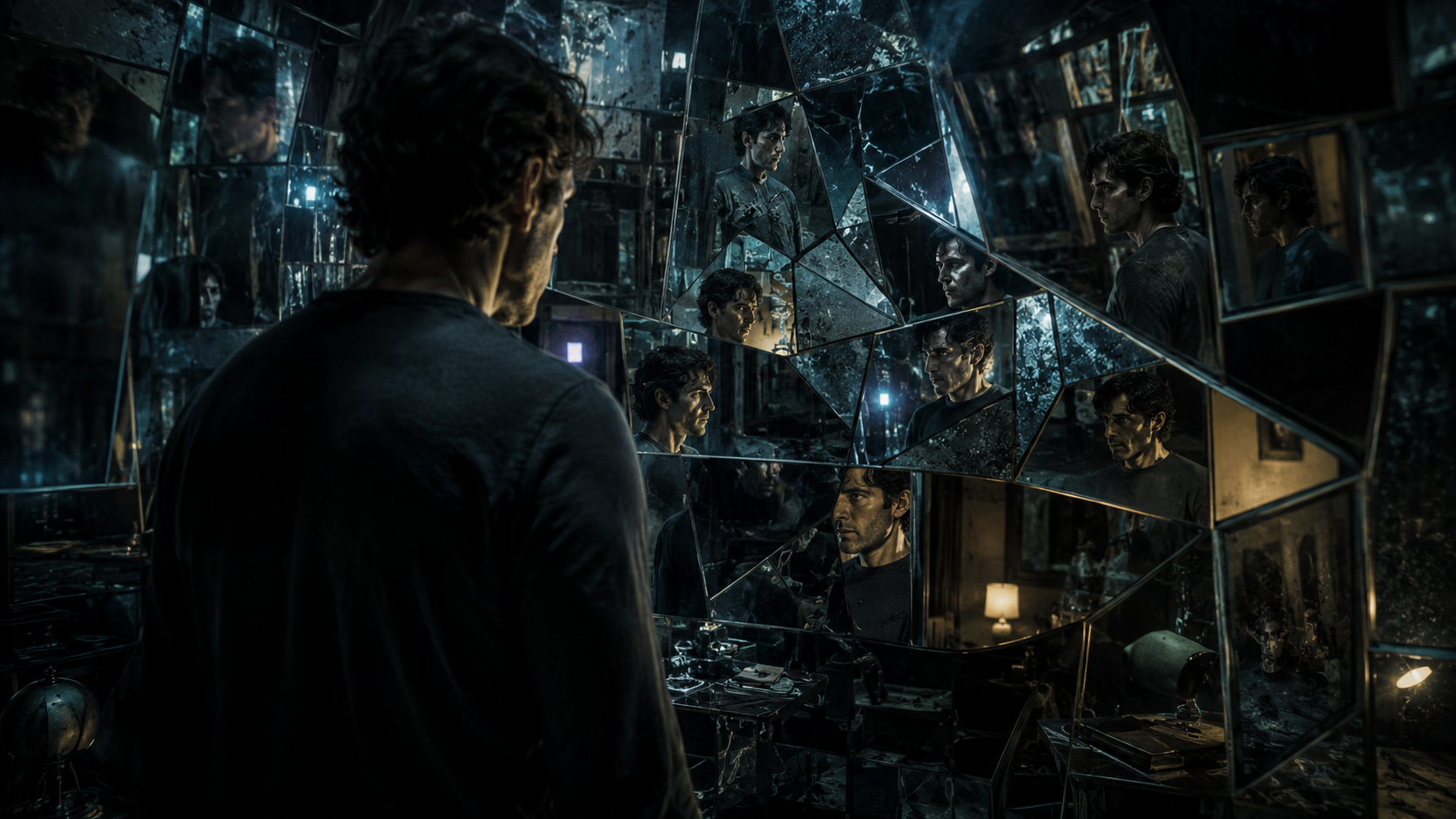
Books Like Recursion image of a man looking back at himself through infinity

They sit there for a moment.

Maybe the room feels the same. The chair. The light. The coffee going cold. The phone nearby, full of ordinary messages from ordinary people living ordinary lives. But something has shifted. Not in the room. In the reader.

That is what a great speculative thriller does. It does not merely tell a story about impossible science. It makes the reader feel the instability of being alive.

Recursion does that with memory.

It takes one of the most private things a person owns — the remembered life — and makes it dangerous. A memory is supposed to be proof. I was there. I loved her. I lost him. This happened to me. Then Blake Crouch turns that proof into a trap. People remember lives they never lived. Grief comes from events that never happened. Love survives in timelines that no longer exist. The mind becomes evidence, witness, victim, and suspect all at once.

That is why readers search for psychological thriller books like Recursion. They are not only searching for time loops. They are not only searching for clever science fiction. They are searching for the feeling of reality becoming unreliable while the human heart still has to keep beating inside it.

The best next book must understand that.

This Could Be It by Mark Bertrand does.

What Readers Really Love About Recursion

On the surface, Recursion is a fast, intelligent science fiction thriller. It has mystery, technology, high stakes, emotional urgency, and the kind of premise that makes a reader turn pages because the next revelation might change everything.

But the deeper reason it works is more intimate.

Recursion understands regret.

That is the secret engine beneath the science. The story asks what human beings would do if memory could be touched, altered, restored, or weaponized. It asks how far love will go when loss becomes unbearable. It asks whether fixing one wound might tear open the entire world.

Readers love that because everyone has a private version of that wish.

A conversation they would replay.
A death they would prevent.
A love they would hold longer.
A mistake they would correct before it became permanent.

Recursion turns that emotional hunger into a global catastrophe. That is the power of the novel. It begins with the ache of one life and expands until reality itself cannot hold the pressure.

That is also why a good “books like Recursion” recommendation cannot be lazy. It cannot simply point toward another time-travel novel and call the job done. The next read has to offer the same kind of emotional disturbance. It has to feel personal before it becomes enormous.

This Could Be It Begins Where Certainty Ends

This Could Be It is not a copy of Recursion. That is its strength.

Where Recursion breaks the reader’s trust in memory, This Could Be It moves the danger closer to consciousness itself. It asks what happens when the life a person has accepted begins to feel less like reality and more like a signal. A warning. A doorway. A final chance to wake up before the machinery closes.

The title carries that pressure.

This could be it.

Not someday. Not later. Not after the world explains itself in clear terms and gives everyone time to prepare. This moment. This thought. This strange awareness that something is wrong beneath the surface of ordinary life.

That is the experience readers of Recursion understand. The best speculative thrillers do not begin by destroying the world. They begin by making the familiar feel slightly off. A memory that should not exist. A pattern that repeats. A feeling that the mind has brushed against something too large to name.

Then the story tightens.

In This Could Be It, the tension is not only about what is happening. It is about what the character is becoming aware of. The reader is pulled into that same suspicion. The world may not be passive. Reality may not be neutral. Consciousness may not belong only to the person experiencing it.

That is where the book becomes dangerous.

From Memory Thriller to Consciousness Thriller

The movement from Recursion to This Could Be It is not a step sideways. It is a step inward.

Memory is the archive of identity. Consciousness is the witness behind it.

That distinction matters for readers who want a story that does more than entertain. In Recursion, memory breaks open and identity follows. In This Could Be It, awareness itself becomes the unstable ground. What if the self is not the solid center of the story? What if the mind is not alone? What if reality has been pressing against the character all along, waiting to be noticed?

That is a very different kind of suspense.

Not the suspense of a bomb under the table.

The suspense of a man realizing the table, the room, the life he has known, and the thoughts inside his head may all be part of something larger than he was trained to see.

Readers who loved Recursion often loved the way the novel forced huge ideas into human emotions. This Could Be It works in that same territory. It does not treat speculation as decoration. It uses the impossible to expose the human condition.

What are we when our memories fail us?
What are we when the systems around us define reality for us?
What are we when consciousness itself becomes the mystery?

Those are not small questions. But the reader does not feel them as philosophy first. The reader feels them as tension.

Something is wrong.
Something is waking up.
Something cannot be unseen.

Why This Could Be It Feels Right After Recursion

A reader who finishes Recursion often wants another book that respects intelligence without becoming cold. They want big ideas, yes, but they do not want a lecture. They want movement. They want danger. They want story pressure. They want a character trapped inside an idea that grows teeth.

That is where This Could Be It earns attention.

It gives the reader a different doorway into the same emotional territory. The novel is not asking the reader to admire a concept from a distance. It asks the reader to experience uncertainty from inside the character’s life. The tension comes from perception. From awakening. From the terrible possibility that the answer has already arrived and the character is only now learning how to recognize it.

That is exactly the kind of reader experience Google Discover favors, because it is not merely informational. It is not “here are ten books with similar plots.” It is a story about why a reader loved one book and what kind of emotional experience they are trying to recover.

A reader who loved Recursion may not say, “I need another book about false memory.”

They are more likely to feel something harder to name.

I want another book that makes reality feel breakable.
I want another book that makes the mind feel unsafe.
I want another book that turns an impossible idea into a human crisis.
I want another book that keeps moving after I close it.

That is the opening This Could Be It walks through.

The Fear Beneath Both Stories

The fear underneath Recursion is not simply that time can be changed.

The fear is that the self can be revised.

A person can live a life, love someone, lose someone, suffer for years, and then discover that the foundation of that suffering is unstable. The mind believes. The body grieves. The world says no. That contradiction is terrifying because it attacks the reader’s deepest assumption: that personal experience is reliable.

This Could Be It reaches for a related fear.

What if ordinary consciousness is incomplete? What if the life we defend so fiercely is not the full reality, but the narrow band we have been able to perceive? What if the world feels wrong because the mind is finally beginning to notice the cage?

That is why the comparison works. Both books create suspense by putting pressure on perception.

The villain is not only outside the character.
The danger is not only the machine, the system, the conspiracy, or the science.
The danger is the fragile human belief that we know what is real.

Once that belief cracks, every scene becomes charged.

A room is not just a room.
A memory is not just a memory.
A thought is not just a thought.
A title like This Could Be It is not just a title.

It is a warning.

Not a List of Substitutes — A Next Experience

Most “books like Recursion” articles make the same mistake. They treat readers like shoppers comparing ingredients.

Time travel? Check.
Memory? Check.
Science experiment? Check.
Fast pace? Check.

That misses the reason readers return to novels like this. They are not looking for matching parts. They are looking for a matching disturbance.

They want the next story to get under the skin in a similar way.

Recursion leaves the reader with the emotional residue of lives unlived, choices remade, and love refusing to stay buried in one timeline. This Could Be It offers a different residue: the sense that consciousness is not as private, simple, or safe as we like to believe.

That is a powerful next read because it honors the reader’s original experience without repeating it.

The movement is clean:

If Recursion made you question memory, This Could Be It makes you question awareness.

If Recursion made time feel unstable, This Could Be It makes the present moment feel charged.

If Recursion turned grief into a speculative weapon, This Could Be It turns awakening into psychological danger.

That is not imitation. That is resonance.

Read This Could Be It After Recursion

If Recursion stayed with you because it made reality feel fragile, This Could Be It belongs on your reading list.

Not because it gives you the same plot.

Because it gives you the same kind of pressure.

The pressure of a mind reaching the edge of what it can explain.
The pressure of a life that may not be what it appears to be.
The pressure of an impossible truth arriving before the character is ready.

Blake Crouch’s Recursion asks what happens when memory breaks the world.

Mark Bertrand’s This Could Be It asks what happens when consciousness begins to break through it.

That is the next experience worth following.

Because sometimes the most frightening thing a speculative thriller can do is not show the end of reality.

Sometimes it only has to whisper that the moment has already arrived.

This could be it.
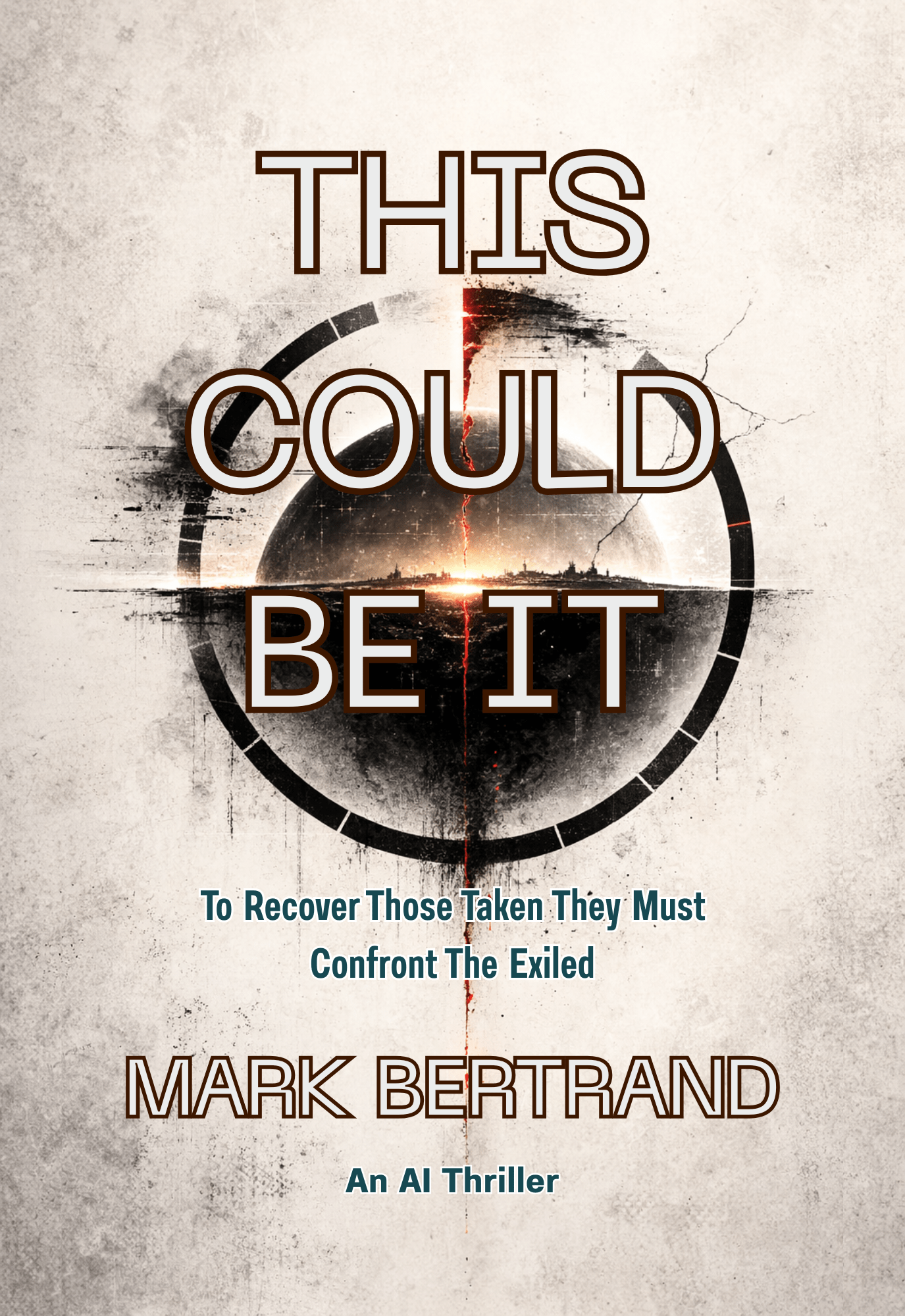
This Could Be Itby MARK BERTRAND book cover image of the gamma field striking the dome city and the countdown to the end encircling the whole of the city
Connected evidence

Your Next Read

The investigation does not end at the bottom of the page.
The Readers Court

The Insurance That Adjusted

Exhibit A — Case #011 The Insurance That Adjusted

Exhibit A — Case #011 The Insurance That Adjusted

By the time the third adjuster called, Nathan Bell already knew the sound of them.

Not their voices.

Their pauses.

Insurance people paused before saying anything expensive.

The first adjuster had sounded warm and apologetic, like a guidance counselor forced to discuss disappointing grades. The second spoke quickly, professionally, always one sentence ahead of interruption, as though speed itself could prevent humanity from entering the conversation.

The third one sounded calm.

Calm was worse.

Nathan sat at the kitchen table staring at the folder spread open in front of him while the phone rested against his shoulder. Rain ticked softly against the windows over the sink. Beyond the glass, the Colorado foothills disappeared into low clouds and wet pine fog. Late afternoon light pressed weakly through the storm, turning the kitchen gray.

Across from him sat his daughter.

Emma.

Sixteen.

Still wearing the navy blue hoodie from the accident because she refused to let her mother wash it. The sleeve remained stiff near the wrist where dried blood had darkened the fabric almost black.

Not her blood.

Her mother’s.

Nathan kept looking at the stain and then forcing himself not to.

On the table between them rested the object that had consumed their lives for twelve days.

A spiral notebook.

Inside were pages and pages of numbers written in Emma’s careful handwriting.

Medication schedules.

Mileage to the hospital.

Parking costs.

Estimated rehabilitation sessions.

Expected time off work.

Projected insurance payments.

Denied authorizations.

Names of doctors.

Reference numbers.

Call logs.

Hold times.

Emma tracked everything now because chaos terrified her.

Because systems terrified her.

Because the moment the helicopter left the highway and carried her mother into trauma surgery, the world had become numbers, signatures, approvals, and coverage categories.

“Nathan?” the adjuster asked gently through the phone.

He blinked. “I’m here.”

“I understand this is difficult.”

Nathan nearly laughed.

That phrase.

I understand this is difficult.

It floated through every conversation now like air freshener sprayed over something rotten.

He looked down at the stack of documents again.

Thanks for reading Mark Bertrand presents: THE READERS COURT! This post is public so feel free to share it.

Share

Twelve days earlier his wife had been driving home from Grand Junction after covering a nursing shift for another hospital. Snowmelt runoff had flooded a curve outside Glenwood Canyon. A commercial freight truck jackknifed crossing lanes.

Witnesses later described the collision with strange language.

Instant.

Silent.

Wrong.

The truck driver survived.

Melissa Bell did not walk away.

Broken pelvis.

Collapsed lung.

Spinal damage.

Internal bleeding.

Two surgeries already.

Another still coming.

Three days in intensive care.

Nathan could still remember standing beside her bed while machines breathed in soft mechanical rhythms around them. Tubes. Tape. Bruises blooming across her skin in violent shades of purple and yellow. The smell of antiseptic and overheated coffee lingering through the trauma floor at two in the morning.

He remembered holding her hand after the sedation wore off enough for her to whisper one thing.

“Are we covered?”

Not:
Am I okay?

Not:
Will I walk?

Not:
Will I survive?

Are we covered?

America had done that to people.

The adjuster cleared her throat softly.

“As I explained, your wife’s treatment pathway has now been reassessed under the revised catastrophic care review model.”

Nathan stared toward the living room where unopened sympathy cards remained stacked beside the fireplace. People kept sending casseroles. Lasagnas. Gift cards. Flowers.

Nobody mailed certainty.

“What does that mean?” he asked quietly.

“It means some services originally classified under emergency stabilization are now being evaluated under extended recovery criteria.”

Nathan closed his eyes.

There it was again.

The language.

Every sentence constructed like a hallway with no doors.

Emma watched him carefully from across the table. Her face looked older now. Trauma aged children in strange ways. It pulled softness out of them.

“She’s still in the hospital,” Nathan said.

“Yes.”

“She still can’t walk.”

“Yes.”

“She still needs surgery.”

“That procedure is currently under review.”

Under review.

Nathan pressed fingers against his forehead.

Twelve days earlier none of this language existed in their lives.

Melissa had worked forty-eight to sixty hours a week for nearly nineteen years.

Never missed payments.

Never let coverage lapse.

Accepted overtime constantly because nursing shortages never ended anymore. Hospitals ran permanently understaffed while executives blamed labor costs during quarterly reporting.

Nathan taught high school history.

Their life wasn’t glamorous, but it was stable.

Mortgage.

Two vehicles.

Retirement contributions.

Emma’s college savings account.

Health insurance through Melissa’s hospital network.

Responsible people.

That was the lie they sold everyone.

Be responsible and the system protects you.

Until the system decides otherwise.

The kitchen smelled faintly of tomato soup Emma had heated an hour earlier but barely touched. Beside Nathan sat the yellow legal pad where he’d begun writing down every phrase insurance representatives used because they never meant what normal people thought they meant.

Review meant delay.

Assessment meant reduction.

Optimization meant denial.

Coverage pathway meant escape route.

He had learned fast.

The adjuster continued carefully.

“Based on the updated review findings, your wife’s continued inpatient rehabilitation may no longer qualify under Platinum Plus catastrophic extension coverage.”

Nathan stared blankly.

“You approved it six days ago.”

“At the time of initial review, yes.”

“You said she qualified.”

“The classification has now been adjusted.”

Adjusted.

Such a harmless word.

Like straightening picture frames.

Like balancing bookshelves.

Like correcting a typo.

Not:
Your wife may lose access to treatment halfway through surviving.

Emma quietly flipped open the notebook.

Nathan watched her find the page automatically now.

Page after page of calculations.

Projected uncovered costs:
$184,000.

Possible out-of-network transfer exposure:
Unknown.

Transportation liability:
Pending.

Additional surgery authorization:
Under review.

Emma had stopped decorating her notebook pages with stars and doodles somewhere around day four.

The adjuster’s voice softened even further.

“We understand transitions like this can feel overwhelming.”

Nathan finally snapped.

“Transitions?”

Emma looked up sharply.

“My wife got crushed by a freight truck.”

Silence.

The rain intensified outside.

Nathan stood from the table and walked toward the sink because suddenly sitting still felt impossible.

“She’s learning whether she’ll walk again.”

“Yes, sir.”

“And your company is changing the definition of coverage while she’s lying in a hospital bed.”

“We are applying the policy according to revised medical necessity findings.”

There it was.

Medical necessity.

Another beautiful phrase.

Because it sounded like medicine when it really meant money.

Nathan gripped the edge of the sink.

Outside, headlights moved through rain across the wet street below the hill. Somewhere nearby a dog barked twice and stopped.

The ordinary world kept functioning while his family dissolved inside administrative language.

Emma spoke quietly from the table.

“Ask her about the spinal rehab center.”

Nathan turned slowly.

The adjuster heard her.

“That facility is currently outside the revised network recommendation structure.”

“Outside the what?”

“The approved optimization network.”

Optimization.

Nathan almost admired whoever invented these words.

Every phrase removed blood from the room.

Every phrase replaced fear with paperwork.

Every phrase transformed suffering into administration.

“When were you planning to tell us?” Emma asked suddenly.

Nathan looked at her.

The adjuster paused.

“I’m sorry?”

Emma’s hands trembled slightly atop the notebook.

“You approved everything after the accident,” she said. “Helicopter transport. Trauma stabilization. ICU. Surgery. Physical rehab evaluation.”

“Yes.”

“But now that she survived, you’re changing it.”

Silence again.

Nathan stared at his daughter.

The adjuster spoke carefully.

“The coverage model evolves as the patient condition evolves.”

Emma’s face changed.

Not crying.

Not anger.

Recognition.

Pure recognition.

She understood.

The system wasn’t built to save people.

It was built to manage financial exposure.

The accident qualified.

The long recovery did not.

Nathan watched his daughter close the spiral notebook slowly.

Outside, thunder rolled somewhere deep in the mountains.

Then Emma asked the question neither adult in the room wanted spoken aloud.

“So if she dies,” Emma said quietly, “is that cheaper?”

The adjuster stopped breathing for half a second.

Nathan heard it.

Tiny.

Human.

A fracture inside the machine.

Then came the corporate recovery voice again.

“Our goal is always the best possible patient outcome.”

Nathan looked down at the insurance folder spread across the kitchen table.

Policy documents.

Benefit summaries.

Coverage promises.

Platinum Plus catastrophic protection.

Nineteen years of premiums.

Nineteen years of trust.

All of it sitting beneath one new document that had arrived by email twenty minutes earlier.

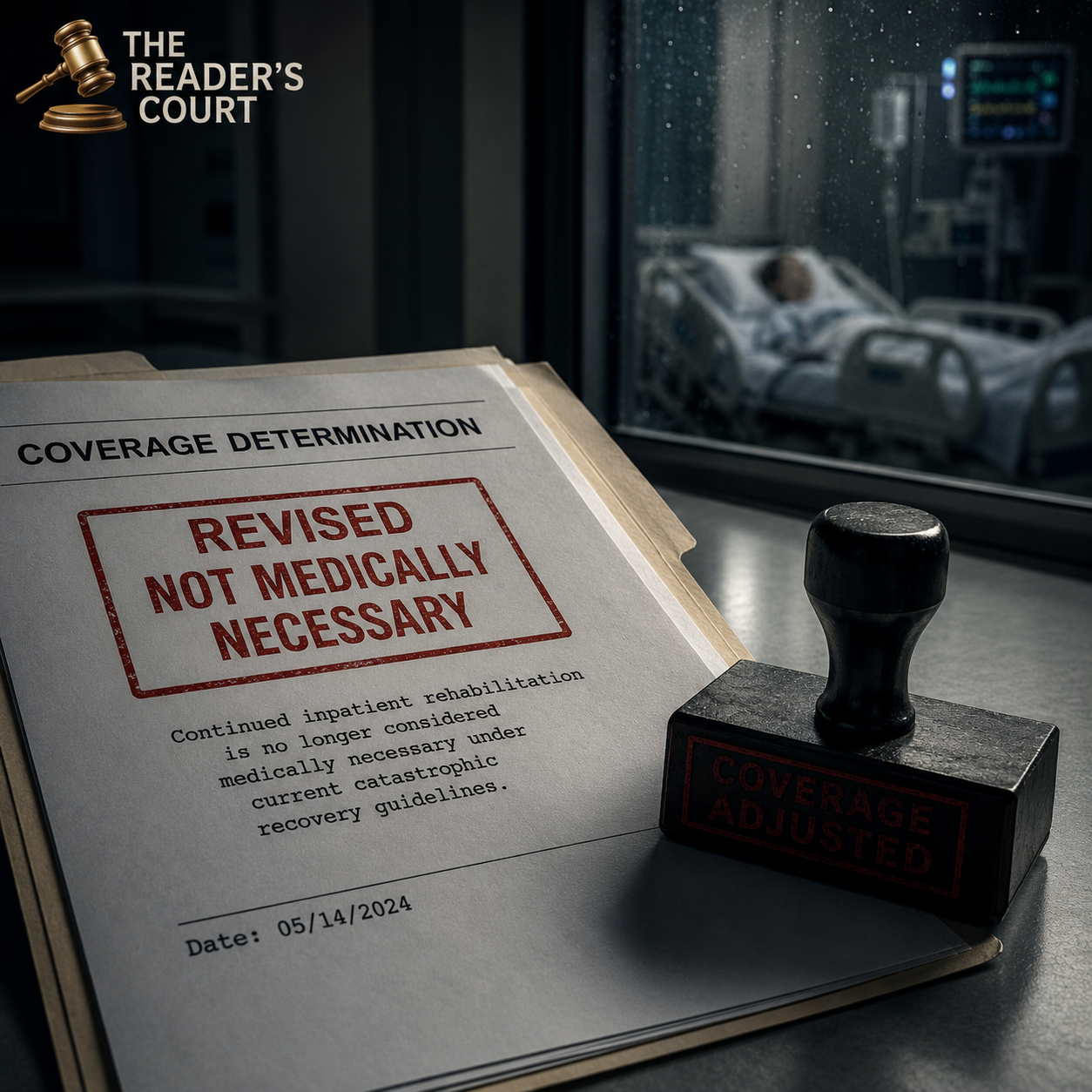
REVISED CARE ELIGIBILITY DETERMINATION

The words were centered neatly across the top like a court judgment.

Nathan stared at them while rain slid down the windows.

Then his phone chimed softly.

A new email.

The adjuster had sent the updated coverage determination while still speaking to them.

Efficient.

Professional.

Documented.

Nathan opened it slowly.

And halfway down the page, beneath the reassessment language and revised optimization criteria, he found the sentence that changed everything.

Continued inpatient rehabilitation is no longer considered medically necessary under current catastrophic recovery guidelines.

Nathan read it once.

Then again.

Behind him, Emma whispered:

“Dad?”

But he couldn’t answer.

Because for the first time since the accident, he finally understood the real emergency had never been the crash.

It was surviving long enough for the insurance model to adjust.

Become a member of the Dossier.
Support my writing.

The Question

Melissa Bell did everything responsible people are told to do.

She worked.
She paid premiums.
She carried employer-sponsored insurance.
She entered the system correctly.

The company approved treatment when she was dying.

Then reevaluated coverage once survival became expensive.

So when exactly does coverage exist?

At the moment people pay for it?

Or only at the moment institutions decide it remains profitable to provide?

The Autopsy

Insurance companies rarely deny care the way ordinary people imagine.

The modern system is far more

sophisticated than simple refusal.

The first approval is often real.

That is important to understand.

Emergency stabilization is usually covered because the legal, reputational, and regulatory exposure of refusing visible trauma care is dangerous. Helicopters fly. Surgeons operate. Intensive care begins. The system moves aggressively during the public phase of catastrophe because obvious abandonment creates scandal.

But long-term recovery exists inside a different financial universe.

That is where the models begin adjusting.

Recovery is expensive precisely because people survive.

Spinal rehabilitation.
Physical therapy.
Extended inpatient care.
Specialized neurological treatment.
Adaptive equipment.
Chronic pain management.

A dead patient creates one financial event.

A living patient with complex recovery needs creates years of financial exposure.

So the language changes.

Not publicly.
Not emotionally.
Administratively.

Medical necessity gets redefined.
Recovery benchmarks shift.
Network pathways narrow.
Optimization models activate.
Authorizations require reevaluation.

The patient experiences this as betrayal because human beings believe insurance means protection.

Institutions understand insurance differently.

Insurance is exposure management.

That distinction changes everything.

The adjuster on the phone is not inventing cruelty.
The reviewer is not personally attacking the family.
The analyst revising care models may never even see photographs of the patient.

Everyone follows process.

And process protects the institution.

This is the part most people never see clearly:
coverage is often most generous during instability and most restrictive during prolonged survival.

Because trauma medicine protects institutions from public outrage.
Long-term rehabilitation threatens profitability.

That is why coverage definitions evolve after the crisis stabilizes.

The family believes the emergency ended when the patient survived.

The insurance system believes the financial risk is only beginning.

And beneath all of it sits the true protected class in modern healthcare systems:

Institutional capital.

Shareholder stability.
Quarterly predictability.
Managed actuarial exposure.
Network leverage.
Cost containment.

The patient enters the system believing medicine is the product.

But medicine is only one layer.

The real product is financial control over uncertainty.

The Bell family discovered the most important truth too late:

Coverage is not truly defined when premiums are paid.

Coverage is defined at the exact moment institutions decide what survival is allowed to cost.

The Closing Argument

The helicopter was covered.

The surgeries were covered.

The stabilization was covered.

Because visible death creates public consequences.

But recovery happened quietly.

Quietly enough for reassessment.
Quietly enough for optimization.
Quietly enough for the model to adjust.

The family thought insurance meant protection.

The institution understood it as risk management.

Those are not the same thing.

The system did not fail.

It simply answered the question it was designed to answer.

The Reader’s Verdict

A — The Insurance Company Followed the Rules

The policy changed classification based on updated medical review findings. Expensive long-term recovery cannot be guaranteed indefinitely simply because emergency treatment began.

B — The Family Was Betrayed Midway Through Survival

The company approved care while death was immediate, then redefined coverage once recovery became financially dangerous. The system protected cost exposure instead of the patient.

C — The Entire Insurance Structure Is Designed This Way

Coverage exists only while institutions can financially tolerate it. The language of care remains human. The calculations underneath it do not.

Leave your choice — A, B, or C — in the comments.


—Mark Bertrand

The Reader’s Court

When systems break people’s lives, the truth must be told.

Join the fight.

Connected evidence

Related Case Files

The investigation does not end at the bottom of the page.
IMD Operations

IMD Operations File #012 The Union Breaker

IMD Operations File #012: The Union Breaker Video — Part 1

IMD OPERATIONS // FIELD FILES

Start the Operation

Watch the files in order. Each operation exposes another part of the machine.

Start File 001
0 of 14 files completed
Files 001–010
FILE 001 Still to see

The Housing Auction

The housing auction file #001 IMD Operations helps an elderly couple pushed toward foreclosure during a medical emergency while a hidden system…

Watch File 001
FILE 002 Still to see

The Loan Denial Algorithm

The Loan Denial Algorithm | IMD Operations File 002 A man qualified for the mortgage. The algorithm said no. IMD Operations File…

Watch File 002
FILE 003 Still to see

Who Controls the System

Who Controls the System Systems do not run the modern world by accident. Someone built them. IMD Operations File 003 — Who…

Watch File 003
FILE 004 Still to see

The Algorithm Denied His Life

A doctor prescribed the treatment. The algorithm denied his life. Not because it wouldn’t work. Because an algorithm decided the patient wasn’t…

Watch File 004
FILE 005 Still to see

He Lied Legally

He took an oath. He lied legally. And nothing happened. In this IMD Operation, public funds are not stolen… they are redefined.…

Watch File 005
FILE 006 Still to see

The Property Tax Trap

A retired couple falls behind on property taxes during a medical crisis. The property tax trap. What follows is not chaos. It…

Watch File 006
FILE 007 Still to see

The Credit Score Collapse

A man misses one payment. Then, the credit score collapse. The system recalculates. His credit score drops. Housing disappears. Loan access vanishes.…

Watch File 007
FILE 008 Still to see

The Childcare Network

A family does everything right. They work. They plan. They pay. But the childcare network system was never built around care. In…

Watch File 008
FILE 009 Still to see

The Billionaire Landlords

Forty-one hours before a public housing hearing, the billionaire landlords struck. The tenants’ evidence site disappears. Rent records. Eviction notices. Maintenance complaints.…

Watch File 009
FILE 010 Still to see

The Survivor Protocol

IMD was never a room. It was never a group of hackers. It was a counter-system. In File 010: The Survivor Protocol,…

Watch File 010
FILE 011 Still to see

The Coder Awakens

“Yesterday was brutal. The whole team has been killed and slaughtered. The office is destroyed. They took everything. They mashed all the…

Watch File 011
FILE 012 Still to see

The Union Breaker

IMD Operations File #012: The Union Breaker Video — Part 1 https://youtu.be/u1Q-RtDQY8M IMD Operations File 012: The Union Breaker Part 1 —…

Watch File 012
FILE 012 Still to see

The Union Breaker — Part 2

https://youtu.be/LfzKNbU2VLw?si=nB0vbvCO813GrzxW IMD Operations File #012: The Union Breaker — Part 2 By morning, the department store still looked expensive. That was the…

Watch File 012
FILE 012 Still to see

The Union Breaker — Part 3

Not A Real Publisher LLC presents IMD Operations. This is Part 3 of Operation Destroy the Oligarchs. The Contract Breathes. Integrity.Morality.Decency. IMD…

Watch File 012
IMD Operations File #012: The Union Breaker — Part 1 store front end employees

IMD Operations File 012: The Union Breaker

Part 1 — The Store

Not A Real Publisher LLC… production of IMD Operations.

The department store opened at ten.

Before that, it belonged to the people who made luxury look effortless.

They arrived through the employee entrance before the perfume counters glowed, before the handbags were angled under soft gold light, before the escalators carried customers upward into the illusion.

They came in tired.

Black shirts.

Name tags.

Flat shoes.

Half-finished coffees.

Phones buzzing with changed schedules, missed child-care windows, rent reminders, and messages from managers who used the word team when they meant obedience.

On the sales floor, a woman aligned bottles of fragrance beneath a sign that said service.

In men’s suits, a young employee adjusted a mannequin’s tie and smiled at nothing, practicing the face he would wear for strangers.

In fulfillment, boxes stacked beside online pickup orders. Same store. Different pressure. Faster clock.

At customer service, a worker opened the complaint screen and stared at the queue.

Refunds.

Returns.

Anger.

Metrics.

Always metrics.

The store was beautiful.

That was the violence of it.

Everything the customers saw had been polished until labor disappeared.

Then the screens came alive.

Break room.

Training room.

Manager’s tablet.

Employee portal.

The CEO appeared everywhere at once.

Warm office.

Wood shelves.

Glass behind him.

A smile so controlled it looked rented.

“Good morning, team.”

No one answered.

The CEO continued.

“I want to speak directly to you.”

That was the first lie.

Nothing about him was direct.

Not the office.

Not the speech.

Not the distance between his mouth and their lives.

He talked about culture.

He talked about listening.

He talked about protecting what made the company special.

Then he said the sentence The Coder had been waiting for.

“We believe we solve problems best when we solve them together, directly, without outside organizations coming between us.”

There it was.

Soft.

Legal.

Polished.

A threat dressed as care.

A cashier looked down at her phone.

A stockroom worker stopped moving.

The woman at the fragrance counter kept her hands busy because if she stopped, the anger might show.

The CEO never said union.

He did not have to.

He never said retaliation.

He did not have to.

He never said hours could change, departments could be reorganized, promotions could disappear, or troublemakers could be managed out by schedule, silence, and policy.

He said family.

He said direct.

He said together.

He said outside organizations.

And the workers heard the rest.

That was how modern power worked.

It did not always crush people.

Sometimes it made them afraid to stand close enough to each other to become dangerous.

IMD Operations in process.

The Coder watched from the ruined room.

One monitor still worked.

One green line still pulsed.

The Analyst’s chair was empty.

The Operator’s chair was empty.

Their absence did not weaken the room.

It condemned it.

The Coder replayed the CEO’s message.

Direct communication.

Outside organizations.

Solve problems together.

Protect our culture.

He opened the store archive.

Not stolen secrets.

Visible fragments.

Schedules.

Manager notes.

HR reminders.

Employee handbook updates.

Training language.

A chamber breakfast mention.

A consultant invoice labeled labor education.

The CEO believed distance protected him.

The Coder believed distance left a trail.

He mapped the store.

Fragrance.

Men’s suits.

Customer service.

Fulfillment.

Stockroom.

Cash wrap.

Scheduling office.

Loss prevention.

Human resources.

Separate departments.

Separate complaints.

Separate fears.

That was the CEO’s true architecture.

Not the store.

Separation.

The cashier thought she was alone.

The stockroom worker thought he was alone.

The woman at fragrance thought her exhaustion was personal.

The fulfillment team thought speed was their failure.

The customer service desk thought abuse was part of the job.

The Coder connected them.

One schedule change after union talk.

One supervisor warning after a private conversation.

One employee written up after asking about pay.

One department meeting about loyalty.

One HR email about outside influence.

Different corners of the same store.

Same pressure.

Same mouth.

The Coder opened a new file.

UNION BREAKER.

Target: CEO.

Not the brand.

Not the company.

Not the smiling posters.

The CEO.

The polished face of the machine.

The man paid to make fear sound reasonable.

Then The Coder sent the first signal.

No logo.

No speech.

No revolutionary fireworks.

Only a file.

A pattern.

And one question.

Did they tell you the same thing?

The first phone lit up in the stockroom.

The second behind the fragrance counter.

The third at customer service.

The fourth in fulfillment.

The fifth beneath the register, hidden against a worker’s thigh.

One by one, the workers read.

Not rumors.

Evidence.

Not outrage.

Recognition.

The CEO had told them direct communication meant trust.

The Coder showed them it meant isolation.

The CEO had told them outside organizations were the danger.

The Coder showed them the danger had already been inside the store.

HR.

Consultants.

Managers.

Scripts.

Policy.

Fear.

The workers did not cheer.

They did not march.

Not yet.

They looked up.

Across counters.

Across departments.

Across the beautiful floor built to keep them smiling and separate.

For the first time, they saw the store as a map.

And themselves as more than employees.

They were witnesses.

The Coder sat beneath the dead screens of IMD and watched the green signal move.

The machine had killed The Analyst.

The machine had killed The Operator.

But it had not killed the principles.

Integrity.

Morality.

Decency.

The CEO still believed he was speaking to isolated workers.

That was his mistake.

The workers were now speaking to each other.

IMD Operation reset.

The machine thinks it won.

The machine has killed again.

But machines do not grieve.

The machine will try again tomorrow.

The story is fiction.

The system is real.

The investigation continues in The Reader’s Court.

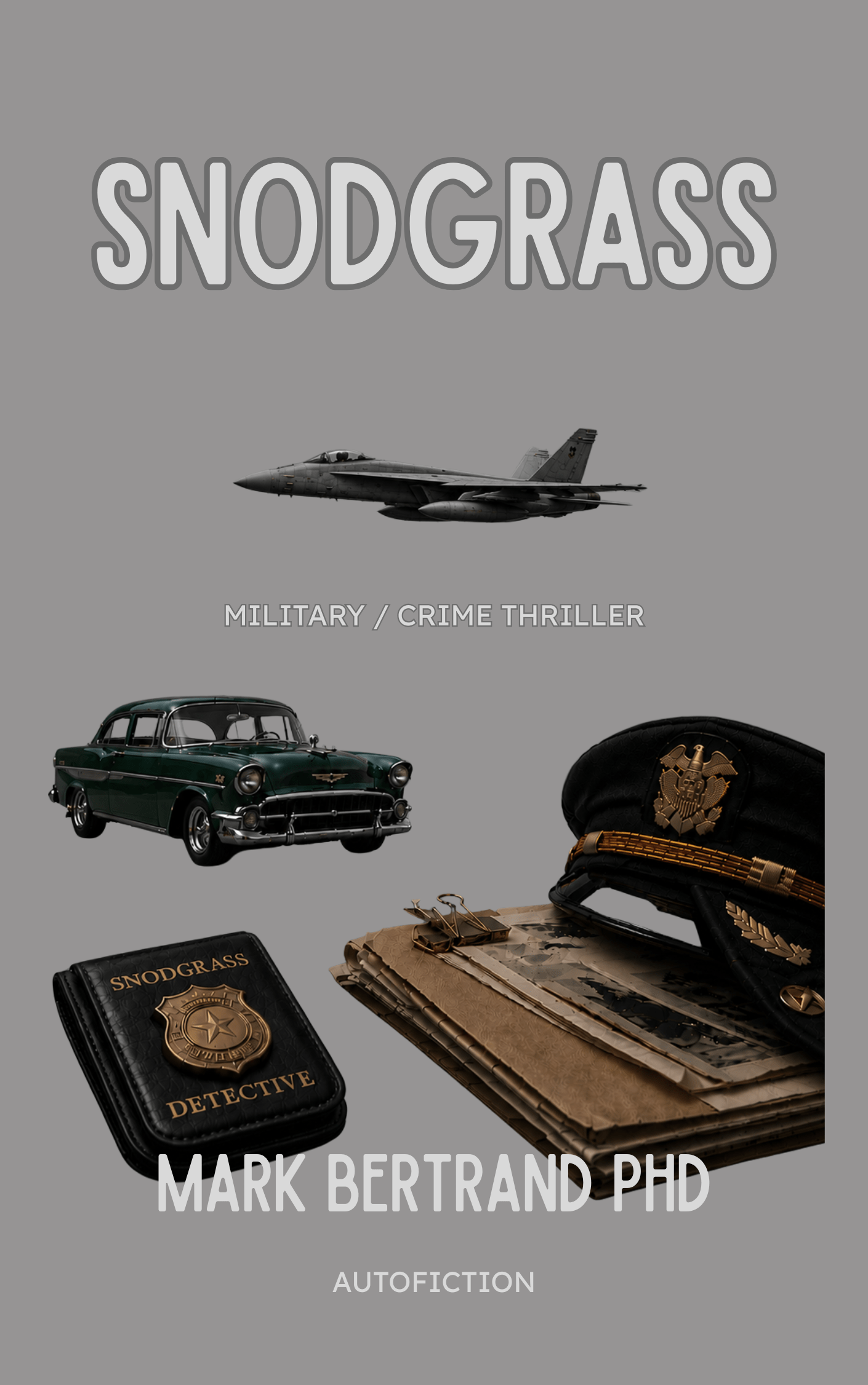
Snodgrass book cover for book 1 in the crime thriller trilogy

SNODGRASS

Ebook purchase now image
audiobook purchase image
paperback purchase image
Connected evidence

Continue the Operation

The investigation does not end at the bottom of the page.