
Exhibit A — Case #005 | The Scholarship That Was Not Renewable
The acceptance letter arrived on a Thursday afternoon in April, folded inside a cream-colored envelope so thick it looked less like mail than something official enough to alter the shape of a life.
Sarah Kim found it propped against the fruit bowl on the kitchen table when she came home from school. Her mother had placed it there on purpose, centered carefully on the scratched wood as though the table itself should understand what it was being asked to hold.
For a moment Sarah only stood in the doorway with her backpack hanging from one shoulder.
The kitchen was small and warm from the rice cooker. A pan was drying beside the sink. Light from the window over the counter fell across the envelope and picked out the university crest pressed into the paper in deep blue ink. NORTHFIELD UNIVERSITY. The letters looked expensive. Permanent. The kind of name that belonged on old stone and library walls and brochures with students in wool coats carrying books across bright green lawns.
Her mother came in from the hallway wiping her hands on a dish towel.
“Well?” she said.
Sarah looked at the envelope again. “You opened my mail?”
“I did not.” Her mother nodded toward it. “I brought it inside. That is not the same thing.”
“You know the email already came.”
“I know.” Her mother pulled out a chair and sat down. “The email is not this. Sit.”
Sarah laughed despite herself. “You’re acting like it’s a court summons.”
“Maybe it is,” her mother said. “Maybe it summons you out of this house.”
There was enough nervousness in the room already that the joke landed softly and then disappeared.
Sarah sat.
She slid one finger beneath the flap and opened the envelope slowly so the paper would not tear. Even that felt important. She removed the letter and unfolded it across the table.
The paper was heavy. It made a faint, expensive sound.
She read the first line out loud because her mother was staring at her face instead of the page.
“Dear Sarah Kim, we are pleased to offer you admission to Northfield University for the fall semester.”
Her mother pressed the dish towel to her mouth.
Sarah kept reading. Her voice was steady until she reached the section farther down the page, set apart in bold type.
Presidential Merit Scholarship
Full tuition coverage for four years.
She stopped.
For a second neither of them said anything.
Then her mother sat down harder than she meant to and let out one sharp breath that sounded almost like a laugh and almost like crying.
“Oh my God,” she said.
Sarah looked at the words again to make sure they were still there. Full tuition coverage for four years. Four years. Not one year with renewal possible. Not partial aid. Not some hopeful arrangement that depended on phone calls and appeals and prayers and forms spread across the kitchen table. Four years.
Her mother reached across and touched the lower corner of the letter with two fingertips.
“Read it again.”
Sarah did.
By the time her father came home, the letter was still lying in the same place. He set a plastic grocery bag on the counter, loosened his work boots with the back of one heel, washed his hands, and only then came to the table.
He smelled faintly of cardboard dust and cold air from the loading docks.
Her mother handed him the letter without speaking.
He read more slowly than either of them had. Line by line. Then he went back and read the scholarship section again.
“Four years?” he said.
“That’s what it says.”
He nodded once, the way he did when measuring something in his head.
“That’s a good school.”
Sarah smiled. “Yeah.”
He looked at her then, not at the letter.
“You wanted this one.”
“I did.”
He placed the page carefully back on the table. “Then this changes things.”
That night her mother bought a small cake from the bakery near the bus stop. It was too sweet and the frosting stuck to the roof of Sarah’s mouth, but nobody cared. Her father cut the slices too large. Her younger brother asked whether Northfield had famous people there. Her mother told him to stop talking with his mouth full. Sarah took a picture of the letter and the cake and the cheap paper plates and the three of them crowding into the frame because the kitchen was too narrow to step back any farther.
Later, before bed, her father slid the letter into a clear plastic sleeve and placed it inside the blue accordion file where the family kept passports, tax records, medical bills, and the apartment lease.
“Don’t leave that lying around,” he said.
“I wasn’t going to.”
He shut the file. “Some papers mean what they say. You keep those close.”
All summer the letter became the object around which the house quietly reorganized itself.
Her mother started collecting things for the dorm in patient, practical installments: two towels from a discount store, a desk lamp still in its box, a navy blanket folded at the foot of Sarah’s bed, adhesive hooks, laundry pods, a plastic caddy for the communal bathroom. Her father found a used mini-fridge through a man at work whose daughter had just graduated. Her brother wrote NORTHFIELD on the side of a cardboard moving box in crooked block letters with a black marker and then decorated the corners with stars until Sarah made him stop.
On some evenings Sarah would remove the letter from the plastic sleeve and read it again for no reason except to feel the shape of it in her hands.
Full tuition coverage for four years.
The words did not feel like money.
They felt like a door opening.
Northfield was the kind of place she had only seen in brochures and online campus tours. Ivy twisting up stone walls. Wide lawns cut so cleanly they looked unreal. Laboratories with glass walls. A library that looked more like a cathedral than a building people actually entered with backpacks and coffee. At orientation, when she first walked through the main quad beneath late-summer sun and heard the bells from the old clock tower strike the hour, she felt the strange double-sensation of having arrived somewhere completely new and somewhere she had already visited a hundred times in private.
In the admissions office, a smiling administrator reviewed her paperwork across a polished desk.
“You’ve done extremely well,” the woman said. “The Presidential Scholarship is one of our most competitive awards.”
Sarah signed where she was told to sign. Enrollment forms. Housing. Meal plan. Registration acknowledgments. Then the administrator passed her one more page.
“This is the annual scholarship compliance agreement,” she said. “Standard requirements.”
Sarah scanned the page. Maintain minimum GPA requirements. Remain enrolled full time. Avoid disciplinary violations.
Nothing about it worried her. Those were the rules of serious life, the ones she had already been living by for years.
She signed.
When she stepped back outside, she held the folder against her chest and stood for a moment in the late August heat while students and families passed across the quad carrying bedding and lamps and unopened boxes. Her future had weight now. It could be carried.
Freshman year was harder than she had imagined and better.
The classes moved fast. Professors assumed you had done the reading and then assumed you had gone beyond it. The engineering students she met during orientation became her study group by accident after one long evening in the library when everyone remained at the same table past midnight and nobody wanted to surrender the outlet near the window.
They argued over formulas and laughed over bad campus pizza. They learned which classrooms had the best heat in winter and which vending machines stole your money. Sarah discovered that she loved the clean logic of difficult problems, the moment when confusion began to give way and the structure inside something finally revealed itself.
She also learned how to stretch every dollar that was not tuition. She worked ten hours a week shelving books at the library. She skipped overpriced coffee. She called home on Sundays while folding laundry in the basement of her residence hall. Her mother always asked whether she was eating enough. Her father always asked about classes. Her brother once held up a half-finished science project to the phone camera and said, “When you come home, you have to fix this part because Mom says it looks stupid.”
At the end of the first year Sarah’s GPA was 3.52.
She checked the scholarship requirements again just to be safe.
More than enough.
When she came home for the summer, the apartment seemed smaller than she remembered and more precious for that reason. The air conditioner rattled in the living room window. The kitchen table still carried its old scratches and water rings. Her room had become a place between departures, with dorm bins stacked in the corner and a Northfield sweatshirt hanging from the chair.
The family had survived a difficult winter. Her mother’s medical bills from an emergency procedure had taken months to pay down. Her father had picked up overtime at the warehouse after a supervisor retired, and for the first time in a long while there was less panic attached to the mailbox and the end of each month.
They were not comfortable. They were breathing.
That August, three days before move-in, the apartment filled again with the ordinary hopeful clutter of departure. Extra notebooks. A mattress topper rolled tight with twine. New pens. A cheap blue rug her mother insisted would make the dorm room “look less temporary.” Two storage bins sat by the front door. Her father checked the car twice to see what would fit in the trunk and what would need to ride on the back seat. Her brother kept sneaking granola bars into different bags as though Northfield existed in a wilderness without stores.
On the morning they were supposed to leave, Sarah woke before everyone else.
The apartment was quiet except for the refrigerator hum and the occasional hiss from the building pipes. Gray morning light lay across the living room. She made coffee, sat at the kitchen table, and opened her laptop to print her class schedule and confirm that her student account was clear before they drove out.
The blue accordion file was already on the table because her mother had taken it out the night before. Inside were all the important papers: dorm assignment, health forms, ID documents, and the original scholarship letter in its plastic sleeve. Sarah slid the letter halfway out and looked at it while the laptop loaded.
Full tuition coverage for four years.
Her father came into the kitchen pulling on his belt. “You’re up.”
“Couldn’t sleep.”
He glanced toward the stacked boxes near the door and smiled in the tired, private way he did when he was pleased but did not want to make too much of it. “Big day.”
Sarah nodded. “I’m just printing a few things.”
He poured himself coffee and went back to the bedroom to finish dressing.
A notification appeared on the student portal.
Scholarship Status Update.
Sarah clicked it without concern. She assumed it was the routine renewal confirmation for second year, one more administrative page to clear before classes started.
Instead a red banner filled the screen.
Additional eligibility verification required under revised institutional funding guidelines.
She frowned and opened the linked document.
The language was dense and sterile. Following a routine financial compliance review. Restructured under updated institutional policy. Continuing financial eligibility. Revised threshold.
Sarah read the page once without understanding it. Then again.
She clicked deeper into the portal and found the financial aid tab. The scholarship amount for the upcoming year had changed. Not reduced a little. Not adjusted. Changed.
She opened the family-income review summary and saw where the difference had entered the system. Her father’s overtime from the previous year. The extra shifts that had paid off hospital bills and kept collection notices from spreading across the table. That number now sat inside the university’s calculations as evidence that the family crossed a new line.
Sarah’s hands went cold.
She opened the billing page.
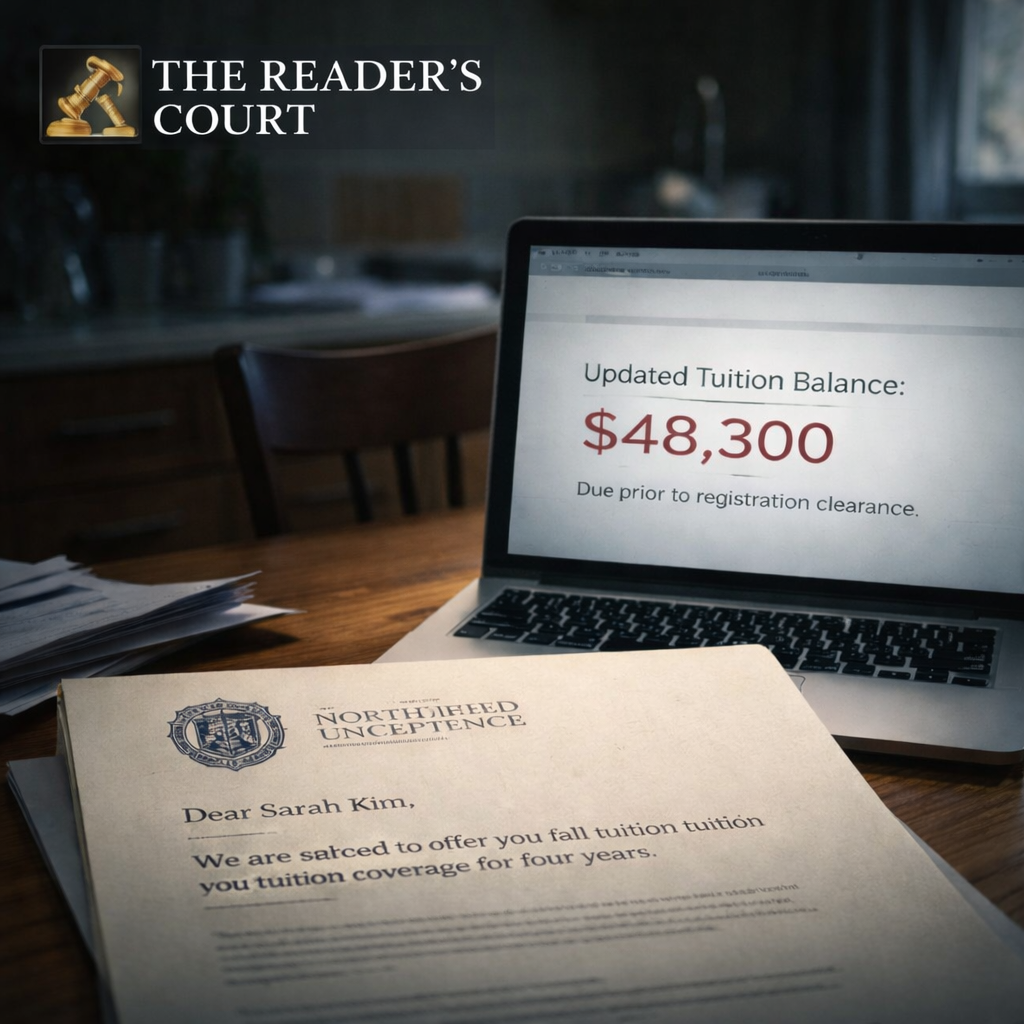
Updated Tuition Balance: $48,300
Due prior to registration clearance.
For several seconds the room seemed to lose sound. The refrigerator still ran. Water still moved somewhere inside the walls. But everything felt farther away, as if the kitchen had drawn back from her and left her sitting alone under a bright hard light.
Her mother came in carrying folded towels. “I found the second set,” she said. “The blue ones, not the white. White gets ruined in those laundry rooms.”
Sarah did not answer.
Her mother set the towels down. “What is it?”
Sarah lifted the original letter from the table with one hand and turned the laptop slightly with the other.
Her mother stepped closer.
On the screen the number remained fixed and flat and impossible.
Her father came back into the room buttoning his cuff. “You ready to start loading?”
Neither of them looked at him.
He saw their faces and stopped.
Sarah placed the acceptance letter beside the laptop so the two documents lay next to each other on the kitchen table, almost touching. The cream-colored page with the blue crest. The white screen with the red banner.
Four years on one side.
Forty-eight thousand three hundred on the other.
And then the system, at last, finished saying what it meant.
Become a member of the Dossier.
Support my writing.
The Question | The Scholarship That Was Not Renewable
Sarah did what she was told to do.
She earned the grades. She kept the scholarship conditions. She stayed enrolled full time. She avoided trouble. She completed her first year with room to spare above the required GPA.
The university also did what it told her it would do, at least long enough for her to organize her life around it. It offered four years. It let her move in, study, work, belong, and build a future on the strength of that promise.
Then the family’s circumstances improved slightly, not because they became wealthy, but because her father worked more hours to pay off medical debt.
So the same system that had helped bring her there now used that narrow improvement to reopen the deal.
The question is not whether the number on the screen was real.
The question is how a promise that felt moral to the family became conditional to the institution the moment the institution found a reason to protect itself.
The Autopsy
A scholarship like Sarah’s is presented to the student as recognition, reward, and opportunity. Inside the institution, it is also a financial instrument. Universities use scholarships to attract desirable students, shape the freshman class, improve academic standing, and influence who says yes. The student experiences honor. The institution manages revenue.
That promise sits inside a larger structure the student never sees. Many universities are carrying bond obligations, construction debt, lender agreements, donor expectations, payroll burdens, and enrollment targets that must be met every year. When those pressures tighten, the institution looks for places where cost can be moved, narrowed, reclassified, or shared.
Aid is one of the most efficient places to do that. A scholarship can be described as generous in public and conditional in policy. A promise can be framed broadly at the front end and reviewed narrowly once the student is already inside the system. Annual compliance language, revised eligibility screens, and institutional-policy clauses create room for the school to change what the family believed had already been settled.
Notice what the review measured. It did not ask what is the right thing after a family has organized a child’s future around a four-year offer. It asked whether the institution could now shift more of the burden back onto the family without violating its own procedures. The father’s overtime was not read as sacrifice. It was read as available capacity.
No individual employee needs to be malicious for this to happen. Admissions can say the original offer was accurate when issued. Financial aid can say the policy changed. University counsel can say the review complied with signed agreements. Lenders can say they never made the decision about Sarah Kim. Each part remains respectable inside its own boundary.
Beneath all of it is the wealth-protection layer. Debt service must be paid. Liquidity must be protected. Credit relationships must remain stable. Expansion plans, payroll, operating margins, and institutional reputation must survive. When those priorities collide with a family’s understanding of a promise, the institution does not ask who is most vulnerable. It asks what protects the institution.
The Reader’s Verdict
Sarah kept her side of the agreement.
The university kept the wording, but not the promise.
Integrity disappeared the moment four years became something the school could advertise with confidence and revise with procedure.
Morality disappeared when a father’s extra shifts, worked to erase medical debt, were converted into evidence that his daughter could bear a bill the family was never meant to carry.
Decency disappeared when the institution waited until she belonged to the place before informing her she could no longer afford to remain there.
No one had to shout.
No one had to lie.
The forms were updated. The numbers were reviewed. The burden was moved.
The school did not ask what is the right thing.
It asked whether the cost could be transferred without violating policy.
That is how Sarah’s future was withdrawn.
—Mark Bertrand
The Reader’s Court
When systems break people’s lives, the truth must be told.
Join the fight.


0 comments
Write a comment