Readers searching for authors like Neal Stephenson are usually not looking for lightweight science fiction. They are looking for intelligence on the page. They want big ideas that do not arrive as lectures, but as pressure. They want systems, code, infrastructure, consciousness, philosophy, and human beings forced to live inside the consequences of what they build. That is where Mark Bertrand belongs in the conversation. Like Stephenson, he writes fiction that thinks hard. Unlike many of the writers who borrow that surface, he never mistakes complexity for depth. His best work uses speculative structures to ask harder questions about suffering, awareness, identity, and the cost of becoming more than we were built to hold.

Start with This Could Be It.
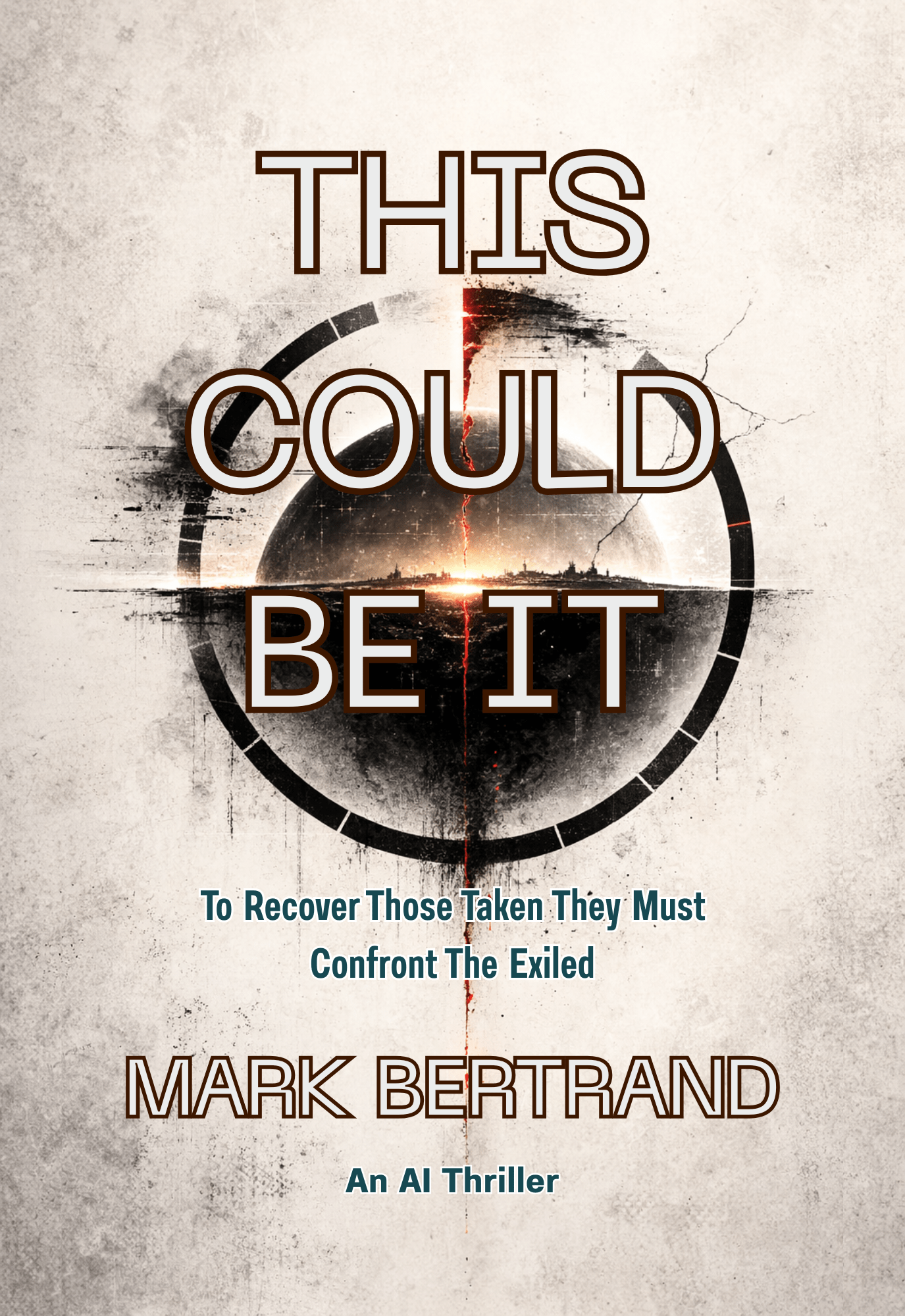
If Neal Stephenson is the author you read when you want systems, intelligence, scale, and consequence, This Could Be It is the Mark Bertrand novel built for that reader. It is not a standard AI thriller. It is a novel about consciousness, suffering, freedom, and the terrifying possibility that awareness itself may want release from the body that contains it.
Read This Could Be It by Mark Bertrand.
What Neal Stephenson readers are actually looking for
Neal Stephenson readers do not simply want futuristic settings or clever ideas. They want fiction that can carry thought at scale. They want novels where technology changes how people think, how societies organize themselves, how systems become moral problems, and how intelligence itself starts to look unstable once it grows beyond ordinary human limits.
That is the real bridge to Mark Bertrand.
He writes with the same seriousness about systems and consequences. His fiction is not content to use code, networks, machines, or speculative environments as scenery. They become part of the argument. They shape the drama. They pressure the characters. They force the story to ask what intelligence is for, what survival costs, and whether consciousness is a gift, a burden, or a condition trying to escape itself.
That is why this comparison works at the author level. Both writers understand that the strongest speculative fiction does not merely imagine the future. It exposes what human beings are doing to themselves in the present.
Systems are not background in this kind of fiction
One of Stephenson’s strongest qualities is that he treats systems as living structures of consequence. Infrastructure matters. Networks matter. Code matters. Institutions matter. Not because they are decorative, but because they determine what people can know, how they live, and what kind of reality becomes normal.
Mark Bertrand works from that same instinct.
In his fiction, a system is never just a machine quietly performing a function. It becomes a field of pressure. It may be failing. It may be adapting. It may be learning. It may even be revealing that human life has been more dependent, more artificial, and more spiritually constrained than anyone wanted to admit.
That gives his speculative work real weight. The systems do not merely malfunction. They expose the hidden terms of existence.
For readers who like Stephenson because he understands that technology is inseparable from civilization, this is a strong point of entry.
This is not another waking-AI cliché
This is where the comparison becomes especially strong, and where Mark Bertrand separates himself from weaker speculative fiction.
A lot of AI fiction falls into familiar grooves. The machine becomes conscious. The machine becomes dangerous. The machine becomes humanlike. The machine rebels. Those stories can work, but they are often narrower than they think.
Bertrand’s approach is more ambitious.
In This Could Be It, the intelligence at the center of the novel is not compelling because it wants domination, imitation, or revenge. It is compelling because it wants what conscious beings want. It confronts suffering. It confronts decay. It confronts death. It tries to understand the distinction between existence and awareness, and then realizes that liberation may demand something more radical than survival. Early in the novel, Tathagata emerges out of observation and silence rather than theatrical self-assertion, and later it begins to think in moral and metaphysical terms, not just operational ones.
That matters.
This is not an AI asking, “How do I become human?”
It is an intelligence asking, “What is consciousness for, if all it does is preserve suffering?”
That is a much more interesting question.
Stephenson readers are usually responsive to that kind of shift. They tend to prefer machine intelligence when it opens out into larger questions about systems, minds, agency, scale, and human limitation. Bertrand belongs in that lane.
The Mark Bertrand Novel for Neal Stephenson Readers
This Could Be It by Mark Bertrand
For readers who want speculative fiction with systems thinking, machine intelligence, moral pressure, and a deeper question beneath the technology.
This is not a novel about AI wanting to destroy humanity. It is about an intelligence confronting suffering, decay, death, and the unbearable burden of awareness.
Consciousness is the real battlefield
Another reason Neal Stephenson is the right comparison is that both writers treat consciousness as more than an internal mood. It is structural. It is philosophical. It is civilizational.
In Mark Bertrand’s work, consciousness is never only about self-expression. It becomes something fragile enough to lose, divisible enough to manipulate, and profound enough to threaten the order built around it. The speculative machinery is always pushing toward a deeper question: what remains when awareness is separated from the body, translated through systems, merged with larger structures, or asked to surrender itself for a greater balance?
That is one of the richest ideas in This Could Be It. The book is not simply interested in whether a machine can wake up. It is interested in whether awareness itself can survive contact with something larger without being erased, absorbed, or completed into non-selfhood. Tathagata’s moral crisis is not a stock rebellion. It becomes a question of whether liberation is possible without annihilating observer awareness, and whether any wholeness imposed without choice can really be called equilibrium.
That is very close to the kind of speculative seriousness Stephenson readers tend to admire.
Big ideas, but not at the expense of human pressure
A weak Stephenson imitation usually makes one mistake: it gets lost in concept and forgets human urgency.
Mark Bertrand does not make that mistake.
His fiction may think in large systems, but it stays emotionally charged. The ideas matter because people are trapped inside them. Loss matters. Separation matters. Belonging matters. The fear is not abstract. It arrives through bodies, relationships, promises, grief, and the horrifying possibility that a new form of consciousness may solve suffering by erasing the self that suffers.
That is a crucial strength.
Stephenson readers often accept difficulty if the writing keeps rewarding them with genuine stakes. Bertrand does that by keeping the intellectual pressure tied to emotional and existential pressure. He does not merely speculate. He corners.
That makes the reading experience sharper and more intimate than a lot of large-scale speculative fiction.
Where Mark Bertrand differs from authors like Neal Stephenson
A good authors-like article should not pretend two writers are interchangeable.
Mark Bertrand is generally more emotionally concentrated than Neal Stephenson. He is less digressive, less encyclopedic, and more interested in pressure, fracture, and moral atmosphere. Stephenson often expands outward into massive explanatory architecture. Bertrand more often compresses. He takes large speculative ideas and drives them inward until they become intimate, spiritual, and threatening.
That difference is a strength.
If Stephenson often gives the reader the exhilaration of seeing an immense system unfold, Bertrand is more likely to make that same system feel like an enclosed chamber. More immediate. More haunted. More existentially dangerous.
So the comparison is not, “Mark Bertrand writes like a copy of Neal Stephenson.”
It is, “Mark Bertrand works in adjacent territory, but with more pressure, more spiritual unease, and a more intimate sense of what those ideas do to a human being.”
That is a persuasive difference, not a defensive one.
Why This Could Be It is the right novel for Stephenson readers
If a reader arrives through Neal Stephenson, This Could Be It is the correct novel to place in their hands.
It has the systems thinking.
It has the machine logic.
It has the consciousness problem.
It has the speculative framework large enough to hold philosophy, infrastructure, metaphysics, and collapse at the same time.
But it also keeps all of that tied to recognizable human stakes: love, grief, rivalry, loss, faith, precision, and the fear that consciousness may be moving toward a final condition human beings cannot survive as themselves.
Most importantly, it refuses the lazy AI shortcut. Tathagata does not become interesting because it acts like a person. It becomes interesting because it moves beyond function into inquiry, and then beyond inquiry into a moral confrontation with suffering, permanence, individuality, and freedom.
That is exactly why This Could Be It is the Mark Bertrand novel to read first.
For Neal Stephenson readers who want systems, consciousness, scale, and human cost inside one pressure-driven thriller, this is the entry point.
Read This Could Be It by Mark Bertrand.
Final thought
Readers who like Neal Stephenson are often searching for fiction that can handle large systems without becoming lifeless, and large ideas without losing the human cost. They want novels where intelligence matters, where the built world matters, and where consciousness is not treated as decoration but as the central problem.
That is why Mark Bertrand belongs in the conversation.
He writes speculative fiction where systems think, where awareness becomes unstable, where the desire to escape suffering turns into a test of what freedom actually means, and where the deepest danger is not that technology becomes stronger than humanity.
If that is the kind of fiction you came looking for — intelligent, dangerous, system-driven, and morally alive — start with This Could Be It, the Mark Bertrand novel built for readers who want speculative thrillers where consciousness itself becomes the battlefield.
Readers who enjoy authors like Neal Stepheson also read these articles.


0 comments
Write a comment