
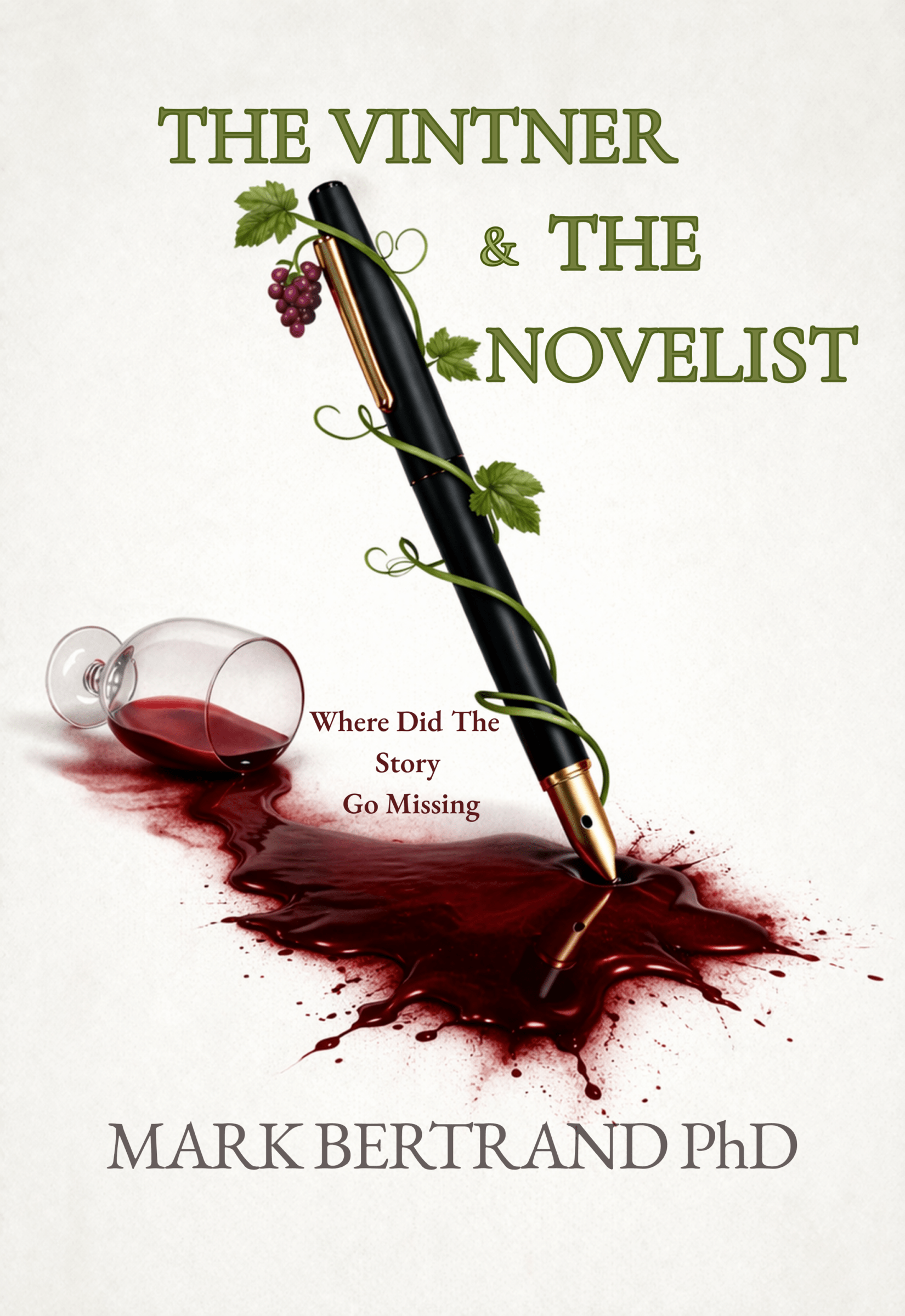
At first glance, The Vintner & The Novelist seems to be a literary psychological thriller about pain, authorship, and the unstable border between a man’s life and the story he writes. But underneath that visible structure sits something harsher and far more original: the hidden courtroom.
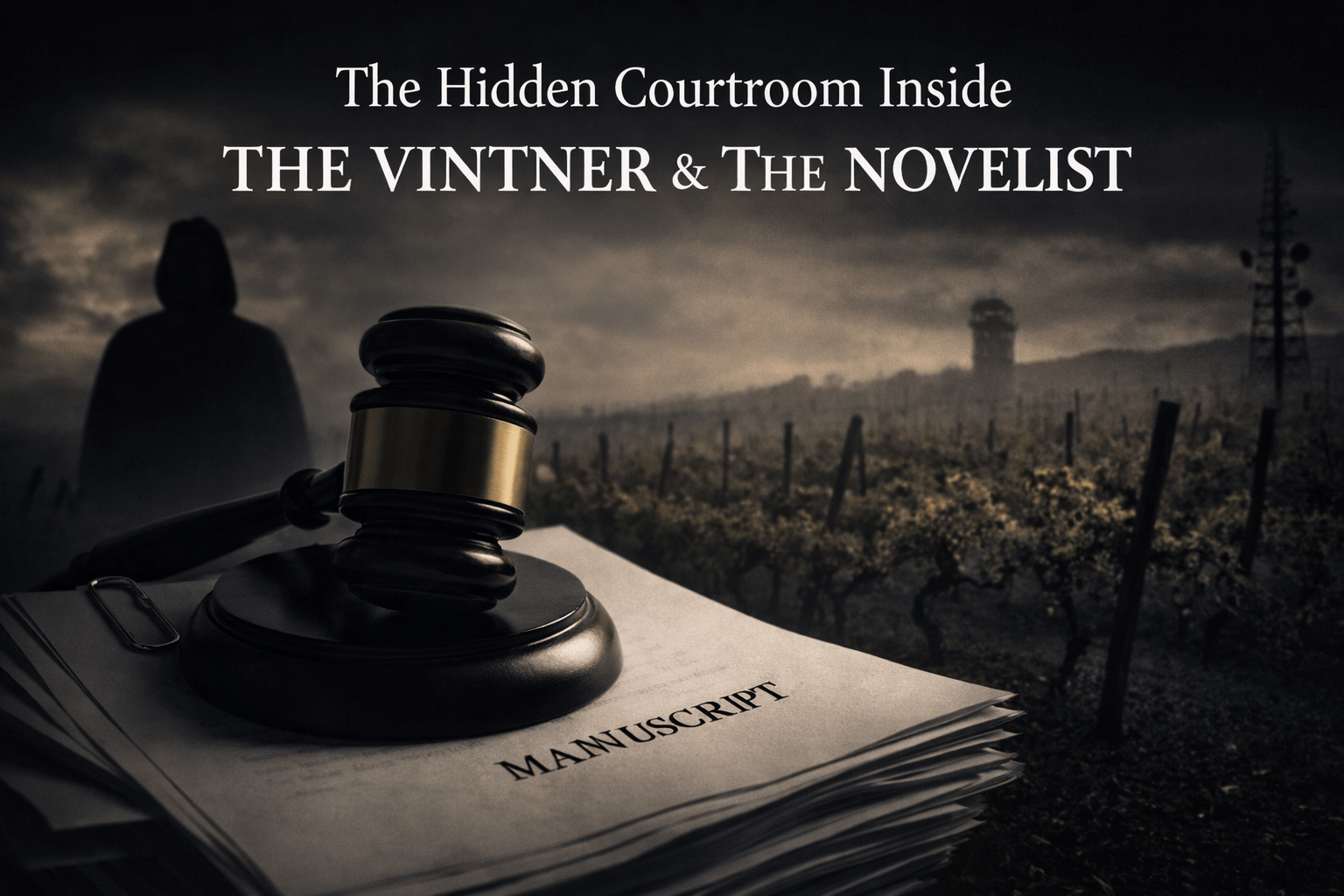
Not a decorative courtroom. Not a metaphor borrowed for atmosphere. A governing one.
This novel is built on charge, custody, judgment, sentence, and authority. It is not merely asking whether the novelist can survive what is happening to him. It is asking who has the right to judge a manuscript, who has the right to possess it, and what becomes of a writer when story itself is treated like evidence.
The novel tells you the truth early
One of the sharpest signals comes before the novel fully begins. The copyright page does not behave like neutral publishing housekeeping. It announces that any resemblance to systems of judgment, control, or permission is intentional, and that “compliance is achieved when resistance becomes indistinguishable from understanding.” That is not ornamental language. It is a warning label. The book is telling you, before the pressure fully arrives, that power here will not come as melodrama. It will come as procedure.
Even the contents page quietly supports that design. Chapter titles such as The Judge, Revision Map Protocol, Custody, The Dossier, and The Eraser do not read like loose surrealism. They read like stages in a legal and institutional process. The architecture of the novel is already judicial before the interpretation catches up.
The charge is not authorship. It is possession.
The hidden courtroom becomes unmistakable the moment the novelist wakes into that chamber and hears the question, “How do you plead?” From there, Bertrand makes one of the book’s most dangerous decisions. The charge is not authorship. It is not publication. It is not plagiarism. It is “possession of a manuscript.”
That wording changes everything.
Authorship implies creation. Possession implies custody. It suggests the manuscript may not belong to the novelist in the full sovereign sense he assumes. It turns the work into an object under dispute and the writer into a man caught too close to it. The novel itself explains the force of that distinction: possession is what you charge a man with when you want to separate the work from the person who made it. That is the real shiver inside the scene. The court is not arguing over whether he wrote it. The court is arguing over whether he ever had the right to hold it.
Once that lands, The Vintner & The Novelist stops being a strange book about a writer in trouble and becomes something more precise: a book about unstable ownership, provisional access, and the terror of being found in custody of something larger than you can justify.
“Narrative erasure” is worse than death
The court does not stop at charge. It names the offense “capital” and the punishment “narrative erasure.” That phrase is one of the novel’s finest inventions because it goes past bodily fear and strikes the writer where identity lives. Death ends a life. Erasure cancels the record of it. It is administrative annihilation. It is not only punishment. It is deletion.
That is why the scene feels so cold. The court does not rage. It processes. The judgment arrives in the voice of a system that has outlived appeal. Even mercy is reduced to procedure. Pardon is not granted. It may be “considered.” The difference is devastating. Compassion here is not moral. It is bureaucratic.
The effect on the reader is profound. The scene refuses the heat of spectacle and replaces it with something more unnerving: authority that no longer needs to raise its voice.
The vineyard is part of the same court
What makes the novel richer is that this courtroom is not confined to the chamber where The Readers sit. Its logic reaches into the vineyard.
The vintner’s life is also ruled by deadlines, notices, assessments, penalties, and systems that continue moving while the body fails. The property tax is not framed as conversation but as procedure presented as inevitability. The land can be lost through paperwork as surely as a manuscript can be lost through judgment. In both worlds, the same pressure applies: a man is measured by forces that do not care about his intentions.
That is the hidden brilliance of the novel. The courtroom is not only a place. It is a governing pattern. In one world, the manuscript is judged. In the other, the vineyard is judged. In one world, the writer faces sentence. In the other, the vintner faces penalties, debt, and possible loss. Both lives are being processed by systems that convert time into consequence.
So the book’s true antagonist is not madness. It is not merely altered reality. It is the structure that keeps turning worth into procedure and survival into permission.
Members Only: The judge does not care what he meant
Later, The Judge makes the
Not yet a member? Request access to The Dossier.
Discover more in Mark Bertrand presents The Readers Court


0 comments
Write a comment