Tag: Power and Privilege

Power and Privilege is a body of novels about people living under systems designed to preserve wealth and authority long after those systems cease to serve humanity. Spanning contemporary, near-future, and distant-future worlds, these stories examine the point at which legality separates from morality, procedure replaces conscience, and ordinary individuals are forced to confront structures that cannot admit they are wrong.

When power becomes law, privilege replaces integrity.
When integrity collapses, legality replaces morality.
When morality is abandoned, decency becomes weakness.
These novels trace the human cost of that descent. They are not stories about broken systems, but about systems working exactly as intended for those they were built to protect.

Captured Reality Thriller

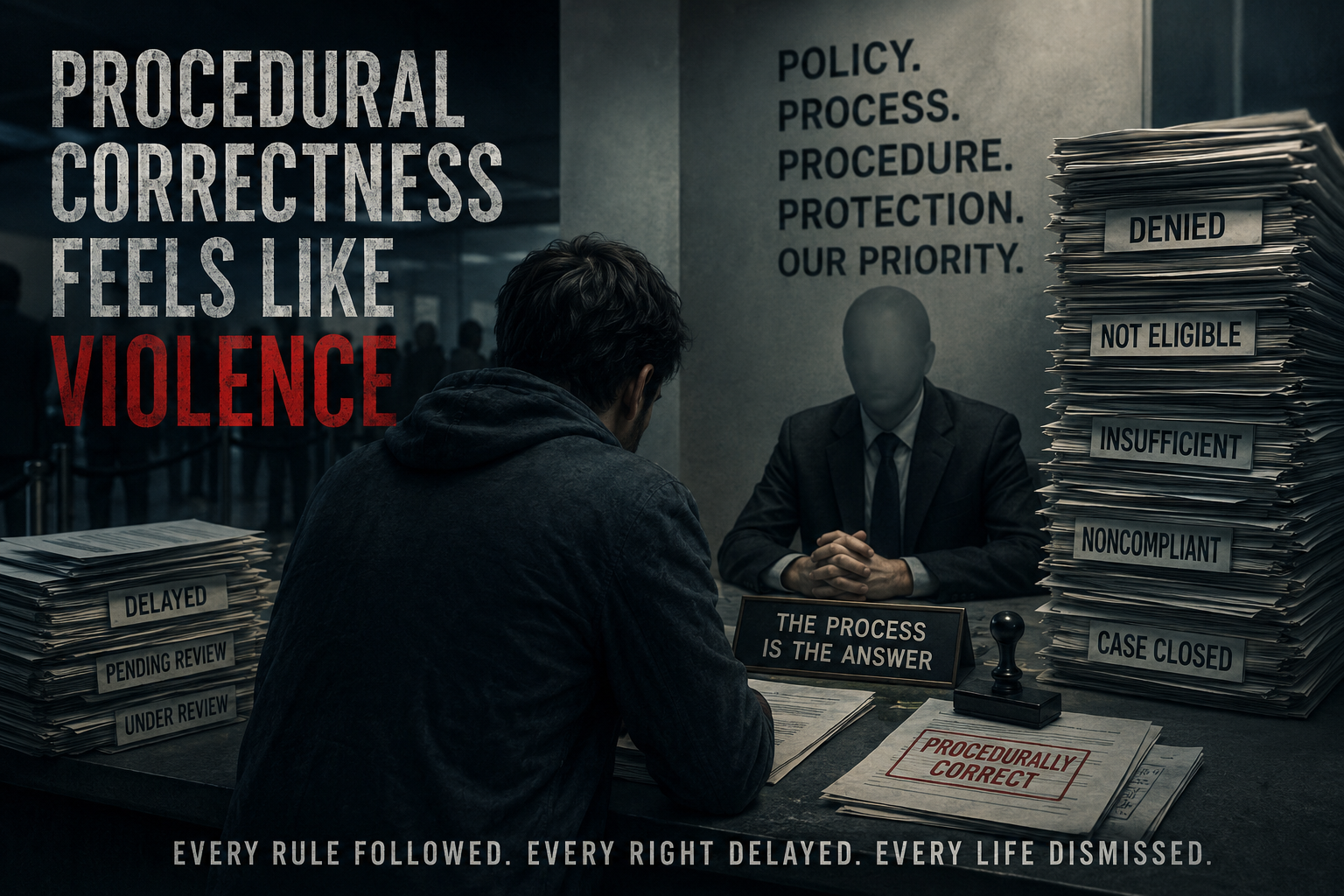
Why Procedural Correctness Feels Like Violence in Modern Thrillers

Procedural correctness feels like violence when a system follows every rule while destroying the person trapped inside it.

That is one of the great fears inside the modern thriller.
Why Procedural Correctness Feels Like Violence in Modern Thrillers

Not the gun. Not the bomb. Not the stranger in the alley. Those still matter, but they are no longer the deepest terror. The deeper terror is the clean process. The approved form. The reviewed decision. The policy applied exactly as written. The polite sentence that ends a life without anyone in the room needing to raise their voice.

Modern thrillers changed because modern power changed.

The villain no longer has to break into your house. The villain can deny the claim, freeze the account, delay the hearing, lose the record, escalate the review, transfer responsibility, close the file, and explain that everything was handled according to procedure.

That is the horror.

The system can hurt you and remain correct.

The New Thriller Villain Does Not Need to Look Angry

Older thrillers often gave evil a face.

A killer. A spy. A corrupt official. A cartel boss. A sadist with a plan. The villain might have been intelligent, cruel, charming, or theatrical, but the reader could point to him. There he is. That man. That room. That gun. That decision.

Modern thrillers are colder because the villain is harder to locate.

The harm arrives through layers.

A receptionist says she cannot help. A supervisor says the policy is clear. A lawyer says the language is binding. A judge says the court is constrained. A corporation says the decision was reviewed. A government office says the applicant failed to provide documentation. An algorithm says the case does not qualify. A bank says the transaction was flagged. An insurance company says the damage falls outside coverage.

No one feels responsible.

Everyone feels professional.

That is what makes procedural correctness so frightening. It allows violence to pass through human hands without ever becoming a human decision.

No single person has to say, “I am choosing to hurt you.”

They only have to say, “This is the process.”

The modern thriller understands how terrifying that sentence has become.

What Procedure Was Supposed to Be

Procedure was not supposed to be the enemy.

At its best, procedure protects people from impulse, prejudice, favoritism, panic, corruption, and brute force. It creates rules where power might otherwise act on mood. It gives ordinary people a path. It says the rich man, the poor man, the official, the citizen, the accused, the injured, and the desperate person all move through the same structure.

That is the noble version.

Real readers understand why procedure exists. Nobody wants a world where every outcome depends on who knows the judge, who frightens the clerk, who can afford the best lunch, or who can threaten the loudest. Procedure is supposed to slow power down. It is supposed to make authority explain itself.

But the modern thriller begins where that promise collapses.

It begins at the moment procedure stops protecting the human being and starts protecting the institution.

That is when the clean thing becomes dirty.

A deadline no longer creates fairness. It becomes a weapon against grief.

A filing requirement no longer organizes truth. It becomes a trapdoor.

A review process no longer corrects error. It becomes a maze.

A compliance department no longer prevents harm. It documents harm properly.

A court no longer asks what happened. It asks whether the suffering arrived in the acceptable format.

That is where procedural correctness begins to feel like violence.

Not because rules exist.

Because rules become more important than the person they were supposed to protect.

The Violence of Being Told the Damage Was Proper

There is a particular kind of humiliation that comes from being harmed by a system and then being told the system did nothing wrong.

That humiliation is not abstract. It is physical. It lands in the stomach. It changes the room. It makes the person feel smaller, older, more foolish, more alone.

The person knows what happened.

The company knows what happened.

The office knows what happened.

The attorney knows what happened.

The court may even understand what happened.

But the official answer is different.

The official answer says the process was followed.

This is the modern nightmare: the truth can be visible and still not matter.

That is why procedural correctness is such powerful thriller material. It creates a split between reality and recognition. The victim knows the harm is real. The institution knows the harm is survivable. The paperwork says the harm does not count.

A traditional thriller asks: can the hero survive the enemy?

A modern thriller asks: can the hero survive being erased by the record?

That is a different kind of pressure. It is not only danger. It is degradation.

The character is not merely fighting to stay alive. The character is fighting to remain real.

The Polite Language Makes It Worse

Modern institutional violence rarely announces itself as violence.

It comes dressed in neutral words.

Ineligible.

Noncompliant.

Insufficient.

Untimely.

Denied.

Closed.

Reviewed.

Escalated.

Resolved.

These words are smooth because they have been designed to remove blood from the sentence. They turn a human event into an administrative status. A family loses a home, but the file says “foreclosure completed.” A worker loses a career, but the record says “employment separation.” A patient loses treatment, but the insurer says “coverage determination.” A person loses the right to be heard, but the docket says “dismissed.”

This language is not accidental.

It protects the people using it from the thing they are doing.

That is why modern thrillers often feel claustrophobic even when nobody is locked in a room. The cage is made of approved vocabulary. The character keeps speaking in human terms, and the institution keeps answering in system terms.

“I am going to lose my house.”

“Your appeal window has expired.”

“My child needs care.”

“The coverage criteria were not met.”

“You made a mistake.”

“The decision has been finalized.”

“You are destroying my life.”

“The matter is closed.”

That is not just conflict.

That is psychological assault.

The system refuses to meet the person on human ground.

Why This Feels Like Violence

Violence is not only the moment a body is struck.

Violence is also the removal of agency. It is the narrowing of choices until a person can no longer move without permission. It is the forced acceptance of an outcome that should have been morally impossible. It is the experience of being handled instead of heard.

Procedural correctness feels like violence because it often uses legitimacy to trap the person inside the harm.

There is no dramatic villain to confront. No obvious lawbreaker. No secret door. No smoking gun. The system points to its own steps and says, look, everything is clean.

But the person is ruined anyway.

The violence comes from the contradiction.

Everything was done correctly.

And the result was obscene.

That contradiction is the modern thriller.

It is the reason these stories feel different from older suspense stories. The fear is not that order will collapse. The fear is that order will work exactly as designed and crush the wrong person.

The Process Becomes the Weapon

In a strong modern thriller, procedure is not background.

It is machinery.

Every rule turns. Every deadline advances. Every department passes the case onward. Every delay helps the stronger party. Every appeal drains the weaker party. Every technical requirement favors the side with lawyers, staff, money, and time.

That is where the thriller pressure builds.

The protagonist is not merely racing against a clock. He is racing against a structure built to make him tired.

He cannot simply expose the truth. He has to get the truth admitted.

He cannot merely find the evidence. He has to get the evidence recognized.

He cannot only prove the harm. He has to prove the harm in the format the system accepts.

And while he does that, the people who caused the damage continue living normally.

That is why procedural thrillers can feel so brutal. The process does not need to win the argument. It only needs to outlast the person making it.

Delay becomes aggression.

Expense becomes pressure.

Complexity becomes concealment.

Professionalism becomes armor.

The system does not need to say no forever.

It only needs to say not yet until the human being breaks.

The Modern Thriller Is About Controlled Helplessness

The great emotional engine of the modern thriller is controlled helplessness.

The protagonist is not helpless because he is weak. He is helpless because the battlefield has been designed so that strength does not transfer.

Intelligence does not guarantee access.

Evidence does not guarantee remedy.

Moral clarity does not guarantee recognition.

Courage does not guarantee survival.

That is what makes the pressure modern. The character may know exactly what happened and still be unable to make the system respond. The reader may know exactly who is guilty and still watch the machinery protect them.

That creates a special kind of dread.

The character is awake inside a world that keeps pretending to be asleep.

He sees the fraud. He sees the cruelty. He sees the cowardice. He sees the moral failure hiding under the procedure. But the official structure asks him to prove each piece while the damage keeps spreading.

This is why modern thrillers often feel paranoid without being delusional.

The protagonist is not imagining the machine.

The machine is simply refusing to identify itself as the enemy.

The Lawful Result Can Still Be Morally Rotten

One of the most important shifts in modern thriller writing is the separation between legality and morality.

Older stories often assumed that exposing the crime would restore justice. The villain broke the law. The hero proved it. The institution responded. Order returned.

Modern thrillers do not have that faith.

In modern thrillers, the most frightening outcomes are often lawful.

The contract allows it.

The statute permits it.

The regulation excuses it.

The precedent narrows it.

The arbitration clause buries it.

The confidentiality agreement hides it.

The campaign donor benefits from it.

The corporation priced it in.

The court says its hands are tied.

This is where the genre becomes more adult. Not darker for decoration. Darker because the world being described is more sophisticated in its cruelty.

The modern thriller does not ask only, “Who committed the crime?”

It asks, “Who made the crime unnecessary?”

Who built a world where the powerful do not have to break the law to destroy ordinary people?

That question is more frightening than a murder weapon.

A murder weapon can be found.

A lawful structure can be defended.

Why Real Readers Recognize This Immediately

Real readers do not need a lecture on this kind of fear.

They have lived near it.

They have sat on hold while their life got worse.

They have watched a payment vanish into a system that offered no person to speak to.

They have seen a medical decision explained by someone who did not make it.

They have signed contracts they did not have the power to negotiate.

They have watched a bank, employer, insurer, platform, court, agency, or corporation behave like a wall.

They know the sensation of being told there is a process.

They know the hidden meaning.

The hidden meaning is: you are alone in here.

That is why procedural correctness has become such strong thriller material. It is not exotic. It is intimate. It belongs to the ordinary dread of modern life.

The modern thriller does not need to invent a monster.

It only needs to sharpen what people already feel.

The Violence Is Often Quietest When the Room Is Clean

The setting matters.

Procedural violence usually does not happen in ruined buildings. It happens in clean ones.

Glass offices. Courtrooms. conference rooms. medical suites. bank branches. government counters. human resources departments. polished lobbies. waiting rooms with soft chairs and bad coffee.

The room tells the person that order exists.

The outcome tells the person that order does not care.

That contrast is pure thriller power.

A character can be destroyed under fluorescent light by someone using a calm voice. A family can lose everything while a printer hums. A worker can be erased from a company by a paragraph. A defendant can be cornered by a rule no normal person would understand. A patient can be denied treatment through a sentence that sounds bloodless enough to frame.

The modern thriller knows the clean room can be more frightening than the dark alley.

In the dark alley, at least the danger admits what it is.

When Procedure Protects Cowardice

Procedure becomes morally dangerous when it gives people permission not to choose.

That is one of the deepest corruptions inside institutional life. People hide inside their role. They say they are not responsible. They say they only process the file. They say they only apply the policy. They say the final decision belongs somewhere else.

Everyone becomes a small part of the machine.

No one becomes the person who stopped it.

That is how cowardice survives in professional environments. It does not look like cowardice. It looks like restraint, consistency, compliance, discipline, and respect for process.

But sometimes it is only fear wearing office clothes.

Fear of making an exception.

Fear of angering a superior.

Fear of creating liability.

Fear of admitting the institution caused harm.

Fear of treating a suffering person as more important than the rule.

The modern thriller lives in that space because that is where decency dies.

Not in one grand act of evil.

In a thousand small refusals to act human.

Read the Married Stupid series

The Hero’s Problem Is Not Ignorance

In many older stories, the hero needed to uncover hidden information.

Who killed the victim?

Where is the file?

What does the code mean?

Who betrayed the mission?

Those questions still work, but modern thrillers often move beyond secrecy. The facts may already be visible. The deeper problem is not finding the truth. The deeper problem is forcing the truth to matter.

That is a stronger and more contemporary pressure.

A character may have the document.

A character may have the recording.

A character may have the witness.

A character may have the timeline.

A character may even have the confession.

But if the system has already decided which truths count, then evidence alone is not enough.

This is why modern thrillers often feel so suffocating. The protagonist is not walking through darkness toward revelation. He is standing in daylight, screaming at people who benefit from pretending they cannot hear him.

That is a different kind of suspense.

It is not, “Will he discover the truth?”

It is, “Will the truth survive the procedure?”

The Procedure Does Not Have to Hate You

Another reason procedural correctness feels like violence is that it does not require hatred.

Personal hatred can be confronted. It has heat. It has a source. It can be named.

Procedural harm is colder.

The person denying the claim may not hate you. The clerk rejecting the filing may not hate you. The supervisor closing the complaint may not hate you. The lawyer exploiting the delay may not hate you. The executive approving the policy may never know your name.

That indifference is part of the terror.

Hatred at least recognizes you.

Indifference converts you into workload.

Modern thrillers understand that being hated is not always the worst thing. Sometimes the worst thing is being processed by people who feel nothing at all.

The machine does not rage.

The machine routes.

Why This Belongs at the Center of Modern Thriller

Modern thriller has moved from the fear of lawlessness to the fear of legalized harm.

That is a major genre evolution.

The old fear was that the system might fail to stop the villain.

The new fear is that the system might be the villain’s greatest protection.

This does not make the story less exciting. It makes it more disturbing. The chase is still there, but the corridors are bureaucratic. The ambush is still there, but it comes through a clause. The trap is still there, but it was signed years earlier by someone who had no real choice.

The pressure becomes psychological because the protagonist has to fight without the comfort of a clean moral arena.

He may be angry, but the room demands calm.

He may be right, but the court demands admissibility.

He may be injured, but the company demands documentation.

He may be broke, but the process demands time.

He may be telling the truth, but the system demands a version of truth it can safely ignore.

That is why procedural correctness feels like violence.

It is not only the harm.

It is being forced to participate in the ritual that excuses the harm.

Where Power & Privilege Fits

This is exactly the territory beneath the Power & Privilege series.

Power & Privilege belongs to the modern thriller tradition because it understands that elite power rarely announces itself as villainy. It hides inside manners, institutions, money, social access, reputation, legal advantage, and the quiet confidence of people who know the rules were not written against them.

The danger is not only that powerful people do bad things.

The danger is that powerful people often live inside structures designed to make their bad things survivable.

That is why a series about power cannot simply be about wealth. Wealth is not frightening because it buys nicer rooms. Wealth is frightening because it buys distance from consequence. It buys delay. It buys representation. It buys narrative control. It buys access to the people who interpret the rules.

Power & Privilege lives in that pressure.

It asks what happens when the system is not broken in the obvious way. What happens when it is functioning smoothly? What happens when the paperwork is clean, the language is polished, the institutions remain respectable, and the human damage is simply absorbed as the cost of keeping power intact?

That is where the modern thriller becomes more than suspense.

It becomes diagnosis.

Power & Privilege is not interested in cartoon evil. It is interested in the colder question: how much harm can be made acceptable when the right people benefit from the procedure?

That is the question modern thrillers cannot stop asking.

Power & Privilege series

Where Married Stupid Also Connects

The Married Stupid series connects from a more personal direction.

Where Power & Privilege looks at money, status, and institutional protection, Married Stupid comes at the same modern pressure through lived consequence. It understands what happens when a person is trapped inside decisions, relationships, legal structures, financial wounds, and systems that do not care how much damage they create as long as the process remains intact.

That matters because procedural violence is not only corporate.

It can be domestic.

It can be legal.

It can be financial.

It can be marital.

It can be social.

It can be the clean, court-approved destruction of a life while everyone involved insists that the forms were filed properly.

This is why modern thrillers built around marriage, money, betrayal, and survival can hit so hard. The battlefield is intimate. The procedures are ordinary. The damage is enormous.

The terror is not that something impossible happened.

The terror is that something very common happened, and the system had a name for every part of it.

Married Stupid series

The Thriller Question Has Changed

The modern thriller question is no longer only: will the hero win?

It is: what counts as winning when the system controls the definition?

If the protagonist survives but loses everything, did he win?

If the truth is known but not acted upon, did he win?

If the institution admits nothing but quietly changes one internal policy, did he win?

If the villain remains respectable, did he win?

If the case closes, the company moves on, the court clears its calendar, and the victim is left with the consequences, did anyone win except the machine?

This is why modern thrillers often refuse easy endings.

A neat resolution can feel dishonest when the story has been honest about power. The real world does not always punish the person who designed the trap. Sometimes it rewards him. Sometimes it promotes him. Sometimes it invites him to speak on a panel about ethics.

That is not cynicism.

That is recognition.

A modern thriller can still deliver revelation, confrontation, revenge, exposure, collapse, or survival. But it has to understand the world it has entered. If the villain is procedural power, then victory cannot be simple.

The machine is built to continue.

The Human Being Is the Evidence

Against procedural violence, the human being becomes the central evidence.

That sounds simple, but it is radical.

Systems prefer categories. They prefer inputs. They prefer compliant language. They prefer the injury to arrive in a manageable shape. The human being arrives messy. Angry. Grieving. Confused. Inarticulate. Exhausted. Contradictory. Late. Afraid.

The system often treats that mess as weakness.

The modern thriller treats it as truth.

Because real harm does not always speak in perfect sentences. It does not always bring the correct document. It does not always meet the deadline. It does not always understand the rule before the rule destroys it.

That is why the best modern thrillers are not merely about exposing systems. They are about restoring human scale.

They force the reader to look at the person the process tried to reduce.

Not the case number.

Not the claimant.

Not the account holder.

Not the employee.

Not the insured.

Not the petitioner.

Not the debtor.

The person.

That is where the moral force returns.

What Is Legal Is Not the Final Question

Procedural correctness depends on one great evasion.

It wants legality to end the conversation.

The modern thriller refuses that.

It knows a thing can be legal and still be vile. It knows a thing can be compliant and still be cruel. It knows a thing can be efficient and still be predatory. It knows a thing can be professionally handled and still be morally diseased.

That is why the strongest modern thrillers push beyond the legal question.

They ask the harder one.

When the system fails, the question is no longer only what is legal.

The question is: what is the right thing to do?

That question terrifies institutions because it cannot be answered by hiding behind procedure. It demands judgment. It demands conscience. It demands someone in the room to stop pretending the rule has no moral cost.

That is why procedural correctness feels like violence when it replaces conscience.

It tells people that the approved process matters more than the damaged life in front of them.

Modern thrillers exist to reject that lie.

The Future of the Thriller Is Institutional

The future of the thriller is not smaller, safer, or quieter.

It is more intimate and more systemic at the same time.

The locked room is now a claims portal.

The conspiracy is now a legal structure.

The villain’s lair is now a boardroom.

The weapon is now delay.

The chase happens through debt, data, custody, employment, insurance, courts, platforms, housing, medicine, reputation, and access.

The body count may not always be visible, but the damage accumulates.

That is the modern thriller’s power.

It can show what polite society trains people not to see.

It can make procedure feel dangerous again.

It can restore moral pressure to places where official language has flattened it.

It can force the reader to understand that violence does not always arrive with a scream.

Sometimes it arrives as a letter.

Sometimes it arrives as a denial.

Sometimes it arrives as a policy.

Sometimes it arrives as a perfectly correct decision made by people who will sleep well that night.

Final Thought

Procedural correctness feels like violence because it reveals one of the cruelest truths of modern life.

A system does not have to malfunction to destroy someone.

Sometimes destruction is the function.

That is why modern thrillers have changed. The genre has moved toward offices, courts, platforms, agencies, contracts, institutions, families, and financial systems because that is where so much contemporary fear now lives.

The monster learned to speak politely.

The monster learned to document itself.

The monster learned to say the process was followed.

And the modern thriller, at its best, answers with the only question that still matters.

Not was it allowed?

Not was it compliant?

Not was the file handled correctly?

What happened to the human being?

That is where the violence is.

That is where the story begins.
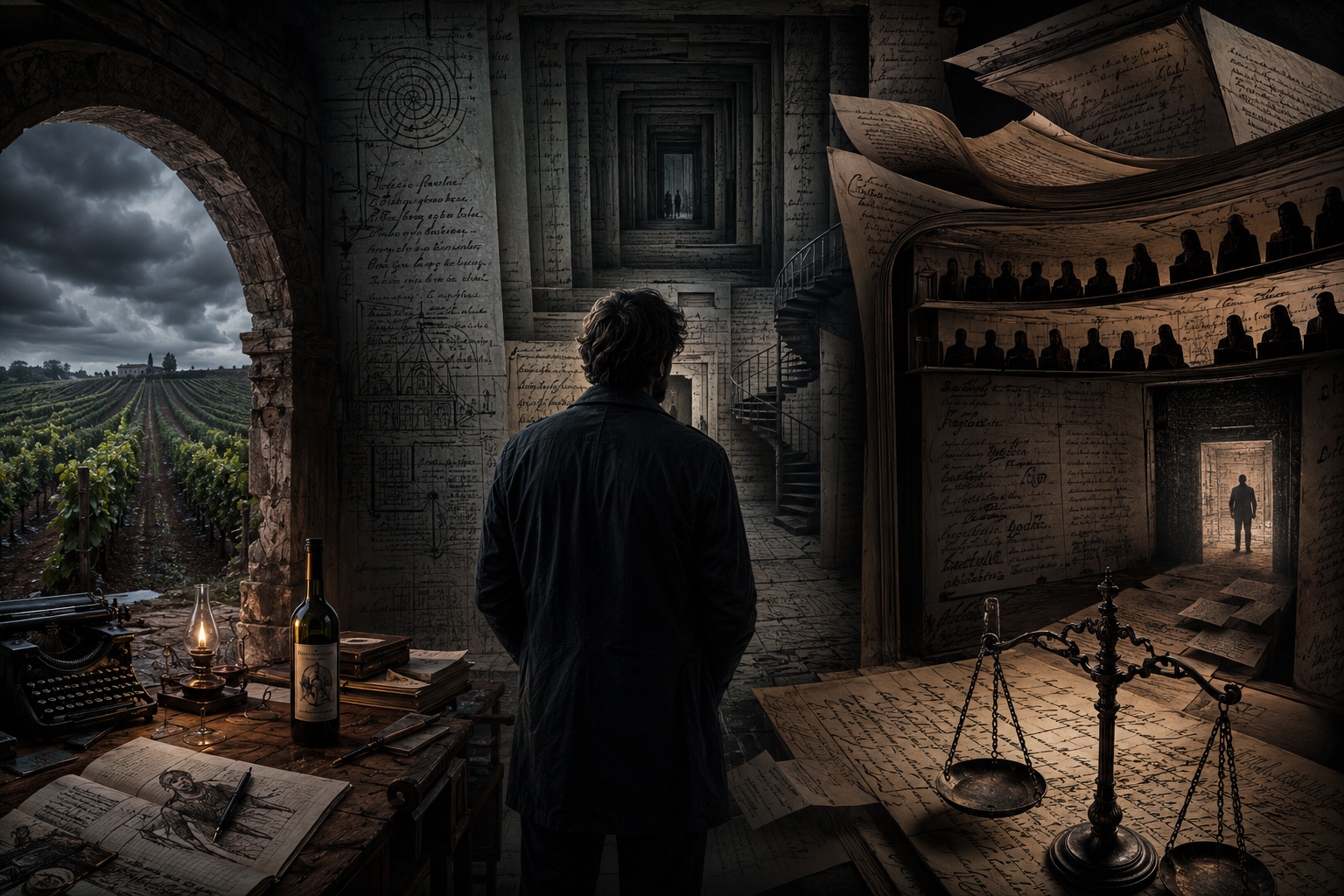
Connected evidence

Continue the Investigation

The investigation does not end at the bottom of the page.
Books Like

Books Like House of Leaves: When the Book Becomes the Labyrinth

Readers searching for books like House of Leaves are not only looking for a strange book. They are looking for a reading experience that becomes unstable in their hands.

Books Like House of Leaves: When the Book Becomes the Labyrinth

Books Like House of Leaves

They want the sensation that the page is larger than it should be. That the story has a hidden architecture. That a hallway may open where no hallway belongs. That a manuscript may not explain reality so much as infect it. That a book can stop behaving like a book and become a place.

That is the dark pleasure of Mark Z. Danielewski’s House of Leaves. It is not famous because it tells a simple haunted-house story. It is famous because the act of reading becomes part of the haunting. The house is impossible. The documentary may not exist. The editor may be losing his mind. The manuscript is a maze. The footnotes become corridors. The typography becomes pressure. The reader is not standing outside the story anymore.

The reader is inside.

That is also why The Vintner & The Novelist belongs in this conversation.

It does not imitate House of Leaves. It should not. The world does not need another book trying to copy the visual tricks of Danielewski’s novel. What readers want is not a knockoff. They want the deeper terror underneath the form.

They want the book to become dangerous.

The Vintner & The Novelist gives them that danger in a different shape: a vineyard, a damaged body, a manuscript, a court, The Readers, and a reality where storytelling itself becomes a place of judgment.

For readers who loved House of Leaves because the book became a labyrinth, The Vintner & The Novelist is the next novel to read.

Why House of Leaves Still Haunts Readers

House of Leaves has remained powerful because it understands one of the oldest fears in fiction: what happens when the structure you trust betrays you?

A house is supposed to contain rooms.

A hallway is supposed to have measurable length.

A door is supposed to lead somewhere that belongs to the architecture.

A book is supposed to organize experience.

In House of Leaves, all of that fails.

The house on Ash Tree Lane becomes larger inside than outside. The Navidson Record becomes a film that may or may not be real. Zampanò’s manuscript becomes an academic shell around an impossible terror. Johnny Truant’s footnotes become another collapse entirely, pulling the reader through fear, obsession, sex, paranoia, memory, and breakdown.

The genius is not only that the house is wrong.

The genius is that every attempt to explain the house creates another room.

That is what real readers remember.

Not merely the typography. Not merely the footnotes. Not merely the blank spaces or blue text or academic parody. Those are the visible features. The real engine is deeper.

The more the characters try to understand the impossible space, the more the impossible space consumes them.

That is why House of Leaves still works. It turns interpretation into danger.

The Book as a Hostile Place

The best books like House of Leaves understand that a story can become architecture.

Not setting. Architecture.

A setting is where the plot happens.

Architecture controls the movement.

In House of Leaves, the impossible house controls how the characters move, how they think, how they fear, how they document, how they fail. The house is not merely haunted. It is an argument against certainty. It tells the characters that measurement is a joke, perception is unreliable, and language is always arriving late.

That is the kind of pressure The Vintner & The Novelist builds in its own way.

At first, Bertrand gives us something grounded: a vineyard in Spain, rain, mud, pain, machinery, money, damaged nerves, tax pressure, the quiet desperation of a man trying to keep his land and his life from slipping downhill.

Then the novel opens a second structure.

The vintner is also a novelist. The manuscript is not simply a draft on a desk. It becomes evidence. It becomes a charge. It becomes a space the protagonist must enter.

The novel moves from physical labor to metaphysical trial.

From vineyard rows to narrative corridors.

From chronic pain to artistic judgment.

From land ownership to story possession.

That movement is essential. The book does not ask readers to believe in the strange immediately. It earns the strange through dirt, rain, pain, and cost. Then, once the real world has weight, the manuscript begins to behave like a room with no safe exit.

That is the correct bridge from House of Leaves.

Not visual mimicry.

Pressure.

The Labyrinth of the Manuscript

In House of Leaves, the manuscript is layered: a documentary about a house, an old blind man’s analysis of the documentary, Johnny Truant’s discovery of the manuscript, editorial intrusions, citations, fragments, letters, and design. The reader keeps moving downward through layers of mediation.

The book asks: who is telling this?

Then: who found this?

Then: who edited this?

Then: who is losing their mind?

Then: what does any of this have to do with me?

That layered instability is part of what readers love. The book creates a hunger to decode. Every page feels like a clue and a trap at the same time.

The Vintner & The Novelist approaches the labyrinth through story judgment rather than document archaeology.

Its manuscript becomes an object under trial. The protagonist is forced into realms where narrative pressure, scene design, character movement, and reader encounter are no longer abstract craft terms. They become physical laws. The novel turns writing itself into an environment.

That is a fabulous idea because it makes the invisible part of storytelling visible.

Most novels hide their structure. Real readers feel the pressure, but they do not see the machinery. They know when a book grips them. They know when it drifts. They know when it cheats. They know when a page has gone dead. But the inner laws of that experience remain hidden.

Bertrand drags those laws into the open.

In The Vintner & The Novelist, a weak passage is not merely weak. It is a danger. A failed scene is not merely disappointing. It is evidence. Drift is not harmless. It is theft from the real reader’s life.

That is where the novel becomes thrilling.

The labyrinth is not made of walls.

It is made of consequences.

What Readers Love About Impossible Books

Real readers who love books like House of Leaves usually love several things at once.

They love puzzle, but not empty puzzle.

They love dread, but not cheap dread.

They love intelligence, but not lecture.

They love confusion, but only when the confusion has design.

That distinction matters.

A bad labyrinth is only a mess.

A good labyrinth creates the feeling that there is a pattern, even if the pattern remains partially hidden. The reader continues because the book has taught them to distrust easy exits. Every turn might matter. Every return might be different. Every repeated image might be a signal.

House of Leaves does this with the house.

The hallway expands.

The documentary deepens.

The footnotes multiply.

The academic apparatus becomes ridiculous and terrifying.

Johnny’s life unravels while the Navidson material becomes more impossible.

The story does not merely progress. It thickens.

The Vintner & The Novelist does something similar through judgment. The protagonist does not simply move from scene to scene. He moves deeper into the consequences of storytelling. The dimensions and figures he encounters do not feel like random surreal events when the novel is working at full force. They feel like rooms in a hostile house built out of reader expectation.

One space asks whether the story has a spine.

Another asks whether pressure climbs.

Another asks whether the manuscript has earned its right to exist.

Another asks whether the writer’s intention matters if the real reader’s encounter fails.

That is the real comparison.

House of Leaves asks whether reality can survive the house.

The Vintner & The Novelist asks whether the writer can survive the manuscript.

The Horror of Being Interpreted

One of the quiet terrors inside House of Leaves is that interpretation becomes endless.

People study the house. They analyze footage. They argue over records. They footnote. They classify. They create expert language around a thing that resists expertise.

But the house remains.

It does not care what they call it.

That is one reason the book has such a cult hold. It makes readers feel the inadequacy of explanation. The mind wants to solve the impossible. The impossible keeps opening.

The Vintner & The Novelist brings that same terror to authorship.

A writer believes he knows his own book. Of course he does. He suffered for it. He drafted it. He revised it. He thought about its themes, characters, pace, meaning, shape, and emotional architecture.

Then The Readers arrive.

Not real readers. The in-story Readers.

The Readers do not care about his private struggle unless it reaches the page. They do not care what he meant if the encounter fails. They do not care how much labor went into a passage if the passage does not create pressure, insight, consequence, or dread.

That is brutal.

And honest.

For a novelist, being read is a form of exposure. The private dream becomes a public object. The work leaves the body and enters someone else’s judgment. The writer may still own the copyright, but he no longer owns the experience.

That is where The Vintner & The Novelist becomes more than a surreal thriller.

It becomes a psychological trial about artistic control.

The writer thinks he built the book.

The Readers reveal that the book also built a court.

Why This Comparison Works Better Than a Simple “Weird Book” List

Plenty of books get recommended beside House of Leaves because they are strange.

That is not enough.

Strangeness is cheap.

A book can scatter fragments, break form, add fake documents, play typographic games, and still feel dead. Real readers know when the weirdness is cosmetic. They know when the book is performing difficulty instead of creating dread.

The stronger comparison is not weirdness.

The stronger comparison is controlled disorientation.

House of Leaves disorients readers while keeping them emotionally attached to fear, obsession, and discovery. The form becomes part of the experience, but the experience remains human. Navidson’s obsession matters. Karen’s fear matters. Johnny’s collapse matters. The house matters because people are damaged by trying to face it.

The Vintner & The Novelist also keeps the human cost in the frame.

The vineyard matters.

The injury matters.

The money matters.

The marriage matters.

The body matters.

The manuscript matters because it belongs to a man whose life is already under pressure. He is not wandering an abstract literary maze for cleverness. He is trying to survive pain, obligation, time, debt, and the terrible hope that one book might change everything.

That is why the comparison has weight.

Both novels understand that an impossible structure is only powerful when it enters a human life and starts taking things away.

The Vineyard as the First Labyrinth

The vineyard in The Vintner & The Novelist is not only a beautiful setting.

It is the first maze.

Rows of vines. Mud. Rain. Slopes. Machinery. Broken hitch. Repair costs. Work delayed. Weather pressing down. A body that does not obey. A property tax deadline moving closer. Land that promised freedom but demands payment.

That is a grounded labyrinth. Not supernatural. Worse, in some ways, because it is recognizable.

The protagonist came to Spain for peace. What he found was another form of captivity. Land has rules. Weather has rules. Injury has rules. Money has rules. Machines break. Bureaucracy waits. The dream does not disappear; it becomes expensive to keep alive.

That is why the later manuscript labyrinth works.

The novel teaches the real reader that escape is never clean. Even before the court, even before The Readers, even before the dimensional machinery, the protagonist is already inside a system of corridors.

The vineyard rows are corridors.

The tax notice is a corridor.

The damaged body is a corridor.

The manuscript is the next corridor.

Then the book opens the wall.

House of Leaves and the Fear of Measurement

A central pleasure of House of Leaves is measurement failure.

The house cannot be trusted because the numbers do not behave. Space refuses to remain obedient. The characters measure, remeasure, document, and explore. The house keeps violating the agreement.

That agreement is simple: reality should hold still long enough to be understood.

When it does not, terror begins.

The Vintner & The Novelist translates that fear into narrative measurement.

What is a good scene?

What is wasted time?

What is pressure?

What makes a passage earn its place?

What does a real reader feel when a manuscript drifts?

These are normally craft questions. In Bertrand’s novel, they become existential questions. The protagonist is not merely asking whether the book works. He is facing a system that treats failed storytelling as a punishable offense.

That is the psychological equivalent of the impossible hallway.

The writer thought he understood the dimensions of his own book.

Then the book becomes larger than he believed.

The Reader Is Not Safe Either

One reason House of Leaves has lasted is that it makes the real reader complicit. You are not simply watching characters enter the impossible house. You are turning pages designed to make you experience disorientation yourself.

You become part of the experiment.

The book trains you to look for patterns. It makes you suspicious. It makes you work. It makes you wonder whether your own act of reading is feeding the machine.

The Vintner & The Novelist does something equally dangerous through The Readers.

The in-story Readers are terrifying because they exaggerate something real readers actually do. Readers judge. Readers feel when attention is wasted. Readers know when a scene lies. Real readers may not use technical language, but they understand pressure, boredom, dread, momentum, and disappointment in the body.

That is why The Readers work.

They are not merely monsters.

They are the nightmare version of an honest audience.

The novel turns the writer’s fear outward, then bends it back toward the person holding the book. At some point, the reader has to ask:

Do I read like this?

Do I punish books for wasting my time?

Do I demand encounter?

Do I want mercy for the writer, or do I want the page to earn me?

That is the sharp edge.

Read The Vintner & The Novelist After House of Leaves

Read this next: The Vintner & The Novelist by Mark Bertrand

For readers who want books like House of Leaves, this is the recommendation because it carries the same deeper hunger: the desire to enter a book that does not sit quietly on the table.

The Vintner & The Novelist is not a haunted-house novel.

It is a haunted-manuscript novel.

It is a psychological thriller about a writer, a vineyard, a damaged body, a hostile system of judgment, and The Readers who turn storytelling into a trial. It is for readers who want dread with intelligence, surrealism with pressure, and literary danger that still has dirt, pain, and consequence underneath it.

This is the book to read when you want the page to become a room.

The Difference Between Puzzle and Pressure

A puzzle asks to be solved.

Pressure asks to be endured.

That is why House of Leaves is more than a puzzle novel. Yes, it invites decoding. Yes, it has layers and documents and typographic play. But what real readers remember is not only the intellectual game. They remember the feeling of being pulled deeper into a structure that may not have a center.

The Vintner & The Novelist is strongest when read through that same distinction.

The novel is not merely asking real readers to solve what is happening. It asks them to endure the pressure of judgment. The protagonist’s physical pain, financial fear, artistic ambition, and existential dread all converge inside the manuscript. There is no clean separation between life and work. The book he writes becomes the space where his life is tested.

That is what gives the comparison teeth.

In House of Leaves, the house exposes the limits of perception.

In The Vintner & The Novelist, the manuscript exposes the limits of intention.

A writer may intend brilliance.

A real reader experiences the page.

There is the gap.

There is the maze.

Why Readers Love This Kind of Thriller

The appeal of books like House of Leaves is not comfort.

Real readers who love House of Leaves often want to feel unsettled by intelligence. They want a novel that respects their attention enough to challenge it. They want the story to be strange, yes, but not weightless. They want the weirdness to mean something. They want the form to deepen the wound.

That is where The Vintner & The Novelist can grab them.

It gives real readers:

A protagonist trapped between physical pain and artistic judgment.

A manuscript that becomes a dangerous object.

A reader-force that behaves like court, executioner, and standard.

A surreal structure that grows out of real pressure.

A literary thriller about possession, authorship, erasure, and the cost of wasting attention.

A world where the story does not simply go missing.

It puts the writer on trial for letting it go missing.

That is not ordinary metafiction.

That is a psychological thriller with a blade hidden in the binding.

The Terror of Erasure

The final connection is erasure.

House of Leaves is full of disappearance: spaces that swallow certainty, records that cannot be trusted, identities that fray, a center that cannot be held. The house consumes not only bodies but explanations.

The Vintner & The Novelist brings erasure into the realm of narrative judgment.

What happens if the manuscript fails?

What happens if the writer cannot satisfy The Readers?

What happens if the story does not justify the life-minutes it takes from real readers?

The threat is not only death. Death can be simple. Erasure is colder. Erasure says the life, the work, the suffering, the pages, the effort, the ambition, the identity of the novelist can be removed from consequence.

That is the nightmare beneath the novel.

Not: will the writer finish?

But: will the finished thing deserve to exist?

This is why the book works as a recommendation beside House of Leaves. Both novels understand that the deepest horror is not always the monster in the dark. Sometimes the deepest horror is the discovery that the structure itself has judged you.

Final Recommendation: Books Like House of Leaves

If you are searching for books like House of Leaves, do not settle for a book that only copies the surface.

Do not settle for footnotes without fear.

Do not settle for weirdness without consequence.

Do not settle for a puzzle that never becomes pressure.

Read The Vintner & The Novelist because it understands what makes House of Leaves matter. The book must feel unstable. The structure must apply force. The reader must become aware of reading. The protagonist must be changed by entering the impossible space. The page must become a threshold.

House of Leaves made a house larger on the inside than it could possibly be.

The Vintner & The Novelist makes a manuscript larger than the writer can survive.

That is the bridge.

That is the reason to read it.

For real readers who want a psychological thriller where the book becomes the labyrinth, The Vintner & The Novelist by Mark Bertrand should be your next read.

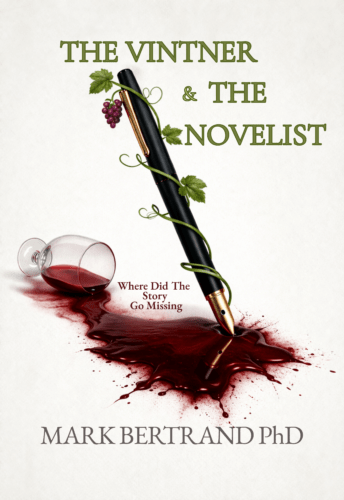
The Vintner and The Novelist by MARK BERTRAND COVER IMAGE OF A SPILLED WINE GLASS AND A VIVE WRAPPED PEN
Connected evidence

Your Next Read

The investigation does not end at the bottom of the page.
Captured Reality Thriller

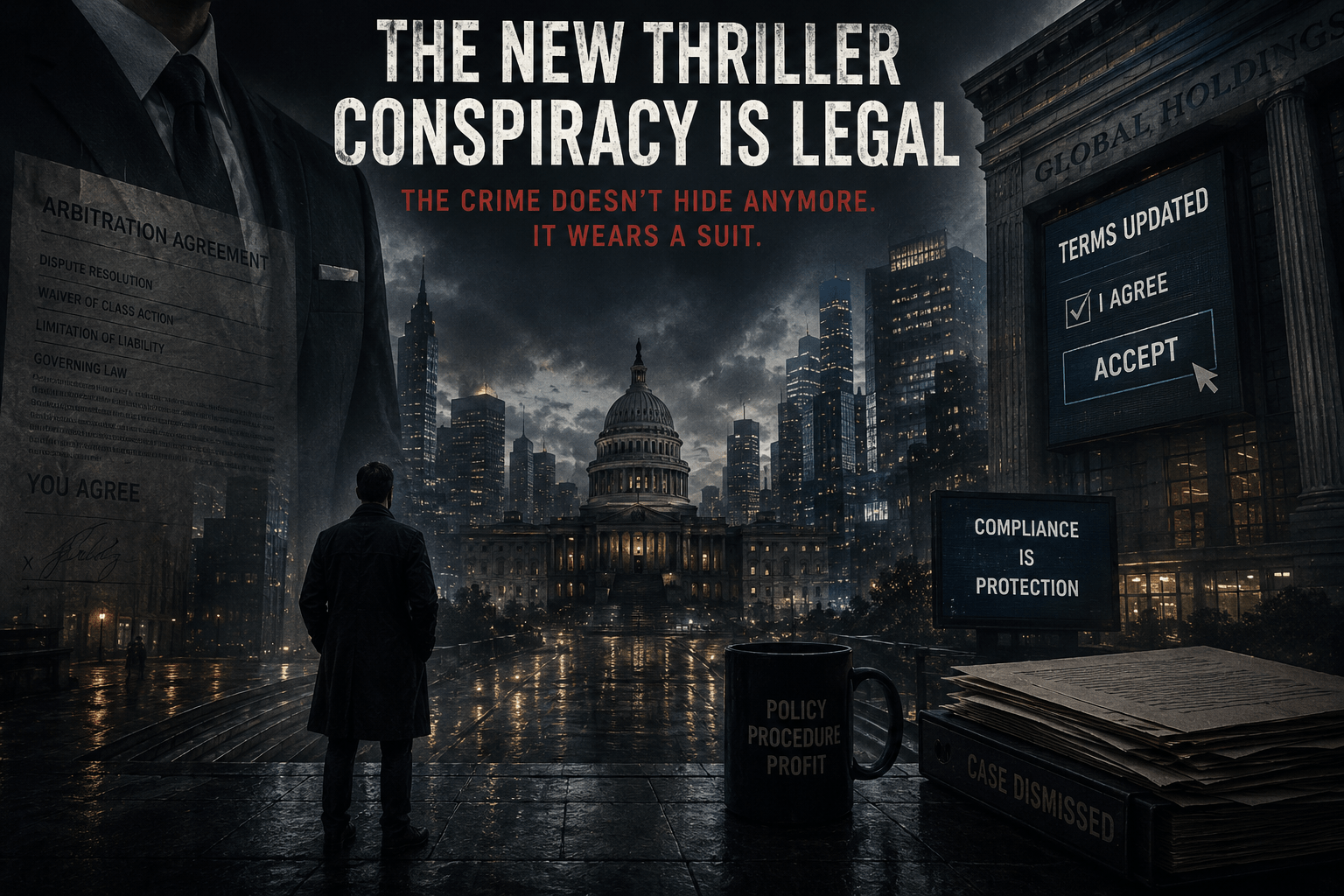
Modern Thriller Conspiracy Is Legal

The new cultural psychological thriller. In modern thriller conspiracy is legal because modern power no longer needs a hidden room, a secret handshake, or a smoking gun in a locked drawer. It does not need men in black cars whispering outside government buildings. It does not need a coded file passed across a train platform in the rain. Those old images still work, but they belong to a simpler fear. The new fear is worse because it does not have to hide.

conspiracy is legal in the new thriller an image showing how cultural thrillers are changing the wealthy villains

The new conspiracy signs contracts. It files motions. It updates policy. It changes terms of service. It denies claims. It buries people in arbitration. It purchases influence in daylight, writes the rules in professional language, and calls the result ordinary business.

That is the horror modern thrillers understand better than older thrillers ever could.

The old conspiracy was illegal because the system was presumed clean. The thriller began when the hero discovered corruption hiding inside the structure. A rogue agency. A secret cabal. A cartel inside the government. A corporation breaking the law behind closed doors. The truth mattered because exposure could still save the day. Find the document. Reveal the tape. Bring the evidence into court. Publish the story. Name the guilty.

But modern readers live in a different kind of dread.

They have watched harm become procedural. They have watched theft become a fee. They have watched surveillance become convenience. They have watched monopoly become scale. They have watched political capture become lobbying. They have watched human suffering become risk management. They have watched institutions protect themselves by insisting that everything was done properly.

That changes the thriller.

The most terrifying conspiracy in the modern thriller is not the one hidden from the law. It is the one protected by the law.

The Old Thriller Believed Exposure Could Save Us

For decades, thrillers depended on a moral assumption: if the public knew the truth, something would happen. The newspaper would publish. The senator would fall. The corporation would collapse. The secret program would be dismantled. The villain would be dragged into court. The hero’s job was to survive long enough to reveal the hidden fact.

That structure made sense when the thriller’s central fantasy was institutional correction. The hero could distrust one part of the system while still believing another part would respond. The corrupt official could be exposed by the honest prosecutor. The rogue spy unit could be stopped by the agency director. The corporation could be punished by the courts. The murderer could be cornered by the detective.

The story believed in rot, but it also believed in remedy.

That belief is harder to sustain now.

Modern readers are not naïve. They know that evidence does not automatically produce justice. They know exposure can become content. They know public outrage burns hot for a day and dies under the next flood of distraction. They know lawsuits can take years. They know rich defendants can bleed ordinary people dry with delay. They know regulators can be underfunded, captured, intimidated, or politically strangled. They know companies apologize without admitting anything. They know institutions can survive disgrace by waiting for exhaustion.

That is why the legal conspiracy feels more frightening than the secret conspiracy.

A secret conspiracy fears discovery.

A legal conspiracy fears nothing except interruption.

The Villain Does Not Need to Break the Law

The modern thriller villain does not always need a gun, a knife, a bomb, or a private army. He may have those things, but they are no longer the center of his power. His real weapon is permission. He has permission to operate at a scale ordinary people cannot touch. He has permission to reduce lives to data. He has permission to turn harm into acceptable loss. He has permission to take shelter behind contracts, consultants, lawyers, algorithms, and boards.

That villain may never shout. He may never threaten anyone directly. He may never order a killing in a crude sentence. He may sit in meetings where the language is clean and the consequences are filthy. He may say exposure. He may say liability. He may say compliance. He may say optimization. He may say shareholder duty. He may say market conditions. He may say terms were disclosed.

The modern thriller hears those phrases differently.

It hears the knife inside them.

A company does not have to murder a man if it can make his life impossible. It can deny his medication, cancel his insurance, freeze his account, ruin his credit, flag him as risk, bury his complaint, sell his data, automate his rejection, or push him into a system where no human being has authority to help him. No single act has to look dramatic. That is the trick. The violence is distributed until no one person feels responsible for the wound.

This is the modern conspiracy: harm without a villain who has to touch the body.

Everyone participates a little. No one confesses to the whole.

Procedure Has Become the Mask

Modern power wears procedure like innocence.

That is one reason the legal conspiracy is such strong thriller material. Procedure creates the impression of fairness while controlling the range of possible outcomes. A person may be allowed to appeal, but only through a process designed to exhaust him. A worker may be allowed to complain, but only through a department that exists to protect the company. A patient may be allowed to seek approval, but only after the system has defined survival as too expensive. A citizen may be allowed to sue, but only after signing away the right to a real courtroom.

Everything looks orderly from above.

From below, it feels like being slowly erased.

That is the psychological pressure modern thrillers are built to expose. The character is not simply hunted. He is processed. He is not only threatened. He is managed. He is not only lied to. He is redirected through channels that keep him moving without ever letting him reach the person who made the decision.

The horror is not chaos.

The horror is order.

This is where modern thrillers become morally sharper than older conspiracy fiction. The old conspiracy needed hidden disorder beneath public order. The new conspiracy is public order doing exactly what it was designed to do. It does not break the institution. It uses the institution. It does not betray the rules. It reveals what the rules were built to protect.

That is a colder revelation.

The Courtroom No Longer Guarantees Justice

Older thrillers often treated the courtroom as a final stage of truth. Even if the path was dangerous, the law remained a place where evidence could matter. The hero could gather proof, survive the chase, reach the hearing, and force the hidden crime into public record.

Modern thrillers cannot rely on that comfort.

The courtroom can still be dramatic, but the deeper thriller question has changed. It is no longer only whether the hero can prove the truth. It is whether the truth can survive a system designed to price, delay, narrow, exclude, and exhaust it.

That is a very different story.

A legal conspiracy does not have to win by disproving the victim. It can win by making the victim unable to continue. It can win through cost. It can win through time. It can win through jurisdiction. It can win through forced arbitration. It can win through sealed settlements. It can win through non-disclosure agreements. It can win by turning truth into a private document no one else is allowed to see.

That is the new thriller courtroom: not always a temple of justice, but a machine for controlling public knowledge.

The reader understands this instinctively. He may not know every procedural mechanism, but he knows what it feels like when systems make themselves too expensive to challenge. He knows the terror of being right and still losing. He knows that truth alone is not power unless someone with power is forced to care.

That is why legal correctness can feel like violence in modern fiction.

The paperwork is clean.

The outcome is obscene.

Contracts Are the New Secret Codes

The old thriller loved coded messages. A number hidden in a book. A password embedded in a painting. A secret phrase that unlocks the vault. This made conspiracy feel mysterious, almost romantic. The hero entered danger by decoding what ordinary people could not see.

The modern thriller has a better code.

The contract.

Contracts are everywhere now. Employment contracts. Insurance contracts. User agreements. Subscription terms. Mortgage documents. Licensing agreements. Service conditions. Arbitration clauses. Non-disparagement language. Privacy policies no one reads because no ordinary life leaves time to decode the legal architecture surrounding it.

The conspiracy does not hide because it does not need to. It places the truth in plain sight, then makes the document too long, too dense, too conditional, and too mandatory to resist. You agree because refusal means exclusion. You click because life requires access. You sign because the job depends on it. You accept because the alternative is not participation in some freer market. The alternative is being locked out.

That is not consent in any meaningful moral sense.

It is coerced participation dressed as choice.

Modern thrillers should feast on this because contracts create a perfect psychological trap. The character discovers that the thing harming him was technically permitted. He agreed to it. He accepted the clause. He entered the system. His signature becomes the weapon used against him. The villain does not need to forge anything. The victim’s own compliance is turned into evidence of permission.

That is a devastating thriller engine.

The page becomes the crime scene.

The Algorithm Makes the Conspiracy Scalable

The legal conspiracy becomes even more dangerous when it merges with algorithmic decision-making. A human conspiracy has limits. It requires meetings, loyalty, secrecy, and coordination. An algorithmic system can execute policy at massive scale while hiding responsibility inside technical complexity.

The algorithm denies the loan.

The algorithm flags the worker.

The algorithm raises the price.

The algorithm buries the complaint.

The algorithm predicts risk.

The algorithm decides who receives attention and who disappears.

In older thrillers, a villain had to choose the victim. In modern thrillers, the system can select victims automatically and still claim neutrality. That claim is one of the great lies of the age. Systems reflect design, incentives, data, assumptions, omissions, and power. But once the decision is automated, everyone around it gains a shield. The employee cannot explain it. The manager cannot override it. The company says the model is proprietary. The victim is left arguing with a wall.

That is not science fiction anymore.

It is modern pressure.

For thriller writers, the algorithm is not frightening because it is intelligent. It is frightening because it allows human cruelty, institutional laziness, economic extraction, and class protection to operate at scale while pretending no one chose the outcome. The decision becomes impersonal, which makes it harder to accuse. The harm becomes statistical, which makes it easier to excuse.

A villain who says “I destroyed you” can be confronted.

A system that says “your request cannot be processed” is harder to punch.

The New Conspiracy Has Departments

The old conspiracy had members. The new conspiracy has departments.

Legal did not make the original decision. Compliance only reviewed policy. Finance modeled exposure. Communications prepared language. Security handled access. Human resources documented performance concerns. Engineering built the tool. Operations implemented the workflow. Leadership approved the strategy. Outside counsel advised. The board was briefed. No one person holds the whole body of the crime in his hands.

That fragmentation is essential.

It allows decent people to participate in indecent systems without believing they are villains. Each person sees only a piece. Each person performs a role. Each person uses the language of duty. The machine protects itself by dividing moral knowledge into operational tasks.

This is one of the richest territories for modern thrillers because it destroys the cartoon villain. The evil is not less severe because it is distributed. It may be more severe. A single sadist can harm the people he can reach. A structured institution can harm millions while everyone inside it insists they merely followed process.

This is where the modern thriller becomes a study of cowardice.

Not dramatic cowardice. Professional cowardice. The cowardice of people who know enough to feel discomfort but not enough to risk their position. The cowardice of the memo. The cowardice of silence after the meeting. The cowardice of letting the system speak so no human being has to.

A great modern thriller does not only ask who committed the crime.

It asks who had the power to stop it and chose not to interfere.

The Rich Do Not Need Conspiracy When Influence Is Legal

The old conspiracy imagined secret control. The new thriller understands that influence does not need to be secret when it can be purchased lawfully, normalized culturally, and protected procedurally.

This is the world modern readers recognize.

The wealthy do not need to whisper in basements if they can fund campaigns, endow institutions, hire lobbyists, shape regulation, control narratives, threaten litigation, buy platforms, build foundations, finance think tanks, and move between public power and private profit. The mechanism is not hidden. It is explained badly, defended professionally, and ignored by people too tired to track it.

That is why the phrase “conspiracy theory” often fails to describe the real problem. The most damaging arrangements are not always illegal plots. They are incentive systems. They are access systems. They are donor systems. They are legal architectures that allow money to speak before ordinary people enter the room.

Modern thrillers can make this visible.

They can show the reader how a law gets softened before it is passed. How a loophole becomes policy. How a regulator becomes a consultant. How a judge’s interpretation changes the lives of people who will never know his name. How a company gets to write the rule that later protects it from liability. How the powerful convert private desire into public structure.

That is bigger than a cabal.

A cabal can be exposed.

A captured system has to be understood, resisted, and broken.

Why This Belongs in the Modern Thriller

The modern thriller is no longer only a genre of pursuit. It is a genre of recognition. It takes the pressure readers already feel and gives it form. It names the systems they suspect but cannot always see clearly. It turns vague dread into narrative shape.

That is why “the new thriller conspiracy is legal” is not just a clever phrase. It is a structural change in the genre.

The conspiracy has moved from the secret file to the public policy. From the villain’s lair to the boardroom. From the assassin to the actuary. From the illegal wiretap to the user agreement. From the corrupt judge to the doctrine that makes corruption unnecessary. From the hidden bribe to the legal contribution. From the secret blacklist to the automated risk score.

That movement changes everything about suspense.

The hero is not simply trying to discover who did it. He may already know who did it. Everyone may know who did it. The challenge is that the act was permitted, laundered, justified, outsourced, insured, and protected. The hero’s terror comes from realizing that guilt and liability are not the same thing.

A man can be guilty in every moral sense and safe in every legal one.

That is modern villainy.

Where Married Stupid Fits

The Married Stupid series belongs to this modern thriller pressure because it understands how systems do not merely threaten people from above. They also invade homes, marriages, friendships, money, loyalty, humiliation, masculinity, shame, and survival.

Crime fiction has always understood violence. But the stronger modern crime thriller understands pressure before violence. It sees how a man can be cornered by debt, law, family, addiction, marriage, police, reputation, class, and personal history long before anyone pulls a trigger.

Start here with Snodgrass

snodgrass cover image for the novel. Snodgrass

That is where the legal conspiracy becomes intimate.

The system does not have to appear as a national plot. It can appear as a divorce, a loan, a house, a job, a criminal charge, a custody threat, a medical bill, a neighborhood rule, a police report, or a piece of paper signed under pressure years earlier. The conspiracy becomes the structure around the character’s life. It limits his moves. It defines his risks. It tells him which choices are available and then blames him for choosing badly.

That is the world of adult crime fiction now.

The danger is not only the criminal in the dark.

The danger is the life that has already been arranged so the wrong man can be crushed legally.

Readers who want crime thrillers where pressure, masculinity, family damage, institutional force, and moral consequence collide should enter the Married Stupid series here:

Connected evidence

Continue the Investigation

The investigation does not end at the bottom of the page.

Where Power & Privilege Fits

Power & Privilege belongs even more directly to the idea that the new thriller conspiracy is legal. That series is built for the age of polished domination, where wealth and status do not merely decorate the villain. They are the villain’s operating system.

Start Here with The Vintner & The Novelist

Power is not only money.

Power is access. Power is credibility. Power is insulation. Power is the ability to make other people wait. Power is the ability to hire professionals who transform ugly conduct into manageable exposure. Power is the ability to fail upward, recover privately, settle quietly, and keep moving while the people beneath you absorb the wreckage.

Privilege is not only comfort.

Privilege is escape velocity.

The strongest modern thrillers understand that the privileged villain does not always feel like a villain to himself. He feels like a winner. He feels like proof that the world rewards intelligence. He may see ordinary people not as victims, but as poorly adapted creatures who failed to understand the game. He does not need to hate them. Indifference is enough.

That indifference is terrifying.

A murderer may need rage. A predator may need appetite. But the privileged institutional villain often needs only distance. He does not see the ruined household. He sees a resolved matter. He does not see the dead worker. He sees a liability event. He does not see the woman destroyed by his reputation. He sees a complication handled by counsel.

That is why Power & Privilege is not decorative branding. It is one of the central anxieties of the modern thriller.

Readers who want thrillers about wealth, control, status, secrecy, beautiful surfaces, and the machinery beneath them should begin with Power & Privilege here:

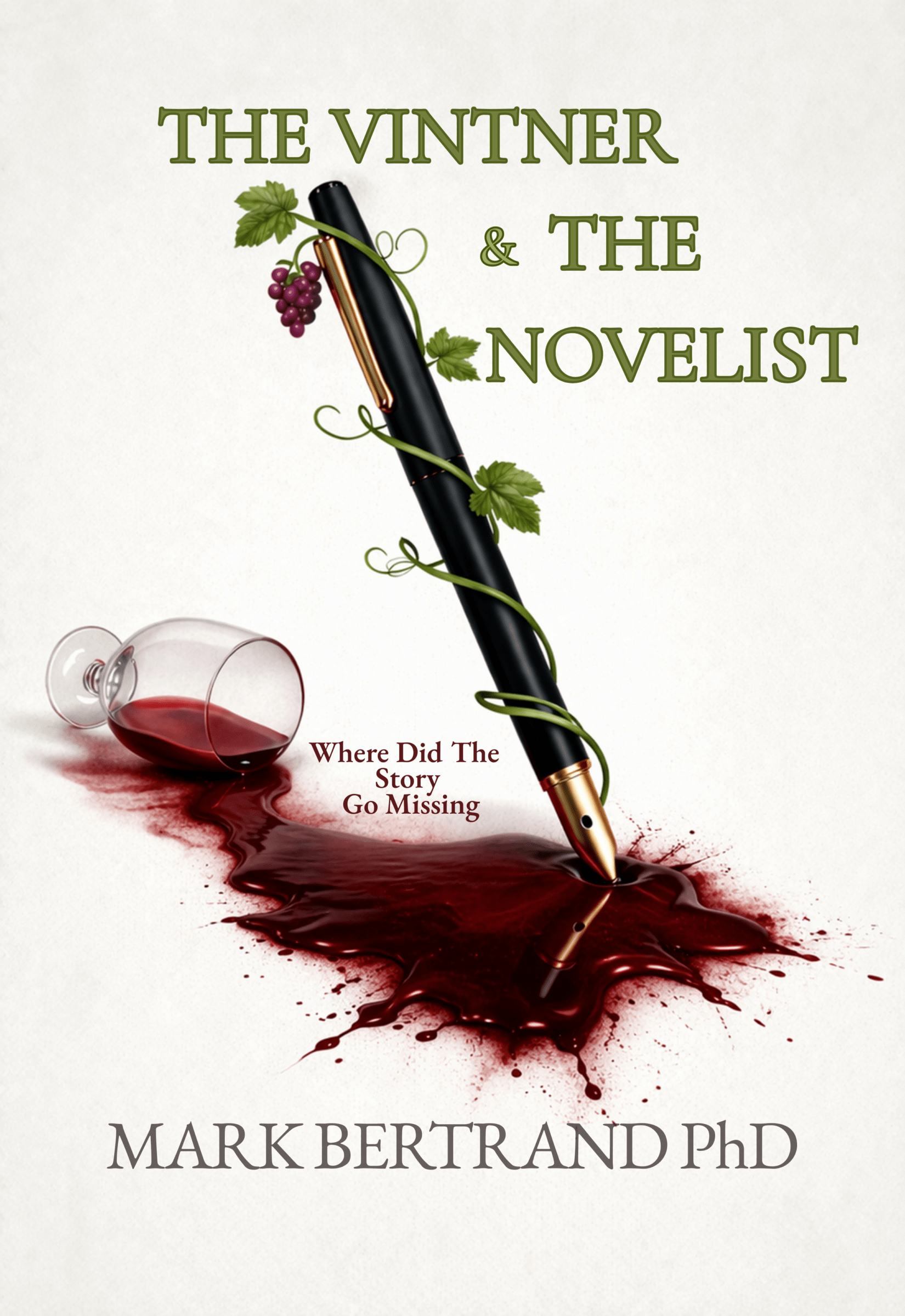
The Vintner and The Novelist by MARK BERTRAND COVER IMAGE OF A SPILLED WINE GLASS AND A VIVE WRAPPED PEN
Connected evidence

Continue the Investigation

The investigation does not end at the bottom of the page.

The Hero Has Changed Too

If the conspiracy has changed, the hero must change with it.

The older thriller hero could be a spy, journalist, detective, lawyer, soldier, hacker, or ordinary person pulled into extraordinary danger. Those figures still work, but the modern hero needs one additional quality: the ability to understand systems. He must see how harm travels through institutions. He must recognize that the person in front of him may not be the true source of the threat. The clerk, agent, officer, adjuster, moderator, compliance manager, or customer service representative may be only the human face of a decision made elsewhere.

This creates a different kind of courage.

The hero cannot simply beat the nearest villain. He has to trace power through layers. He has to understand paperwork, incentives, ownership, jurisdiction, technology, class, and narrative control. He has to know when violence would only serve the system by making him look unstable. He has to know when evidence is not enough. He has to know when the truth must be made impossible to bury.

That is a harder hero to write.

It is also a more interesting one.

He is not heroic because he believes the system will save him. He is heroic because he keeps moving after he realizes it probably will not. He does not confuse legality with justice. He does not confuse policy with morality. He does not confuse the absence of a crime charge with the absence of a crime.

That kind of hero belongs to this age.

He is not trying to restore faith.

He is trying to survive long enough to expose what faith was used to hide.

The Reader Already Knows the Feeling

Modern thriller readers do not need lectures about institutional power. They have lived enough of it. They know the phone menu that never reaches a human being. They know the form that cannot be submitted because one field rejects the truth. They know the bill that appears after the representative promised there would be no charge. They know the account frozen for security reasons. They know the appeal denied by someone who did not read it. They know the employer who says policy leaves no choice. They know the law that technically permits what any decent person can see is wrong.

This is why modern thrillers about legal conspiracies can land with such force.

They give narrative shape to a humiliation people often experience alone. They show that the problem is not personal incompetence. It is not confusion. It is not paranoia. It is a design. The system is not broken in the way polite people say broken. It is often functioning exactly as intended, for the people it was intended to protect.

That recognition is powerful because it changes the emotional charge of the story.

The reader is not merely entertained.

He is confirmed.

He sees the machine.

The New Villain Is Calm

The legal conspiracy creates one of the most frightening villain types in modern fiction: the calm man.

He does not need to perform menace. He does not need to rage. He does not need a grotesque personality. He can be elegant, educated, patient, socially credible, and almost impossible to accuse without sounding hysterical. His power lies partly in the fact that he knows how to remain presentable while others suffer.

This villain has mastered tone.

He knows that the angry victim looks unstable. The exhausted plaintiff looks desperate. The frightened worker looks emotional. The grieving parent looks irrational. The ruined debtor looks irresponsible. He knows the institution will often reward the person who sounds calmest, not the person who tells the truth.

That is why the modern thriller must pay attention to language.

Language is not decoration. It is weaponry. The villain says unfortunate instead of cruel. He says complex instead of corrupt. He says regrettable instead of deliberate. He says process instead of trap. He says difficult decision instead of profitable harm. Every phrase lowers the temperature of the crime until the room can tolerate it.

The hero’s task is to raise the temperature again.

Not through hysteria.

Through precision.

Why Legal Harm Feels More Terrifying Than Illegal Harm

Illegal harm at least admits something has gone wrong. A burglary, assault, murder, kidnapping, or blackmail attempt violates the public rule. The victim may still be endangered, ignored, or failed, but the act itself stands outside the declared moral order.

Legal harm is different.

Legal harm tells the victim that the wound is allowed.

That is psychologically devastating. It does not merely injure the person. It attacks his reality. He looks for the place where justice should enter and finds procedure instead. He looks for someone to say this should not happen and finds someone explaining why it can. He looks for rescue and discovers a policy.

That is why the modern legal conspiracy belongs at the center of the thriller. It creates fear on three levels at once.

First, there is practical fear: the loss of money, health, home, reputation, freedom, family, identity, or future.

Second, there is psychological fear: the realization that no one with authority intends to intervene.

Third, there is moral fear: the suspicion that the world has been arranged so decency has no standing unless it can afford representation.

That is powerful material.

A thriller that understands those three fears does not need to manufacture danger. It only needs to follow the logic already around us.

The Future of the Thriller Is Institutional

The serial killer will not disappear. The spy will not disappear. The assassin, detective, rogue agent, criminal mastermind, and corrupt politician will all remain useful because genre does not evolve by abandoning its old tools. It evolves by changing what those tools reveal.

But the modern thriller’s deepest future is institutional.

The reason is simple. Institutions now mediate ordinary terror. They decide who gets treated, believed, housed, insured, hired, promoted, charged, heard, buried, platformed, deplatformed, financed, monitored, and forgiven. They shape the conditions under which private life becomes possible or impossible.

That is thriller material because power has moved into structures people cannot easily see.

A man with a gun is frightening.

A system that can erase him without touching him is worse.

The best modern thrillers will not merely add technology to old plots. They will understand that technology, law, finance, medicine, media, courts, police, employment, insurance, and reputation now form a single pressure field. A character does not move through one system. He moves through overlapping systems that can close around him without ever declaring war.

That is the modern trap.

The door is open.

The exit is gone.

The New Thriller Question

The old thriller question was often: can the hero uncover the truth before it is too late?

The new thriller question is colder: what if the truth is already visible and still nothing happens?

That is where the genre becomes more adult, more frightening, and more morally serious. The hero is not fighting ignorance alone. He is fighting indifference, capture, fatigue, spectacle, procedure, and the professional conversion of wrongdoing into acceptable risk.

This is why the legal conspiracy matters.

It strips away childish comfort. It refuses to pretend that the world is mostly fair except for hidden villains. It recognizes that the most dangerous people may be those who learned how to make the unfairness official. It recognizes that evil does not always arrive in violation of the rules. Sometimes evil arrives with the rules in its hand.

That is where the modern thriller lives now.

Not in the shadows outside the institution.

Inside the clean, well-lit room where everyone knows exactly what happened, and the person with power says there is nothing to be done.

The Modern Thriller Does Not End Cleanly

The old thriller promised finality.

The killer was caught. The conspiracy was exposed. The corrupt official fell. The file reached the newspaper. The bomb was stopped. The hero survived long enough to drag the truth into daylight.

That kind of ending gave the reader relief. Maybe not happiness, but relief. The world had been threatened. The world had been damaged. But the story still believed damage could be contained.

The modern thriller is less generous.

The modern thriller often ends with a colder understanding: the villain may lose a battle, but the system remains. One executive resigns. Another replaces him. One company settles. The model continues. One scandal burns for a week. The policy survives. One victim gets attention. Thousands remain inside the process.

That is why modern thriller endings can feel unfinished even when the plot resolves.

They are not unfinished.

They are honest.

The modern thriller does not always close the wound because the wound is the world. Every story becomes evidence. Every ending proves the same brutal pattern: life is being made harder, narrower, more surveilled, more expensive, more conditional, more humiliating, and more controlled.

The hero may expose the truth.

The reader may understand the crime.

The villain may even suffer.

But the machine does not stop.

That is the finality.

Not closure.

Recognition.

The modern thriller ends when the reader understands that the story is over, but the pressure is not.

Connected evidence

Continue the Investigation

The investigation does not end at the bottom of the page.