
Readers who seek out authors like Patricia Highsmith are not looking for heroes. They are drawn to something far more unsettling—stories where the mind becomes the accomplice, where intelligence does not prevent wrongdoing but makes it possible, even defensible. These are narratives built on rationalization, on the quiet shift from doubt to permission. That is the terrain Mark Bertrand enters, where the most dangerous moment is not the act itself—but the decision that makes it acceptable.

The Crime Before the Crime
Highsmith understood something most thrillers avoid:
the real story begins long before anything happens.
It begins in thought.
In justification.
In the subtle rearranging of what is allowed.
Mark Bertrand works in that same space.
The tension is not built on surprise, but on recognition. The reader sees the shift forming—watches a character move from hesitation to reasoning, from reasoning to permission. And once that line is crossed, the outcome feels less like an event and more like an inevitability.
Intelligence as a Liability
Patricia Highsmith’s characters are rarely foolish. They are observant, self-aware, often disturbingly perceptive.
And that is exactly the problem.
They use that intelligence to explain away what should stop them.
Mark Bertrand sharpens this further.
His characters do not stumble into bad decisions. They construct them. They build clean, articulate frameworks that allow them to proceed while still believing themselves intact. The more intelligent they are, the more convincing the argument becomes.
Which creates a colder tension:
Not “will they get away with it?”
But “how far can they take this before they no longer recognize themselves?”
Identification Without Comfort
Highsmith does something rare—she aligns the reader with characters they should resist.
Not through sympathy, but through proximity.
You see what they see.
You understand the reasoning.
You feel the pull.
Bertrand operates with the same precision.
You are not told to agree.
You are placed in a position where you could agree.
And that possibility is where the discomfort lives.
Control Is Always an Illusion with authors like Patricia Highsmith
In Highsmith’s work, control is fragile. Characters believe they can manage consequences, contain outcomes, regulate exposure.
They cannot.
Bertrand leans into that same illusion—but frames it with more intention.
Control is not lost by accident.
It is surrendered in increments.
A decision here.
A justification there.
Each one reasonable in isolation.
Each one moving the character further from a point they can return to.
The System That Protects the Decision
This is where Bertrand diverges.
Highsmith isolates the individual—the private mind, the personal descent, the quiet moral collapse.
Bertrand places that same collapse inside a larger structure.
The decision is not just personal.
It is supported.
By narrative.
By status.
By systems that allow certain people to cross lines and remain protected.
The result is more than psychological tension.
It becomes recognition—that the mind does not operate alone. It operates within frameworks that absorb, justify, and sustain what it chooses.
Where the Comparison Becomes Exact
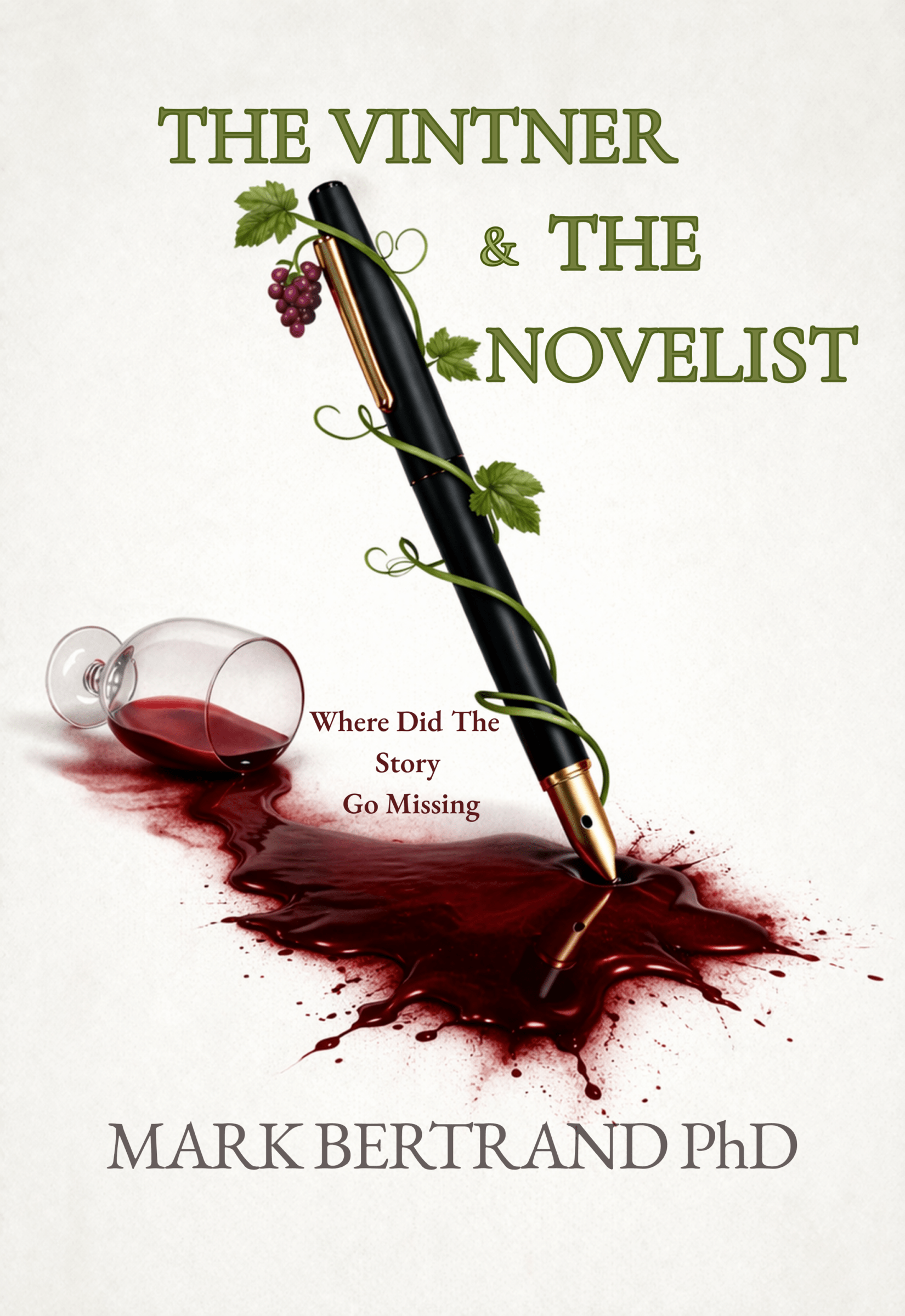
This is where Mark Bertrand’s The Vintner & The Novelist locks into the same lineage.
The same interior pressure.
The same rational mind constructing its own permission.
The same quiet movement toward something that cannot be undone.
But with an added layer:
Bertrand does not just show the mind at work.
He shows what allows that mind to succeed.
And once that is visible, the tension changes.
It is no longer about a single character.
It is about the conditions that make that character possible.
The Inevitable Next Read
Readers drawn to authors like Patricia Highsmith will recognize the precision immediately—the focus on thought, on justification, on the moment a line is crossed internally before it is crossed in the world.
But they will also feel the difference.
Where Highsmith isolates, Bertrand connects.
Where Highsmith observes, Bertrand pressures.
Where Highsmith reveals the mind, Bertrand reveals what stands behind it.
And once you see that, the question changes.
Not whether a character is capable.
But what made it possible in the first place?
Popular articles for those who read authors like Patricia Highsmith also read.


0 comments
Write a comment