
The Modern Thriller No Longer Fears the Same Captivity
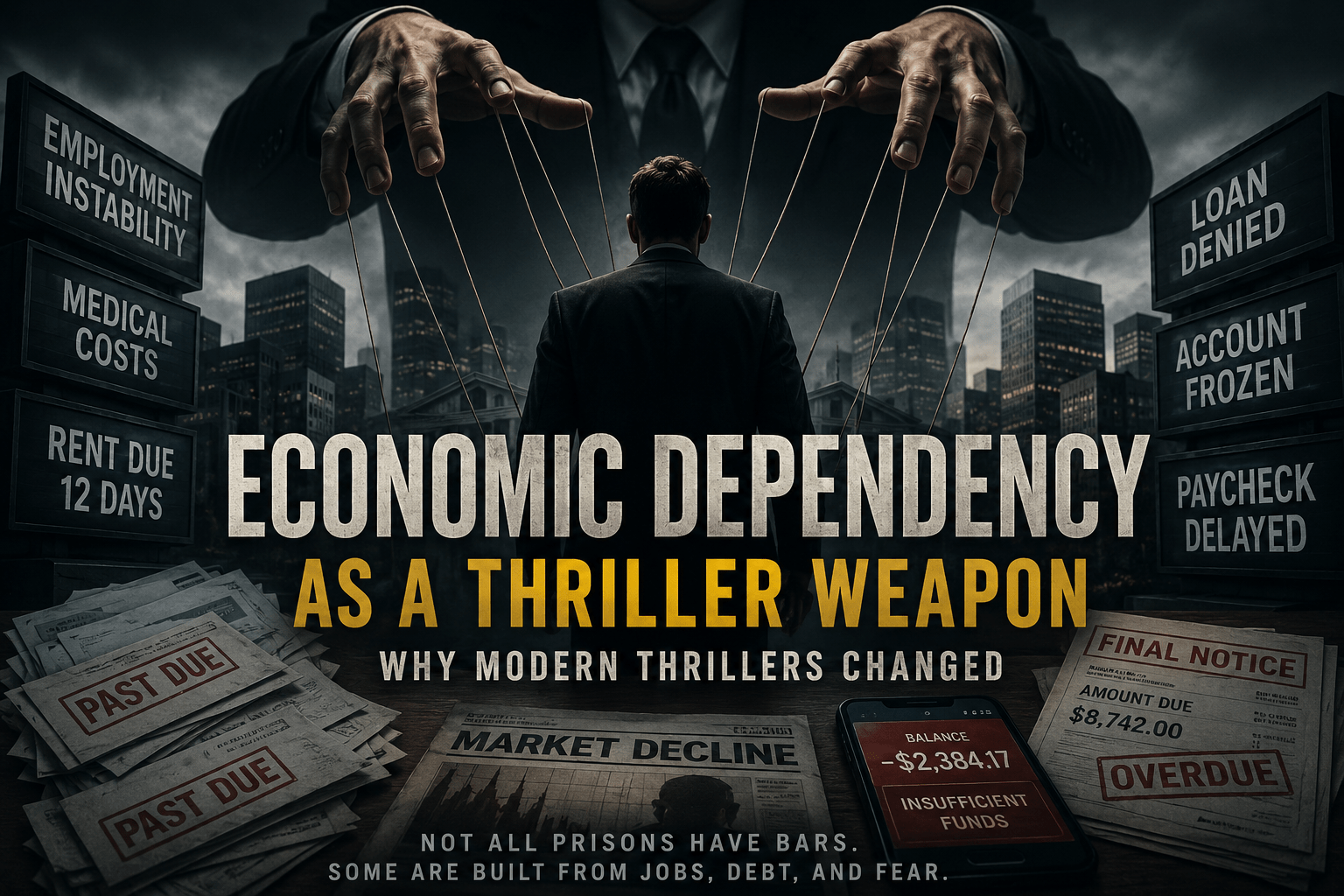
Economic dependency as a thriller weapon has become one of the most powerful weapons in modern thriller fiction because modern life itself increasingly feels built around controlled vulnerability. Older thrillers understood captivity physically. A hostage tied to a chair beneath a hanging lightbulb. A victim locked inside a basement while the detective raced against time to discover the building before the killer returned. The prison was visible, which meant readers could point directly at the danger.
Modern life changed that psychology completely.
Today, millions of people wake up every morning already trapped inside systems they cannot realistically afford to leave. They stay inside collapsing jobs because healthcare depends on employment. They tolerate humiliation because rent is due in twelve days. They ignore corruption because promotion depends on silence. They endure unstable industries, manipulative institutions, predatory debt structures, reputational pressure, and psychological exhaustion because modern survival increasingly depends on maintaining access to systems that can withdraw stability almost instantly.
That kind of fear changed the modern thriller whether the genre fully recognized it or not.
The old thriller feared violence.
The modern thriller increasingly fears dependency.
And dependency may be one of the most effective weapons modern systems ever created.
The Pressure Never Stops
One reason economic pressure works so effectively in modern suspense is because it never fully leaves the character alone. Violence arrives in moments. Financial instability settles into the nervous system permanently. A person living beneath constant economic pressure begins recalculating every decision emotionally, psychologically, and morally.
That pressure changes behavior slowly.
People stop speaking honestly at work because they cannot risk unemployment. They stay inside psychologically damaging situations because instability feels more dangerous than unhappiness. They accept institutional mistreatment because losing insurance coverage would be catastrophic. They compromise themselves gradually because modern life punishes instability faster than it punishes corruption.
Older thrillers often depended on explosive moments of danger.
Modern psychological thrillers increasingly understand the terrifying power of sustained pressure instead. A person does not need a gun pointed at him every day to feel trapped. Sometimes all it takes is the quiet realization that one missed paycheck could begin unraveling the entire structure surrounding his life.
That realization follows people home now.
It sits beside them during dinner. Sleeps beside them at night. Travels with them to work. Moves silently through careers, friendships, family structures, and identity itself.
Modern fear became economic long before many thrillers adapted to it.
Economic Dependency as a Thriller Weapon Is Invisible
What makes Economic Dependency as a Thriller Weapon such powerful thriller territory is that the pressure rarely appears dramatic on the surface. Nobody sees chains. Nobody hears screams. The systems continue functioning normally while ordinary people quietly absorb extraordinary psychological strain beneath them.
A denied claim.
A frozen account.
A manipulated market.
A restructuring notice.
A platform altering visibility.
A corporation reducing labor.
A bank adjusting terms.
An institution redefining eligibility.
Modern life increasingly conditions people to tolerate forms of pressure that previous generations might have recognized immediately as cruelty.
But systems rarely describe themselves as cruel.
They describe themselves as efficient.
That distinction matters because it changes how suspense operates emotionally. The danger no longer feels isolated to one villain operating outside civilization. The danger begins feeling embedded inside ordinary structures themselves. The protagonist is not merely running from violence anymore. He is trying to survive inside environments designed around leverage, dependency, instability, and controlled vulnerability.
That creates a different psychological atmosphere entirely.
The fear becomes slower.
Colder.
Harder to escape.
And because readers already recognize versions of this pressure in their own lives, the suspense begins feeling uncomfortably real.
Why Financial Pressure Became Psychological
Money inside modern thrillers is rarely just money anymore. It represents control over stability itself. Once stability becomes fragile, nearly every other part of life becomes vulnerable alongside it.
Financial pressure changes how people think. It alters judgment. Weakens resistance. Creates desperation. Distorts morality. Makes manipulation more effective. A person terrified of collapse becomes easier to influence because survival itself begins narrowing available choices.
That psychological erosion is where many modern thrillers become far more unsettling than older chase narratives.
A serial killer threatens the body.
Economic pressure threatens identity. It is the key ingredient for economic dependency as a thriller weapon.
It changes how people see themselves. It forces compromises they once believed impossible. It slowly teaches characters to normalize conditions they would once have rejected immediately. The protagonist begins measuring truth against affordability. Integrity against survival. Stability against dignity.
That tension feels psychologically familiar to modern readers because contemporary life increasingly demands similar calculations from ordinary people every day.
The modern thriller did not simply become darker.
It became more structurally intimate.
Where the Married Stupid Series Fits
The Married Stupid Series by Mark Bertrand operates directly inside this modern pressure system.

The series understands that vulnerability rarely begins with physical violence alone. Financial instability, criminal influence, authority failure, psychological manipulation, and narrative control intersect until pressure itself becomes part of the weapon surrounding the characters. It is a prime example of economic dependency as a thriller weapon. The danger grows heavier because the people inside these novels are not merely trying to survive isolated threats. They are trying to survive systems capable of destabilizing identity, perception, judgment, and trust simultaneously.
That is what gives the Married Stupid series its modern psychological tension.
The pressure inside these novels does not arrive only through overt violence. It emerges through leverage, instability, dependency, manipulated perception, and the terrifying realization that once people become economically vulnerable, they also become psychologically vulnerable.
This is where economic dependency as a thriller weapon fits naturally inside the Married Stupid series. The threat is not only violence. It is leverage. It is instability. It is the terrifying awareness that once a person becomes financially vulnerable, almost every other part of his life becomes easier to manipulate.
The series understands something many contemporary thrillers are beginning to recognize: modern systems rarely need to imprison people physically when financial instability already controls so much of human behavior.
That shift changes suspense profoundly.
The question is no longer simply:
Who wants to hurt me?
The question becomes:
What am I willing to become in order to survive this pressure?
That is modern thriller territory.
The New Thriller Weapon Is Invisible
What makes economic dependency such powerful thriller territory is that the pressure rarely appears dramatic on the surface. Nobody sees chains. Nobody hears screams. The systems continue functioning normally while ordinary people quietly absorb extraordinary psychological strain beneath them.
A denied claim.
A frozen account.
A manipulated market.
A restructuring notice.
A platform altering visibility.
A corporation reducing labor.
A bank adjusting terms.
An institution redefining eligibility.
Modern life increasingly conditions people to tolerate forms of pressure that previous generations might have recognized immediately as cruelty.
But systems rarely describe themselves as cruel.
They describe themselves as efficient.
That distinction matters because it changes how suspense operates emotionally. The danger no longer feels isolated to one villain operating outside civilization. The danger begins feeling embedded inside ordinary structures themselves. The protagonist is not merely running from violence anymore. He is trying to survive inside environments designed around leverage, dependency, instability, and controlled vulnerability.
That creates a different psychological atmosphere entirely.
The fear becomes slower.
Colder.
Harder to escape.
And because readers already recognize versions of this pressure in their own lives, the suspense begins feeling uncomfortably real.
Why Financial Pressure Became Psychological
Money inside modern thrillers is rarely just money anymore. It represents control over stability itself. Once stability becomes fragile, nearly every other part of life becomes vulnerable alongside it.
Financial pressure changes how people think. It alters judgment. Weakens resistance. Creates desperation. Distorts morality. Makes manipulation more effective. A person terrified of collapse becomes easier to influence because survival itself begins narrowing available choices.
That psychological erosion is where many modern thrillers become far more unsettling than older chase narratives.
A serial killer threatens the body.
Economic pressure threatens identity.
It changes how people see themselves. It forces compromises they once believed impossible. It slowly teaches characters to normalize conditions they would once have rejected immediately. The protagonist begins measuring truth against affordability. Integrity against survival. Stability against dignity.
That tension feels psychologically familiar to modern readers because contemporary life increasingly demands similar calculations from ordinary people every day.
The modern thriller did not simply become darker.
It became more structurally intimate.
The Architecture of Modern Fear
The most frightening part of economic dependency is not simply that it controls behavior.
It is that the control gradually begins feeling normal.
People adjust themselves to pressure systems constantly. They normalize exhaustion, instability, fear, silence, compromise, humiliation, surveillance, and dependence because modern life increasingly rewards adaptability more than resistance. Economic dependency as a thriller weapon is the systems surrounding them and continues operating politely while ordinary people quietly absorb the psychological cost required to remain functional inside them.
That may be one of the defining fears beneath modern suspense fiction.
Not the fear of sudden violence.
The fear of becoming structurally trapped inside systems capable of reshaping human behavior through dependency alone.
And that may be why economic pressure now feels more frightening than many traditional thriller villains ever did.
Reader Question
What feels more frightening in modern fiction:
A violent threat that arrives suddenly —
or a system capable of slowly reshaping a person’s choices through financial pressure and dependency?
Start Here — Snodgrass, book 1 in the series.

SNODGRASS

Related Reading
That is why economic dependency as a thriller weapon belongs at the center of modern thriller fiction. It names the fear many readers already carry: not simply that someone might attack them, but that the systems surrounding them might quietly remove their choices until survival itself becomes a form of obedience.
Continue exploring the evolution of modern thriller fiction:
Readers interested in psychological systems thrillers, institutional pressure, crime infrastructure, and modern suspense should also explore:
From Books Like:
From The Dossier:


0 comments
Write a comment