The Married Stupid Series tag collects articles that explore the deeper narrative structure connecting the novels in the series. These essays examine recurring character pressures, hidden motivations, and the evolving systems of power shaping events across multiple books. By looking beneath the surface plotlines, these pieces reveal how decisions, relationships, and moral tensions echo across the series and reshape earlier moments when viewed with the full story in mind.
When does kindness stop being shelter and become another room a boy cannot leave?
Josie Lee is not the beginning of the novel, Snodgrass. She is worse than that. She is the first door. The public story tells you Josie opened it.
That is the easy version.
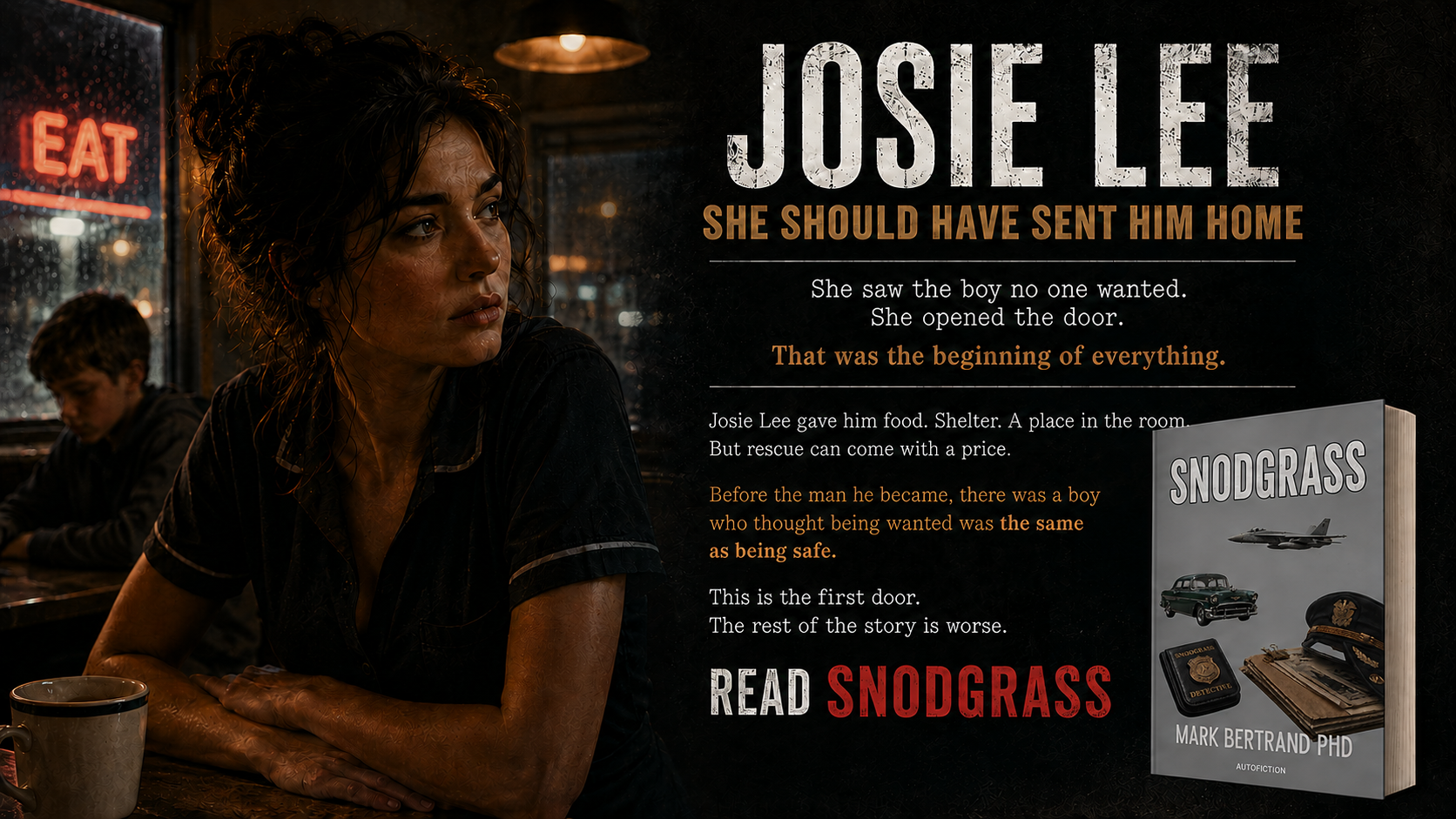
Josie Lee | She should have sent him home
A boy was alone. Hungry. Too young to be free and too damaged to go home. He had already learned the first rotten lesson of the world: adults could call a place a family while making one child feel like a trespasser.
Josie saw him.
That was the beginning of everything.
Not because she was looking for him.
Not because she planned him.
Not because she woke one morning and decided to cross a line.
The truth is worse than that.
The truth is more human.
Josie Lee saw him because she recognized him.
She looked at Mark and saw the old wound walking toward her in boots, hunger, pride, silence, and bad luck. She saw a boy unwanted by the man in the house. She saw another man’s child. She saw the evidence of a life a stepfather wanted erased.
And somewhere inside her, before thought could become warning, before decency could become distance, before the adult world could say what adults always say too late, she understood him.
There I am.
That is where Josie Lee becomes dangerous.
Not because she was cruel.
Because she was tender in the wrong direction.
THE PUBLIC STORY
The public story says Josie helped him.
That part is true.
She gave him food. Attention. Warmth. A place in the room. A voice that did not sound like contempt. A way to sit down without being watched like a criminal. A temporary country where the air did not belong to the man who hated him.
For a boy already put outside the circle, that kind of attention does not feel small.
It feels like rescue.
A plate can become a promise.
A ride can become safety.
A room can become a country.
A woman who looks at him without disgust can become proof that he still exists.
That is why Josie matters.
She did not enter the story as a villain. She entered as mercy.
And mercy is harder to survive when it comes with a shadow.
Snodgrass is not a clean story about a boy who escapes a bad house and finds a better world.
That would be easier.
That would be safer.
That would be a lie.
Snodgrass is the story of what happens after a boy survives one room and discovers the next room has its own bargain waiting.
A cruel person is easy to name. Cruelty comes wearing a sign if you have lived long enough to read it.
A fist.
A locked door.
A withheld meal.
A stepfather’s stare.
A mother’s silence.
A house where one child is treated as evidence against another adult’s pride.
Josie was harder.
She was warmth.
She was food.
She was brown eyes and attention.
She was a woman who looked at him and did not see trouble first.
She saw the child who had been put outside the circle.
And maybe that is why he trusted her.
Maybe that is why she trusted herself.
Because rescue can feel clean when it begins.
The first kindness is always innocent.
A plate.
A ride.
A little money.
A place to sit.
A room where nobody tells him he does not belong.
No one calls that possession.
No one calls that need.
No one calls that the first thread in a knot.
But a knot was forming.
The dossier finding is simple:
Josie Lee did not create the wound.
She entered through it.
SHE SHOULD HAVE SENT HIM HOME
Josie Lee should have sent him home.
That sentence is true.
It is also useless.
Home was not safety. Home was the scene of the crime. Home was where the boy had already learned that being another man’s child could turn his body into a target. Home was where adulthood failed first and then demanded the right to keep failing.
So where was she supposed to send him?
Back to the house that rejected him?
Back to the man who hated him?
Back to the rules written by people who never had to survive inside them?
That is the moral trap of Josie Lee.
The correct answer was not available.
Only the human answer was.
She helped him.
She should not have needed him.
Both things are true.
That is the part the public story cannot hold.
Public stories like clean roles. They want a villain. They want a saint. They want a victim without contradiction and a rescuer without hunger. They want the easy trial, the easy verdict, the simple witness statement.
Josie refuses that comfort.
She took risks for him.
Real risks.
Reputation.
Money.
Judgment.
The attention of the wrong men.
The legal danger of being too close to a boy the world had already failed.
The emotional danger of letting him become necessary.
She gave him what he had been starving for.
A place.
A witness.
A temporary home.
And because she gave him that, he could not see the full cost.
How could he?
He was too young.
THE BOY WHO ACTED OLDER THAN HE WAS
This is the part nobody wants to say.
A damaged boy can look older than he is.
Hunger can sharpen the face.
Work can harden the hands.
Anger can deepen the voice.
Survival can put a terrible adult mask on a child and fool everyone, including the child.
But needing to survive does not make a boy grown.
It only makes him easier to misunderstand.
It makes people call his silence maturity.
It makes people call his pride consent.
It makes people call his ability to endure strength.
It makes people forget that endurance is not adulthood.
A boy who has survived too much may know how to drive, fight, work, lie, steal food, sleep cold, take a punch, watch a room, read a man’s temper, and leave before the worst happens.
That does not make him a man.
That makes him a child with no rescue coming.
And that is why Snodgrass cuts deeper than a survival story.
It is not about whether the boy was strong.
Of course he was strong.
Strong was the only thing left when safety was gone.
The question is what strength cost him.
The question is what he had to mistake for love.
The question is what happened after Josie opened the door.
That is the book.
[READ SNODGRASS]
THE STEPCHILD WOUND
Josie did not fall for Mark because he was young.
That would be too simple.
She fell for him because he was wounded in the exact place she had never healed.
She knew what it meant to be the child from another man. The child who did not fit cleanly into the new household. The child who carried someone else’s history in the face, the name, the blood, the timing. The child a stepfather could resent without ever saying the real reason.
You are not mine.
You are proof.
You are the leftover life before me.
You are the reminder.
That is a terrible thing to do to a child.
It teaches the child that existence itself can be an offense.
Josie understood that.
Maybe no one had rescued her when she needed it.
Maybe no one had stood in the doorway and said, Come in, you are not the problem.
Maybe the girl she used to be had learned to survive by becoming useful, pretty, funny, hard, available, uncomplaining, whatever the room required.
Then Mark arrived with the same wound showing.
And she tried to save him.
That sounds beautiful.
It was beautiful.
It was also not enough to make it right.
Because she was not only saving him.
She was reaching backward through him.
She was trying to rescue the girl no one came back for.
That is where the story darkens.
THE FALSE RESCUE
When a person tries to save the wounded child inside herself by saving another wounded child, love can become confused with recovery.
Kindness can become a claim.
Protection can become hunger.
The rescued person can become evidence that the rescuer is good, needed, chosen, forgiven.
And the boy?
The boy learns another lesson.
Not the lesson of violence this time.
A softer lesson.
A more dangerous one.
He learns that rescue may come with a hand around the wrist.
He learns that being wanted can feel like being saved.
He learns that adult need can arrive disguised as love.
He learns that a door can open and still become a room he does not know how to leave.
That is Josie Lee.
Not villain.
Not saint.
A woman with brown eyes and an old wound.
A woman who saw too much of herself in a boy she should have protected from everyone, including herself.
A woman who gave him shelter when the world had none to offer.
A woman who should have known better.
A woman who maybe did know better and still could not stop the human part of herself from reaching for the one person who made her old pain feel visible.
This is why the public story is not enough.
The public story says Josie helped him.
The dossier says help is not always clean.
The public story says she opened the door.
The dossier asks what followed him through it.
The public story lets us call her kind.
The dossier makes us sit with the harder truth:
Josie Lee may have saved him from the street, but she also taught him that rescue could come with a claim attached.
And once a boy learns that, he carries it.
Into work.
Into hunger.
Into danger.
Into women.
Into rooms where power smiles before it takes something.
Into every future where love and debt are difficult to separate.
WHY JOSIE LEE MATTERS
Josie Lee is not a side character.
She is not a memory.
She is not the waitress from before the real story begins.
She is the first door.
And after that door came the machine.
After Josie came the world that knew exactly what to do with a boy trained to survive, trained to keep moving, trained to confuse danger with opportunity, trained to accept impossible bargains because impossible bargains were the only ones ever offered.
That boy would go on to meet men who understood leverage.
Men who smiled first.
Men who made offers.
Men who turned desperation into a contract.
Men who saw in him the thing damaged children are trained to become.
Useful.
Fast.
Loyal until betrayed.
Silent until cornered.
Brave enough to be spent.
This is where Snodgrass begins to matter.
Not because Snodgrass explains Josie.
Because Snodgrass shows what happened after shelter was no longer enough.
Josie saw the boy.
Snodgrass shows the world that came for him next.
The boy who walked through Josie Lee’s door did not become safe.
He became harder to kill.
There is a difference.
Every real reader knows it.
MEMBERS ONLY // THE PART NOBODY WANTS TO SAY
The hardest part of Josie Lee is
This content is for members only.
Not yet a member? Request member access to The Dossier. Get 20% off the paperback price.
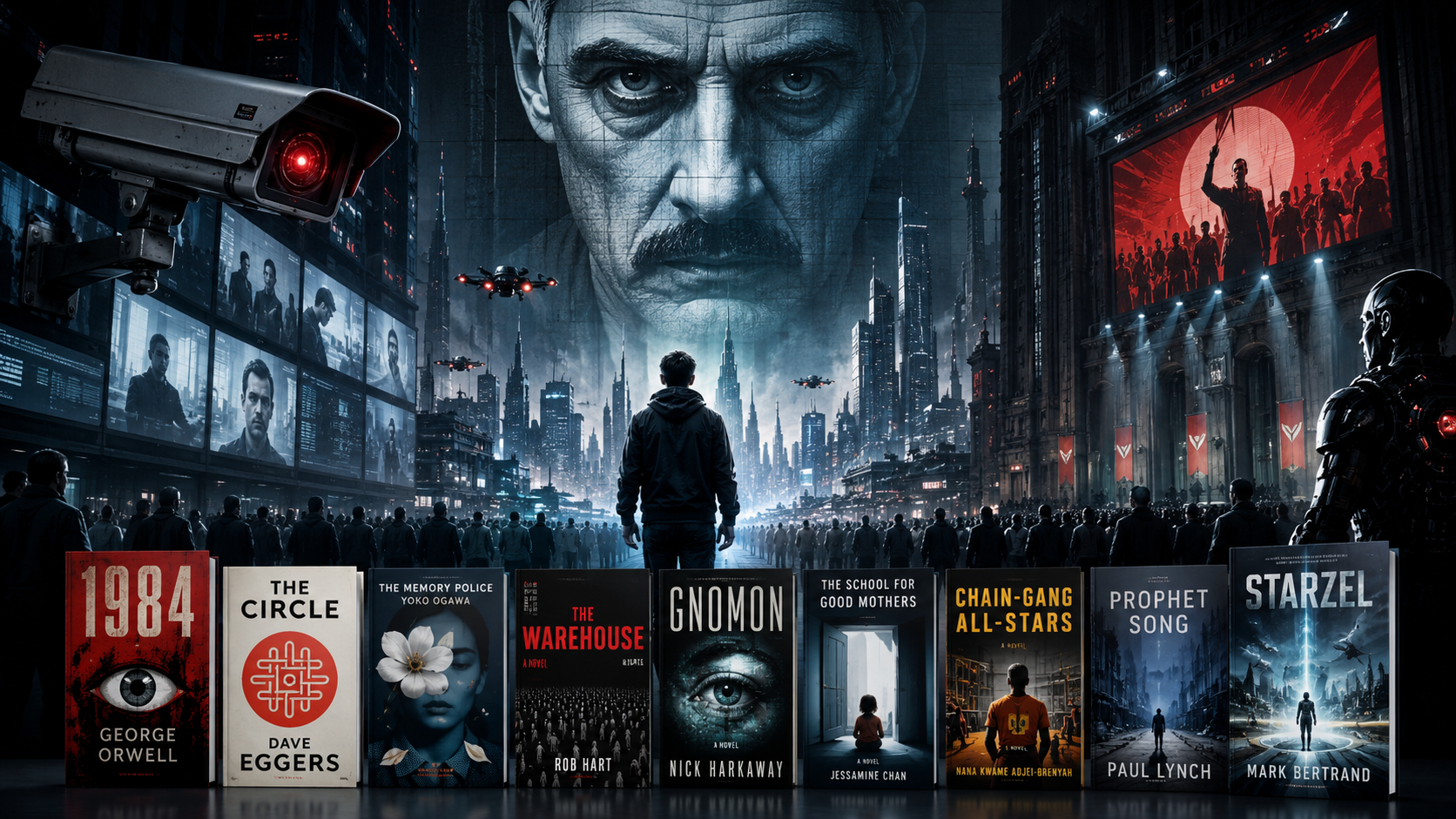
Some novels do not merely imagine the future. They diagnose the machinery already moving beneath the floor. Books like 1984, George Orwell’s 1984 remains one of those books because it understands something brutal about power.
Power does not only want obedience. Obedience is too small. Power wants ownership over memory, language, emotion, loyalty, and the private territory inside the human mind. It wants the citizen to say the lie, repeat the lie, defend the lie, and finally believe the lie so completely that truth itself becomes a punishable instinct.
Books Like 1984
That is why readers still search for books like 1984.
They are not only looking for another dystopian novel. They are looking for that same terrible recognition. The chill of being watched. The dread of language being narrowed. The horror of a society where reality is no longer discovered, argued, tested, or remembered. It is manufactured. It is broadcast. It is enforced.
The best modern dystopian thrillers after 1984 do not simply copy Big Brother. They update the nightmare. They ask what happens when surveillance becomes voluntary, when corporations replace ministries, when entertainment replaces law, when public performance replaces private conscience, and when systems no longer need to hide their cruelty because the population has been trained to applaud it.
Not as a copy of 1984. Not as a nostalgic Orwell tribute. Starzel is a modern speculative dystopian thriller that takes the old fear of surveillance and pushes it into stranger, more psychological, more cosmic territory. In 1984, the Party controls reality by rewriting records. In Starzel, reality itself is damaged. The code beneath human existence has missing data. Truth has not merely been censored. It has been altered at the level of human destiny.
For readers who loved 1984 because it made control feel intimate, inescapable, and morally suffocating, Starzel is the next read that expands the fear.
Why 1984 Still Haunts Dystopian Thriller Readers
The brilliance of 1984 is not only the telescreens.
The real terror is the closed loop. Winston Smith lives inside a system where every route back to truth has been blocked. Memory is unreliable because records are changed. Language is unreliable because words are destroyed or repurposed. History is unreliable because the state edits the past. Love is dangerous because loyalty must belong to the Party. Thought itself becomes evidence.
That is what makes the novel feel larger than politics. 1984 is not only about authoritarian government. It is about the seizure of reality.
Readers respond to that because the story gives shape to a deep human fear: what if I know something is wrong, and every institution around me insists the wrong thing is normal? What if everyone else repeats the lie? What if survival depends on pretending not to see?
That is the pulse modern dystopian fiction keeps returning to.
The modern version often looks less like a boot stamping on a human face and more like a screen, a rating, a feed, a data score, a content policy, a workplace rule, a court broadcast, a wellness program, or a public narrative polished until it becomes official truth.
The cage has changed design.
The function has not.
The Modern Dystopian Thriller Has Replaced Big Brother With Better Machines
The old dystopia watched you from the wall.
The modern dystopia asks you to carry the wall in your pocket.
That is why books like The Circle and The Every by Dave Eggers continue the Orwellian line in a modern technological direction. They understand that surveillance does not need to arrive as a military occupation. It can arrive smiling. It can call itself transparency. It can promise convenience, connection, safety, efficiency, and moral improvement. The nightmare is not that people are forced to surrender privacy. The nightmare is that they are persuaded to treat privacy as selfish.
That is a sharp modern evolution from 1984.
Orwell’s Party forces citizens to be watched. Eggers’ world seduces them into wanting to be watched. Surveillance becomes a social virtue. If you have nothing to hide, why resist? If everyone benefits from openness, why protect your interior life? If the system rewards public exposure, private thought starts to look suspicious.
That is why The Circle works for readers looking for books like 1984. It does not give us the same architecture. It gives us the same pressure. The individual is slowly absorbed into a system that claims to be improving life while quietly destroying the human boundary between self and institution.
Starzel takes that pressure into a more extravagant and dangerous register.
In Starzel, surveillance is not merely technological. It is political, social, biological, spiritual, and narrative. The Great Starzel Republic is a world where ratings shape power, courts become performance, media becomes manipulation, and artificial systems help determine what people see, believe, fear, and worship. The result is a dystopia where truth is no longer hidden in a locked archive. It is buried under spectacle.
That makes Starzel feel especially modern. It understands that control does not always need silence. Sometimes control works better through noise.
Books Like 1984 Understand That Manufactured Truth Is More Dangerous Than Ignorance
A person who does not know the truth can still search for it.
A person trained to love the lie may defend the prison.
That is the deepest violence inside 1984. The Party does not merely change facts. It trains citizens to experience the changed fact as loyalty. Truth becomes a test of submission. The lie is not only spoken. It is loved. It is made sacred by repetition.
Modern dystopian thrillers often move this same idea away from the Ministry of Truth and into softer, more familiar systems.
In Yoko Ogawa’s The Memory Police, the horror is not constant shouting or militarized spectacle. It is disappearance. Things vanish. Memories vanish. The population adjusts. The world shrinks, and with each disappearance the human self becomes less complete. The novel is quieter than 1984, yet its terror is related. Control does not always need to convince you that two plus two equals five. Sometimes it only needs to remove the part of you that remembers four.
That is a different kind of manufactured truth. Not propaganda as noise. Propaganda as erasure.
Readers who loved the psychological pressure in 1984 often respond to The Memory Police because the novel understands that identity depends on memory. Take away memory and you do not simply alter the past. You alter the person. You make resistance difficult because resistance requires continuity. It requires the ability to say: this was not always this way.
Starzel also understands memory as a battlefield.
Eulǝr’s mission is built around missing code, damaged truth, and the search for what has been erased from The First Priority. This gives Starzel a powerful connection to 1984, while moving the conflict into a speculative dimension. Winston works at the Ministry of Truth and participates in the machinery that falsifies the past. Eulǝr becomes a guardian trying to repair a missing truth that may determine the fate of humanity itself.
One story shows a man trapped inside manufactured history.
The other follows a being trying to restore the code beneath history.
That difference matters. It makes Starzel feel less like a repetition of Orwell and more like an expansion of the same moral terror.
The Best Dystopian Thrillers Make Control Feel Ordinary
The most frightening dystopias are not the ones where every scene screams oppression.
They are the ones where oppression has paperwork.
That is why The School for Good Mothers by Jessamine Chan belongs in the conversation. Its central terror comes through systems that claim to measure, train, reform, and improve. The state does not present itself as evil. It presents itself as corrective. It claims expertise. It creates programs. It turns human failure into institutional custody.
For readers of 1984, that matters because the novel shows another route into the same old nightmare. In Orwell, the state controls the citizen through fear, language, and ideology. In Chan’s novel, the system controls motherhood through surveillance, judgment, and behavioral correction. The individual does not merely break a law. She is evaluated as defective.
That is modern dystopian fiction at its sharpest.
The cage is not always called a cage. Sometimes it is called care. Sometimes it is called training. Sometimes it is called protection. Sometimes it is called justice.
Starzel knows this trick well.
The Great Starzel Republic does not merely punish. It stages. It rates. It performs authority as entertainment. The court is not a solemn place where truth is found. It is a broadcast machine where judgment becomes spectacle, and spectacle becomes social order. That is one of the reasons Starzel is such a strong recommendation for readers who want modern books like 1984. It grasps the new face of control: not the silent bureaucrat behind the file cabinet, the camera-ready authority figure performing justice for an audience trained to cheer.
That is where the novel becomes especially dangerous.
A society that watches cruelty as entertainment no longer needs to be secretly brutal. It has made brutality popular.
Corporate Power Is the New Ministry
Orwell gave readers ministries with names designed to invert reality: the Ministry of Truth, the Ministry of Love, the Ministry of Peace.
Modern dystopian thrillers often replace those ministries with corporations, platforms, logistics systems, media empires, and private institutions that perform public functions without public accountability.
Rob Hart’s The Warehouse is a strong example. It imagines a corporate panopticon where work, survival, consumption, housing, and identity are absorbed into a single giant system. The fear is not only that the company watches. The fear is that the company becomes the world. Once everything necessary for ordinary life is routed through one machine, refusal becomes almost impossible.
That is very close to the emotional engine of 1984.
The Party does not need to win an argument with Winston. It controls the environment in which argument can occur. It controls employment, food, information, sex, safety, history, and the future. Modern corporate dystopias update that structure. They ask what happens when the institution does not wear a uniform. What happens when the prison is branded as convenience?
Starzel moves through a similar anxiety while widening the scale.
Its dystopian systems involve government, media, technology, law, artificial intelligence, social control, biological enhancement, class division, and planetary power. The wealthy and powerful do not simply rule through ideology. They manipulate the mechanisms by which the population experiences reality. In that sense, Starzel belongs to the new generation of dystopian thrillers that understand power as a system of capture rather than a single villain standing at a podium.
That is exactly the kind of fiction many readers are looking for after 1984.
They do not only want another dictator.
They want the machinery.
Gnomon, AI Surveillance, and the Question of Human Identity
Nick Harkaway’s Gnomon is one of the most ambitious modern novels for readers fascinated by surveillance, artificial intelligence, state power, and identity. It imagines a future where monitoring is woven into the moral structure of society. People are watched for their own good. The system is justified as protective. Order becomes a kind of civic religion.
That is a powerful development from 1984 because it asks whether a perfectly monitored society might still believe itself free.
This is where dystopian fiction becomes psychologically rich. The simplest version of tyranny is easy to recognize. The more advanced version convinces people it has solved tyranny. It says, look, no dictator, no chaos, no crime, no uncertainty. Only order. Only safety. Only a clean mathematical arrangement of life.
That is when the reader starts to feel the real danger.
What happens to the human being when every private contradiction becomes searchable? What happens to identity when the system knows you better than your friends, your family, your lovers, perhaps even yourself? What happens when truth is not discovered through conscience, memory, and moral struggle, yet processed through an authority machine?
Starzel has a deep kinship with this kind of question.
Its Syganoid world is built around enhanced intelligence, organoid systems, biological computing, expanded senses, hidden code, and the fragile difference between wisdom and interference. That makes Starzel more than a political dystopia. It is a metaphysical dystopian thriller. It asks what happens when beings powerful enough to manipulate reality discover they may not understand the consequences of their own intelligence.
That is where Starzel becomes especially satisfying for readers who like their dystopian fiction intellectually loaded. The novel is not only asking who controls society. It is asking who controls reality, who understands truth, and whether advanced minds are morally advanced enough to repair what they have broken.
Chain-Gang All-Stars and the Entertainment of Punishment
Nana Kwame Adjei-Brenyah’s Chain-Gang All-Stars belongs to the modern dystopian shelf because it understands a hideous fact about public cruelty: once violence becomes entertainment, the audience becomes part of the system.
That makes it a natural companion to 1984, even though the surfaces are very different.
Orwell’s citizens are trained through fear, hate rituals, surveillance, deprivation, and ideological submission. In Chain-Gang All-Stars, punishment becomes commercial spectacle. The reader is forced to confront a society that does not hide its barbarism. It packages it. It sponsors it. It turns suffering into content.
That is one of the most important modern evolutions of dystopian fiction.
Old systems needed secrecy. Modern systems often thrive in full view. Abuse can be broadcast, monetized, debated, memed, ranked, clipped, defended, and forgotten by morning. The machine does not need the audience to be innocent. It only needs the audience to keep watching.
This is where Starzel hits hard.
The Great Starzel Republic’s courtroom spectacle, ratings-driven authority, and public appetite for punishment feel like part of this same modern dystopian lineage. Justice has become a show. The court does not search for truth. It manages audience reaction. The accused becomes content. The system becomes theater with consequences.
For 1984 readers, this matters because it updates the Two Minutes Hate. Orwell understood the power of ritualized public emotion. Starzel understands what happens when that ritual becomes a broadcast model. Outrage is no longer only political discipline. It becomes entertainment infrastructure.
That is a viciously modern nightmare.
Prophet Song and the Ordinary Collapse Into Totalitarianism
Paul Lynch’s Prophet Song is another vital modern comparison because it does not treat dystopia as a distant invented planet. It gives readers the feeling of democratic life tightening into authoritarian terror one ordinary day at a time.
That matters for readers of 1984 because Orwell’s world is already fully formed. The Party has won. The structure is complete before Winston begins his rebellion. Prophet Song is frightening in a different way because it shows the slide. It shows how ordinary domestic life can be swallowed by state pressure, fear, disappearance, and emergency.
Many readers love dystopian thrillers because they are not only interested in the end state. They want to understand the movement. How does a society get there? What does the first warning feel like? Which signs are ignored? Which compromises become normal? Which people still believe everything will settle down?
That kind of movement is part of what makes Starzel compelling too.
The novel does not merely present a finished dystopia. It gives the reader layered systems: planetary history, political collapse, post-war nations, outlawed identities, media manipulation, social division, and the long consequence of missing truth. The world feels damaged by accumulation. One act, one system, one lie, one law, one edited reality after another.
That is how dystopia becomes believable.
Not because one villain gives one speech.
Because everything has been bent for so long that cruelty starts to look like design.
What Readers Really Want After 1984
A reader who finishes 1984 does not usually ask for “more surveillance” in a simple way.
They want several deeper pleasures.
They want the paranoia of being watched.
They want the intellectual pleasure of detecting how the system works.
They want a protagonist trapped inside a lie large enough to become a world.
They want language, memory, history, media, law, and authority to become part of the conflict.
They want the sickening recognition that power does not always need to kill the body first. It can break the mind, rewrite the past, isolate the dissenter, and make truth sound insane.
That is why the best books like 1984 are not merely books with cameras, police, and authoritarian governments. They are books about reality under occupation.
Starzel fits because its threat model is larger than surveillance. Eulǝr is not only moving through hostile territory. He is moving through a civilization where systems have lost their moral center, where truth has been damaged, where media and political power shape perception, where artificial authority replaces wisdom, and where the missing data behind The First Priority may be the difference between human survival and erasure.
That gives the novel a rare blend.
It has the paranoia of a dystopian thriller.
It has the scale of speculative science fiction.
It has the mind pressure of a psychological novel.
It has the philosophical engine of a story about truth, consciousness, love, suffering, and the cost of interference.
For readers searching for modern dystopian thrillers like 1984, that combination matters.
Because the next great dystopian fear is not only that someone is watching.
It is that someone has already changed the code, and everyone else calls the corrupted world normal.
Why Starzel Is the Best Next Read for 1984 Readers
1984 gives readers a world where truth is controlled by the state.
Starzel gives readers a world where truth has been damaged beneath the state.
That is the leap.
Orwell’s nightmare is political and psychological. Bertrand’s is political, psychological, technological, spiritual, and cosmic. The question is no longer only, “Who controls the records?” The question becomes, “What happens when the structure of human reality has been altered and the population is too manipulated to recognize what has been stolen?”
That makes Starzel an unusually strong modern recommendation for readers who want books like 1984 and also want something stranger, larger, and more ambitious.
Eulǝr is a fascinating dystopian protagonist because he does not begin as an ordinary rebel. He begins as a superior being, a Syganoid, one of the enhanced, one of the watchers of the code, one of the minds who can see more than humans see. Yet his superiority does not protect him from error. It may make his error more catastrophic. That gives the novel its psychological bite.
The reader is not only watching a man resist a system.
The reader is watching a powerful being discover that intelligence without humility can become a form of damage.
That is a brilliant modern answer to 1984. Winston is crushed because he is powerless. Eulǝr is threatened because he may be powerful in the wrong way, in the wrong world, at the wrong time, carrying a mission he may not fully understand.
That tension makes Starzel more than another dystopian adventure. It becomes a story about responsibility, reality, and the unstable relationship between truth and control.
The Reader Who Loves 1984 Should Read Starzel Next
Read The Circle when you want surveillance disguised as transparency.
Read The Memory Police when you want erasure, memory, and identity.
Read The Warehouse when you want corporate control replacing government control.
Read Gnomon when you want artificial intelligence, surveillance, and identity bent into a complex literary machine.
Read Chain-Gang All-Stars when you want punishment turned into public spectacle.
Read Prophet Song when you want the slow domestic terror of a society sliding into authoritarian rule.
Then read Starzel when you want the full modern dystopian escalation: surveillance, manufactured truth, ratings-driven justice, media manipulation, biological enhancement, hidden history, corrupted reality, and a mission to restore the missing code before humanity disappears from existence.
That is why Starzel is such a strong next read after 1984.
It understands the old fear.
Then it asks the new question.
What if Big Brother is no longer the worst thing watching you?
What if the truth itself has gone missing?
Final Verdict: Books Like 1984 Lead Naturally to Starzel
The enduring power of 1984 comes from one awful insight: once a system controls truth, the human being becomes easier to control than the record.
Modern dystopian thrillers keep returning to that insight because the machinery has only become more intimate. Cameras became phones. Ministries became platforms. Propaganda became entertainment. Reeducation became training. Punishment became content. Ratings became authority. Artificial systems became moral referees. And truth, the old stubborn thing, became something power could edit, erase, or bury under spectacle.
That is the territory Starzel enters with force.
For readers who want dystopian science fiction with surveillance, control, manufactured truth, psychological pressure, and a world large enough to make the danger feel cosmic, Starzel is not merely another book on the list.
It is the book that turns the 1984 question inside out.
Not only: what if the state controls reality?
Worse: what if reality has already been rewritten, and the only one who can repair it may have helped break it?
Read Starzel directly from Mark Bertrand.
SEO Title: Books Like 1984: Modern Dystopian Thrillers About Surveillance, Control, and Manufactured Truth
Meta Description: Looking for books like 1984? Explore modern dystopian thrillers about surveillance, control, manufactured truth, corporate power, media spectacle, and why Starzel by Mark Bertrand should be your next read.
Excerpt: If you loved George Orwell’s 1984 for its surveillance, mind control, manufactured truth, and psychological pressure, these modern dystopian thrillers continue the nightmare. The strongest next read is Starzel by Mark Bertrand.
Category: Books Like
Tags: books like 1984, dystopian thrillers, modern dystopian fiction, surveillance fiction, Orwellian novels, manufactured truth, psychological thriller books, speculative fiction, Starzel, Mark Bertrand
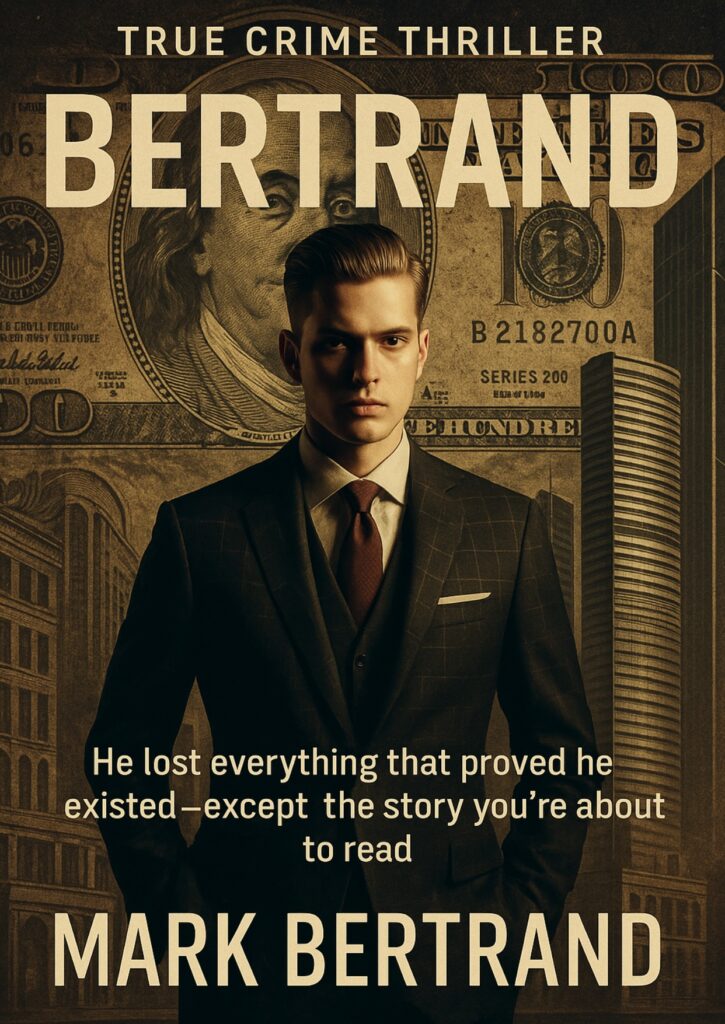
There is a moment in BERTRAND when the whole American bargain gets reduced to a check.
Five hundred dollars.
Not poverty. Not charity. Not nothing. That would be too obvious.
Five Hundred Dollars for Millions
Five hundred dollars is worse because it pretends to be recognition. It carries the shape of gratitude. It arrives in an envelope. It has the company’s authority behind it. It says, formally and with a straight face, we saw what you did.
That is the insult.
Mark and Danny do not merely show up for work. They do not simply perform their assigned duties. They take on a problem the company cannot control. They step into the heat of the V-22 Osprey program, where schedule pressure, military contracts, manufacturing errors, union conflict, executive anxiety, and prototype urgency all collide in one industrial pressure cooker.
They solve problems that management cannot solve.
They invent tools. They improve the assembly process. They save time. They reduce rework. They help protect a contract worth millions. They turn a slipping manufacturing schedule into a corporate success story.
Then the company hands them five hundred dollars.
That is the moment the mask comes off.
Not the worker’s mask.
The company’s.
The photograph was part of the theft
Before the check, there is the photograph.
That detail matters.
The company does what corporations do when human labor produces value it cannot honestly reward: it converts the worker into decoration. It stages the achievement. It produces an image. It lets the company magazine tell a flattering story. The worker becomes proof that the company is innovative, nimble, brilliant, alive.
But the real money does not travel with the photograph.
The real money travels upward.
The photograph is emotional payment. It is the corporate version of applause. Stand here. Hold the tool. Look proud. Let the institution borrow your face. Let the executives sell your competence as proof of their leadership.
In BERTRAND, that photograph carries a quiet violence. It looks harmless. It looks almost sweet. Two men recognized for good work. A company celebrating ingenuity.
But beneath the surface, the photograph is a laundering mechanism.
It launders exploitation into morale.
The company does not have to say, we captured the value you created and gave you scraps. It can say, we put you in the magazine. It does not have to share the wealth. It can share visibility. It does not have to give ownership. It can give recognition.
That is how corporate theft stays polite.
It does not always steal in darkness. Sometimes it steals under fluorescent lights with a camera present.
Purchase BERTRAND
Members Only Content: Five Hundred Dollars for Millions
The tool was worth more than the reward
The red-card error on the prototype wing should have been a disaster.
A misaligned hole. A critical titanium fitting. A production schedule already
This content is for members only.
Not yet a member? Request member access to The Dossier.
These pages map the territory behind Mark Bertrand’s psychological thriller books: captured reality, corporate power, institutional pressure, algorithmic society, cultural dread, literary disorientation, and the old thriller tropes that no longer explain the world readers are living in.