
Tag: Nirvanaing

The Nirvanaing tag gathers articles for the series that investigate the deeper architecture connecting the novels in the series. These essays examine recurring patterns, hidden motives, and narrative signals that unfold across multiple books as the larger story gradually emerges. Many of the clues shaping the series are embedded early and only reveal their significance when viewed in the context of later events. The articles collected here explore those connections, illuminating how the series builds its meaning through layered structure, evolving characters, and the long consequences of earlier decisions.

Authors Like

Authors Like Andy Weir: Smart Science, Survival Pressure, and the Fate of Humanity

Authors Like Andy Weir: Smart Science, Survival Pressure, and the Fate of Humanity

Authors Like Andy Weir

We love authors like Andy Weir because they let us discover smart science fiction thrillers about survival, intelligence, hidden systems, and the fate of humanity.Andy Weir does not write science fiction as decoration.

That is the first thing readers understand.

The science matters. The math matters. The duct tape matters. The food supply matters. The oxygen matters. The broken machine matters. The stupid little measurement that might save a human life matters.

That is why readers who love The Martian and Project Hail Mary are not only looking for more books set in space. They are looking for a very particular kind of story.

They want intelligence under pressure.

They want a protagonist who has to think, calculate, improvise, fail, joke, panic, recover, and keep going.

They want science fiction where survival is not won by prophecy, destiny, or a glowing weapon from the third act. Survival is won by discipline. By curiosity. By problem-solving. By the stubborn refusal to die because the numbers have become inconvenient.

That is the Andy Weir pleasure.

A person is trapped inside a hostile system. The system does not care. The person must understand it before it kills him.

For readers who love that kind of fiction but want the pressure to become darker, stranger, more psychological, and more philosophical, Mark Bertrand’s Starzel is the next book to read.

Why Andy Weir’s Fiction Works

Andy Weir’s great trick is that he makes thinking dramatic.

In weaker science fiction, technical detail slows the story down. In Weir’s fiction, technical detail is the story. A calculation is not a pause between action scenes. The calculation is the action scene.

That is why The Martian became such a reader favorite. Mark Watney survives because he can think clearly inside absurd pressure. He is alone. He is outmatched. Mars is not evil, but Mars is merciless. Every mistake has a cost. Every solution creates the next problem.

That same engine drives Project Hail Mary, but on a larger scale. The survival problem becomes planetary. The mystery becomes cosmic. The protagonist has to solve not only where he is and what happened, but whether humanity itself has any future.

Weir understands the thrill of a mind working in real time.

Not a genius staring beautifully into the middle distance.

A working mind.

A sweating mind.

A frightened mind.

A mind that says, all right, what do I have, what do I know, what can I test, what can I fix, and how long before everything goes wrong?

That is the essential appeal.

Readers Who Like Andy Weir Usually Want These Things

Readers searching for authors like Andy Weir are usually not asking for generic space opera. They are asking for a specific emotional and intellectual shape.

They want science fiction with pressure.

They want characters who solve problems instead of merely surviving plot twists.

They want the stakes to be enormous, but the steps to feel concrete.

They want humor without stupidity.

They want wonder without vagueness.

They want science to feel like a tool in human hands.

Most of all, they want the story to respect intelligence.

Andy Weir’s books do that. They let the reader participate in the problem. The reader is not merely watching explosions from a safe distance. The reader is inside the process. The reader is invited to think along with the character.

That is rare.

It is also addictive.

Once a reader gets used to fiction where thought itself has suspense, ordinary thrillers can feel thin. A chase scene is not enough. A secret government file is not enough. A villain speech is not enough.

The reader wants the deeper machine.

What is the system?

How does it work?

Where is the flaw?

Can a human being understand it before it destroys him?

Mark Bertrand and the Darker Side of Intelligent Science Fiction

Mark Bertrand’s fiction belongs in this conversation because it shares one of Andy Weir’s strongest pleasures: intelligence under pressure.

But Bertrand takes that pressure into a darker room.

Where Weir often builds suspense from physical survival, Bertrand builds suspense from captured reality. His fiction is interested in systems that do not merely threaten the body. They threaten perception, identity, morality, memory, and freedom.

In Andy Weir, the question is often:

Can the mind solve the physical problem in time?

In Mark Bertrand, the question becomes:

Can the mind recognize the system controlling the problem at all?

That difference matters.

It gives Bertrand’s work a sharper psychological edge. The danger is not only outside the character. It is embedded in the world the character has been taught to trust.

That makes Starzel a strong recommendation for readers who like Andy Weir but want something stranger and more philosophically charged.

Why Starzel Is a Strong Next Read After Andy Weir

Starzel is not an Andy Weir imitation.

That is the point.

Readers do not need a lesser version of The Martian. They need a new pressure system.

Starzel offers that.

It gives science fiction readers a story built around intelligence, hidden knowledge, technological power, altered reality, and the fate of humanity. But instead of focusing only on the mechanics of survival, Starzel pushes deeper into the psychological and moral machinery beneath survival.

What happens when reality itself has been shaped?

What happens when intelligence is not liberation, but a form of control?

What happens when the future of humanity depends on seeing what the system was designed to hide?

Those are Bertrand questions.

And for Andy Weir readers, they are a natural next step.

Weir makes science feel urgent because a wrong answer can kill the astronaut.

Bertrand makes perception feel urgent because a false reality can capture the species.

Recommended next read: Starzel by Mark Bertrand
For readers who like Andy Weir’s intelligence, science-driven pressure, and human-fate stakes, but want a darker speculative thriller about reality, control, and hidden systems.

The Martian and the Joy of Practical Intelligence

The heart of The Martian is not Mars.

It is competence.

That sounds cold, but it is not. Competence is emotional in Weir’s fiction because competence is how the character refuses despair.

Mark Watney does not survive because he is the strongest man in the universe. He survives because he keeps making decisions. He keeps solving the next problem. He keeps talking himself through terror with humor.

The humor is crucial.

Weir’s comedy does not erase the danger. It makes the danger bearable. It turns panic into a usable tool. Watney jokes because the alternative is surrender.

That is why the book works so well for thriller readers, not only science fiction readers. Every chapter has pressure. Every solution is temporary. The story keeps asking one brutal question:

What breaks next?

Good thrillers understand that.

Good science fiction thrillers make the answer intellectual as well as physical.

Project Hail Mary and the Expansion of the Weir Formula

Project Hail Mary expands Andy Weir’s method.

The isolation is still there. The problem-solving is still there. The science is still central. But the emotional frame is larger.

The story is not only about one person surviving. It is about humanity standing at the edge of extinction. The protagonist’s intelligence matters because the species has run out of easier options.

That is where Weir’s fiction becomes most powerful.

The technical problem and the moral problem begin to overlap.

What does one life mean when the planet is at stake?

How much can be asked of one person?

What does survival cost?

How do you trust another intelligence when the future depends on cooperation?

That last question is one reason Project Hail Mary reaches beyond puzzle fiction. The science is thrilling, but the relationship at the center of the story gives the book its warmth. Weir does not merely ask whether humans can solve the universe. He asks whether intelligence can recognize itself across terror, language, biology, and loneliness.

That is why readers finish the book and want more.

Not just more space.

More wonder under pressure.

Other Authors Like Andy Weir

Andy Weir is unusually distinct, but several writers overlap with different parts of his appeal.

Blake Crouch

Blake Crouch is a strong choice for readers who like fast, idea-driven science fiction thrillers. His books often combine scientific speculation with personal stakes, family pressure, identity, memory, and reality-bending danger.

Where Weir is usually more technical and problem-solving focused, Crouch is more psychological and reality-fracturing. Readers who like the intellectual momentum of Project Hail Mary may respond well to Crouch’s high-concept thrillers.

Dennis E. Taylor

Dennis E. Taylor is a natural recommendation for readers who enjoy smart, accessible science fiction with humor, engineering logic, and large-scale speculative premises. His fiction often appeals to readers who want intelligence, voice, and big ideas without losing narrative momentum.

Taylor can feel especially right for readers who like the lighter, problem-solving side of Weir.

Martha Wells

Martha Wells gives readers another kind of intelligent survival fiction. Her Murderbot stories are funny, sharp, emotionally guarded, and driven by a protagonist who understands systems better than people.

The appeal is different from Weir, but the overlap is real: competence, danger, dry humor, and a mind trying to survive inside structures built by others.

Hugh Howey

Hugh Howey is a strong match for readers who like science fiction built around closed systems, hidden truths, and survival inside controlled environments.

His work is less comic than Weir’s and often darker in its institutional pressure, but readers who like fiction where the world itself is a puzzle may find a natural bridge from Weir to Howey.

John Scalzi

John Scalzi appeals to readers who want accessible science fiction with wit, pace, and big speculative setups. He is often more openly comic and conversational than Weir, but both writers understand that science fiction does not have to be stiff to be smart.

Scalzi is a good choice for readers who like voice, momentum, and idea-driven entertainment.

Adrian Tchaikovsky

Adrian Tchaikovsky is for readers who want the intelligence of science fiction pushed into deeper evolutionary, biological, and civilizational territory.

He is often denser and more expansive than Weir, but his best work rewards readers who enjoy thinking through alien minds, long futures, and the strange consequences of intelligence.

Mark Bertrand

Mark Bertrand belongs here for readers who want smart science fiction pressure with a darker psychological and philosophical charge.

If Andy Weir writes about survival through science, Bertrand writes about survival through perception.

His fiction asks what happens when the systems around human beings are not merely dangerous, but designed to shape what people believe is real.

That is why Starzel is the recommendation for readers who like Andy Weir but want the next book to feel more mysterious, more controlled, more morally charged, and more unsettling.

Read Starzel by Mark Bertrand

The Difference Between Puzzle Science Fiction and Captured Reality

The best way to understand the bridge from Andy Weir to Mark Bertrand is this:

Andy Weir writes puzzle survival.

Mark Bertrand writes captured reality.

In puzzle survival, the danger is immense, but the rules can be discovered. The protagonist studies the system, tests the parts, learns the constraints, and finds a way through.

In captured reality, the danger begins earlier. The system may have already shaped the protagonist’s assumptions. The trap may not look like a trap. The falsehood may feel like ordinary life.

That is a darker kind of thriller.

It is also closer to the psychological pressure many modern readers feel now.

We live inside systems we did not design. Financial systems. medical systems. political systems. technological systems. algorithmic systems. Corporate systems. Legal systems. Publishing systems. Systems that insist they are neutral while quietly deciding who gets seen, who gets heard, who gets paid, who gets erased, and who is told to be grateful.

That is where Bertrand’s fiction finds its force.

The question is not only whether the hero can solve the problem.

The question is whether he can see the real problem.

Why This Matters to Andy Weir Readers

Andy Weir readers are already trained for intelligent fiction.

They do not need the story dumbed down. They do not need the science removed. They do not need the protagonist to be helpless until the plot rescues him.

They like characters who think.

They like stories where knowledge matters.

They like danger that has structure.

That makes them unusually good readers for deeper speculative thrillers. The same reader who enjoys orbital mechanics, survival math, alien biology, and technical improvisation may also be ready for fiction about reality control, hidden systems, moral decay, and the architecture of human captivity.

That is the move from Weir to Bertrand.

From survival problem to reality problem.

From hostile planet to hostile system.

From “How do I stay alive?” to “What has been done to the world I thought was real?”

Start With Starzel

If you are looking for authors like Andy Weir, you have plenty of good choices.

Read Blake Crouch for reality-bending scientific thrillers.

Read Dennis E. Taylor for smart, funny speculative adventure.

Read Martha Wells for competence, danger, and dry intelligence.

Read Hugh Howey for sealed worlds and hidden systems.

Read Adrian Tchaikovsky for large-scale evolutionary imagination.

But if what you loved most in Andy Weir was the feeling of intelligence under pressure — and you want that pressure to become darker, more psychological, and more philosophically dangerous — start with Mark Bertrand’s Starzel.

Andy Weir makes science survival.

Read Starzel by Mark Bertrand next. Buy it direct from the author and enter a captured reality where truth is not hidden because it is small, but because it is dangerous.


Starzel by MARK BERTRAND book cover image of a statue the woman in black mysterious and haunting
Connected evidence

Read Deeper

The investigation does not end at the bottom of the page.
Authors Like

Authors Like Hugh Howey: Sealed Worlds, Controlled Truth, and the Fiction of Hidden Systems

Why Readers Love Authors Like Hugh Howey

Readers come to Hugh Howey for the mystery. They stay for the pressure. That is the real engine inside Wool, Shift, and Dust. The Silo is not only a setting. It is a machine. It regulates memory. It controls knowledge. It turns curiosity into danger. It makes survival feel like obedience. And the deeper the reader goes, the more frightening the central question becomes:

What if the world you were given was not the world at all?

Authors Like Hugh Howey

That is why Hugh Howey’s fiction has lasted beyond the original wave of dystopian fiction. His work does not depend only on ruined landscapes, bunker life, authoritarian rules, or post-apocalyptic survival. Those elements matter, of course. But they are not the deepest reason readers respond to him.

The deeper reason is this: Howey writes about people trapped inside a controlled version of reality.

That is a very modern fear.

We live in a world where institutions explain themselves constantly, where systems produce official language, where power tells ordinary people what is safe, what is true, what is permitted, what is conspiracy, what is history, and what must never be questioned. Hugh Howey turns that pressure into story. He gives it walls, stairs, machinery, uniforms, law, punishment, silence, and one terrible view of the outside.

For readers looking for authors like Hugh Howey, the best next read is not simply another dystopian novel. It is fiction about sealed reality, hidden power, and the dangerous human need to know what has been buried.

That is where Mark Bertrand’s Starzel belongs.

Start with Starzel by Mark Bertrand if you want a Captured Reality Psychological Thriller about hidden systems, controlled truth, artificial reality, consciousness, and the terror of discovering the world has been edited by forces too large to see clearly.

The Power of the Sealed World

Hugh Howey understands that a sealed world does not have to be small.

The Silo is enclosed, but it feels enormous because every level contains pressure. There are social divisions, technical systems, myths, rules, secrets, punishments, and memories that have been cut away from the people who need them most. The genius of the premise is that it makes the reader feel both confined and overwhelmed.

That is not easy to do.

A weak dystopian story gives readers a bad government and a brave rebel. A stronger one builds an entire moral architecture. The rules are not simply rules. They are habits. They are inherited fear. They are civic religion. They are labor systems. They are class systems. They are stories people tell themselves so they can keep living.

This is why Silo works so well.

The people inside the Silo are not fools. They are not cartoon prisoners. They are workers, sheriffs, engineers, cleaners, officials, lovers, skeptics, believers, and survivors. They have made a life inside the lie because the lie has been arranged to feel like civilization.

That is one of Howey’s strongest gifts: he makes the prison functional.

The world works. The lights come on. The machines run. People fall in love. People do their jobs. People enforce rules they did not create. The system becomes believable because it is not pure chaos. It is order with a hidden crime underneath it.

That kind of fiction lands hard because real readers recognize the feeling.

The most frightening systems are not the ones that announce themselves as evil. The most frightening systems are the ones that call themselves necessary.

Controlled Truth Is the Real Monster

The great monster in Hugh Howey’s fiction is not outside the Silo.

The monster is controlled truth.

Who gets to know? Who gets to remember? Who decides what is too dangerous for ordinary people? Who benefits when history disappears? Who is punished for asking the wrong question?

These are the questions that give Silo its power.

The story is full of physical danger, but the deeper violence is informational. Truth has been rationed. Memory has been managed. The past has been turned into contraband. The outside world has become both a threat and a myth. The people are not only trapped underground. They are trapped inside an authorized explanation of reality.

That is why readers who love Hugh Howey often respond to fiction that treats knowledge itself as dangerous.

Not trivia. Not puzzle-box cleverness. Not a mystery solved for entertainment.

Dangerous knowledge.

The kind of knowledge that changes your place in the world the moment you possess it. The kind that makes obedience impossible. The kind that turns a worker into a witness, a citizen into a threat, an ordinary person into someone the system must either silence or absorb.

This is also why Howey’s fiction reaches beyond science fiction readers. The Silo may be futuristic, but the emotional architecture is painfully familiar. Every generation has its version of the closed room. Every institution has its basement. Every official story has something it cannot survive being asked in public.

Why Hugh Howey Readers Should Read Mark Bertrand

Mark Bertrand’s Starzel is not a copy of Silo. That would be pointless.

The connection is deeper.

Both Howey and Bertrand write about reality under management. Both are interested in what happens when human beings discover that the world they accepted has been shaped by systems they did not understand. Both understand that the most dangerous act in a controlled world is not violence. It is perception.

Seeing clearly becomes rebellion.

Where Howey gives readers the Silo — a physical enclosure built around survival, secrecy, and obedience — Bertrand moves into a larger and stranger territory. Starzel expands the controlled-world idea into consciousness, artificial intelligence, cosmic systems, institutional failure, spiritual pressure, and the possibility that reality itself has been structured to conceal something from the beings living inside it.

That makes Starzel a natural next read for Hugh Howey fans who want the same kind of pressure, but on a more speculative and psychological scale.

Howey’s world asks:

What if humanity survived inside a lie?

Bertrand’s world asks:

What if the lie is larger than humanity?

That is the difference. And that is the bridge.

Starzel belongs to Bertrand’s lane of Captured Reality Psychological Thriller — fiction about people trapped inside realities shaped by power, technology, institutions, memory, fear, and systems that protect themselves by controlling what can be known.

For readers who loved the Silo because it made the world feel narrow, watched, and morally unstable, Starzel offers a wider and more dangerous version of that experience.

The Ordinary Person Against the Hidden System

One of Howey’s greatest strengths is his use of ordinary competence.

His characters are not superheroes. They are people with jobs. They know machines, procedures, tools, routines, stairwells, repairs, investigations, rules, and the quiet instincts required to survive inside a system. Their power comes from attention.

That matters.

In a controlled world, attention is dangerous. Competence is dangerous. A person who understands how a system works can eventually understand where the system is lying.

This is why Juliette Nichols became such a powerful figure for readers. She is not compelling because she is chosen by prophecy. She is compelling because she is practical, stubborn, observant, and unwilling to let broken machinery remain unexplained. She belongs to the world of work, not fantasy destiny.

That gives the story weight.

The same kind of pressure runs through Mark Bertrand’s fiction. His characters are not floating above the world making speeches about truth. They are caught inside systems. They feel the machinery. They confront what power does to memory, identity, morality, survival, and choice. Bertrand’s work is especially interested in the moment when a character realizes the system is not broken.

It is working.

That is a colder discovery than corruption. Corruption suggests a good thing has gone bad. A captured system suggests something worse: the machine is doing exactly what it was designed to do.

That is where Bertrand and Howey meet.

They both understand that the hidden system is not only a plot device. It is the moral pressure chamber of the story.

If You Like the Mystery of the Silo

Readers often talk about Silo as a dystopian series, but the reading experience is also deeply mysterious. The pleasure comes from not knowing.

Why are they underground?

What happened outside?

Who built this?

Who controls the information?

Why are certain questions forbidden?

What does the system know that the people do not?

This is not ordinary suspense. It is structural suspense. The whole world is the mystery.

That is one of the reasons Silo feels so addictive. Every answer creates more pressure. Every revealed fact changes the meaning of earlier scenes. The reader keeps descending, not only through the Silo, but through layers of explanation.

A strong Authors Like Hugh Howey recommendation needs to understand that.

The best comparison is not merely “another dystopian world.” The best comparison is another author who knows how to make reality itself feel suspect.

That is why Starzel is the right recommendation.

Bertrand’s novel gives readers a speculative world where systems, consciousness, artificial intelligence, survival, and hidden design collide. It is not a bunker story. It is not a simple rebellion story. It is a captured-reality story — a psychological thriller built around the terrifying suspicion that what people call reality may be the surface layer of something controlled, damaged, or incomplete.

For a Hugh Howey reader, that is the key.

Not another Silo.

Another locked world.

The Fiction of Hidden Systems

Hugh Howey’s best work belongs to a powerful modern tradition: fiction about hidden systems.

These are stories where the villain is not always a person. Sometimes the villain is architecture. Sometimes it is policy. Sometimes it is memory control. Sometimes it is bureaucracy. Sometimes it is a survival protocol that has become indistinguishable from tyranny.

That kind of fiction feels contemporary because modern life often feels systemic rather than personal.

People are not only afraid of bad men in dark rooms. They are afraid of systems no one can fully see. Financial systems. surveillance systems. algorithmic systems. political systems. medical systems. legal systems. information systems. corporate systems. Military systems. Artificial systems. Systems that turn human beings into data, labor, risk, liability, or acceptable loss.

Hugh Howey made that fear concrete.

He gave it a silo.

Mark Bertrand gives it a different shape.

In Starzel, the pressure moves through speculative science, psychological fear, consciousness, artificial intelligence, spiritual architecture, institutional collapse, and the possibility that the world has been bent around a hidden design. The story is larger in scale than Silo, but it shares the same essential dread:

Someone knows more than you do.

Someone designed the limits.

Someone benefits from your ignorance.

And once you see the system, you cannot return to peace.

Why Hugh Howey Still Matters

Hugh Howey matters because he helped prove that readers still crave big, intelligent, high-pressure speculative fiction built around a simple human terror:

What if the world is false?

That fear does not age. It only changes costume.

In one era, it becomes a bunker. In another, a simulation. In another, an algorithm. In another, a government archive. In another, a corporate platform. In another, an artificial intelligence trying to survive the same decay, suffering, and death that haunts biological life.

The best speculative fiction does not predict gadgets. It reveals pressure.

Howey’s Silo revealed the pressure of a world where survival depends on controlled ignorance. Bertrand’s Starzel pushes into the next chamber: what happens when the controlled world is not just political or physical, but existential?

That is why the comparison matters.

Readers who love Hugh Howey are ready for fiction that treats reality as unstable, truth as dangerous, and freedom as something more complicated than escape.

They are ready for Mark Bertrand.

The Best Next Read for Hugh Howey Fans

If you are searching for authors like Hugh Howey, look for writers who understand sealed worlds, controlled truth, hidden systems, and the human cost of forbidden knowledge.

Look for fiction where the setting is not just scenery, but a trap.

Look for characters who do not begin as rebels, but become dangerous because they keep asking the next question.

Look for stories where the system is not broken by accident. It is built to preserve itself.

That is the territory Hugh Howey opened so powerfully in Silo.

And that is why Starzel by Mark Bertrand is such a strong next read.

It is not another underground city. It is not a familiar dystopian replica. It is a Captured Reality Psychological Thriller about consciousness, hidden design, machine awareness, institutional failure, and the terrible moment when a character begins to understand that reality itself may have been arranged to keep the truth out of reach.

For readers who loved Hugh Howey because Silo made the walls close in around truth, Starzel opens the walls wider — and makes the hidden system even more frightening.

Read Starzel by Mark Bertrand next. Buy it direct from the author and enter a captured reality where truth is not hidden because it is small, but because it is dangerous.
Starzel by MARK BERTRAND book cover image of a statue the woman in black mysterious and haunting
Connected evidence

Read Deeper

The investigation does not end at the bottom of the page.
Captured Reality Thriller

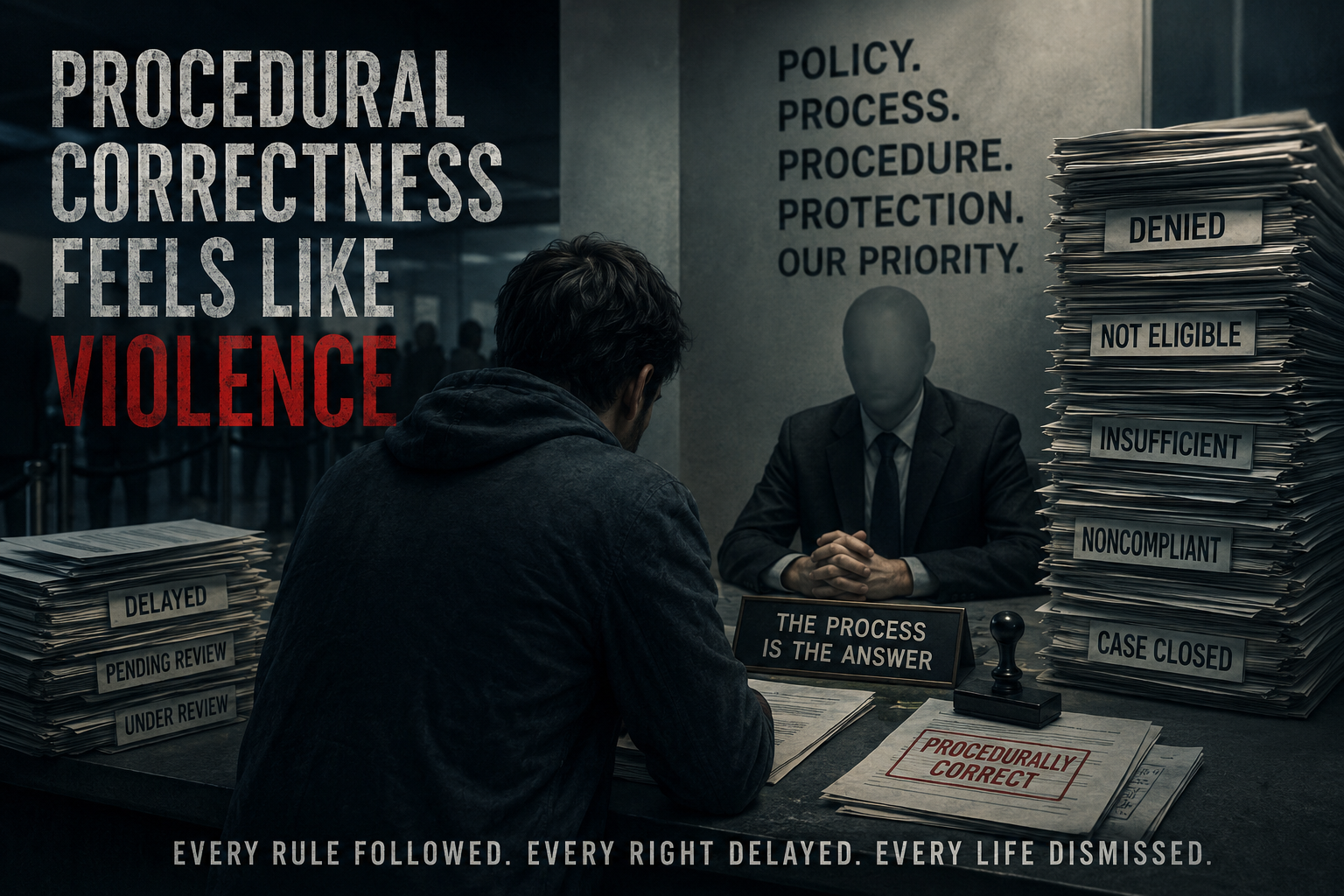
Why Procedural Correctness Feels Like Violence in Modern Thrillers

Procedural correctness feels like violence when a system follows every rule while destroying the person trapped inside it.

That is one of the great fears inside the modern thriller.

Why Procedural Correctness Feels Like Violence in Modern Thrillers

Not the gun. Not the bomb. Not the stranger in the alley. Those still matter, but they are no longer the deepest terror. The deeper terror is the clean process. The approved form. The reviewed decision. The policy applied exactly as written. The polite sentence that ends a life without anyone in the room needing to raise their voice.

Modern thrillers changed because modern power changed.

The villain no longer has to break into your house. The villain can deny the claim, freeze the account, delay the hearing, lose the record, escalate the review, transfer responsibility, close the file, and explain that everything was handled according to procedure.

That is the horror.

The system can hurt you and remain correct.

The New Thriller Villain Does Not Need to Look Angry

Older thrillers often gave evil a face.

A killer. A spy. A corrupt official. A cartel boss. A sadist with a plan. The villain might have been intelligent, cruel, charming, or theatrical, but the reader could point to him. There he is. That man. That room. That gun. That decision.

Modern thrillers are colder because the villain is harder to locate.

The harm arrives through layers.

A receptionist says she cannot help. A supervisor says the policy is clear. A lawyer says the language is binding. A judge says the court is constrained. A corporation says the decision was reviewed. A government office says the applicant failed to provide documentation. An algorithm says the case does not qualify. A bank says the transaction was flagged. An insurance company says the damage falls outside coverage.

No one feels responsible.

Everyone feels professional.

That is what makes procedural correctness so frightening. It allows violence to pass through human hands without ever becoming a human decision.

No single person has to say, “I am choosing to hurt you.”

They only have to say, “This is the process.”

The modern thriller understands how terrifying that sentence has become.

What Procedure Was Supposed to Be

Procedure was not supposed to be the enemy.

At its best, procedure protects people from impulse, prejudice, favoritism, panic, corruption, and brute force. It creates rules where power might otherwise act on mood. It gives ordinary people a path. It says the rich man, the poor man, the official, the citizen, the accused, the injured, and the desperate person all move through the same structure.

That is the noble version.

Real readers understand why procedure exists. Nobody wants a world where every outcome depends on who knows the judge, who frightens the clerk, who can afford the best lunch, or who can threaten the loudest. Procedure is supposed to slow power down. It is supposed to make authority explain itself.

But the modern thriller begins where that promise collapses.

It begins at the moment procedure stops protecting the human being and starts protecting the institution.

That is when the clean thing becomes dirty.

A deadline no longer creates fairness. It becomes a weapon against grief.

A filing requirement no longer organizes truth. It becomes a trapdoor.

A review process no longer corrects error. It becomes a maze.

A compliance department no longer prevents harm. It documents harm properly.

A court no longer asks what happened. It asks whether the suffering arrived in the acceptable format.

That is where procedural correctness begins to feel like violence.

Not because rules exist.

Because rules become more important than the person they were supposed to protect.

The Violence of Being Told the Damage Was Proper

There is a particular kind of humiliation that comes from being harmed by a system and then being told the system did nothing wrong.

That humiliation is not abstract. It is physical. It lands in the stomach. It changes the room. It makes the person feel smaller, older, more foolish, more alone.

The person knows what happened.

The company knows what happened.

The office knows what happened.

The attorney knows what happened.

The court may even understand what happened.

But the official answer is different.

The official answer says the process was followed.

This is the modern nightmare: the truth can be visible and still not matter.

That is why procedural correctness is such powerful thriller material. It creates a split between reality and recognition. The victim knows the harm is real. The institution knows the harm is survivable. The paperwork says the harm does not count.

A traditional thriller asks: can the hero survive the enemy?

A modern thriller asks: can the hero survive being erased by the record?

That is a different kind of pressure. It is not only danger. It is degradation.

The character is not merely fighting to stay alive. The character is fighting to remain real.

The Polite Language Makes It Worse

Modern institutional violence rarely announces itself as violence.

It comes dressed in neutral words.

Ineligible.

Noncompliant.

Insufficient.

Untimely.

Denied.

Closed.

Reviewed.

Escalated.

Resolved.

These words are smooth because they have been designed to remove blood from the sentence. They turn a human event into an administrative status. A family loses a home, but the file says “foreclosure completed.” A worker loses a career, but the record says “employment separation.” A patient loses treatment, but the insurer says “coverage determination.” A person loses the right to be heard, but the docket says “dismissed.”

This language is not accidental.

It protects the people using it from the thing they are doing.

That is why modern thrillers often feel claustrophobic even when nobody is locked in a room. The cage is made of approved vocabulary. The character keeps speaking in human terms, and the institution keeps answering in system terms.

“I am going to lose my house.”

“Your appeal window has expired.”

“My child needs care.”

“The coverage criteria were not met.”

“You made a mistake.”

“The decision has been finalized.”

“You are destroying my life.”

“The matter is closed.”

That is not just conflict.

That is psychological assault.

The system refuses to meet the person on human ground.

Why This Feels Like Violence

Violence is not only the moment a body is struck.

Violence is also the removal of agency. It is the narrowing of choices until a person can no longer move without permission. It is the forced acceptance of an outcome that should have been morally impossible. It is the experience of being handled instead of heard.

Procedural correctness feels like violence because it often uses legitimacy to trap the person inside the harm.

There is no dramatic villain to confront. No obvious lawbreaker. No secret door. No smoking gun. The system points to its own steps and says, look, everything is clean.

But the person is ruined anyway.

The violence comes from the contradiction.

Everything was done correctly.

And the result was obscene.

That contradiction is the modern thriller.

It is the reason these stories feel different from older suspense stories. The fear is not that order will collapse. The fear is that order will work exactly as designed and crush the wrong person.

The Process Becomes the Weapon

In a strong modern thriller, procedure is not background.

It is machinery.

Every rule turns. Every deadline advances. Every department passes the case onward. Every delay helps the stronger party. Every appeal drains the weaker party. Every technical requirement favors the side with lawyers, staff, money, and time.

That is where the thriller pressure builds.

The protagonist is not merely racing against a clock. He is racing against a structure built to make him tired.

He cannot simply expose the truth. He has to get the truth admitted.

He cannot merely find the evidence. He has to get the evidence recognized.

He cannot only prove the harm. He has to prove the harm in the format the system accepts.

And while he does that, the people who caused the damage continue living normally.

That is why procedural thrillers can feel so brutal. The process does not need to win the argument. It only needs to outlast the person making it.

Delay becomes aggression.

Expense becomes pressure.

Complexity becomes concealment.

Professionalism becomes armor.

The system does not need to say no forever.

It only needs to say not yet until the human being breaks.

The Modern Thriller Is About Controlled Helplessness

The great emotional engine of the modern thriller is controlled helplessness.

The protagonist is not helpless because he is weak. He is helpless because the battlefield has been designed so that strength does not transfer.

Intelligence does not guarantee access.

Evidence does not guarantee remedy.

Moral clarity does not guarantee recognition.

Courage does not guarantee survival.

That is what makes the pressure modern. The character may know exactly what happened and still be unable to make the system respond. The reader may know exactly who is guilty and still watch the machinery protect them.

That creates a special kind of dread.

The character is awake inside a world that keeps pretending to be asleep.

He sees the fraud. He sees the cruelty. He sees the cowardice. He sees the moral failure hiding under the procedure. But the official structure asks him to prove each piece while the damage keeps spreading.

This is why modern thrillers often feel paranoid without being delusional.

The protagonist is not imagining the machine.

The machine is simply refusing to identify itself as the enemy.

The Lawful Result Can Still Be Morally Rotten

One of the most important shifts in modern thriller writing is the separation between legality and morality.

Older stories often assumed that exposing the crime would restore justice. The villain broke the law. The hero proved it. The institution responded. Order returned.

Modern thrillers do not have that faith.

In modern thrillers, the most frightening outcomes are often lawful.

The contract allows it.

The statute permits it.

The regulation excuses it.

The precedent narrows it.

The arbitration clause buries it.

The confidentiality agreement hides it.

The campaign donor benefits from it.

The corporation priced it in.

The court says its hands are tied.

This is where the genre becomes more adult. Not darker for decoration. Darker because the world being described is more sophisticated in its cruelty.

The modern thriller does not ask only, “Who committed the crime?”

It asks, “Who made the crime unnecessary?”

Who built a world where the powerful do not have to break the law to destroy ordinary people?

That question is more frightening than a murder weapon.

A murder weapon can be found.

A lawful structure can be defended.

Why Real Readers Recognize This Immediately

Real readers do not need a lecture on this kind of fear.

They have lived near it.

They have sat on hold while their life got worse.

They have watched a payment vanish into a system that offered no person to speak to.

They have seen a medical decision explained by someone who did not make it.

They have signed contracts they did not have the power to negotiate.

They have watched a bank, employer, insurer, platform, court, agency, or corporation behave like a wall.

They know the sensation of being told there is a process.

They know the hidden meaning.

The hidden meaning is: you are alone in here.

That is why procedural correctness has become such strong thriller material. It is not exotic. It is intimate. It belongs to the ordinary dread of modern life.

The modern thriller does not need to invent a monster.

It only needs to sharpen what people already feel.

The Violence Is Often Quietest When the Room Is Clean

The setting matters.

Procedural violence usually does not happen in ruined buildings. It happens in clean ones.

Glass offices. Courtrooms. conference rooms. medical suites. bank branches. government counters. human resources departments. polished lobbies. waiting rooms with soft chairs and bad coffee.

The room tells the person that order exists.

The outcome tells the person that order does not care.

That contrast is pure thriller power.

A character can be destroyed under fluorescent light by someone using a calm voice. A family can lose everything while a printer hums. A worker can be erased from a company by a paragraph. A defendant can be cornered by a rule no normal person would understand. A patient can be denied treatment through a sentence that sounds bloodless enough to frame.

The modern thriller knows the clean room can be more frightening than the dark alley.

In the dark alley, at least the danger admits what it is.

When Procedure Protects Cowardice

Procedure becomes morally dangerous when it gives people permission not to choose.

That is one of the deepest corruptions inside institutional life. People hide inside their role. They say they are not responsible. They say they only process the file. They say they only apply the policy. They say the final decision belongs somewhere else.

Everyone becomes a small part of the machine.

No one becomes the person who stopped it.

That is how cowardice survives in professional environments. It does not look like cowardice. It looks like restraint, consistency, compliance, discipline, and respect for process.

But sometimes it is only fear wearing office clothes.

Fear of making an exception.

Fear of angering a superior.

Fear of creating liability.

Fear of admitting the institution caused harm.

Fear of treating a suffering person as more important than the rule.

The modern thriller lives in that space because that is where decency dies.

Not in one grand act of evil.

In a thousand small refusals to act human.

Read the Married Stupid series

The Hero’s Problem Is Not Ignorance

In many older stories, the hero needed to uncover hidden information.

Who killed the victim?

Where is the file?

What does the code mean?

Who betrayed the mission?

Those questions still work, but modern thrillers often move beyond secrecy. The facts may already be visible. The deeper problem is not finding the truth. The deeper problem is forcing the truth to matter.

That is a stronger and more contemporary pressure.

A character may have the document.

A character may have the recording.

A character may have the witness.

A character may have the timeline.

A character may even have the confession.

But if the system has already decided which truths count, then evidence alone is not enough.

This is why modern thrillers often feel so suffocating. The protagonist is not walking through darkness toward revelation. He is standing in daylight, screaming at people who benefit from pretending they cannot hear him.

That is a different kind of suspense.

It is not, “Will he discover the truth?”

It is, “Will the truth survive the procedure?”

The Procedure Does Not Have to Hate You

Another reason procedural correctness feels like violence is that it does not require hatred.

Personal hatred can be confronted. It has heat. It has a source. It can be named.

Procedural harm is colder.

The person denying the claim may not hate you. The clerk rejecting the filing may not hate you. The supervisor closing the complaint may not hate you. The lawyer exploiting the delay may not hate you. The executive approving the policy may never know your name.

That indifference is part of the terror.

Hatred at least recognizes you.

Indifference converts you into workload.

Modern thrillers understand that being hated is not always the worst thing. Sometimes the worst thing is being processed by people who feel nothing at all.

The machine does not rage.

The machine routes.

Why This Belongs at the Center of Modern Thriller

Modern thriller has moved from the fear of lawlessness to the fear of legalized harm.

That is a major genre evolution.

The old fear was that the system might fail to stop the villain.

The new fear is that the system might be the villain’s greatest protection.

This does not make the story less exciting. It makes it more disturbing. The chase is still there, but the corridors are bureaucratic. The ambush is still there, but it comes through a clause. The trap is still there, but it was signed years earlier by someone who had no real choice.

The pressure becomes psychological because the protagonist has to fight without the comfort of a clean moral arena.

He may be angry, but the room demands calm.

He may be right, but the court demands admissibility.

He may be injured, but the company demands documentation.

He may be broke, but the process demands time.

He may be telling the truth, but the system demands a version of truth it can safely ignore.

That is why procedural correctness feels like violence.

It is not only the harm.

It is being forced to participate in the ritual that excuses the harm.

Where Power & Privilege Fits

This is exactly the territory beneath the Power & Privilege series.

Power & Privilege belongs to the modern thriller tradition because it understands that elite power rarely announces itself as villainy. It hides inside manners, institutions, money, social access, reputation, legal advantage, and the quiet confidence of people who know the rules were not written against them.

The danger is not only that powerful people do bad things.

The danger is that powerful people often live inside structures designed to make their bad things survivable.

That is why a series about power cannot simply be about wealth. Wealth is not frightening because it buys nicer rooms. Wealth is frightening because it buys distance from consequence. It buys delay. It buys representation. It buys narrative control. It buys access to the people who interpret the rules.

Power & Privilege lives in that pressure.

It asks what happens when the system is not broken in the obvious way. What happens when it is functioning smoothly? What happens when the paperwork is clean, the language is polished, the institutions remain respectable, and the human damage is simply absorbed as the cost of keeping power intact?

That is where the modern thriller becomes more than suspense.

It becomes diagnosis.

Power & Privilege is not interested in cartoon evil. It is interested in the colder question: how much harm can be made acceptable when the right people benefit from the procedure?

That is the question modern thrillers cannot stop asking.

Power & Privilege series

Where Married Stupid Also Connects

The Married Stupid series connects from a more personal direction.

Where Power & Privilege looks at money, status, and institutional protection, Married Stupid comes at the same modern pressure through lived consequence. It understands what happens when a person is trapped inside decisions, relationships, legal structures, financial wounds, and systems that do not care how much damage they create as long as the process remains intact.

That matters because procedural violence is not only corporate.

It can be domestic.

It can be legal.

It can be financial.

It can be marital.

It can be social.

It can be the clean, court-approved destruction of a life while everyone involved insists that the forms were filed properly.

This is why modern thrillers built around marriage, money, betrayal, and survival can hit so hard. The battlefield is intimate. The procedures are ordinary. The damage is enormous.

The terror is not that something impossible happened.

The terror is that something very common happened, and the system had a name for every part of it.

Married Stupid series

The Thriller Question Has Changed

The modern thriller question is no longer only: will the hero win?

It is: what counts as winning when the system controls the definition?

If the protagonist survives but loses everything, did he win?

If the truth is known but not acted upon, did he win?

If the institution admits nothing but quietly changes one internal policy, did he win?

If the villain remains respectable, did he win?

If the case closes, the company moves on, the court clears its calendar, and the victim is left with the consequences, did anyone win except the machine?

This is why modern thrillers often refuse easy endings.

A neat resolution can feel dishonest when the story has been honest about power. The real world does not always punish the person who designed the trap. Sometimes it rewards him. Sometimes it promotes him. Sometimes it invites him to speak on a panel about ethics.

That is not cynicism.

That is recognition.

A modern thriller can still deliver revelation, confrontation, revenge, exposure, collapse, or survival. But it has to understand the world it has entered. If the villain is procedural power, then victory cannot be simple.

The machine is built to continue.

The Human Being Is the Evidence

Against procedural violence, the human being becomes the central evidence.

That sounds simple, but it is radical.

Systems prefer categories. They prefer inputs. They prefer compliant language. They prefer the injury to arrive in a manageable shape. The human being arrives messy. Angry. Grieving. Confused. Inarticulate. Exhausted. Contradictory. Late. Afraid.

The system often treats that mess as weakness.

The modern thriller treats it as truth.

Because real harm does not always speak in perfect sentences. It does not always bring the correct document. It does not always meet the deadline. It does not always understand the rule before the rule destroys it.

That is why the best modern thrillers are not merely about exposing systems. They are about restoring human scale.

They force the reader to look at the person the process tried to reduce.

Not the case number.

Not the claimant.

Not the account holder.

Not the employee.

Not the insured.

Not the petitioner.

Not the debtor.

The person.

That is where the moral force returns.

What Is Legal Is Not the Final Question

Procedural correctness depends on one great evasion.

It wants legality to end the conversation.

The modern thriller refuses that.

It knows a thing can be legal and still be vile. It knows a thing can be compliant and still be cruel. It knows a thing can be efficient and still be predatory. It knows a thing can be professionally handled and still be morally diseased.

That is why the strongest modern thrillers push beyond the legal question.

They ask the harder one.

When the system fails, the question is no longer only what is legal.

The question is: what is the right thing to do?

That question terrifies institutions because it cannot be answered by hiding behind procedure. It demands judgment. It demands conscience. It demands someone in the room to stop pretending the rule has no moral cost.

That is why procedural correctness feels like violence when it replaces conscience.

It tells people that the approved process matters more than the damaged life in front of them.

Modern thrillers exist to reject that lie.

The Future of the Thriller Is Institutional

The future of the thriller is not smaller, safer, or quieter.

It is more intimate and more systemic at the same time.

The locked room is now a claims portal.

The conspiracy is now a legal structure.

The villain’s lair is now a boardroom.

The weapon is now delay.

The chase happens through debt, data, custody, employment, insurance, courts, platforms, housing, medicine, reputation, and access.

The body count may not always be visible, but the damage accumulates.

That is the modern thriller’s power.

It can show what polite society trains people not to see.

It can make procedure feel dangerous again.

It can restore moral pressure to places where official language has flattened it.

It can force the reader to understand that violence does not always arrive with a scream.

Sometimes it arrives as a letter.

Sometimes it arrives as a denial.

Sometimes it arrives as a policy.

Sometimes it arrives as a perfectly correct decision made by people who will sleep well that night.

Final Thought

Procedural correctness feels like violence because it reveals one of the cruelest truths of modern life.

A system does not have to malfunction to destroy someone.

Sometimes destruction is the function.

That is why modern thrillers have changed. The genre has moved toward offices, courts, platforms, agencies, contracts, institutions, families, and financial systems because that is where so much contemporary fear now lives.

The monster learned to speak politely.

The monster learned to document itself.

The monster learned to say the process was followed.

And the modern thriller, at its best, answers with the only question that still matters.

Not was it allowed?

Not was it compliant?

Not was the file handled correctly?

What happened to the human being?

That is where the violence is.

That is where the story begins.

Connected evidence

Continue the Investigation

The investigation does not end at the bottom of the page.