

Readers searching for authors like Robert Mason are not looking for heroic war stories or cinematic combat fantasy. They’re looking for what it feels like to live inside a military machine the pressure, the boredom, the procedures, the fear, and the quiet psychological cost that accumulates between missions.
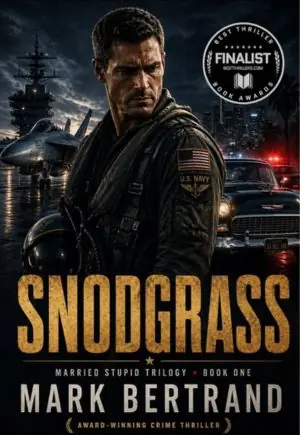
That’s exactly the territory my award winning novel, Snodgrass occupies.
Why readers search for Robert Mason
Robert Mason’s Chickenhawk remains one of the most respected military memoirs ever written because it strips war of mythology and replaces it with experience.
Readers come to Mason for:
- First-person military realism
- Procedural detail that creates credibility
- Stress embedded in routine, not just combat
- The mental toll of repeated missions
- A narrator who doesn’t posture or editorialize
Mason doesn’t write about war as spectacle.
He writes about living inside it.
Where Snodgrass belongs in that lineage
Like Mason, Snodgrass is grounded in daily military life, not isolated heroics.
Carrier operations.
Maintenance hangars.
Ops rooms.
Briefings.
Paperwork.
Waiting.
Combat matters—but it’s framed correctly: as one pressure among many.
In Snodgrass, tension builds through:
- Constant readiness
- Bureaucratic friction
- Chain-of-command dynamics
- Aircraft limits and mechanical risk
- The body reacting before conscious thought
The result is the same immersive realism Mason readers recognize immediately.
Aviation realism without romance
Mason’s helicopters in Vietnam were unforgiving machines.
Snodgrass treats fighter aircraft the same way.
Jets are not symbols of freedom or dominance.
They are systems with margins—and exceeding those margins has consequences.
The flight sequences in Snodgrass emphasize:
- Situational awareness under saturation
- Reflex overtaking deliberation
- The thin line between control and catastrophe
- How training surfaces when thinking is too slow
This is aviation written for readers who know the difference between fantasy and flight.
The key difference—and why it strengthens the book
Where Robert Mason focuses primarily on the psychological erosion caused by sustained combat, my novel Snodgrass expands the lens.
The book places military life alongside:
- A criminal survival past
- Institutional bureaucracy
- Authority as procedure rather than personality
This contrast sharpens everything.
The narrator understands systems not just as a soldier, but as someone who learned—early—how rules are enforced, ignored, or exploited depending on context.
That layered awareness gives Snodgrass a perspective Mason readers often appreciate once they encounter it.
Stress isn’t loud. It’s constant.
One of the strongest parallels between Mason and the novel Snodgrass is tone.
There’s no melodrama here.
No artificial bravado.
No inflated stakes.
Instead, stress accumulates through repetition:
- drills that might become real
- missions that could escalate
- authority that speaks calmly while holding power
This is how military pressure actually works—and why Mason’s readers trust it when they see it again.
Who should read Snodgrass
You’ll want this book if:
- You value military memoir grounded in routine and realism
- You appreciate aviation written with technical respect
- You’re drawn to first-person narratives that don’t romanticize service
- You want to understand how systems shape people over time
If Chickenhawk showed you the cost of flying combat missions, Snodgrass shows you the cost of living inside the structure that demands them.
A final word for authors like Robert Mason readers
Robert Mason wrote about surviving war.
Snodgrass writes about surviving institutions—military, economic, and personal.
Different conflicts.
Same honesty.
If you’re searching for authors like Robert Mason because you want truth without myth, Snodgrass belongs on your list.
Book Finder Your Next Great Read using my AI tool
Follow me on Bluesky



0 comments
Write a comment