
What's New

Dossier

Tuesday Lunches Aren’t Kindness

Detective SNODGRASS doesn’t romanticize mentorship. It shows you a mentor doing something colder and rarer. Those Tuesday lunches aren’t kindness.
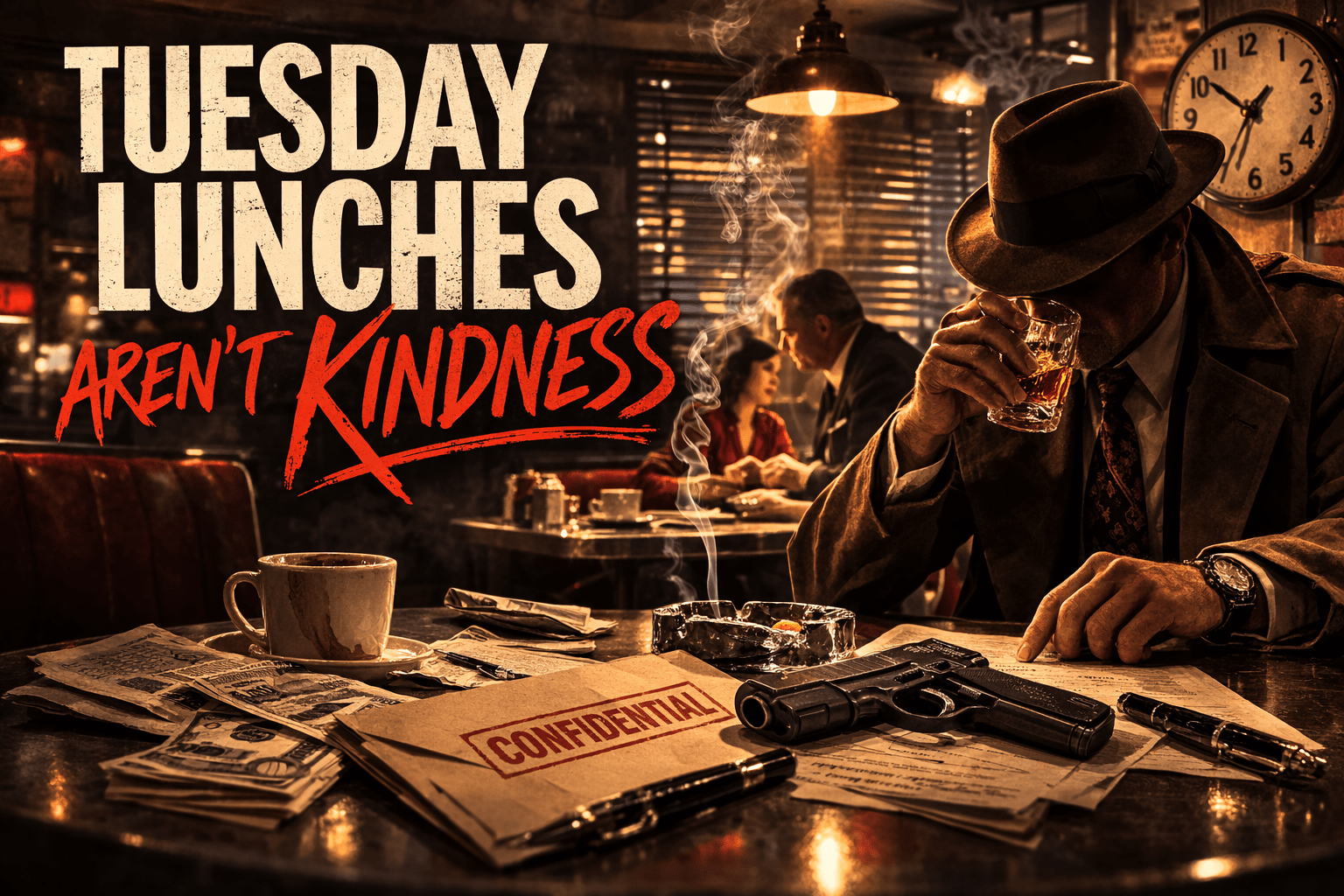
Tuesday Lunches Aren’t Kindness cover image showing a tense man and woman facing each other across a dim restaurant table, with coffee, a whiskey glass, a handgun, a newspaper, and a black rotary phone in the foreground.

Tuesday Lunches Aren’t Kindness

Snodgrass reads Mark’s journal and snaps it shut like it’s poison. He asks if Mark is writing a criminal code to live by. Then he quotes the journal from memory—with conviction and a touch of horror—so Mark can hear his own mind spoken back to him.

The novel Snodgrass

Mark goes defensive. Physical. The flashlight beam hits his eyes. Snodgrass clocks the martial arts training and dismisses it: it won’t keep him out of prison.

Then comes the question that isn’t legal, isn’t procedural, and isn’t safe.

Why are you afraid?

Mark’s answer is too quick, too absolute: he isn’t afraid of anything. Snodgrass contradicts him gently: you are, and it’s okay. And then the offer: lunch every Tuesday, and he’ll do his best to keep Mark out of prison.

The scene is drenched in weather and sensory specifics—Denver spring storms, pouring rain, the car splashing puddles, the run into Denny’s warmth, fried-food scents, and Snodgrass’s loving description of chemical trickery lighting up the tongue.

It reads like comfort. It’s actually engineering. The scene isn’t information. It’s training. And the training method comes straight out of Mark’s own playbook.

Members Only: Snodgrass Uses the Con-Man Rule Against the Con-Man.

The first line of Mark’s own “method” is the

This content is for members only.

Not yet a member? Request access to The Dossier.

SNODGRASS book cover image of a naval aviator, aircraft carrier, f18 hornet, a sweet 1955 Chevy Belair and a cityscape

Find more Articles like these on The Readers’s Court

Dossier

The Bluff Protocol

bluff protocol image of a crime board of information and photos

The first thing the system does in SNODGRASS is not prove anything. That’s the bluff protocol.

It floods the room.

The Bluff Protocol

When Snodgrass sits down with Mark, the file is already fat with “facts,” already arranged like a verdict. He reads inventory, then people, then insinuations—stolen property, a runaway, a sixteen-year-old girl—stacked so fast the mind doesn’t have time to separate what’s real from what’s strategic.

The novel Snodgrass

And Mark reacts the way the system wants him to react: jaw tight, fists clenched, trying to fight the story with heat.

Here’s the deeper truth most readers miss on the first pass: the interrogation isn’t a conversation. It’s a pressure environment designed to make you trade precision for survival. You don’t answer because you’re guilty—you answer because the air gets thin. You start correcting small things. You start explaining. You start volunteering structure. And structure is what they can hang you with.

The book doesn’t sermonize. It simply shows the mechanism: when they “make a fuss,” it’s often because they’re still fishing. Panic is the bait. Now the part the book doesn’t announce out loud: how this bluff technique turns you into their co-author.

Members Only: How Authority Gets You to Confess Without Asking for a Confession.”

The bluff protocol in SNODGRASS works because it forces

This content is for members only.

Not yet a member? Request access to The Dossier.

SNODGRASS book cover image of a naval aviator, aircraft carrier, f18 hornet, a sweet 1955 Chevy Belair and a cityscape
Dossier

What The Delay Is Protecting

Most stories accelerate when things go wrong.This one hesitates. If you notice moments where systems pause instead of fail, where alerts arrive late or not at all, where resolution feels deliberately postponed—don’t correct for it. Don’t assume it’s atmosphere or pacing. What the delay is protecting.

what the delay is protecting inside the transportation tunnel

This world does not reward urgency. It resists it. Events don’t collide head-on; they slide past each other, narrowly missing the kind of impact most narratives rely on. When something should escalate and doesn’t, that absence matters more than the action you expected.

Watch for what doesn’t trigger panic.
Notice which characters wait when others would act.
Pay attention to repairs, restorations, maintenance—especially when they feel oddly calm.

At some point, you may feel the urge to push the story forward yourself.
To want answers sooner.
To wish something would finally break.

That urge is not incidental.

The story isn’t asking you to decode symbols or predict outcomes. It’s asking something quieter and more uncomfortable: to notice how quickly impatience begins to feel like justification.

Some forces in this world are not trying to move history forward. They’re trying to keep it from arriving too early.

Just keep that in mind while you read.

Members Only: What the Delay Is Protecting

The hesitation you’re sensing isn’t

This content is for members only.

Not yet a member? Request access to The Dossier.

this could be it cover image