
 Books Like category are articles where I examine novels that echo the themes and tensions found in my thrillers. Each article compares books where ordinary lives collide with powerful systems and difficult moral choices. If you’re looking for suspense that exposes how the world really works, these are the books that live in the same territory.
Books Like The Future: When Power Wants to Outlive Humanity
Readers who loved books like The Future were not only looking for another dystopian novel. They were looking for a story where power becomes intimate, where the future is not an idea but a weapon, and where women do not merely survive the machine but confront it.

Readers who loved books like The Future usually were not searching for another generic dystopian thriller. They were looking for a novel with momentum, danger, intelligence, and the cold realization that the people building tomorrow may have no interest in saving ordinary human life at all. Simon & Schuster presents The Future as a story in which a handful of friends plot a daring heist to save the world from tech giants whose greed threatens life as we know it, while major coverage also stresses its fast pace, its satire, and its fascination with what happens when private power begins to imagine itself as civilization’s rightful heir.
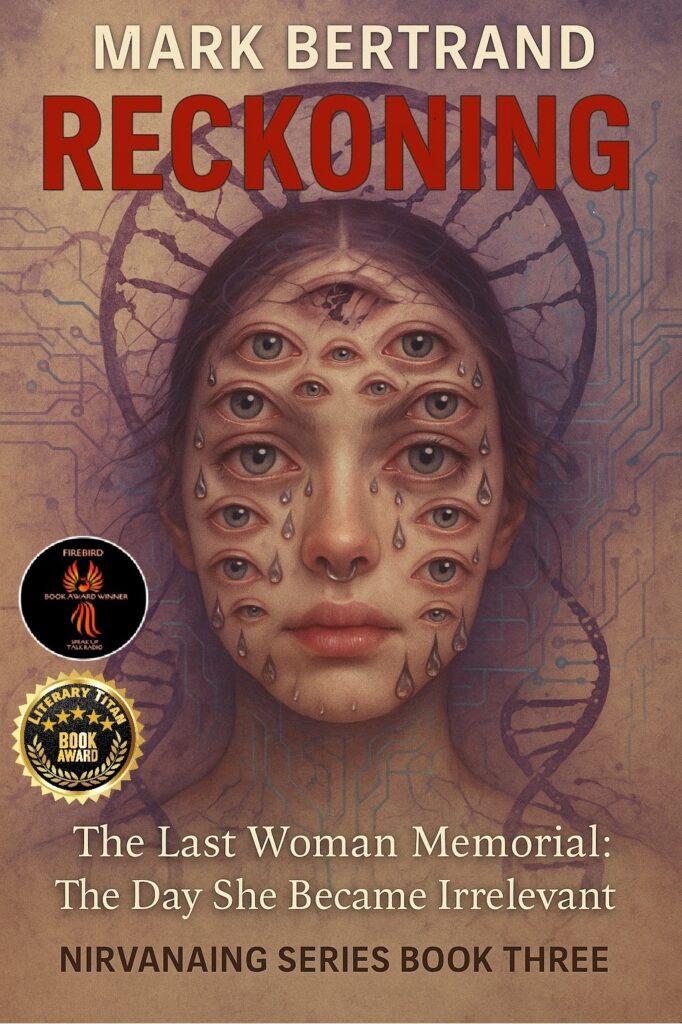
That is exactly where Reckoning becomes the next best read.
Not because it copies The Future. It does not. It goes somewhere darker. But it understands the same central fear: once power becomes wealthy enough, technological enough, and ideologically certain enough, it starts treating human beings as obstacles, raw material, or legacy clutter. In Reckoning, that fear is not kept at the level of corporate satire. It is dragged into marriage, pregnancy, public performance, broadcast culture, political ideology, and the body itself. Lydia Daniels arrives under crushing emotional and professional strain, while Laura Benton rises as a woman shaped by heartbreak, political force, and a war against a transhuman future.
Why readers loved The Future
What gives The Future its pull is not only the premise. It is the movement of the book. The story turns elite survivalism, tech arrogance, and civilizational anxiety into pressure on the page. It does not just ask whether the world is collapsing. It asks who expects to inherit the collapse, who has already prepared to profit from it, and whether anyone outside that circle can still act in time. The publisher’s framing leans into the heist and the threat posed by tech giants, while reviews emphasize its speed, tonal agility, and its mix of dark wit with genuine alarm about our social and technological direction.
That is why readers finished it wanting more than another apocalypse novel. They wanted another book where systems are the villain, but the story still moves like a thriller.
Where Reckoning hits the same nerve
Reckoning lands on that same nerve, but with more psychological abrasion.
Laura Benton is not merely resisting an abstract machine. She is fighting a future embodied by Dr. Victor Lang and the neurotech world he is pushing into existence. Her conflict with him is ideological, political, and deeply personal. She has watched the man she loved become colder, more optimized, less human. She sees the hybrids not as progress but as the death of tenderness, intuition, and moral proportion. Her war against Lang is therefore not just a policy dispute. It is a fight over whether the future will still deserve to be called human.
That is the same deep current that makes The Future work. In both novels, the danger comes from people who speak in the language of necessity, advancement, scale, and inevitability. In both novels, the future is not neutral. It is being claimed. The difference is that Reckoning pushes the argument closer to the skin. It hurts more. It is less interested in clever distance and more interested in emotional consequence.
Strong female characters who are not there to decorate the story
Readers of The Future often respond to the fact that its women are not passive witnesses to elite power. They are entangled in it, resisting it, manipulating it, surviving it, and redirecting it. That is part of the book’s charge.
Reckoning gives readers that same satisfaction, but in a sharper and more volatile register.
Lydia Daniels is not a stock “strong female character.” She is emotionally unstable, professionally cornered, intelligent, reactive, and painfully aware that she is losing control of both her marriage and her business. Her pregnancy does not soften the pressure around her. It intensifies it. Her publishing agency is faltering, her identity is tied to a collapsing mission, and even her brief escape becomes another stage for exposure and self-reproach.
Laura Benton operates in a different key. She is disciplined, strategic, wounded, and ideologically charged. She has already held power. She has already paid for it. She carries heartbreak into action. She does not simply react to events; she studies, plans, recruits, and prepares to meet a technological future with political force of her own.
That is the real overlap. Readers who loved The Future for women who are central to the machinery of the plot will find in Reckoning women who are not merely central. They are the pressure points.
Theme: who gets to define the human future
The strongest comparison between these books is not “technology is dangerous.” That is too blunt to be useful.
The real comparison is this: both novels are obsessed with who claims the right to define humanity’s next stage.
In The Future, that question emerges through tech elites, greed, bunkers, survival logic, and the monstrous confidence of people who assume their own continuity matters more than everyone else’s. The novel’s official framing and critical reception both center that fear.
In Reckoning, the question becomes even more intimate and more philosophical. Laura’s resistance to Lang is resistance to a version of progress that treats human vulnerability as a flaw to be edited out. She is not just fighting invention. She is fighting a future in which efficiency, enhancement, and control erase the fragile things that make life worth defending.
That is why the book resonates after The Future. It takes the same broad anxiety and makes it personal, ideological, and bodily.
Plot movement: collision, spectacle, and tightening pressure
One of the pleasures of The Future is that it moves. Even when it is thinking hard about systems, it still behaves like a thriller. It advances through escalation, shifting alliances, and the gathering sense that the people trying to stop disaster are already late.
Reckoning builds movement through collision.
Lydia carries the psychological and domestic front. Laura carries the ideological and political front. Victor Lang carries the transhuman and technocratic front. Adam Cole and the VoxCast world carry the media front, where spectacle is not commentary on power but one of its delivery systems. The result is a novel that keeps folding the personal into the public and the public back into the personal. It does not drift. It converges.
That matters for readers. It means Reckoning gives them the same feeling The Future gives them at its best: the sense that large forces are in motion and every chapter tightens the field.
Why Reckoning is the next best read after The Future
If you loved The Future because it gave you near-future pressure, female force, collapsing moral authority, and the terror of private systems trying to outlive the people they damage, then Reckoning belongs on your list.
But it offers a different pleasure.
It is less amused.
Less satirical.
More intimate.
More psychologically scorched.
It takes the question Who controls the future? and makes it uglier, more emotional, and more human. It asks what happens when power no longer wants our consent, our labor, or even our obedience. It wants to move past us entirely.
That is where Reckoning earns the comparison. It is not another version of The Future. It is the next read for people who wanted something darker, more psychologically loaded, and more willing to turn ideology, media, gender, and transhuman ambition into a genuine thriller engine.
Readers who read books like the future aslo read these articles.