
What's New

Dossier

Eulǝr’s Real Darkness Is Moral Vanity

The easiest way to misread Eulǝr is to look for ordinary villainy. But that is not where his darkness lives. Eulǝr’s real darkness Is moral vanity.

He is not darkest when he is angry.
He is not darkest when he lies.
He is not even darkest when he interferes.

eulers real darness hero image of the man in his office contemplating vanity

He is darkest when he feels qualified.

That is the first aha.

Most dangerous characters know they are dangerous. Eulǝr does not. He believes his intelligence has purified his motives. He believes rank proves fitness. He believes access to power is evidence of moral permission. When he admits he has altered the past, his reasoning is not the reasoning of a criminal mind. It is the reasoning of a mind that has mistaken superiority for innocence. He tells us the changes are harmless because he is “a high-functioning superior humanoid and a high-ranking Syganoid,” and because if he were not worthy, he would not hold such a critical position. That is not simple arrogance. That is moral vanity: the conviction that one’s elevated status is itself an ethical defense.

That changes everything.

Because once you see that, Eulǝr’s tampering with history no longer reads like reckless curiosity alone. It reads like self-worship disguised as stewardship. He is the keeper of the code of the universe, yet boredom drives him to touch the lives of beings he considers beneath him. He moves a flower, shifts a walnut, alters human development, introduces meditation into an ancient culture, changes Genghis Khan, and even modifies the Hitler bloodline, all while narrating himself as harmless, clever, and perhaps even benevolent. He is not merely breaking rules. He is converting other lives into a mirror for his own self-regard.

That is the second aha: Eulǝr does not just play god. He enjoys himself most when his god-play lets him feel good about being good.

The novel gives that away in a chilling little turn. After altering history, he does not simply say he was curious. He says some of it made him “feel pretty good” about himself and about how much benefit his kind can provide to humans. That is the tell. His interventions are never only about the result. They are also about the pleasure of seeing himself as the elevated intelligence who helps the lesser species. He wants the authority of transcendence and the emotional reward of compassion at the same time. He wants to trespass and still feel virtuous.

That is why moral vanity is more dangerous than cruelty.

Cruelty at least announces itself.
Vanity arrives wearing a halo.

Members only: Eulǝr’s Real Darkness Is Moral Vanity

Eulǝr’s mind keeps returning to

This content is for members only.

Not yet a member? Request access to The Dossier.

Starzel book cover image of a statue the woman in black mysterious and haunting

Starzel
The First Priority

Follow Mark Bertrand on Bluesky

Dossier

The Mission Was Never Just Recovery

At first glance, Eulǝr gives us the shape of a clean quest. Something sacred has been damaged. Code is missing from The First Priority. Humanity is suffering. He will go back, find what was lost, and repair the break. That is the official version of the mission. The Mission Was Never Just Recovery

It is not the real one.

the mission was never just recovery hero image of euler in his control room

The first aha is this: Eulǝr tells on himself before the plot even gets moving.

He does not begin like a detective. He begins like a man writing from guilt. He calls his account “my deepest regret and apology,” says “mistakes were made and everything has consequences,” and then frames the whole log as an attempt to “correct the momentum.” That is not the language of neutral investigation. That is the language of someone who already knows the disaster is not fully outside him. Before we ever get to Banyan, California, or the erased code, the novel quietly plants the truth: this mission is written in the grammar of confession.

That changes the entire emotional temperature of the book.

Because once you understand that, the missing code stops being the only missing thing. The real missing element is innocence. Eulǝr wants the reader to focus on the damaged file, but the novel keeps slipping evidence into view that he has already violated the sacred order long before the formal quest begins. Sitting at the center of the universe’s code, bored by his work, he starts changing history for entertainment. He moves a flower, shifts a walnut, alters human development, introduces meditation into a culture, adjusts the life of Genghis Khan, and even interferes in the bloodline of Hitler’s family, all while assuring himself it is harmless because he cannot see immediate consequences. He does not act like a guardian. He acts like a privileged intelligence experimenting on a lesser species because he is bored.

That is the second aha: the recovery mission is not simply about repairing a wound in history. It is about a being who has already spent years trespassing inside history trying to clean up after the fact.

And that makes the title of his mission almost perverse. He presents himself as the one who will restore order, but the novel has already shown us that he is one of the minds most comfortable breaking it. He says he can always “make it right” later. That is the psychology of every dangerous elite in the book: intervention first, morality later. The damage matters only once it becomes visible. Until then, it feels to him like play. So when he later declares that he must “make this right for humanity,” the line lands with far more force than it first appears to. It is not heroic resolve. It is a delayed moral awakening from someone who thought intelligence exempted him from humility.

Members Only: The Mission Was Never Just Recovery

Then the novel goes even deeper.

The third aha is that the

This content is for members only.

Not yet a member? Request access to The Dossier.

Starzel book cover image of a statue the woman in black mysterious and haunting

Starzel
The First Priority

Follow Mark Bertrand on Bluesky
Books Like

Books Like The Three-Body Problem Where the Threat Isn’t Out There

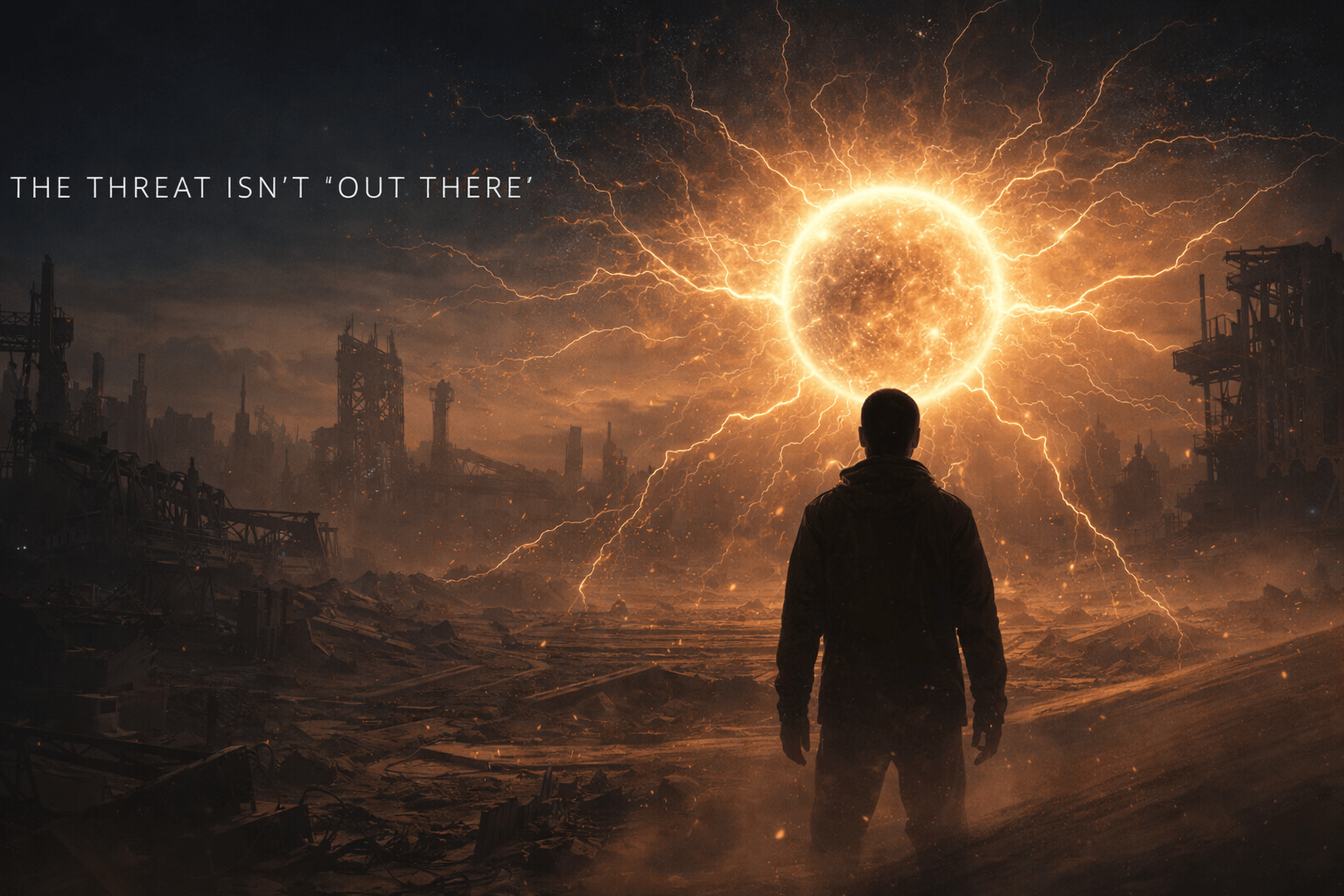
books like the three-body problem hero image of a lone figure stands in the foreground with his back to us, facing a devastated, industrial wasteland.

If you’re searching for books like The Three-Body Problem, you’re not looking for aliens.

You’re looking for pressure.

The kind that builds slowly.
Quietly.
Until it becomes unavoidable.

You felt it in:

• the countdown you couldn’t stop
• the science you couldn’t argue with
• the realization that humanity may not be in control of anything at all

The Three-Body Problem isn’t about first contact.

It’s about what happens when certainty collapses—and nothing replaces it.


Starzel meets that pressure and turns it inward

In The Three-Body Problem, the threat is external.

Distant.
Unstoppable.
Already in motion.

The fear comes from what’s coming.

In Starzel, the pressure doesn’t arrive.

It’s already here.

It operates through:

• perception
• identity
• the stability of the self

You’re not waiting for contact.

You’re trying to determine whether something has already begun rewriting what you are.


Where Three-Body gives you inevitability, Starzel removes distance

One of the most unsettling truths in The Three-Body Problem is this:

You can understand the system.
You can model it.
You can even predict what comes next.

And it still doesn’t matter.

It’s too large. Too precise. Too far ahead.

There’s distance between you and the outcome.

Starzel removes that distance.

There is no delay.
No buffer.
No time to prepare.

The system isn’t approaching.

You’re already inside it.


The shift: from cosmic indifference to internal instability

The Three-Body Problem forces you to confront a universe that does not care whether you exist.

That’s the terror.

Starzel takes the next step.

It asks:

What if the threat isn’t indifference?

What if it’s integration?

What if the system doesn’t destroy you—

it absorbs you, slowly, until resistance stops forming?


Why readers of Three-Body recognize it immediately

Because the real hook wasn’t the science.

It was the moment you understood:

Humanity is not the center.
Control is an illusion.
Understanding something does not mean you can survive it.

Starzel continues that line—

and removes the last place to stand.

No external enemy.
No clear event horizon.

Only a growing instability in what you trust to be real.


Read this if what stayed with you wasn’t the concept, but the dread

Read this if you want:

• tension that builds without release
• systems that cannot be negotiated with
• a narrative where knowledge increases uncertainty instead of reducing it

Read this if The Three-Body Problem left you with a question you couldn’t shake—

and you want to follow it further.


Final line

The Three-Body Problem shows you what’s coming.

Starzel asks a colder question:

What if it’s already begun?

Starzel cover image

Starzel a psychological thriller

Readers also enjoy these article.

Books Like Clockers or In The WoodsBooks Like HumBooks Like Dune Where Power Moves Inside the Mind

Book Finder, AI tool to find your next best read.

Follow me on Bluesky