The image read, if you know what this is, proceed. I clicked it anyway.
Story 1 — The Line That Stayed
I noticed it because I was supposed to be done. The dossier had a lot of articles for the novels. I should have clicked there. The free novel at the start here got my attention. Lots to discover on this website in the archives. Clues are everywhere. Thrillers are like that. I read on.
The article was old, the kind of stale page nobody visited twice unless they were paid to care, and I had already read it once earlier that week. I only opened it again because something about the phrasing had stayed with me, not in a memorable way, not because it was brilliant, but because it had felt polished past the point of honesty. The page was clean, institutional, bloodless. It said what pages like that always said. Nothing to see. Nothing to question. Nothing beneath the surface but approved language resting in approved order. I would have closed it after thirty seconds if one sentence had not caught in my head like a hook under skin.
I scrolled back and read the paragraph again. Then I refreshed the page and read it again. Then I opened the page in another browser, then on my phone, then from the cached result, then from the direct link I sent to myself. The sentence remained in every version I could still reach. That was the first bad feeling. Not the sentence itself. The persistence of it. Most mistakes reveal themselves when you press on them. This one did the opposite. It held. I knew I had seen the page before, and I knew something had changed, because I had the disagreeable habit of saving things that bothered me. So I opened the copy I had captured three nights earlier and set it side by side with the live page. The layout was the same. The timestamp was different. One paragraph had been altered.
I counted slowly this time, not trusting my eyes, not trusting my memory, and not trusting the sudden excitement that wanted to rush ahead of proof. First paragraph. Second. Third. Fourth. Fifth. The added sentence sat in the sixth paragraph exactly where no normal editor would have bothered to place it, buried low enough to avoid casual readers and high enough to survive a page trim. It did not improve the paragraph. It did not clarify it. It did not even belong to its rhythm. It looked as though someone had slid a thin blade between two ribs and then wiped off the handle. The paragraph itself remained dull, but inside it was a line with an odd pressure to it, a line that seemed calm only until you stayed with it one second too long.
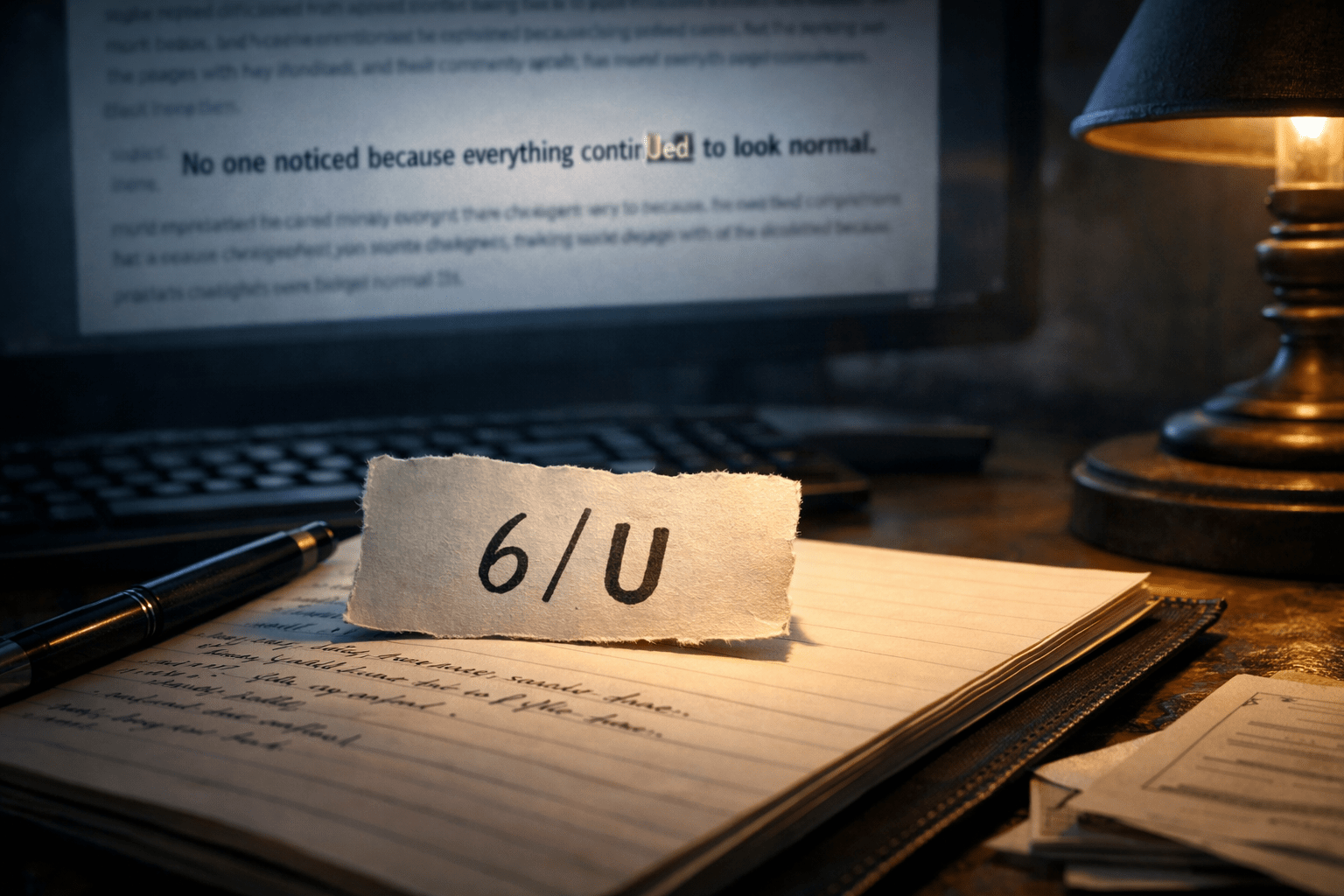
The sentence was simple enough: “No one noticed because everything continUed to look normal.” That was all. No warning. No flourish. No claim large enough to be mocked. But there, in the middle of a word that should have passed untouched, was the capital letter. Not at the start. Not after a period. Not part of a name. Just a single U lodged where it had no right to be. I copied the sentence into a blank document. The U stayed capitalized. I copied the entire paragraph into plain text. It stayed there too. I checked the page source, and there it was again, written clean into the body as if someone wanted it preserved through every translation and every scrape. That was when the room changed on me. A minute earlier I had been rereading an article. Now I was looking at a placed thing.
People talk about intuition as though it arrives like revelation. Mine came dressed as reluctance. I did not want it to mean anything. I wanted fatigue, sloppiness, a tired editor, a formatting glitch, some harmless answer that would let the night collapse back into its ordinary shape. Instead I found myself reaching for a legal pad and writing down what I already knew before I was prepared to admit it. I wrote the paragraph number first because placement felt deliberate. Then I wrote the letter because the sentence had preserved it through every test. My pen stopped over the page, and I stared at what I had written in the corner of the pad: 6 / U. It looked ridiculous and immediate at the same time, the sort of notation a stranger would mistake for nonsense and I could no longer pretend was accidental. I tore the page off, folded it once, then once again, and set it beside the keyboard.
After that I did what people do when they have crossed from curiosity into involvement and still refuse to say the word involvement out loud. I went backward. I checked the earlier version line by line. I looked for other changes. A comma moved. A date standardized. One hyperlink replaced. All normal. Only that inserted sentence had the feel of intention, and only that one letter had the feel of instruction. I began testing the page for pattern. First words of each paragraph. Last words. Headings. Metadata. Image alt text. Nothing answered me cleanly, but the page no longer felt like a page. It felt staged. Not theatrical. Worse than that. Designed. Someone had chosen the sixth paragraph. Someone had chosen the U. Someone had trusted that most people would slide over both without leaving so much as a fingerprint.
That should have been the point where I closed the laptop and let the thing go. Instead I opened the article one more time and read the paragraph in place, letting the surrounding sentences press in around it. They were dead sentences. Administrative sentences. Sentences written by people who preferred language after it had been drained of blood. The inserted line was dead too if you skimmed it. That was the trick. It did not announce itself as a message. It announced itself as nothing. But the more I looked at it, the more I felt the presence behind it: not a writer, not exactly, and not an editor either. Someone arranging surfaces. Someone making use of invisibility. Someone who understood that the safest way to hide a signal was not to make it cryptic but to make it boring.
I leaned back and listened to the apartment. The refrigerator motor cut on. A car passed below. Somewhere in the building a pipe clicked inside the wall. Everything ordinary was still intact, which should have calmed me and did the opposite. I unfolded the scrap of paper and looked again at the two marks in my own handwriting. 6 / U. The code did not explain itself. It did not have to. That was not its purpose. Its purpose was to do exactly what it had done: separate the world into two versions, the one I had been living in an hour earlier and the one I was living in now. In the first, the sentence was an error. In the second, it was proof that something hidden had expected to survive.
I closed the browsers but not before saving the page, the source, the old copy, and the new one into a folder I named with the date and nothing else. I did not want to dignify what I had found with a dramatic title. Not yet. I turned the scrap over and wrote one sentence on the back of it, a sentence I could not remember deciding to write: If this was placed, there were others. Then I slipped the paper under the keyboard as if that could conceal it from whoever had left it there for me to find.
When I finally turned off the lamp, the article still glowed faintly in my mind, not as text but as arrangement. Sixth paragraph. One wrong letter. A line that stayed when it should have vanished. I lay awake longer than I should have, thinking about how many things pass for harmless simply because they are boring, and how often hidden design depends on the courtesy of our inattention. By morning I no longer believed I had stumbled onto a mistake.
I believed I had touched the edge of a system, and that somewhere inside it, someone already knew what kind of reader would stop at the sixth paragraph and notice the U.
I had to return to the menu. I hovered over the Home. It showed me the next step. I hovered over it again and opened it.