
Tag: Crime Thriller

Crime thrillers are often built around detectives, investigations, and the pursuit of justice after a crime has already been committed. The works gathered here move beyond those familiar patterns to examine the deeper systems surrounding crime—institutions that shape investigations, pressures that distort truth, and the quiet calculations made by those operating on both sides of the law. These stories reveal how crime rarely exists in isolation. It grows out of power, loyalty, ambition, and the structures that quietly allow certain actions to happen while others are pursued.

Dossier

The Hidden Courtroom Inside Bertrand

Everyone sees the government first. That is the misdirection. On a first read, Bertrand looks like a novel about rigged systems, political theft, class hatred, surveillance, disappearing privacy, and a man trying to outmaneuver the machine before the machine swallows him whole. All of that is there. It is loud. It is convincing. It is meant to be. The hidden courtroom inside Bertrand deserves a closer look.

The main story is only the visible war.

The hidden courtroom with brass scales, an open ledger, and a lone blurred observer facing the judge’s bench.

The hidden war is older, darker, and far more intimate.

The real villain in Bertrand is not the government.

It is judgment.

Not policy.
Not law.
Not even punishment in the ordinary sense.

Judgment.

That is one of the deepest revelations inside the novel, and it is one many readers will not fully catch on the first pass because the political and financial machinery throws so much heat. The state stares at him. The banks trail him. The auditors sniff the air. Institutions keep score. He knows he is moving through a world built by men who already owned the scoreboard before he entered the arena.

That is what the novel wants you to see first.

Then, once you are looking there, it begins working the knife somewhere else.

Because the government is only the outer shell of the terror.
The inner shell is a courtroom he carries inside his own chest.

That hidden courtroom is one of the most devastating moves in Bertrand.

The narrator does not merely fear being arrested.
He fears being weighed.

That is different.

A man who fears arrest still believes escape is possible.
A man who fears judgment knows escape may be impossible, because the judge is no longer outside him. The judge is internal. The ledger is internal. The witnesses are internal. The sentence may already be in motion before anyone knocks on the door.

That is why the money language in Bertrand matters so much more than it first appears. Money in this novel is never only money. It keeps mutating into spiritual bookkeeping. Ledgers. Tallies. Collectors. Reckoning. Accounts. What looks like a story about financial ambition and institutional corruption is secretly haunted by the language of final review.

That changes the novel completely.

Because once you see that, Bertrand stops being only a story about a man trying to beat the state and becomes something more dangerous: a story about a man trying to outrun the possibility that he is guilty in a deeper sense than the law can define.

He can justify the offshore structures.
He can justify the false names.
He can justify the secrecy.
He can justify the manipulations.

What he cannot fully silence is the sensation that every move is being entered somewhere permanent.

That is the meaning of the hidden courtroom.

And Bertrand does not leave that courtroom abstract. That is what gives the novel its force. It does not drift off into vague spiritual fog. It arrives wearing faces. The stare of the stepfather. The disappointed gaze of authority. The dead. The younger self betrayed. The version of the man he might have been if appetite had not won so many private arguments.

The novel refuses to let judgment stay theoretical.
It personalizes it.
It domesticates it.
It makes reckoning feel less like religion and more like memory with authority.

That is where Bertrand becomes far more psychologically ruthless than many readers expect.

Because the narrator is not fighting one enemy.
He is fighting two enemies nested inside each other.

The outer enemy says:
You broke the rules.

The inner enemy says:
You became the kind of man who needed to.

That second accusation cuts deeper than prison ever could.

And now one of the strangest turns in the novel becomes visible.

The Hidden Courtroom Members Only

The spiritual setting is not relief from this courtroom.
It is the perfect chamber for it.

A weaker novel would use silence, meditation, the abbey, and

This content is for members only.

Not yet a member? Request access to The Dossier.
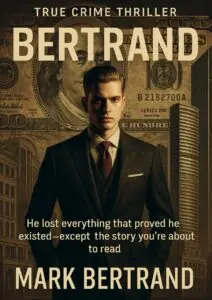
Bertrand book cover image

Bertrand crime thriller

The Readers Court

Books Like

Books Like Billy Summers or Harlem Shuffle — Why Snodgrass Belongs on Your List

Readers searching for books like Billy Summers or Harlem Shuffle aren’t just after action. They’re drawn to stories where survival choices aren’t clear-cut, and where the past—whether criminal or military—casts a long shadow.

books like billy summer image of a standing paperback of SNODGRASS by Mark Bertrand sits upright on a dark wooden surface. The cover shows a close crop of a man’s hand gripping a pistol at his side, suggesting tension and violence without showing the full figure.

If that’s what pulls you toward those books like Billy Summers, there’s a contemporary crime-driven novel you may not have encountered yet—but should.

That novel is Snodgrass.

What Readers Love About Books Like Billy Summers (Stephen King)

Billy Summers works because it’s not only about the job—it’s about the man who has to live with the job. The violence is practical, the conscience is complicated, and the deeper tension isn’t “will he get away,” but “what is this turning him into.”

Readers who respond to Billy Summers tend to value:

  • Criminal action grounded in psychology, not spectacle
  • Men with skills—and damage—trying to stay in control
  • Violence as consequence, not entertainment

What Readers Love About Harlem Shuffle (Colson Whitehead)

Harlem Shuffle is crime with texture. It’s not a caper; it’s a world. A man gets pulled into criminal gravity not because he’s evil—but because it’s profitable, available, and sometimes necessary.

Readers drawn to Harlem Shuffle often want:

  • Crime as an ecosystem (money, loyalty, reputation, survival)
  • Moral compromise that happens in inches, not leaps
  • A protagonist who isn’t a gangster—until he is

Where Snodgrass Fits — And Why It’s Different

Snodgrass sits in the overlap between these two traditions:
criminal survival + identity pressure + systems closing in—but with one crucial addition:

It has war overhead.

It opens inside a Navy carrier environment under Libya-mission tension—conflict, authority, and threat saturating everything.
Then it folds backward into the narrator’s early criminal life: hunger, opportunism, and the first small thefts that harden into method.

What makes it hit differently is the two-track pressure:

  1. The military machine (discipline, hierarchy, war footing)
  2. The crime machine (need, profit, escalation, exposure)

You feel both working at once.

Even when the narrator is simply remembering, he’s calculating. Planning. Running models. Looking for angles—like the bank-kiting scheme explained later in the book, where the method is criminal but the mindset is engineering. Snodgrass

The Crime in Snodgrass Isn’t “Bad Guy Crime”

This is important.

The crime here isn’t written as cartoon villainy—it’s written as adaptation. A logic that begins in scarcity, then evolves into skill, then becomes identity.

You see that shift early in the train-robbery episode: hungry teenagers, open rail cars, no supervision, and a brain that immediately understands “there is opportunity here.” Snodgrass

And later, when law enforcement closes in, it becomes procedural, personal, and relentless—Detective Snodgrass lays out the evidence and the implications with the calm weight of the state behind him. Snodgrass

Why Readers of King and Whitehead Choose Snodgrass

Readers who finish Billy Summers or Harlem Shuffle often go searching for something specific but hard to name:

Not “more violent.”
Not “more plot.”
Just more intimate. More inside the mind that does it.

Snodgrass answers that search by:

  • Putting the reader inside the criminal’s mental process—not after the fact, but in real time
  • Treating crime as a discipline that develops (planning, observation, misdirection)
  • Mixing that criminal evolution with military threat and duty, creating constant tension

Where Snodgrass Goes Further

Most crime books give you either:

  • A criminal operating in the streets
    or
  • A soldier operating in war

Snodgrass gives you a man who has been both—and shows what happens when those mentalities merge.

By the time the Libya mission turns lethal, the narrator recognizes the psychological shift:
“Now I’ve learned to kill… what changes will come?” Snodgrass

That line matters because it’s not cinematic. It’s not proud.
It’s clinical.
And that’s exactly the tone of the book.

If You’re Searching for Books Like Billy Summers or Harlem Shuffle

You’re already beyond surface-level crime.

Snodgrass was written for readers who want:

  • Crime as psychology and system—not gimmick
  • A protagonist who is competent, controlled, and compromised
  • Tension that comes from implication, escalation, and consequence

If Billy Summers showed you how a man becomes dangerous,
and Harlem Shuffle showed you how a man becomes complicit,
Snodgrass shows you what happens when a man becomes both—
and still has to fly the mission tomorrow.

SNODGRASS book cover image of a naval aviator, aircraft carrier, f18 hornet, a sweet 1955 Chevy Belair and a cityscape

Snodgrass | Married Stupid

Books Like Going Infinite or The Cult of WeBooks Like Broken Light

Follow me on Bluesky and Mark Bertrand channel.

Books Like

Books Like Going Infinite or The Cult of We — Why Bertrand Belongs on Your List

Readers who search for books like Going Infinite or The Cult of We aren’t looking for “business books.” They’re looking for a specific kind of story.

books like going infinite or the cult of we

A rise that feels inevitable. A worldview that infects everyone in the room. A system that smiles while it builds the trap.

If that’s what pulls you toward Going Infinite and The Cult of We, there’s a contemporary book you likely haven’t encountered yet, but should.

That book is Bertrand.

What Readers Love About Books Like Going Infinite

Michael Lewis’s Going Infinite pulls you into modern money the way thrillers pull you into a heist: velocity, confidence, a logic that feels unstoppable right up until it isn’t.

Readers who respond to Going Infinite tend to value:

Ambition and momentum over moral lectures
Systems and incentives over “bad guy” simplifications
Collapse as consequence, not surprise

What Readers Love About Books Like The Cult of We

The Cult of We isn’t just about a company. It’s about belief as a product. A culture that rewards performance over reality, and a leadership myth that turns ordinary people into accomplices.

Readers drawn to The Cult of We often want:

Charisma as a weapon, not a charm
Corporate language used as camouflage
A slow-motion reveal of how the room got hypnotized

Where Bertrand Fits — And Why It’s Different

Bertrand sits precisely at the intersection of these two traditions: modern money and modern belief. But it doesn’t watch the machine from the outside.

It’s first-person, inside the architecture. A not-for-profit “mission” becomes the clean front for offshore structure, shell layers, and trading velocity—built to move money without leaving seams.

Like Going Infinite, it understands the core addiction: leverage. The need for one more layer, one more day, one more clean story. It treats money as momentum and compliance as physics—friction, drag, signal, latency.

Like The Cult of We, it shows how belief is manufactured. The language stays serene while the machinery underneath is anything but. The pitch is spiritual. The infrastructure is predatory.

But Bertrand goes further in one crucial way.

It removes the comfort of distance.

There’s no journalist’s protective glass. No boardroom documentary tone. You’re inside the mind that’s building the maze, justifying the maze, and starting to feel the maze tighten around his own throat—because the system isn’t just watching. It’s learning.

Purchase Bertrand eBook $4.99

Purchase Bertrand paperback $19.99

Why Readers of Books Like Going Infinite or The Cult of We Stories Choose Bertrand

Readers who finish books like Going Infinite or The Cult of We often search for something that feels similar but harder, sharper, more intimate.

Not louder.
Not more sensational.
Just more complicit.

Bertrand answers that search by:

Treating “mission” as a mask that makes everything possible
Making data and behavior the real currency behind the scenes
Turning oversight into psychological pressure instead of courtroom spectacle

It reads like a finance thriller, but it insists on something colder: the feeling of being measurable, traceable, and one decimal away from exposure.

If You’re Searching for Books Like Going Infinite or The Cult of We

You’re already past “entrepreneurship stories.”

Bertrand was written for real readers who want:

Power described as a system, not a personality
Belief portrayed as a tool, not a virtue
Tension that comes from implication, architecture, and surveillance

If Going Infinite showed you how new money talks itself into inevitability, and The Cult of We showed you how a room gets converted, Bertrand shows you what happens when both are in play—and the only person who understands the structure is the one building it.

Bertrand book cover image

Purchase Bertrand eBook $4.99

Purchase Bertrand paperback $19.99

Readers who read books like Going Infinite also read these articles.

Books Like Dune Where Power Moves Inside the MindBooks Like Neuromancer — When Access Isn’t Power AnymoreBooks Like The Future: When Power Wants To Outlive Humanity

Follow me on Bluesky and my IMD Operations channel.