
Tag: Institutional Failure

Institutions are designed to create order, stability, and fairness. Yet history repeatedly shows how systems built for protection and oversight can fail when power, incentives, or bureaucracy overwhelm their original purpose. The articles in this section explore the points where institutions break down—when regulations fail, accountability disappears, or systems begin protecting themselves instead of the people they were meant to serve.

Dossier

The Hidden Courtroom Inside Bertrand

Everyone sees the government first. That is the misdirection. On a first read, Bertrand looks like a novel about rigged systems, political theft, class hatred, surveillance, disappearing privacy, and a man trying to outmaneuver the machine before the machine swallows him whole. All of that is there. It is loud. It is convincing. It is meant to be. The hidden courtroom inside Bertrand deserves a closer look.

The main story is only the visible war.
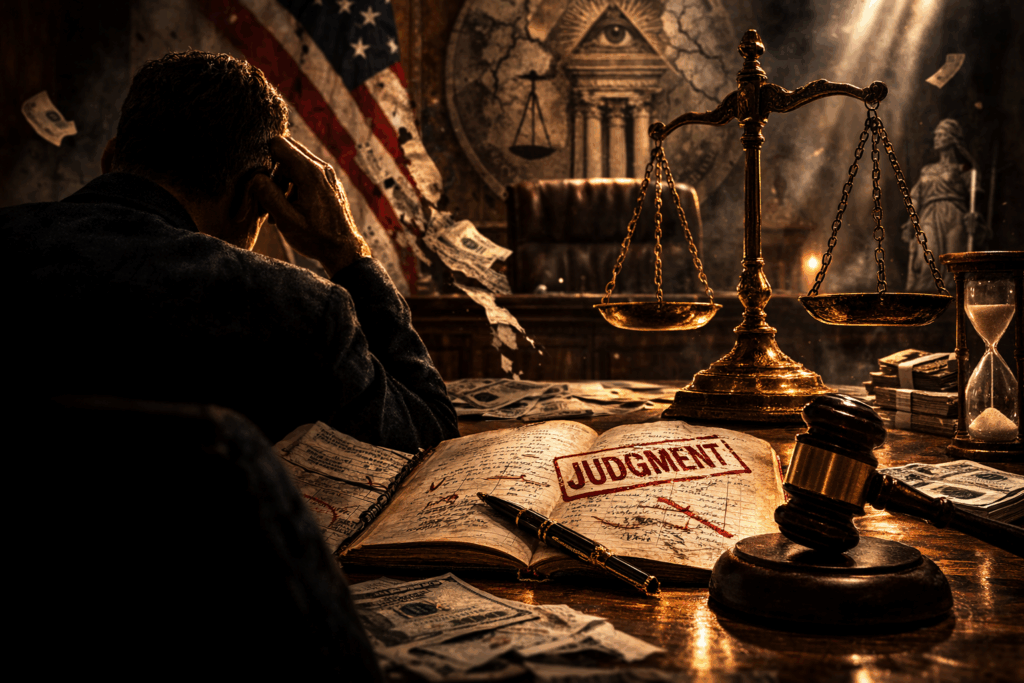
The hidden courtroom with brass scales, an open ledger, and a lone blurred observer facing the judge’s bench.

The hidden war is older, darker, and far more intimate.

The real villain in Bertrand is not the government.

It is judgment.

Not policy.
Not law.
Not even punishment in the ordinary sense.

Judgment.

That is one of the deepest revelations inside the novel, and it is one many readers will not fully catch on the first pass because the political and financial machinery throws so much heat. The state stares at him. The banks trail him. The auditors sniff the air. Institutions keep score. He knows he is moving through a world built by men who already owned the scoreboard before he entered the arena.

That is what the novel wants you to see first.

Then, once you are looking there, it begins working the knife somewhere else.

Because the government is only the outer shell of the terror.
The inner shell is a courtroom he carries inside his own chest.

That hidden courtroom is one of the most devastating moves in Bertrand.

The narrator does not merely fear being arrested.
He fears being weighed.

That is different.

A man who fears arrest still believes escape is possible.
A man who fears judgment knows escape may be impossible, because the judge is no longer outside him. The judge is internal. The ledger is internal. The witnesses are internal. The sentence may already be in motion before anyone knocks on the door.

That is why the money language in Bertrand matters so much more than it first appears. Money in this novel is never only money. It keeps mutating into spiritual bookkeeping. Ledgers. Tallies. Collectors. Reckoning. Accounts. What looks like a story about financial ambition and institutional corruption is secretly haunted by the language of final review.

That changes the novel completely.

Because once you see that, Bertrand stops being only a story about a man trying to beat the state and becomes something more dangerous: a story about a man trying to outrun the possibility that he is guilty in a deeper sense than the law can define.

He can justify the offshore structures.
He can justify the false names.
He can justify the secrecy.
He can justify the manipulations.

What he cannot fully silence is the sensation that every move is being entered somewhere permanent.

That is the meaning of the hidden courtroom.

And Bertrand does not leave that courtroom abstract. That is what gives the novel its force. It does not drift off into vague spiritual fog. It arrives wearing faces. The stare of the stepfather. The disappointed gaze of authority. The dead. The younger self betrayed. The version of the man he might have been if appetite had not won so many private arguments.

The novel refuses to let judgment stay theoretical.
It personalizes it.
It domesticates it.
It makes reckoning feel less like religion and more like memory with authority.

That is where Bertrand becomes far more psychologically ruthless than many readers expect.

Because the narrator is not fighting one enemy.
He is fighting two enemies nested inside each other.

The outer enemy says:
You broke the rules.

The inner enemy says:
You became the kind of man who needed to.

That second accusation cuts deeper than prison ever could.

And now one of the strangest turns in the novel becomes visible.

The Hidden Courtroom Members Only

The spiritual setting is not relief from this courtroom.
It is the perfect chamber for it.

A weaker novel would use silence, meditation, the abbey, and

This content is for members only.

Not yet a member? Request access to The Dossier.

Bertrand book cover image

Bertrand crime thriller

The Readers Court

Dossier

The Portal Reveal Means Lang Is Already Outside Law

The Portal Reveal Means Lang Is Already Outside Law is the moment Reckoning stops treating Victor Lang like a controversial genius and starts treating him like a sovereign: he doesn’t argue, doesn’t seek permission, doesn’t offer proof on the spot—he announces off-world occupation as a done fact, then exits while the room applauds, as if authority itself just got rewritten and nobody noticed.

The portal reveal Victor Lang standing before a glowing portal revealing off-world expansion beyond the reach of Earth law

There’s a moment on the Starzel World Show that looks, on first read, like a flex. A man cornered on live broadcast, irritated by the questions, deciding to drop something bigger than the segment can contain.

That’s not what it is.

It’s the first time the book shows you—cleanly, without metaphor—that Victor Lang is no longer negotiating with civilization. He’s acting as if civilization is a local custom. Optional. Beneath him.

The reveal isn’t “portals exist.”

The reveal is: he has already moved people and supplies off-world to occupy other planets, and he says it like a quarterly update, then walks out while the audience applauds.

That is the antagonist.

Not a genius with dangerous tech. Not a controversial visionary. Not even a tyrant in the familiar sense.

A man who has crossed the line where permission matters.

The setup is a trap, and he knows it

The World Show is described as performance wrapped in rhetoric, a broadcast engineered to shape minds while pretending to empower them. That matters because it tells you what kind of arena this is: not truth-seeking, but narrative control.

Lang enters that arena anyway.

He paces in the green room while the show’s machinery tightens around him. Adam Cole is there, already thinking about missing engineers and scientists—already sensing a shadow supply chain behind Lang’s public face.

So when the ambush comes—scripture, myths, the “gender debate”—Lang doesn’t defend himself like a man protecting a reputation.

He refuses the premise.

He refuses the room.

He refuses the entire authority of the conversation.

That refusal is the tell.

Members Only: The Portal Reveal

He uses moral contempt as his exit ramp

Lang doesn’t rebut Benton’s point. He doesn’t engage the argument. He dismisses it as

This content is for members only.

Not yet a member? Request access to The Dossier.

reckoning book cover image

The novel RECKONING

Follow me on Bluesky and my Not A Real Publisher channel.

Dossier

The Real Battlefield Was Applause

The Real Battlefield Was Applause: Suffragette City and the Moon Anarchists is where Reckoning finally shows the real war—two off-world networks fighting over attention, not territory: the Mars secret society selling a myth you can cheer for, and the Moon anarchists trying to break that myth before applause turns it into permission.

the real battlefield was applause image of lang on stage with audience watching

The novel RECKONING

Suffragette City looked like a place.

It wasn’t.

It was a story that moved through the world faster than any ship, any vote, any treaty—because it moved through attention. It moved through the one resource nobody could ration: the human need to believe there was somewhere better than here.

Adam Cole wrote it, and the manuscript didn’t treat that as a literary flourish. It treated it like a weapons release. His report grabbed “diplomats, politicians, and warriors across the globe,” not because it proved anything, but because it made people feel something and then called that feeling truth.

That’s the link between the Mars secret society and the Moon anarchists.

Not a handshake. Not a code phrase.

Applause.

Suffragette City was smuggled in through admiration

The first time the reader “entered” Suffragette City, it happened in an apartment, over coffee, with a man reading aloud while another man listened—eyes closed—letting the words do what words do when they find the right target.

The city became a symbol. A “testament.” A “vision.” A place “you never want to leave.”

That’s not geography. That’s recruitment.

A secret society didn’t need to advertise itself with banners. It needed a myth. Cole delivered it.

Members Only: The Real Battlefield Was Applause

The book showed how applause became permission

When Amy Goodman walked onto that stage, the audience

This content is for members only.

Not yet a member? Request access to The Dossier.

reckoning book cover image

The novel RECKONING

Follow me on Bluesky and my Righters Doom channel.

project 2029. image leads to stories that provide the codes and the 15 key letters. If you know where to look you can find them all.