
He had heard the argument all his life, so many times it no longer sounded like an argument at all.
It sounded like weather.
Cap wealth, and the wealthy will leave.
Help people too much, and they will stop trying.
Ease the pressure, and the nation will soften.
Remove fear, and ambition will die.
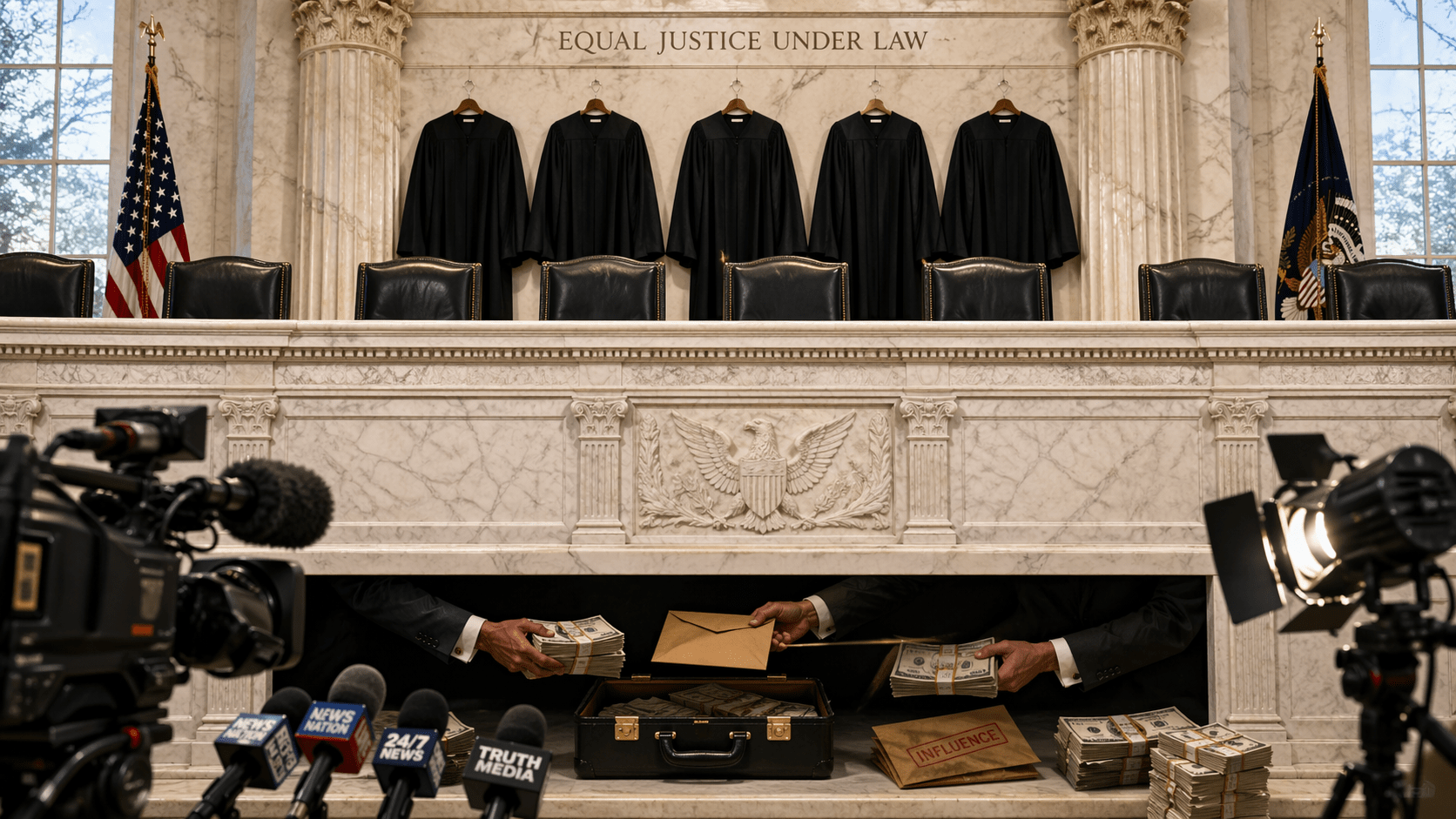
By the time a lie survives three generations, it learns how to dress like common sense.
He was old enough to know that now.
The network had been running the same week-long package under different titles for years. Sometimes it was framed as economic realism. Sometimes personal responsibility. Sometimes national competitiveness. The language changed. The pulse beneath it never did. Always the same warning delivered with calm eyes and steady voices: do not disturb the hierarchy that feeds you. Do not ask whether the system is cruel. Ask only whether cruelty is necessary.
He used to think repetition meant confidence.
Now he understood it meant maintenance.
The clip that caught his attention was not dramatic. No shouting panel. No viral collapse. Just a senior commentator with an expensive face and a voice smoothed by decades of permission saying, “We should be careful about punishing success. Once those who create value feel unwanted, they disengage. And when a society rewards dependency, it eventually consumes itself.”
The host nodded as if gravity had been explained.
He watched it once.
Then again.
Then he muted the sound and watched their expressions instead.
That was where the truth always showed first.
Not in language. In comfort.
The commentator was not defending a principle. He was protecting a design that had made him possible.
He pulled the transcript, then the producer notes, then the sponsor blocks tied to the segment. It was routine work for him now, tracing the neat invisible lines between narrative and revenue. What made this different was not the segment itself. It was the recurrence. The same argument appearing across outlets that publicly despised each other. Rival papers. Rival channels. Rival platforms. Different branding, same emotional architecture.
Fear below. Permission above.
He started building a wall chart in his apartment, paper and string because he no longer trusted any screen not to look back. The names spread first, then the boards, then the foundations, then the private funds tucked behind cultural institutes and policy centers and media literacy nonprofits that spent suspicious amounts of time teaching the public what could not be imagined.
The line always came back to one proposition:
A frightened population is easier to price.
He stared at that sentence for a long time.
Not control.
Price.
That was cleaner. More honest.
When people lived one missed payment from humiliation, one medical bill from collapse, one landlord decision from exile, they would tolerate almost anything. They would call survival freedom because the alternative was to admit the arrangement was engineered. They would work while sick, age while anxious, apologize for needing rest, and thank the men above them for the privilege of being exhausted.
The rhetoric about motivation had never been about virtue.
It was about pressure.
Pressure made workers accept wages that could not dignify life.
Pressure made families remain grateful for scraps.
Pressure made citizens mistake insecurity for discipline.
Pressure made desperation look moral.
And if enough people were kept close enough to the edge, those born on the high ground could mistake altitude for genius.
That part made him angrier than he liked.
Not the money itself. Money had no mind. It moved where it was permitted to move. What sickened him was the inherited performance of superiority. Men who had never stood in a pharmacy choosing between medication and groceries explaining incentives to people who had. Women who had never feared eviction speaking solemnly about discipline. Entire bloodlines protected by trust funds and informal introductions lecturing the public on merit as if comfort were an achievement of character.
They had eaten from padded tables for so long they believed their posture was evidence of evolutionary refinement.
He found the internal deck two nights later.
It was not labeled with anything theatrical. No secret emblem. No dramatic seal. Just a bland strategy file inside a shared folder for a public-affairs coalition that officially did not exist. He nearly missed it because the language was so bloodless. Audience retention curves. message resilience. reputational inoculation. social compliance framing.
Then a slide stopped him.
He leaned toward the screen.
There were four tested narratives ranked by durability.
One of them read:
Prosperity depends on exceptional individuals retaining disproportionate rewards.
Another:
Excessive public support erodes initiative and strains the productive class.
Underneath, in smaller type, were the emotional outcomes those narratives produced when repeated over time.
Acceptance of inequality.
Suspicion of solidarity.
Fear of collective provision.
Internalization of precarity as personal failure.
He sat back, eyes fixed on the glow.
Not theory.
Instruction.
The old rhetoric was not a cultural misunderstanding. It was managed continuity.
He printed everything and carried it home in a grocery bag, the pages resting against a loaf of bread and two cans of soup, as if that were the proper scale of the thing. On the walk back he passed a man sleeping in the recessed doorway of a bank whose quarterly profits could have housed half the district. No one looked directly at the man. The city had trained itself out of the reflex.
By midnight, his apartment felt smaller.
There was one page he kept returning to, one that seemed almost too candid to be real. It was from a closed-door briefing for on-air talent and surrogate economists, a single paragraph under the heading “Motivational Framing.” It advised speakers to describe economic insecurity as unfortunate but socially useful. Too much stability, the memo warned, could create expectation. Expectation could lead to demands. Demands could destabilize investor confidence and reduce elite participation in civic life.
Elite participation.
He laughed when he read it, though nothing about it was funny.
That was the phrase they used when billionaires threatened to withhold what they had never intended to share.
As though society were a dinner party and the people permitted to eat depended entirely on whether the hosts remained charmed.
He pinned the page to the wall and looked around the room at the accumulating evidence, the branching structure of a doctrine that had hidden in plain sight by speaking every day. It was not merely that the wealthy wanted more. Wanting more was human. The darker truth was that an entire informational order had been built to make the public defend the mechanisms of its own diminishment. Tell them comfort makes them weak. Tell them help makes them lazy. Tell them fairness drives greatness away. Keep repeating it until deprivation feels like maturity.
Once deprivation becomes identity, revolt feels childish.
He might have remained there until dawn if not for the envelope.
It had been slid under his door without a sound.
No stamp. No address. Just his name, handwritten in a narrow, deliberate script.
Inside was a single folded card.
No greeting. No threat.
Only a sentence:
You are no longer looking at commentary. You are looking at doctrine.
And below it, a photograph.
At first he did not understand what he was seeing. It looked like a conference room after hours. Long glass wall. City lights behind it. Twelve chairs. Eleven occupied. One empty. Every figure in the photograph was turned slightly away from the camera, as if the image had been taken in the moment before they noticed the intrusion. On the far wall, reflected backward in the glass, were words from a presentation slide.
He held the photo under the lamp and angled it until the reflection sharpened.
The title on the slide was one word:
Abundance
He went still.
Not because the word surprised him, but because it did.
He had expected the hidden doctrine to have a hard name. Something fortified. Defensive. A language of scarcity dressed in the neutral clothing of markets.
But this word suggested something more dangerous.
They knew.
They knew scarcity was not the natural consequence of limited means.
They knew hunger was maintained.
They knew fear was curated.
They knew a society could be organized around enough.
And they also knew that if people ever truly believed that, the spell would break.
That was why the rhetoric had to remain relentless. Not because abundance was impossible, but because it was imaginable.
And once imaginable, it became difficult to justify the machinery built to prevent it.
He turned the photograph over.
On the back, in the same narrow hand, was another message.
Floor 10. Tuesday. Come alone.
He read it twice, then a third time.
Outside, the city kept making its ordinary noises: buses sighing at the curb, a bottle breaking somewhere in the alley, the low mechanical hum of money moving while people slept. But inside the apartment something had shifted. The wall of evidence no longer looked like a theory of corruption. It looked like the perimeter of an opening.
He thought of the years the public had been told that dignity must be rationed, that mercy was expensive, that the future belonged only to those ruthless enough to deserve it. He thought of the people bent under this doctrine so long they had begun to speak it in their own voices, policing each other with the language of their captors. He thought of children raised inside permanent economic tension until anxiety felt like personality.
Then he looked again at the word in the photograph.
Abundance was not a slogan.
It was the forbidden premise.
The ideal they had spent centuries teaching people to mock before it could be named.
He slipped the card into his coat pocket and began taking down the papers from the wall, one by one, not to destroy them but to carry them. The carefulness of the act steadied him. Somewhere above the city, behind polished glass and curated opinion, people who had mistaken privilege for superiority were still telling each other that fear was necessary, that desperation was instructive, that ordinary men and women had to be pressed hard enough to remain useful.
Maybe they believed it.
Maybe belief was the final luxury.
Either way, he was done listening.
By morning he would know whether Floor 10 was an invitation, a trap, or the first honest door anyone had opened in a very long time. But for the first time since this began, he felt something stronger than outrage.
He felt the shape of a different order pressing upward through the lies, as if the buried ideal itself had grown tired of staying underground. Then you see the story in the Dossier. The Vintner and The Novelist… a hidden courtroom where the membership is always free.