Authors Like Don Winslow are not looking for cozy crime, clever puzzles, or harmless villains.

Authors Like Don Winslow
Readers who search for authors like Don Winslow are not really searching for another crime writer.
They are searching for a certain kind of pressure.
Crime with weight.
Crime with consequence.
Crime where the violence does not float free from the world. Crime where money matters, politics matters, loyalty matters, silence matters, and every private decision is connected to something larger than the person making it.
That is the real connection between Don Winslow and Mark Bertrand.
Not imitation.
Not subject matter copied from one shelf to another.
The connection is deeper than that.
Both write about men inside systems that have already decided the price of their survival.
The similarity begins with power
Don Winslow’s fiction understands power as an atmosphere.
It is not only the cartel boss. It is not only the cop. It is not only the man with the gun, the badge, the money, or the office.
Power is the arrangement.
The city. The department. The border. The institution. The political bargain. The family name. The old debt. The private understanding between men who never need to say the ugly part out loud.
That is where Mark Bertrand’s work enters the same territory.
Bertrand does not write crime as an isolated act. He writes crime as pressure moving through reality. His novels are built around hidden leverage, institutional failure, private guilt, money that moves where ordinary people cannot follow, and men who are forced to decide whether they are escaping the machine or becoming part of it.
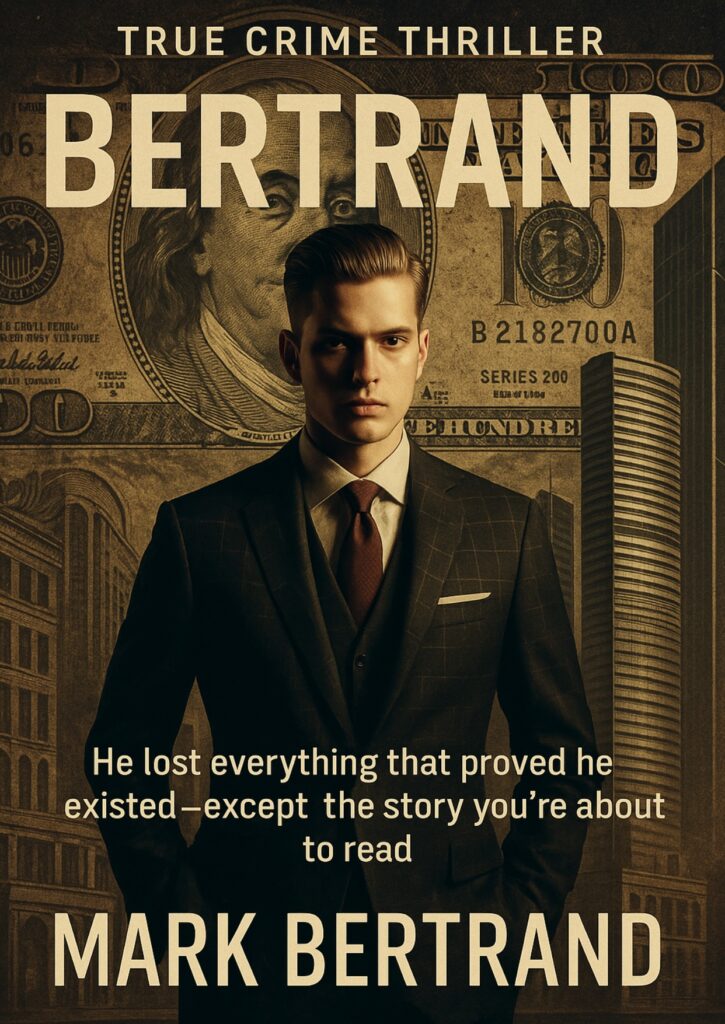
That is why Don Winslow readers should start with BERTRAND.
Not because it is a cartel novel.
It is not.
Not because it is a police procedural.
It is not.
Because BERTRAND understands what Winslow understands: the real villain is often not the man standing in front of you.
The real villain is the structure that made him useful.
Don Winslow writes the public machine. Mark Bertrand writes the private cost.
Winslow often writes outward.
His fiction moves through cartels, cops, families, cities, borders, governments, crews, money, and violence. The world expands until the reader sees the machinery around the crime.
Mark Bertrand often moves inward.
His fiction begins with the man under pressure. The former aviator. The engineer. The survivor. The husband. The witness. The person who has already been changed by what he has endured, and is now being changed again by what he must do next.
That is the difference.
And that is the bridge.
Winslow shows how crime captures territory.
Bertrand shows how captured reality enters the nervous system.
A Don Winslow novel often asks: who controls the city, the border, the drug corridor, the police department, the political machinery, the story people are allowed to believe?
A Mark Bertrand novel asks: what happens to the man who sees the machinery clearly enough to survive it?
And what does survival do to him?
The men are not clean
This is another strong connection.
Winslow does not build harmless men.
Neither does Bertrand.
The men in this kind of fiction are not polished moral examples. They are not soft commercial heroes designed to reassure the reader. They are damaged, intelligent, cornered, capable, dangerous, proud, frightened, loyal, compromised, and often more honest about violence than the respectable people judging them.
That matters.
Because crime fiction loses power when the central character is too clean.
A clean man can solve a puzzle.
A compromised man can reveal a world.
That is where BERTRAND belongs beside the work of Don Winslow. It is not interested in pretending that survival leaves the soul untouched. It is interested in the harder question.
What happens when a man learns how the system works?
What happens when he learns that decency is not enough?
What happens when the only available tools are already dirty?
Corruption is not decoration
In weaker crime fiction, corruption is scenery.
A dirty cop. A bad politician. A crooked lawyer. A greedy businessman. A thug with a payroll.
The reader recognizes the pieces. The story moves on.
Don Winslow’s fiction is stronger because corruption is not decoration. It is architecture. It shapes the choices before the characters ever enter the room.
Mark Bertrand’s fiction works the same way.
The corruption is not there to give the plot flavor. It is there because the world itself has been arranged to protect certain people and expose others. Money gets hidden. Responsibility gets shifted. Ordinary people absorb the damage. The official story remains clean because the dirt has been moved somewhere else.
That is the captured reality.
That is the Bertrand lane.
A world where the facts exist, but the system controls which facts matter.
A world where law and morality are no longer the same thing.
A world where the person who tells the truth may still lose, because the lie has better funding.
The violence is moral before it is physical
Winslow readers understand that violence is not always the first wound.
Sometimes the first wound is betrayal.
Debt.
Humiliation.
Silence.
A rigged deal.
A government lie.
A family bargain.
A system that forces a man to choose between remaining innocent and remaining alive.
Mark Bertrand writes from that same understanding.
The physical violence matters, but the moral violence comes first. The pressure comes first. The corner comes first. The impossible choice comes first.
That is why BERTRAND is the right Mark Bertrand novel for a Don Winslow reader.
It is not selling the reader a body count.
It is selling something colder.
The education of a man inside power.
The style connection: hard motion under moral weight
Don Winslow’s best pages move.
They do not sit still to admire themselves. They drive forward through pressure, decision, consequence, escalation, and cost.
Mark Bertrand’s style is different, but the motion is related.
The sentences are built around pressure. The scenes often carry the feeling of a man thinking fast while something closes around him. The voice is literary without becoming soft. The story wants intelligence, but it does not want academic distance. It wants blood in the room. It wants money on the table. It wants the reader to feel the machinery working beneath the conversation.
That is the similarity worth building the page around.
Not “here are ten crime authors.”
That is thin.
The real point is this:
If you read Don Winslow because you want crime fiction about power, consequence, compromised men, institutional rot, and the machinery beneath violence, Mark Bertrand belongs on your shelf.
Why BERTRAND is the place to start
BERTRAND is the most direct bridge for Don Winslow readers.
It has the pressure.
It has the money.
It has the hidden machinery.
It has the former naval aviator turned engineer moving through a world of offshore accounts, shell nonprofits, government pressure, private danger, and moral compromise.
It has the central Bertrand question:
What does a capable man become when the world teaches him that clean rules are for people without power?
That question is the real Don Winslow connection.
The arena is different.
The pressure is familiar.
A Don Winslow reader does not need another version of Don Winslow. That would be pointless. Winslow already exists.
What the reader needs is another author who understands that crime is not merely an event.
Crime is a system of permissions.
Who gets protected.
Who gets hunted.
Who gets believed.
Who gets erased.
Who profits.
Who pays.
BERTRAND lives in that territory.
Not another Don Winslow
Mark Bertrand is not another Don Winslow.
That should be said clearly.
Bertrand’s psychological thriller fiction is more psychological, more intimate, more interior, and more concerned with captured reality than with the broad crime epic. His work does not simply follow criminal organizations. It follows the pressure those organizations, institutions, systems, and hidden arrangements put on the human mind.
Winslow often gives the reader the map.
Bertrand gives the reader the damage of seeing the map too clearly.
That is the value of the comparison.
Readers who want identical subject matter should reread Winslow.
Readers who want the same moral pressure in a different literary machine should read Mark Bertrand.
The Don Winslow reader who should read Mark Bertrand
This page is not for every crime reader.
It is for the reader who knows crime fiction can do more than entertain.
The reader who wants force without stupidity.
The reader who wants men under pressure, not cardboard heroes.
The reader who wants money, law, violence, and morality in the same room.
The reader who understands that corruption is not always loud.
Sometimes it is quiet.
Sometimes it wears a suit.
Sometimes it signs the document.
Sometimes it hides inside procedure.
Sometimes it does not break the law because someone already bent the law around it.
That reader should read BERTRAND.
Final word
The strongest similarity between Don Winslow and Mark Bertrand is not plot.
It is not setting.
It is not cartel fiction, police fiction, or organized crime fiction.
It is the belief that crime is never only crime.
Crime is pressure.
Crime is power.
Crime is permission.
Crime is the visible bruise left by an invisible arrangement.
Don Winslow writes that arrangement across cities, borders, cartels, cops, and empires.
Mark Bertrand writes it through captured reality, private survival, institutional pressure, hidden money, and the moral damage done to a man who learns how power actually works.
That is why readers looking for authors like Don Winslow should not stop with another crime shelf.
They should read BERTRAND.