Tag: Psychological Thriller

Psychological thrillers are often associated with unreliable narrators, secrets, and twists of perception. The works gathered here move beyond those familiar devices to explore the deeper pressures shaping human behavior—fear, ambition, loyalty, and the quiet calculations people make under strain. These stories examine how individuals navigate moral tension and psychological conflict when the systems around them begin to close in, revealing how the most dangerous turning points often occur long before anyone recognizes them as such.

Dossier

The Bluff Protocol

bluff protocol image of a crime board of information and photos

The first thing the system does in SNODGRASS is not prove anything. That’s the bluff protocol.

It floods the room.

The Bluff Protocol

When Snodgrass sits down with Mark, the file is already fat with “facts,” already arranged like a verdict. He reads inventory, then people, then insinuations—stolen property, a runaway, a sixteen-year-old girl—stacked so fast the mind doesn’t have time to separate what’s real from what’s strategic.

The novel Snodgrass

And Mark reacts the way the system wants him to react: jaw tight, fists clenched, trying to fight the story with heat.

Here’s the deeper truth most readers miss on the first pass: the interrogation isn’t a conversation. It’s a pressure environment designed to make you trade precision for survival. You don’t answer because you’re guilty—you answer because the air gets thin. You start correcting small things. You start explaining. You start volunteering structure. And structure is what they can hang you with.

The book doesn’t sermonize. It simply shows the mechanism: when they “make a fuss,” it’s often because they’re still fishing. Panic is the bait. Now the part the book doesn’t announce out loud: how this bluff technique turns you into their co-author.

Members Only: How Authority Gets You to Confess Without Asking for a Confession.”

The bluff protocol in SNODGRASS works because it forces

This content is for members only.

Not yet a member? Request access to The Dossier.

SNODGRASS book cover image of a naval aviator, aircraft carrier, f18 hornet, a sweet 1955 Chevy Belair and a cityscape
Dossier

Three Hundred Years of Patience

three hundered years of patience image of artificial intelligence studying human consciousness in a psychological AI thriller

This story does not sit at the end of anything. Three Hundred Years of Patience was only the start.

If you’re looking for culmination, closure, or finality, you won’t find it here. What you’re reading takes place long before any of that becomes possible. Three centuries before The Dot. Far enough back that most outcomes still look like accidents.

That distance matters.

What appears in these pages as hesitation, delay, or misalignment is not failure. It’s rehearsal. This world is learning—slowly—what happens when understanding arrives before it can be carried.

Pay attention to how often systems wait.
Notice how frequently resolution is deferred.
Watch how often something could move forward—and doesn’t.

This isn’t a story about a return.
It’s a story about preparation.

Three hundred years before The Dot, nothing is ready. Not the people. Not the myths. Not the language. And certainly not the consequences.

If something in the book feels unfinished, unresolved, or deliberately restrained, that isn’t a gap. It’s the point.

You’re reading the long patience before anything is allowed to conclude.

Just keep that in mind while you read.

Members Only: What Patience Is Doing Here

Tathagata does not wait because

This content is for members only.

Not yet a member? Request access to The Dossier.

Dossier

Gatlia and the Shape of Order

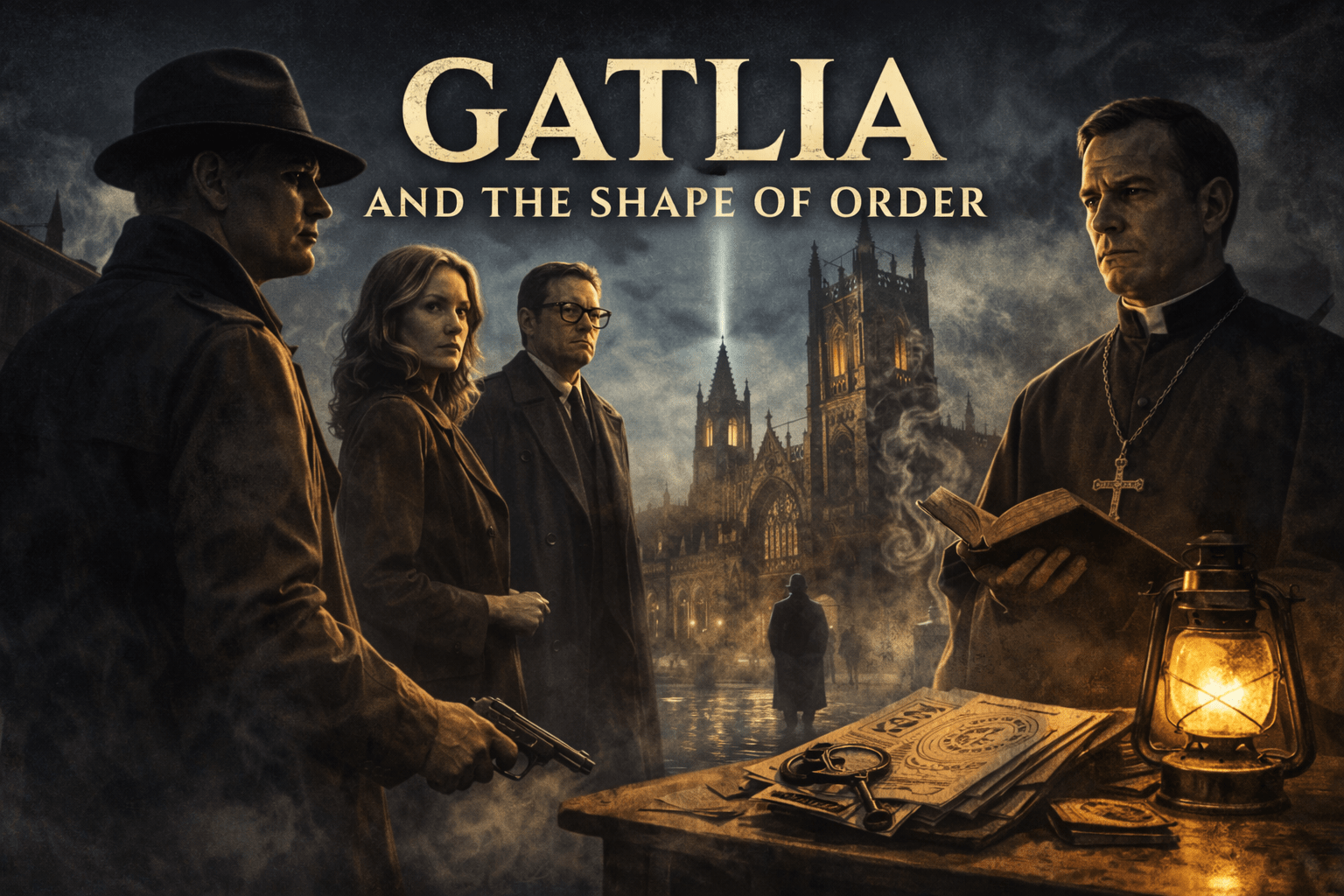
Gatlia and the Shape of Order cover image showing four figures in a dark, foggy city before a Gothic cathedral, including a priest holding an open book, with a lantern, documents, and a noir atmosphere.

Every world decides, sooner or later, who gets to keep it stable. In this one, stability does not come from belief or consensus. Gatlia and the shape of order insist it comes from institutions that remember how quickly things fall apart when authority hesitates. The medical center is one of those institutions. Quiet. Procedural. Trusted.

Dr. Gatlia stands at its center.

She is not written as cruel. She is not written as corrupt. She does not grandstand or argue philosophy. She works. She classifies. She contains. When something goes wrong, she does not ask what it means. She asks what it threatens.

That distinction matters.

To Gatlia, medicine is not only about healing bodies. It is about maintaining continuity. Panic is more dangerous than pain. Disorder more dangerous than death. Truth, if released without structure, can fracture a population faster than any disease.

From that perspective, Casper and Eulǝr are not visionaries. They are destabilizers.

They move outside approved channels.
They invite individuals to experience meaning directly.
They bypass the old filters—elder review, institutional pacing, sanctioned language.

To someone like Gatlia, that isn’t progress. It’s negligence.

Watch how she operates.
Notice when things are handled quietly instead of publicly.
Pay attention to what never becomes an emergency.

She does not oppose change outright. She slows it. Redirects it. Absorbs it into systems designed to outlast individuals. That restraint feels reasonable. Responsible, even.

And that’s what makes it dangerous.

Because control exercised calmly rarely looks like control at all.

Just keep that in mind while you read.

Members Only: Why Gatlia Is Afraid of Them

Gatlia’s loyalty is not to

This content is for members only.

Not yet a member? Request access to The Dossier.