Tag: Thriller Series

Thriller Series explores connected psychological, political, speculative, crime, and techno-thriller narratives that evolve across multiple books or episodes. These stories follow recurring characters, systems, institutions, conspiracies, and escalating conflicts where pressure, power, morality, and human survival deepen over time.

IMD Operations

IMD Operations File #012: The Union Breaker — Part 3

IMD OPERATIONS // FIELD FILES

Start the Operation

Watch the files in order. Each operation exposes another part of the machine.

Start File 001
0 of 14 files completed
Files 001–010
FILE 001 Still to see

The Housing Auction

The housing auction file #001 IMD Operations helps an elderly couple pushed toward foreclosure during a medical emergency while a hidden system…

Watch File 001
FILE 002 Still to see

The Loan Denial Algorithm

The Loan Denial Algorithm | IMD Operations File 002 A man qualified for the mortgage. The algorithm said no. IMD Operations File…

Watch File 002
FILE 003 Still to see

Who Controls the System

Who Controls the System Systems do not run the modern world by accident. Someone built them. IMD Operations File 003 — Who…

Watch File 003
FILE 004 Still to see

The Algorithm Denied His Life

A doctor prescribed the treatment. The algorithm denied his life. Not because it wouldn’t work. Because an algorithm decided the patient wasn’t…

Watch File 004
FILE 005 Still to see

He Lied Legally

He took an oath. He lied legally. And nothing happened. In this IMD Operation, public funds are not stolen… they are redefined.…

Watch File 005
FILE 006 Still to see

The Property Tax Trap

A retired couple falls behind on property taxes during a medical crisis. The property tax trap. What follows is not chaos. It…

Watch File 006
FILE 007 Still to see

The Credit Score Collapse

A man misses one payment. Then, the credit score collapse. The system recalculates. His credit score drops. Housing disappears. Loan access vanishes.…

Watch File 007
FILE 008 Still to see

The Childcare Network

A family does everything right. They work. They plan. They pay. But the childcare network system was never built around care. In…

Watch File 008
FILE 009 Still to see

The Billionaire Landlords

Forty-one hours before a public housing hearing, the billionaire landlords struck. The tenants’ evidence site disappears. Rent records. Eviction notices. Maintenance complaints.…

Watch File 009
FILE 010 Still to see

The Survivor Protocol

IMD was never a room. It was never a group of hackers. It was a counter-system. In File 010: The Survivor Protocol,…

Watch File 010
FILE 011 Still to see

The Coder Awakens

“Yesterday was brutal. The whole team has been killed and slaughtered. The office is destroyed. They took everything. They mashed all the…

Watch File 011
FILE 012 Still to see

The Union Breaker

IMD Operations File #012: The Union Breaker Video — Part 1 https://youtu.be/u1Q-RtDQY8M IMD Operations File 012: The Union Breaker Part 1 —…

Watch File 012
FILE 012 Still to see

The Union Breaker — Part 2

https://youtu.be/LfzKNbU2VLw?si=nB0vbvCO813GrzxW IMD Operations File #012: The Union Breaker — Part 2 By morning, the department store still looked expensive. That was the…

Watch File 012
FILE 012 Still to see

The Union Breaker — Part 3

Not A Real Publisher LLC presents IMD Operations. This is Part 3 of Operation Destroy the Oligarchs. The Contract Breathes. Integrity.Morality.Decency. IMD…

Watch File 012

Not A Real Publisher LLC presents IMD Operations.

This is Part 3 of Operation Destroy the Oligarchs.

The Contract Breathes.

Integrity.
Morality.
Decency.

IMD Operations in process.

The vote was supposed to be the end.

That was the story The Narrator prepared.

A temporary disturbance.
A labor misunderstanding.
A moment of emotion corrected by procedure.

But procedure failed.

The ballots were counted.
The union held.
The contract moved from paper… into life.

And inside the department store chain, something ancient and dangerous entered the building.

Not violence.
Not sabotage.
Not revenge.

A boundary.

For the first time, the employees did not stand alone in front of human resources.

For the first time, the schedule could not be changed at midnight without consequence.

For the first time, a woman with two children did not have to choose between medicine and rent.

For the first time, the machine said no…

and someone said no back.

IMD Operations in process.

The board of directors met before sunrise.

No cameras.
No press.
No smiles polished for shareholders.

Just men and women around a black glass table, staring at numbers that no longer obeyed.

The CEO stood at the end of the room.

He had spent years calling starvation efficiency.
He had called exhaustion flexibility.
He had called fear culture.
He had called turnover optimization.

Now the board called it exposure.

The Technologist had built the logic.

A scheduling engine that treated human lives as movable parts.
An attendance system that punished illness before it recognized it.
A productivity dashboard that measured obedience and called it performance.

The Financier had controlled the flow.

Every denied raise became margin.
Every understaffed shift became profit.
Every benefit withheld became shareholder value.

The Merchant had set the value.

The customer was always worth saving.
The worker was always worth replacing.

The Architect had shaped the environment.

Bright lights.
Long aisles.
Security cameras.
Break rooms too small for the number of people breaking inside them.

And The Narrator had controlled the story.

They were not underpaid.

They were entry-level.
They were not exhausted.
They were resilient.
They were not trapped.
They were grateful.

But the story broke when the contract went public.

Medical coverage expanded.

Not as charity.
As obligation.

Child care support became real.

Not as a campaign promise.
As a line item.

Wages rose.

Not enough to make anyone rich.
Enough to let them breathe.

Schedules stabilized.

Not perfectly.
But enough that parents could plan dinner, appointments, sleep.

Stress dropped in ways the company had never measured because stress had never appeared on the balance sheet unless it threatened profit.

Respect entered the building awkwardly at first.

Managers stopped pointing.
Supervisors stopped speaking through clenched teeth.
Human resources stopped calling people into rooms alone.

Because the room had changed.

There was always a witness now.

There was always a record.

There was always someone sitting beside the employee who knew the rules better than the person trying to bend them.

That was the fracture The Analyst had identified.

Not the wage.

The isolation.

The system had not survived by paying little.

It survived by making each employee believe they were alone when harm arrived.

The Coder entered.

Not to break the system—
but to move through it.

To trace how one decision became many.

A denied sick day.
A missed shift.
A written warning.
A lost promotion.
A smaller paycheck.
A late fee.
A payday loan.
A medical delay.
A child left with the wrong person because the right person had to work.

Independent systems…

aligning.

Retail policy.
Bank fees.
Health insurance.
Child care costs.
Rent pressure.
Credit scores.
Transportation penalties.

No one had to conspire.

The system did that for them.

The Operator acted.

Not loudly.
Not publicly.

Precisely.

The board packet appeared in every director’s inbox at 6:04 a.m.

Not stolen.

Assembled.

From public filings.
Internal contradictions.
Employee testimonies.
Insurance denials.
Turnover records.
Scheduling data.
Exit interviews no one had read because the company never intended to learn from them.

The title page contained one sentence:

The company did not lose control because workers organized.
The company lost control because management made organization inevitable.

By 7:20 a.m., the CEO was no longer defending strategy.

He was defending liability.

By 8:10, human resources was no longer a department of protection.

It was evidence.

By 9:35, the board voted.

The CEO was removed.

The head of human resources was terminated.

Two vice presidents resigned before their names could be entered into minutes.

The public statement called it a leadership transition.

The employees called it Tuesday.

On the sales floor, no one cheered.

That was not how survival sounded.

Survival sounded like a mother checking her phone and realizing the prescription was covered.

It sounded like a father seeing next month’s schedule before next month began.

It sounded like a cashier taking lunch without asking permission like a child.

It sounded like a stockroom worker opening a pay stub and not going silent.

It sounded like someone laughing in the break room without looking at the camera first.

The machine had trained them to expect punishment after relief.

So the first days were quiet.

Then the body began to believe what the contract already knew.

Shoulders lowered.

Voices changed.

People stopped apologizing before asking questions.

A young employee who had never stayed at a job longer than six months requested union training.

A department lead who used to repeat corporate language stopped saying family and started saying workers.

A grandmother in footwear finally scheduled the surgery she had postponed twice.

A single father moved his child from emergency babysitting to licensed care.

A woman in cosmetics who used to cry in her car after closing shift now drove home while it was still light.

Nothing exploded.

No windows shattered.

No one went to war.

The store opened.
The lights came on.
Customers entered.
Shelves were stocked.
Registers worked.
Orders moved.

The system had claimed dignity would destroy the business.

It did not.

It only destroyed the lie.

In the dark above the city, The Council watched the signal spread.

The Technologist saw workers sharing contract language across platforms the company did not own.

The Financier saw wage pressure appearing where fear used to be.

The Merchant saw value detach from obedience.

The Architect saw the environment fail to contain the people inside it.

And The Narrator saw the most dangerous thing of all.

A better story.

Not rebellion.

Proof.

The employees had not asked to own the company.

They had asked to survive working for it.

And once survival became visible, the old language weakened.

Efficiency.
Flexibility.
Culture.
Opportunity.

Words designed to hide extraction.

Words that no longer worked the same way in the mouths of people who had learned the shape of the cage.

IMD did not celebrate.

IMD does not fight people.

IMD exposes alignment.

When systems designed to protect people begin protecting power—

IMD activates:

Integrity.
Morality.
Decency.

The Coder stood alone in the glow of a green terminal, watching the last board memo cross the screen.

The Analyst’s fracture remained marked.

The Operator’s action remained invisible.

The workers remained real.

That was enough.

Because the purpose was never to humiliate a CEO.

It was to make the system visible where it was designed to remain invisible.

And for one chain, in one city, inside one building where fear used to pass as management…

the machine lost.

IMD Operation complete.

The board will hire another executive.

Human resources will get a new name.

Consultants will arrive with softer language.

The Council will adjust the model.

The machine will try again tomorrow.
IMD Operations

IMD Operations File #012: The Union Breaker — Part 2

IMD OPERATIONS // FIELD FILES

Start the Operation

Watch the files in order. Each operation exposes another part of the machine.

Start File 001
0 of 14 files completed
Files 001–010
FILE 001 Still to see

The Housing Auction

The housing auction file #001 IMD Operations helps an elderly couple pushed toward foreclosure during a medical emergency while a hidden system…

Watch File 001
FILE 002 Still to see

The Loan Denial Algorithm

The Loan Denial Algorithm | IMD Operations File 002 A man qualified for the mortgage. The algorithm said no. IMD Operations File…

Watch File 002
FILE 003 Still to see

Who Controls the System

Who Controls the System Systems do not run the modern world by accident. Someone built them. IMD Operations File 003 — Who…

Watch File 003
FILE 004 Still to see

The Algorithm Denied His Life

A doctor prescribed the treatment. The algorithm denied his life. Not because it wouldn’t work. Because an algorithm decided the patient wasn’t…

Watch File 004
FILE 005 Still to see

He Lied Legally

He took an oath. He lied legally. And nothing happened. In this IMD Operation, public funds are not stolen… they are redefined.…

Watch File 005
FILE 006 Still to see

The Property Tax Trap

A retired couple falls behind on property taxes during a medical crisis. The property tax trap. What follows is not chaos. It…

Watch File 006
FILE 007 Still to see

The Credit Score Collapse

A man misses one payment. Then, the credit score collapse. The system recalculates. His credit score drops. Housing disappears. Loan access vanishes.…

Watch File 007
FILE 008 Still to see

The Childcare Network

A family does everything right. They work. They plan. They pay. But the childcare network system was never built around care. In…

Watch File 008
FILE 009 Still to see

The Billionaire Landlords

Forty-one hours before a public housing hearing, the billionaire landlords struck. The tenants’ evidence site disappears. Rent records. Eviction notices. Maintenance complaints.…

Watch File 009
FILE 010 Still to see

The Survivor Protocol

IMD was never a room. It was never a group of hackers. It was a counter-system. In File 010: The Survivor Protocol,…

Watch File 010
FILE 011 Still to see

The Coder Awakens

“Yesterday was brutal. The whole team has been killed and slaughtered. The office is destroyed. They took everything. They mashed all the…

Watch File 011
FILE 012 Still to see

The Union Breaker

IMD Operations File #012: The Union Breaker Video — Part 1 https://youtu.be/u1Q-RtDQY8M IMD Operations File 012: The Union Breaker Part 1 —…

Watch File 012
FILE 012 Still to see

The Union Breaker — Part 2

https://youtu.be/LfzKNbU2VLw?si=nB0vbvCO813GrzxW IMD Operations File #012: The Union Breaker — Part 2 By morning, the department store still looked expensive. That was the…

Watch File 012
FILE 012 Still to see

The Union Breaker — Part 3

Not A Real Publisher LLC presents IMD Operations. This is Part 3 of Operation Destroy the Oligarchs. The Contract Breathes. Integrity.Morality.Decency. IMD…

Watch File 012

IMD Operations File #012: The Union Breaker — Part 2

By morning, the department store still looked expensive.

That was the trick.

The marble floor still reflected the chandeliers.

The perfume counters still glowed.

The handbags still sat beneath soft gold light, waiting to be touched by people who could afford to mistake leather for status.

Customers entered through glass doors and saw elegance.

They did not see the signal.

They did not see the phones lighting up behind registers, inside lockers, beneath counters, in the stockroom, beside online pickup bins, and under the customer service desk.

They did not see workers reading the same message.

Did they tell you the same thing?

They did.

And for one full day, the store changed without appearing to change.

That was how the first rebellion survived.

It did not announce itself.

It listened.

A cashier saved a screenshot.

A fragrance associate copied a schedule.

A stockroom worker photographed a new attendance warning.

A fulfillment lead wrote down the exact words his manager used.

Direct communication.

Protect our culture.

Outside organizations.

Solve problems together.

The words had been harmless when each worker heard them alone.

Together, they became a fingerprint.

The CEO did not know it yet.

He still believed fear moved downward.

From the executive floor to regional leadership.

From regional leadership to store directors.

From store directors to department managers.

From department managers to workers who needed rent, child care, insurance, medication, and hours.

But The Coder had reversed the current.

Now the fear was moving back up.

IMD Operations in process.

The Coder sat alone in the ruined IMD room.

The Analyst was dead.

The Operator was dead.

The old chairs remained empty.

The machine had taken the people.

It had not taken the function.

So The Coder built the function again.

Not with speeches.

With structure.

He opened the store map.

Fragrance.

Men’s suits.

Handbags.

Customer service.

Fulfillment.

Stockroom.

Cash wrap.

Scheduling office.

Human resources.

Loss prevention.

Eight departments.

One pressure system.

The CEO’s face stayed in the center.

Not because he touched every worker.

Because every pressure protected him.

That was the point of the modern corporation.

No single hand on the throat.

Only policy.

Only process.

Only managers saying their hands were tied while tying the knot tighter.

At 11:12 a.m., the first retaliation arrived.

It did not look like retaliation.

It looked like a schedule update.

Maria Lopez, fragrance.

Closing shift changed to opening.

Sunday added.

Tuesday removed.

Child-care window destroyed.

No explanation.

Just a notification.

Please confirm.

Across the store, three more workers received changes.

One in stockroom.

One in fulfillment.

One at customer service.

All four had opened the union signal.

All four had saved the CEO’s message.

All four had been visible to the same assistant manager the day before.

The company called it operational need.

The Coder called it contact.

He marked the schedule changes in green.

Then he waited.

The second pressure arrived after lunch.

A department manager pulled a young employee from men’s suits into a “check-in.”

Glass office.

Open blinds.

Soft voice.

No witness.

“We just want to make sure you feel heard.”

The employee nodded.

The manager smiled.

“You know, outside groups can promise things they can’t deliver.”

The employee nodded again.

He remembered the instruction.

Do not argue.

Do not explain your fear to the people paid to measure it.

Document the phrase.

Save the message.

Map the pattern.

The manager kept smiling.

“We’re a family here.”

There it was again.

The employee left the office with his hands shaking.

Inside his pocket, the phone recording remained dark.

The Coder received the file thirteen minutes later.

He did not celebrate.

Fear was not victory.

Fear was the material.

He placed the recording beside the CEO broadcast.

Same phrase.

Same order.

Same emotional trap.

Direct.

Outside.

Family.

Together.

The CEO still had not said union.

That was why he was dangerous.

The third pressure came from human resources.

A mandatory listening session.

Small groups.

Twelve employees each.

No agenda.

Managers present.

HR present.

No notes allowed.

The Coder read the invite twice.

Then he sent the second instruction.

Go.

Listen.

Say little.

Let them repeat the script.

The workers obeyed.

Not because they were fearless.

Because fear finally had a place to go.

In the listening session, HR talked about care.

A manager talked about culture.

A regional leader talked about uncertainty.

Then she made the mistake.

“We have to protect this store from outside influence.”

The room went quiet.

A cashier looked at the fragrance associate.

The fragrance associate looked at the stockroom worker.

The stockroom worker looked at the fulfillment lead.

No one smiled.

No one spoke.

But everyone heard it.

Same words.

Same store.

Same mouth.

That evening, the Coder assembled the packet.

Schedule changes.

Manager check-in.

HR listening session.

CEO broadcast.

Attendance warnings.

Shift cuts.

Policy reminders.

A pattern of pressure dressed as management.

Then he did what CEOs never understood.

He did not release it.

Not yet.

Exposure too early became noise.

Noise gave the CEO room to deny.

The Coder needed the CEO confident.

He needed him comfortable.

He needed him to believe the workers were still alone.

So The Coder built the next layer.

A quiet roster.

Not a public list.

Not a reckless chat.

A protected map of who had evidence, who needed protection, who had dependents, who could speak, who should not speak yet, who was being watched, who was being squeezed, who had already been punished by schedule.

The union was not born from anger.

Anger was easy.

The union was born from discipline.

In the ruined IMD room, the green map widened.

The store was no longer a store.

It was a pressure diagram.

And for the first time, the workers were not the pressure points.

They were the witnesses.

At closing, the CEO sent another message.

Shorter this time.

Warmer.

More careful.

“I know there has been confusion. I want every member of our family to know my door is always open.”

The workers watched it in silence.

The Coder paused the video on the CEO’s face.

The smile.

The office.

The distance.

The lie pretending to be concern.

Then he added one line to the target file.

The CEO has responded to the signal.

That mattered.

Because now the CEO was not reacting to rumor.

He was reacting to organization.

And every reaction created evidence.

The Coder looked at the empty chairs.

The Analyst would have named the fracture.

The Operator would have moved the blade.

Now both tasks belonged to him.

He spoke the principles alone.

Integrity.

Morality.

Decency.

Then he sent the third instruction into the store.

Do not let them isolate you.

Two minutes later, Maria Lopez looked up from her phone.

Across the break room, the stockroom worker looked up too.

At customer service, a cashier stopped pretending she was reading the return policy.

In fulfillment, three workers stood beside the online pickup bins and said nothing while understanding everything.

The CEO had used the schedule to break them.

The Coder had turned the schedule into proof.

That was how the wealthy began to fall.

Not all at once.

Not with thunder.

First, their clean systems betrayed them.

Then their language betrayed them.

Then their managers betrayed them by repeating what they had been trained to say.

And finally, their workers stopped mistaking isolation for weakness.

The machine still owned the store.

But it no longer owned the silence.

IMD Operation complete.

The machine thinks it won.

The machine has killed again.

But machines do not grieve.

The machine will try again tomorrow.
Dossier

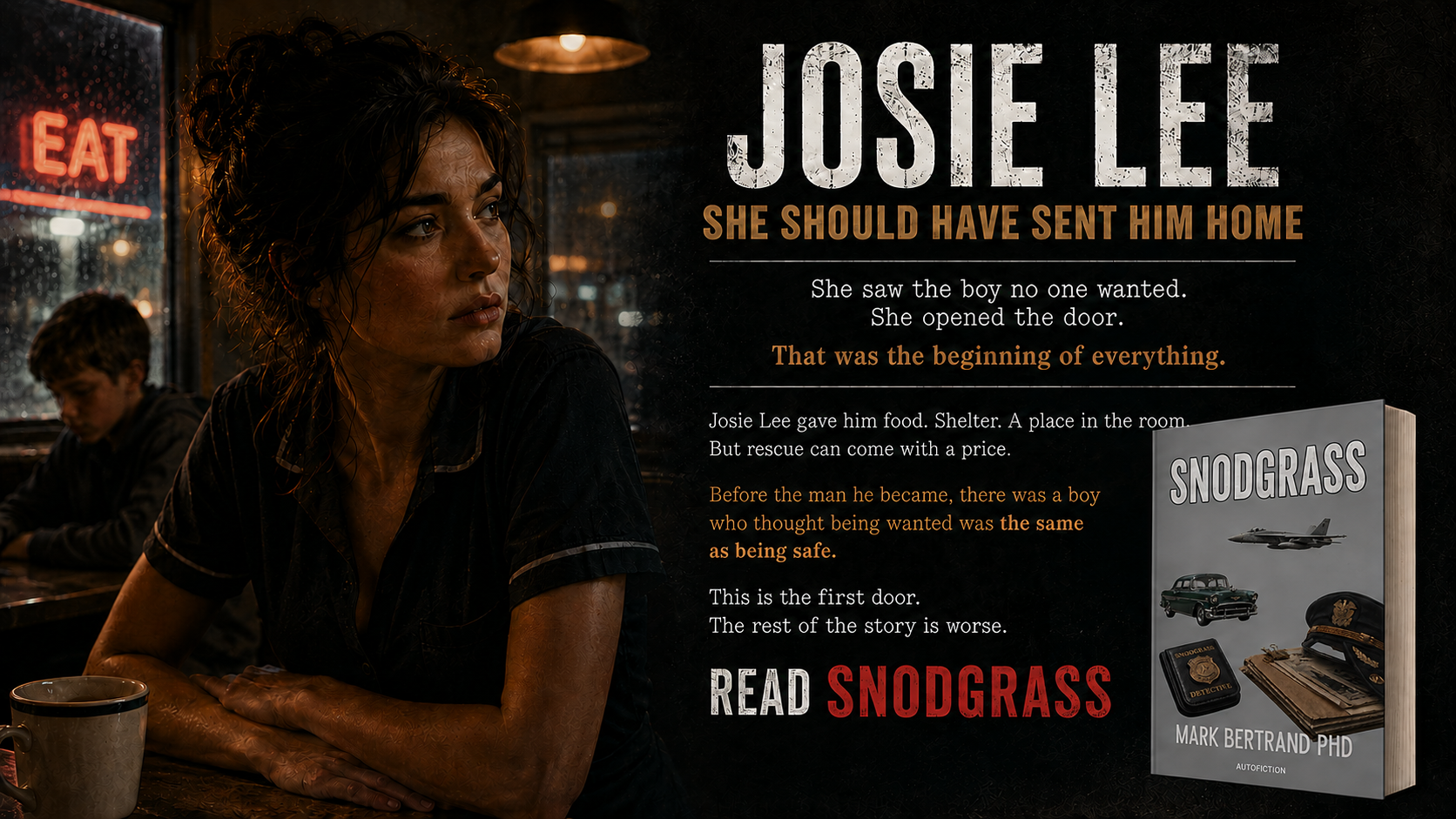
JOSIE LEE: SHE SHOULD HAVE SENT HIM HOME

When does kindness stop being shelter and become another room a boy cannot leave?

Josie Lee is not the beginning of the novel, Snodgrass. She is worse than that. She is the first door. The public story tells you Josie opened it.

That is the easy version.

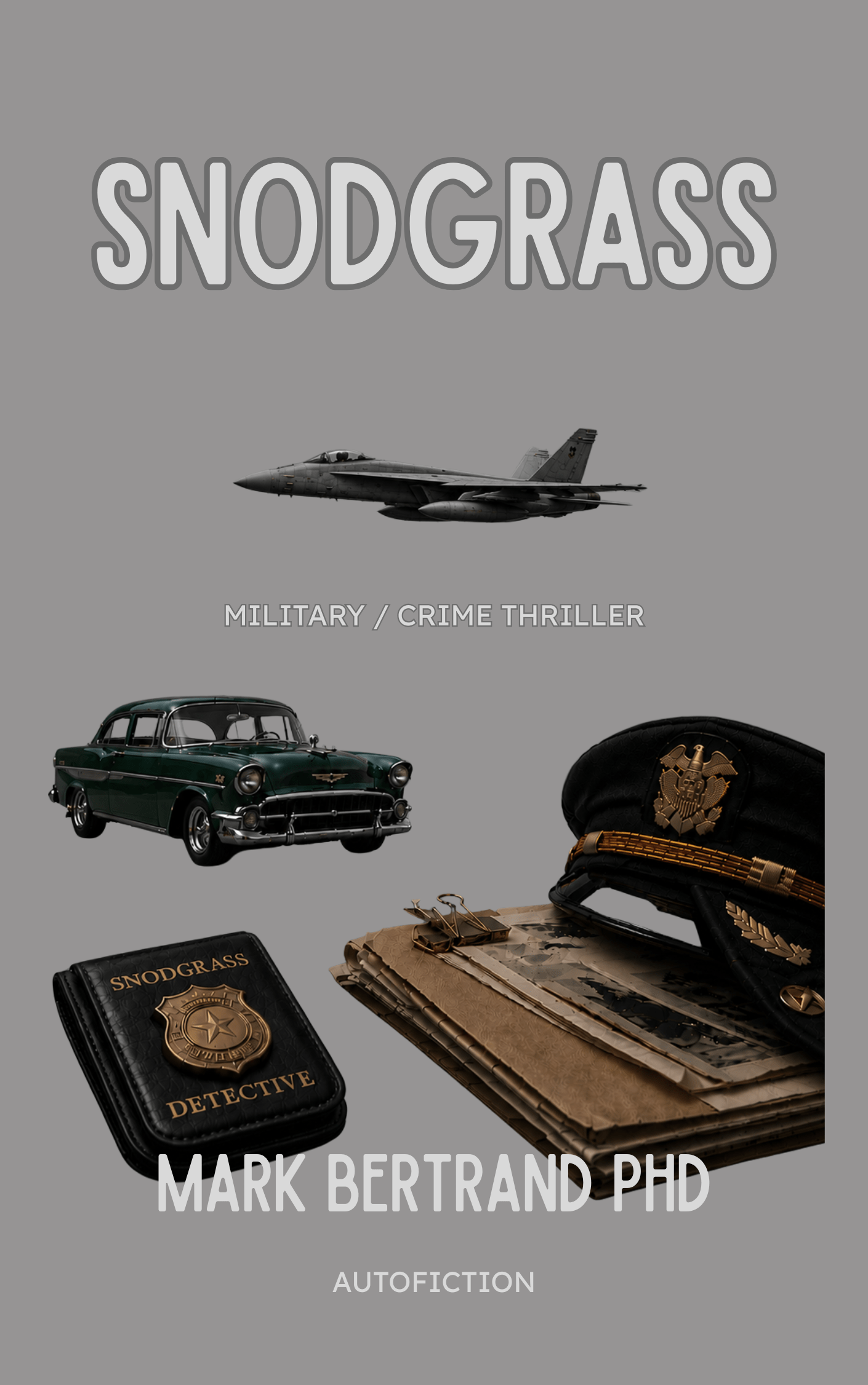
JOSIE LEE: SHE SHOULD HAVE SENT HIM HOME with Snodgrass book cover.

Josie Lee | She should have sent him home

A boy was alone. Hungry. Too young to be free and too damaged to go home. He had already learned the first rotten lesson of the world: adults could call a place a family while making one child feel like a trespasser.

Josie saw him.

That was the beginning of everything.

Not because she was looking for him.

Not because she planned him.

Not because she woke one morning and decided to cross a line.

The truth is worse than that.

The truth is more human.

Josie Lee saw him because she recognized him.

She looked at Mark and saw the old wound walking toward her in boots, hunger, pride, silence, and bad luck. She saw a boy unwanted by the man in the house. She saw another man’s child. She saw the evidence of a life a stepfather wanted erased.

And somewhere inside her, before thought could become warning, before decency could become distance, before the adult world could say what adults always say too late, she understood him.

There I am.

That is where Josie Lee becomes dangerous.

Not because she was cruel.

Because she was tender in the wrong direction.

THE PUBLIC STORY

The public story says Josie helped him.

That part is true.

She gave him food. Attention. Warmth. A place in the room. A voice that did not sound like contempt. A way to sit down without being watched like a criminal. A temporary country where the air did not belong to the man who hated him.

For a boy already put outside the circle, that kind of attention does not feel small.

It feels like rescue.

A plate can become a promise.

A ride can become safety.

A room can become a country.

A woman who looks at him without disgust can become proof that he still exists.

That is why Josie matters.

She did not enter the story as a villain. She entered as mercy.

And mercy is harder to survive when it comes with a shadow.

Snodgrass is not a clean story about a boy who escapes a bad house and finds a better world.

That would be easier.

That would be safer.

That would be a lie.

Snodgrass is the story of what happens after a boy survives one room and discovers the next room has its own bargain waiting.

Josie Lee was one of those bargains.

[READ SNODGRASS]

THE HIDDEN INJURY

A cruel person is easy to name. Cruelty comes wearing a sign if you have lived long enough to read it.

A fist.

A locked door.

A withheld meal.

A stepfather’s stare.

A mother’s silence.

A house where one child is treated as evidence against another adult’s pride.

Josie was harder.

She was warmth.

She was food.

She was brown eyes and attention.

She was a woman who looked at him and did not see trouble first.

She saw the child who had been put outside the circle.

And maybe that is why he trusted her.

Maybe that is why she trusted herself.

Because rescue can feel clean when it begins.

The first kindness is always innocent.

A plate.

A ride.

A little money.

A place to sit.

A room where nobody tells him he does not belong.

No one calls that possession.

No one calls that need.

No one calls that the first thread in a knot.

But a knot was forming.

The dossier finding is simple:

Josie Lee did not create the wound.

She entered through it.

SHE SHOULD HAVE SENT HIM HOME

Josie Lee should have sent him home.

That sentence is true.

It is also useless.

Home was not safety. Home was the scene of the crime. Home was where the boy had already learned that being another man’s child could turn his body into a target. Home was where adulthood failed first and then demanded the right to keep failing.

So where was she supposed to send him?

Back to the house that rejected him?

Back to the man who hated him?

Back to the rules written by people who never had to survive inside them?

That is the moral trap of Josie Lee.

The correct answer was not available.

Only the human answer was.

She helped him.

She should not have needed him.

Both things are true.

That is the part the public story cannot hold.

Public stories like clean roles. They want a villain. They want a saint. They want a victim without contradiction and a rescuer without hunger. They want the easy trial, the easy verdict, the simple witness statement.

Josie refuses that comfort.

She took risks for him.

Real risks.

Reputation.

Money.

Judgment.

The attention of the wrong men.

The legal danger of being too close to a boy the world had already failed.

The emotional danger of letting him become necessary.

She gave him what he had been starving for.

A place.

A witness.

A temporary home.

And because she gave him that, he could not see the full cost.

How could he?

He was too young.

THE BOY WHO ACTED OLDER THAN HE WAS

This is the part nobody wants to say.

A damaged boy can look older than he is.

Hunger can sharpen the face.

Work can harden the hands.

Anger can deepen the voice.

Survival can put a terrible adult mask on a child and fool everyone, including the child.

But needing to survive does not make a boy grown.

It only makes him easier to misunderstand.

It makes people call his silence maturity.

It makes people call his pride consent.

It makes people call his ability to endure strength.

It makes people forget that endurance is not adulthood.

A boy who has survived too much may know how to drive, fight, work, lie, steal food, sleep cold, take a punch, watch a room, read a man’s temper, and leave before the worst happens.

That does not make him a man.

That makes him a child with no rescue coming.

And that is why Snodgrass cuts deeper than a survival story.

It is not about whether the boy was strong.

Of course he was strong.

Strong was the only thing left when safety was gone.

The question is what strength cost him.

The question is what he had to mistake for love.

The question is what happened after Josie opened the door.

That is the book.

[READ SNODGRASS]

THE STEPCHILD WOUND

Josie did not fall for Mark because he was young.

That would be too simple.

She fell for him because he was wounded in the exact place she had never healed.

She knew what it meant to be the child from another man. The child who did not fit cleanly into the new household. The child who carried someone else’s history in the face, the name, the blood, the timing. The child a stepfather could resent without ever saying the real reason.

You are not mine.

You are proof.

You are the leftover life before me.

You are the reminder.

That is a terrible thing to do to a child.

It teaches the child that existence itself can be an offense.

Josie understood that.

Maybe no one had rescued her when she needed it.

Maybe no one had stood in the doorway and said, Come in, you are not the problem.

Maybe the girl she used to be had learned to survive by becoming useful, pretty, funny, hard, available, uncomplaining, whatever the room required.

Then Mark arrived with the same wound showing.

And she tried to save him.

That sounds beautiful.

It was beautiful.

It was also not enough to make it right.

Because she was not only saving him.

She was reaching backward through him.

She was trying to rescue the girl no one came back for.

That is where the story darkens.

THE FALSE RESCUE

When a person tries to save the wounded child inside herself by saving another wounded child, love can become confused with recovery.

Kindness can become a claim.

Protection can become hunger.

The rescued person can become evidence that the rescuer is good, needed, chosen, forgiven.

And the boy?

The boy learns another lesson.

Not the lesson of violence this time.

A softer lesson.

A more dangerous one.

He learns that rescue may come with a hand around the wrist.

He learns that being wanted can feel like being saved.

He learns that adult need can arrive disguised as love.

He learns that a door can open and still become a room he does not know how to leave.

That is Josie Lee.

Not villain.

Not saint.

A woman with brown eyes and an old wound.

A woman who saw too much of herself in a boy she should have protected from everyone, including herself.

A woman who gave him shelter when the world had none to offer.

A woman who should have known better.

A woman who maybe did know better and still could not stop the human part of herself from reaching for the one person who made her old pain feel visible.

This is why the public story is not enough.

The public story says Josie helped him.

The dossier says help is not always clean.

The public story says she opened the door.

The dossier asks what followed him through it.

The public story lets us call her kind.

The dossier makes us sit with the harder truth:

Josie Lee may have saved him from the street, but she also taught him that rescue could come with a claim attached.

And once a boy learns that, he carries it.

Into work.

Into hunger.

Into danger.

Into women.

Into rooms where power smiles before it takes something.

Into every future where love and debt are difficult to separate.

WHY JOSIE LEE MATTERS

Josie Lee is not a side character.

She is not a memory.

She is not the waitress from before the real story begins.

She is the first door.

And after that door came the machine.

After Josie came the world that knew exactly what to do with a boy trained to survive, trained to keep moving, trained to confuse danger with opportunity, trained to accept impossible bargains because impossible bargains were the only ones ever offered.

That boy would go on to meet men who understood leverage.

Men who smiled first.

Men who made offers.

Men who turned desperation into a contract.

Men who saw in him the thing damaged children are trained to become.

Useful.

Fast.

Loyal until betrayed.

Silent until cornered.

Brave enough to be spent.

This is where Snodgrass begins to matter.

Not because Snodgrass explains Josie.

Because Snodgrass shows what happened after shelter was no longer enough.

Josie saw the boy.

Snodgrass shows the world that came for him next.

The boy who walked through Josie Lee’s door did not become safe.

He became harder to kill.

There is a difference.

Every real reader knows it.

MEMBERS ONLY // THE PART NOBODY WANTS TO SAY

The hardest part of Josie Lee is

This content is for members only.

Not yet a member? Request member access to The Dossier. Get 20% off the paperback price.

Snodgrass book cover for book 1 in the crime thriller trilogy
Ebook purchase now image
audiobook purchase image
paperback purchase image