
Books Like

books like category image defines the intent of the articles Books Like category are articles where I examine novels that echo the themes and tensions found in my thrillers. Each article compares books where ordinary lives collide with powerful systems and difficult moral choices. If you’re looking for suspense that exposes how the world really works, these are the books that live in the same territory.

Books Like

Books Like Misery: When the Reader Owns the Writer

Readers searching for books like Misery usually want more than a trapped-writer thriller. They want the pressure of a story turning against the person who created it. They want the claustrophobia of being judged by someone who believes the book belongs to them. They want the terrible intimacy between writer and reader, where admiration becomes control, and control becomes punishment.

books like misery image of the vintner at his desk with an intruder at the door and spilled wine

That is why The Vintner & The Novelist belongs in the conversation.

Not because it repeats the plot of Misery. It does not. There is no simple hostage room. No ordinary fan with a hammer. No single house where the writer’s body is trapped while the manuscript becomes a weapon.

Instead, Mark Bertrand takes the same essential terror and moves it into stranger, deeper, more psychological ground: What if the reader did not merely demand a better book? What if the reader became the court? What if the writer was not imprisoned by a person, but by the judgment of reading itself?

In The Vintner & The Novelist, the writer is not only afraid of failure. He is afraid of being erased.

For readers who want books like Misery but darker, more intellectual, and more reality-bending, The Vintner & The Novelist is the next novel to read.

Why Misery Still Holds Readers by the Throat

Misery works because it understands a brutal truth about storytelling: once a book enters the world, the writer no longer fully owns it.

The reader brings expectation. Hunger. Anger. Love. Possession.

That is the genius pressure inside Misery. The novelist has written something. The reader has received it. But reception turns into entitlement. The reader does not merely want the story. The reader wants authority over the story.

That is why Misery still frightens. The physical violence matters, of course. But the deeper horror is artistic captivity. The writer is forced to confront a reader who believes devotion grants ownership.

You wrote this for me.

You owe me.

You will fix it.

That is the nerve Misery presses.

The strongest books like Misery do not simply trap another writer in another room. They find new ways to ask the same ugly question:

Who owns the story once someone else needs it?

How The Vintner & The Novelist Pushes That Terror Further

The Vintner & The Novelist begins in grounded physical pain: a vineyard, a storm, a damaged body, a tractor accident, a man trying to hold together land, labor, money, injury, marriage, and purpose.

Then the novel moves.

The vintner is also a novelist. His manuscript is no longer merely a manuscript. It becomes evidence. A charge. A possession. A thing he must defend before forces that do not care about his intention.

That is where Bertrand’s novel becomes a natural successor for readers looking for books like Misery.

In Misery, one reader takes control.

In The Vintner & The Novelist, The Readers become a system.

They are not fans in the soft, flattering sense. They are not the cozy imagined audience writers dream about while drafting. They are judgment. They are consequence. They are the unforgiving pressure behind every page that fails to matter.

The charge is not that the novelist wrote badly.

The charge is worse.

He wasted the reader’s time.

That idea gives the novel its blade.

Purchase The Vintner & The Novelist
Ebook just $4.99
Paperback just $24.99

The Reader as Judge, Jury, and Executioner

The best psychological thrillers understand that fear is not always a man with a weapon. Sometimes fear is a verdict. Books like Misery.

In The Vintner & The Novelist, the writer enters a kind of impossible court where the manuscript is treated as something dangerous to possess. Not a private object. Not a harmless draft. Not an unfinished artistic experiment.

A manuscript.

A charge.

A risk.

The terror is not only that The Readers may hate the book. The terror is that they may be right to hate it.

That is a sharper kind of pressure than simple captivity. It attacks the writer where he is most exposed. Not his body first. His purpose. His talent. His authority. His belief that his suffering, discipline, imagination, and craft mean anything unless the reader experiences the work as alive.

This is where The Vintner & The Novelist becomes a powerful recommendation for readers who loved Misery. It understands the same closed-loop dread between writer and reader, then turns the room into a metaphysical trial.

The question is no longer only: Can the writer survive the reader?

The question becomes: Can the writer survive being read?

That is the sales hook. If Misery made you afraid of the obsessed reader, The Vintner & The Novelist makes you afraid of the true reader — the one who can tell when the story is lying.

Writing as Punishment

One reason Misery remains so effective is that writing itself becomes labor under threat. The novelist cannot retreat into romantic myths about inspiration. He must produce. He must revise. He must satisfy someone who has turned reading into domination.

The Vintner & The Novelist takes that same pressure and makes it colder.

Here, writing is not a refuge. It is evidence of guilt or innocence. The manuscript must justify the time it takes from real readers. Every passage has to earn its place. Every delay has a cost. Every drift, every indulgence, every decorative emptiness becomes a crime against attention.

That makes the novel unusually alive for serious readers.

This is not just a thriller about what happens to a man. It is a thriller about what happens to a story when the excuses are stripped away.

Atmosphere is not enough.

Style is not enough.

Intention is not enough.

The Readers want encounter.

They want the book to do something to them.

And if it does not, punishment follows.

That is a viciously good idea for a psychological thriller because it turns the act of reading into the source of dread. The real reader, sitting outside the novel, starts to feel implicated. The question sneaks out of the fictional court and moves into the room.

Am I one of The Readers?

Do I judge this way?

Should I?

Why The Vintner & The Novelist Is Not a Copy of Books Like Misery

A weaker “books like Misery” recommendation would simply point to another novel about an author in danger.

That is not enough.

The better comparison is structural and emotional.

Misery gives readers confinement, obsession, bodily vulnerability, and the horror of creative coercion.

The Vintner & The Novelist gives readers vineyard realism, chronic pain, artistic terror, metaphysical judgment, and a court of readers who turn manuscript failure into existential punishment.

The overlap is not plot.

The overlap is pressure.

Both novels understand that writers are never entirely safe from the people who read them. Both understand that fiction is intimate enough to become dangerous. Both understand that the reader’s love can become a form of ownership.

But Bertrand’s novel adds a new layer: the reader is not merely unstable. The reader may be necessary.

The Readers are terrifying because they represent the standard every writer fears.

Did the story matter?

Did it move?

Did it waste me?

Did it tell the truth?

The Vintner, the Novelist, and the Cost of Being Judged

The vineyard material matters because it grounds the book before reality begins to bend.

The protagonist is not floating in clever literary abstraction. He is a man with a damaged body, a failing margin, land under pressure, a wife, taxes, repairs, and pain that has become part of his daily weather. That gives the later surreal and judicial material weight. The strange does not feel decorative. It feels like pressure breaking through the skin of ordinary life.

That is one of the reasons The Vintner & The Novelist can reach readers beyond the usual literary puzzle audience.

The book has dirt under its nails.

The vineyard is not scenery. It is a clock. The body is not backstory. It is a debt. The manuscript is not a prop. It is the trial.

And The Readers are waiting.

For readers who loved the artistic captivity of Misery, that movement matters. Bertrand does not simply ask whether a writer can endure punishment. He asks whether the work itself can endure judgment.

That is the deeper nightmare.

Read This If You Want Books Like Misery With a Sharper Psychological Edge

Read The Vintner & The Novelist if you want:

a trapped-writer thriller without the familiar room,

a manuscript that becomes dangerous,

a story where readers are not passive,

a psychological thriller with surreal and literary force,

a book about authorship, judgment, possession, and erasure,

and a novel that treats reading as an act of power.

Misery made the obsessed reader unforgettable.

The Vintner & The Novelist makes the act of being read feel like standing trial.

That is why this novel belongs on any serious list of books like Misery. Not because it imitates the surface. Because it understands the wound underneath.

The writer writes.

The reader judges.

And somewhere between them, the story either lives or disappears.

If you are looking for books like Misery, read The Vintner & The Novelist by Mark Bertrand next. This is the novel for readers who know the most dangerous person in the room is not always the writer. Sometimes it is the one turning the page.

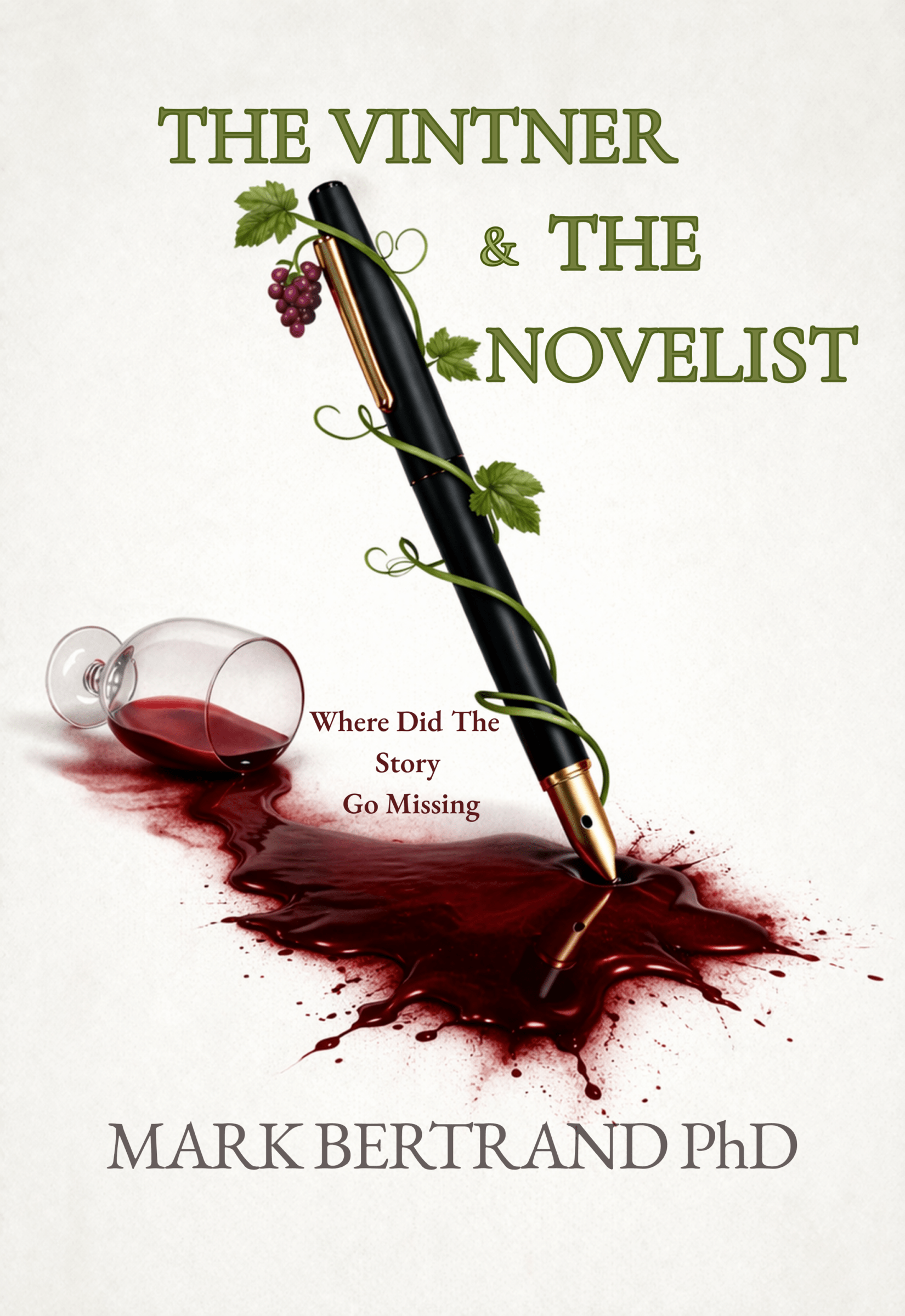
the vintner & the novelist book cover image

Purchase The Vintner & The Novelist
Ebook just $4.99
Paperback just $24.99

Readers who read books like Misery also read these articles.

Books Like Clockers or In The WoodsBooks Like HumBooks Like Dune Where Power Moves Inside the Mind
Books Like

Books Like Trust: When Money Gets to Rewrite the Truth

Readers who look for books like Trust are usually not looking for another simple novel about rich people.

They are looking for something colder than that.

books like trust image of a man standing in a kaleidoscope of a surreal world

They want novels about money as a private language. Money as protection. Money as concealment. Money as the power to decide which version of events survives. They want books where wealth does not merely sit in a bank account. It moves through marriages, documents, reputations, newspapers, private rooms, public lies, and the quiet machinery that lets certain people remain untouchable.

That is why books like Trust remains such a powerful novel for readers drawn to financial power and moral instability. It understands that money does not only buy houses, servants, influence, and safety. Money buys narrative. It buys the right to explain oneself last. It buys the right to have other people’s memories corrected, softened, erased, or rewritten.

For readers who responded to that pressure, BERTRAND by Mark Bertrand belongs on the same shelf, but not because it imitates Trust. It does something rougher, more intimate, and more psychologically exposed.

Trust studies wealth from the outside and through competing versions of truth.

BERTRAND takes the reader inside the man who decides he will no longer let the system write the terms of his life.

Why Readers Look for Books Like Trust

A reader who loves Trust is often drawn to the tension between fact and construction.

What really happened?

Who gets to tell the story?

What does money hide?

What does power protect?

Those questions make Trust more than a financial novel. It becomes a novel about authorship itself. Not literary authorship in the soft academic sense, but authorship as domination. The person with power gets to arrange the evidence. The person with money gets to decide what is dignified, what is vulgar, what is remembered, and what is buried.

That is the true seduction of the book.

It gives real readers the pleasure of watching a story open and correct itself. Then open again. Then correct itself again. Each layer makes the previous layer less stable. The reader is not only reading about wealth. The reader is being shown how wealth edits reality.

That is also where BERTRAND begins to matter.

Because BERTRAND is not a story about wanting money in the cheap sense. It is not about greed as decoration. It is not the familiar rise-and-fall morality play where ambition gets punished so everyone can feel clean again.

It is about the moment a man looks at work, talent, loyalty, intelligence, class, religion, morality, government, finance, and corporate authority, then reaches a brutal conclusion:

The rules were not written to reward him.

They were written to use him.

What Trust Gives Readers

Trust gives readers a world where finance becomes mythology.

Its power comes from distance, control, and arrangement. The wealthy figures inside the book live behind polished surfaces. Their rooms are arranged. Their lives are narrated. Their reputations are managed. Everything appears civilized because civilization itself has been trained to admire wealth before it questions it.

That is the genius of the experience.

The reader feels the refinement, then senses the violence underneath it.

There may be no alleyway beating. No visible blood on the floor. No gun in the drawer. But the violence is there. It lives in who gets diminished. Who gets credited. Who disappears into someone else’s version of the truth. Who becomes useful only after being reduced to a function inside another person’s legacy.

That kind of reading pleasure is intellectual, but it is not bloodless.

It works because real readers understand the feeling. They know institutions do this. Families do this. Corporations do this. Governments do this. Wealth does this better than almost anything else.

It does not have to shout.

It can simply file the document.

Why BERTRAND Belongs Beside Trust

BERTRAND belongs beside Trust because it also understands money as more than money.

Money is escape.

Money is oxygen.

Money is revenge.

Money is proof that the system did not get the final word.

But where Trust moves through layered narratives and the cold architecture of legacy, BERTRAND moves through the hot interior of a man who is still fighting the machine while it is happening.

The reader enters corporate rooms, aerospace facilities, offshore structures, meditation halls, financial schemes, and private moral weather. The result is not a polished portrait of wealth after it has already won. It is a live account of the struggle to get out from under the machinery before it crushes the last decent thing inside the self.

That difference matters.

Trust is fascinated by the way wealth preserves itself.

BERTRAND is fascinated by the kind of man who decides preservation is not enough. He wants control. He wants leverage. He wants to understand the system well enough to survive it, exploit it, and maybe one day short-circuit it.

This gives BERTRAND a harder psychological edge.

The book does not ask whether ambition is good or bad. That question is too clean for the world it enters. Instead, it asks what ambition becomes when fairness has already been removed from the room.

Where the Similarity Lives

The strongest similarity between Trust and BERTRAND is not plot.

It is pressure.

Both books understand that capitalism is not merely an economic system. It is a reality-producing system. It tells people what counts as success, what counts as failure, what counts as intelligence, what counts as theft, and what counts as respectable accumulation.

In Trust, the wealthy can surround themselves with narratives that protect them. The story asks who benefits when history is turned into a private estate.

In BERTRAND, the narrator sees the same machine from a lower and more volatile position. He is not born safely inside the estate. He is trying to break into the logic of power before the doors close forever.

That creates a different kind of reader tension.

The question is not simply, “What is true?”

The question becomes, “What does a man do once he sees the truth and realizes truth alone has no power?”

That is the darker kinship between the novels.

Both books know that systems do not need to be honest to endure. They only need enough people to keep obeying them.

The Man Inside the Machine

One of the reasons BERTRAND works as a next read after Trust is that it gives readers a more exposed psychological engine.

This is not a distant portrait of capital. It is capital as hunger inside the body.

The narrator is not merely analyzing the world. He is absorbing it. Corporate betrayal enters him. Class contempt enters him. Religious damage enters him. Family wounds enter him. The humiliation of being underpaid, underestimated, and used becomes part of his internal weather.

That is where the book becomes more than a story about money.

It becomes a story about what happens when intelligence is forced to serve survival before it can serve peace.

The meditation scenes matter for this reason. They are not spiritual decoration. They sharpen the contradiction. A man can teach breath, clarity, non-attachment, and inner stillness while privately building mechanisms of control. He can understand suffering and still choose domination. He can see the cage clearly and still decide the answer is not purity, but escape.

That contradiction gives BERTRAND its bite.

It is not interested in making the reader comfortable with the narrator.

It is interested in making the reader understand how a person gets there.

Where BERTRAND Moves Differently

Readers coming from Trust should know that BERTRAND is not elegant in the same way.

It is more combustible.

Trust has the feel of documents locked in a private archive. BERTRAND has the feel of a confession written too close to the fire. It carries anger, memory, argument, strategy, bitterness, intelligence, self-justification, and moments of brutal lucidity.

That is not a weakness. That is the point.

The book is not trying to reproduce the calm surface of wealth. It is trying to show what the climb costs when the man climbing knows the ladder is rigged.

This is where BERTRAND may hit hardest for readers who like dark psychological fiction about power. It refuses the easy version of morality. It does not offer the clean comfort of a good man resisting a bad system. It gives us a man who sees the bad system clearly and begins to wonder why he should remain clean inside it.

That is a more dangerous question.

And it is a more interesting one.

Why Readers of Financial and Psychological Novels Should Read BERTRAND

Readers who search for novels like Trust often want fiction with intelligence, structure, and moral pressure. They want books about money, but not merely books about getting rich. They want stories where wealth changes the atmosphere around every human decision.

BERTRAND gives them that, but with a stronger psychological current.

It is for readers who want:

Novels about money and power.

Psychological fiction about ambition.

Dark literary thrillers about systems.

Books about corporate betrayal and class rage.

Novels where morality is not simple because survival is not simple.

Stories about men trying to escape the place society assigned them.

And most of all, it is for readers who understand that the most dangerous character is not always the man who wants money.

Sometimes it is the man who once believed merit would be enough.

The Reader Who Should Read BERTRAND Next

Read BERTRAND after Trust if what stayed with you was not only the wealth, but the machinery behind the wealth.

Read it if you are drawn to stories where money controls memory, where institutions reward obedience, where talent gets used before it gets paid, and where the private self becomes a battlefield between decency and survival.

Read it if you want a novel that does not politely observe the system from a safe literary distance.

BERTRAND gets closer.

It puts the reader inside the pressure chamber with a man who has learned too much to remain innocent and suffered too much to remain obedient.

Final Thought

Trust shows how money can rewrite the truth once power has already won.

BERTRAND shows what happens before that victory is complete, when the man outside the gates learns the language of the machine and decides he may have to become dangerous to survive it.

For readers looking for books like Trust, that is the next dark pleasure.

Not another story about wealth.

A story about what wealth does to the soul before the soul decides whether to surrender, adapt, or strike back.

Bertrand by mark bertrand book cover image

Discover Bertrand and purchase the true crime novel.

Readers who read books like Trust also read these articles.

Books Like Foundation — When the System Becomes the StoryBooks Like The Chaos Agent: A Modern Threat That Feels Uncomfortably CloseBooks Like Red Clocks When the State Enters the Body
Books Like

Books Like Red Clocks When the State Enters the Body

Readers who love books like Red Clocks were not looking for spectacle. They were looking for pressure—the kind that builds slowly, politically, and inside the body—until the question is no longer what the system does, but what it makes a woman become.

books like red clocks image of a woman looking out of a window across the city scape of toronto

Readers who loved Red Clocks were not chasing explosions or collapse. They were drawn to something colder. A near-future where laws reshape private life, where ideology walks into the most intimate spaces, and where women must navigate not just restriction, but identity under pressure.

That is where Reckoning meets them.

Not at the level of surface dystopia, but at the level of intrusion. In Reckoning, the system does not simply regulate behavior. It presses into relationships, into ambition, into pregnancy, into the fragile space where a person tries to decide what her life is allowed to mean. Lydia Daniels is already breaking under the weight of marriage, business collapse, and impending motherhood, while Laura Benton stands on the opposite axis—controlled, strategic, and locked in ideological war against a future that threatens to redefine the human itself.

Why readers love Books Like Red Clocks

What gives books like Red Clocks its power is restraint.

The novel imagines a near-future America where abortion is illegal and new laws restrict the autonomy of women in increasingly invasive ways. But it does not rely on spectacle. It works through multiple women, each facing a different form of constraint, and builds a quiet, accumulating dread.

Readers responded to that control. The sense that nothing dramatic needs to happen for a life to be narrowed, redirected, or erased. The law becomes the atmosphere. The pressure becomes normal.

That is the experience readers are looking for when they search for books like Red Clocks.

Where Reckoning hits the same nerve

Reckoning delivers that same pressure, but with sharper psychological edges and more visible ideological conflict.

Lydia’s pregnancy is not a symbol. It is a pressure point. It sits inside a failing marriage, a collapsing professional identity, and a mind that cannot stabilize itself. Every decision she makes is colored by that reality. Every interaction is charged.

Laura Benton carries the other side of the argument. Where Lydia is collapsing inward, Laura is pushing outward. She sees the coming transhuman future not as liberation but as control disguised as progress. Her resistance is political, but also deeply personal. She has already lost something to that future. She refuses to lose the rest.

This is where Reckoning aligns with books like Red Clocks. Both novels understand that control is not only enforced. It is lived. It changes how a woman thinks, feels, chooses, and survives.

Strong female characters under pressure, not above it

One of the defining strengths of Red Clocks is that its women are not heroic in a conventional sense. They are constrained, uncertain, compromised, and forced into decisions that reveal the cost of the system rather than defeat it.

Reckoning operates in that same space, but with more volatility.

Lydia is not composed. She is reactive, unstable, and painfully aware of her own unraveling. Her strength is not clean. It is contested moment by moment. She lashes out, withdraws, questions herself, and keeps moving anyway.

Laura is strength in a different form. Controlled, ideological, and sharpened by loss. She does not drift through the system. She studies it. Plans against it. Prepares for confrontation.

Readers who connected with Red Clocks will recognize this immediately. These are not symbolic women. These are women inside pressure.

Theme: control of the body, control of the future

The obvious connection between these novels is political control over women’s lives. But the deeper connection is about authorship.

Who gets to decide what a life is for?

In Red Clocks, that question is framed through reproductive law, social expectation, and the quiet violence of limitation.

In Reckoning, the question expands. It is no longer only about the body. It is about the future of the human itself. Victor Lang’s transhuman vision offers enhancement, efficiency, and evolution—but at the cost of the very imperfections that make human life meaningful. Laura Benton’s resistance is therefore not only political. It is philosophical. She is fighting for the right to remain human.

That escalation is what makes Reckoning the natural next read. It takes the same core fear—control of women’s lives—and pushes it into the next stage: control of what a human being is allowed to become.

Plot movement: quiet pressure versus converging force

Red Clocks moves through accumulation. Small pressures. Quiet decisions. Parallel lives tightening under the same system.

Reckoning builds through convergence.

Lydia’s internal collapse.
Laura’s ideological resistance.
Victor Lang’s expanding influence.
A media environment shaping public truth in real time.

These forces do not sit side by side. They move toward each other. The result is a different kind of tension. Less quiet, more volatile. But rooted in the same foundation: systems pressing inward until something gives.

Why Reckoning is the next best read after Red Clocks

If you love books like Red Clocks because it showed how the state can enter the most private parts of life and reshape them without spectacle, Reckoning gives you that same intrusion.

But it does not stop there.

It is more volatile.
More confrontational.
More willing to push the argument beyond control into transformation.

It asks a harder question.

Not just who controls women’s lives?
But what happens when power decides to redesign the human being entirely—and calls it progress?

That is where Reckoning becomes the next read.

It takes the quiet dread of Red Clocks and sharpens it into a psychological and ideological thriller where the body, the mind, and the future are all under negotiation—and none of it is safe.

reckoning cover image of a woman with many eyes filled in tears

Discover more about Reckoning and buy the novel.

Readers who read books like Red Clocks also enjoy these articles.

Books Like Billy Summers or Harlem ShuffleBooks Like The Three-Body Problem Where the Threat Isn’t Out ThereBooks Like Red Sky Mourning: What Violence Costs, Where Systems Fail

Mark Bertrand