 Books Like category are articles where I examine novels that echo the themes and tensions found in my thrillers. Each article compares books where ordinary lives collide with powerful systems and difficult moral choices. If you’re looking for suspense that exposes how the world really works, these are the books that live in the same territory.
Books Like 1984: Modern Dystopian Thrillers About Surveillance, Control, and Manufactured Truth
Some novels do not merely imagine the future. They diagnose the machinery already moving beneath the floor. Books like 1984, George Orwell’s 1984 remains one of those books because it understands something brutal about power.
Power does not only want obedience. Obedience is too small. Power wants ownership over memory, language, emotion, loyalty, and the private territory inside the human mind. It wants the citizen to say the lie, repeat the lie, defend the lie, and finally believe the lie so completely that truth itself becomes a punishable instinct.
Books Like 1984
That is why readers still search for books like 1984.
They are not only looking for another dystopian novel. They are looking for that same terrible recognition. The chill of being watched. The dread of language being narrowed. The horror of a society where reality is no longer discovered, argued, tested, or remembered. It is manufactured. It is broadcast. It is enforced.
The best modern dystopian thrillers after 1984 do not simply copy Big Brother. They update the nightmare. They ask what happens when surveillance becomes voluntary, when corporations replace ministries, when entertainment replaces law, when public performance replaces private conscience, and when systems no longer need to hide their cruelty because the population has been trained to applaud it.
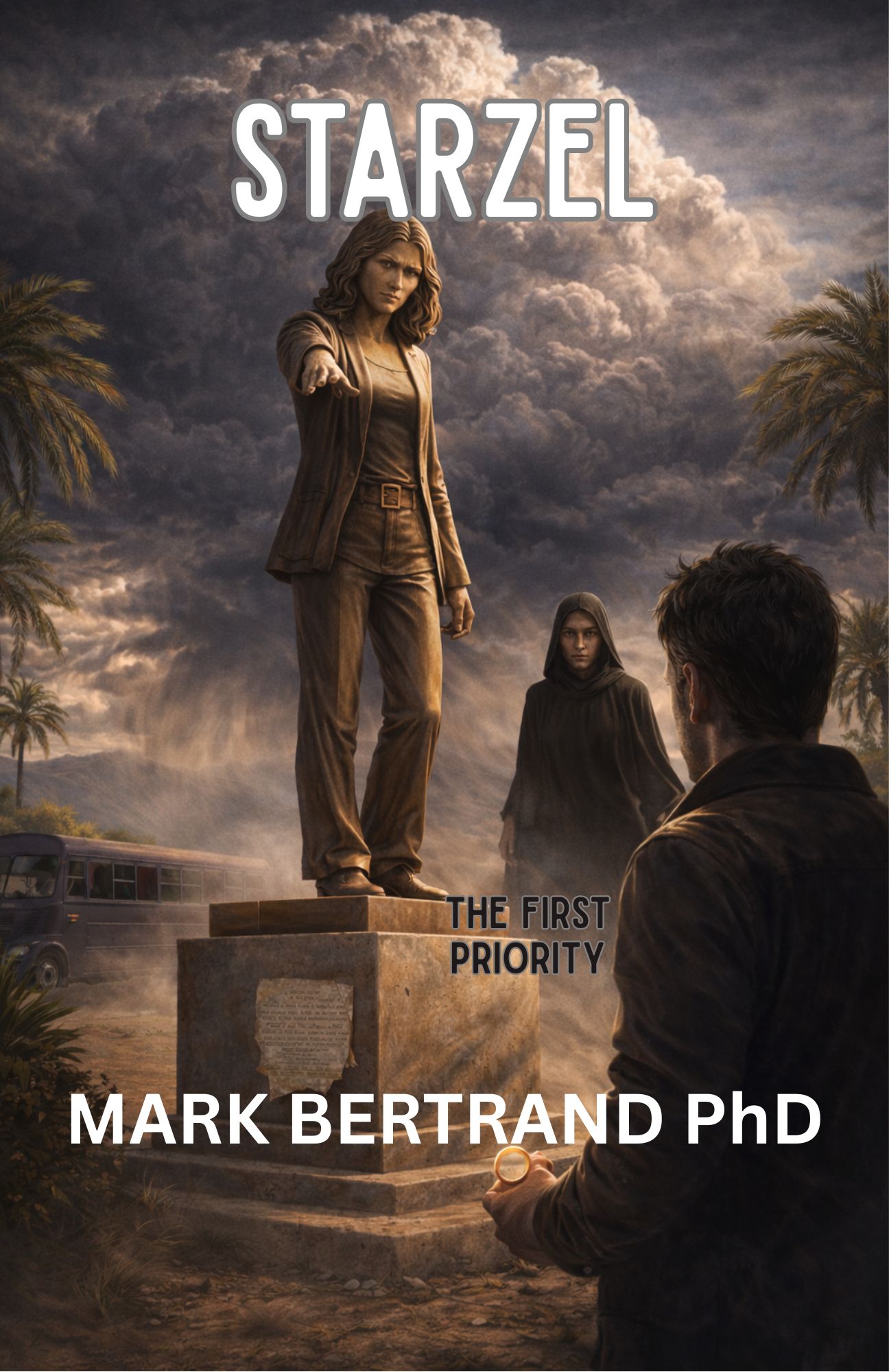
That is where Mark Bertrand’s Starzel belongs.
Not as a copy of 1984. Not as a nostalgic Orwell tribute. Starzel is a modern speculative dystopian thriller that takes the old fear of surveillance and pushes it into stranger, more psychological, more cosmic territory. In 1984, the Party controls reality by rewriting records. In Starzel, reality itself is damaged. The code beneath human existence has missing data. Truth has not merely been censored. It has been altered at the level of human destiny.
For readers who loved 1984 because it made control feel intimate, inescapable, and morally suffocating, Starzel is the next read that expands the fear.
Why 1984 Still Haunts Dystopian Thriller Readers
The brilliance of 1984 is not only the telescreens.
The real terror is the closed loop. Winston Smith lives inside a system where every route back to truth has been blocked. Memory is unreliable because records are changed. Language is unreliable because words are destroyed or repurposed. History is unreliable because the state edits the past. Love is dangerous because loyalty must belong to the Party. Thought itself becomes evidence.
That is what makes the novel feel larger than politics. 1984 is not only about authoritarian government. It is about the seizure of reality.
Readers respond to that because the story gives shape to a deep human fear: what if I know something is wrong, and every institution around me insists the wrong thing is normal? What if everyone else repeats the lie? What if survival depends on pretending not to see?
That is the pulse modern dystopian fiction keeps returning to.
The modern version often looks less like a boot stamping on a human face and more like a screen, a rating, a feed, a data score, a content policy, a workplace rule, a court broadcast, a wellness program, or a public narrative polished until it becomes official truth.
The cage has changed design.
The function has not.
The Modern Dystopian Thriller Has Replaced Big Brother With Better Machines
The old dystopia watched you from the wall.
The modern dystopia asks you to carry the wall in your pocket.
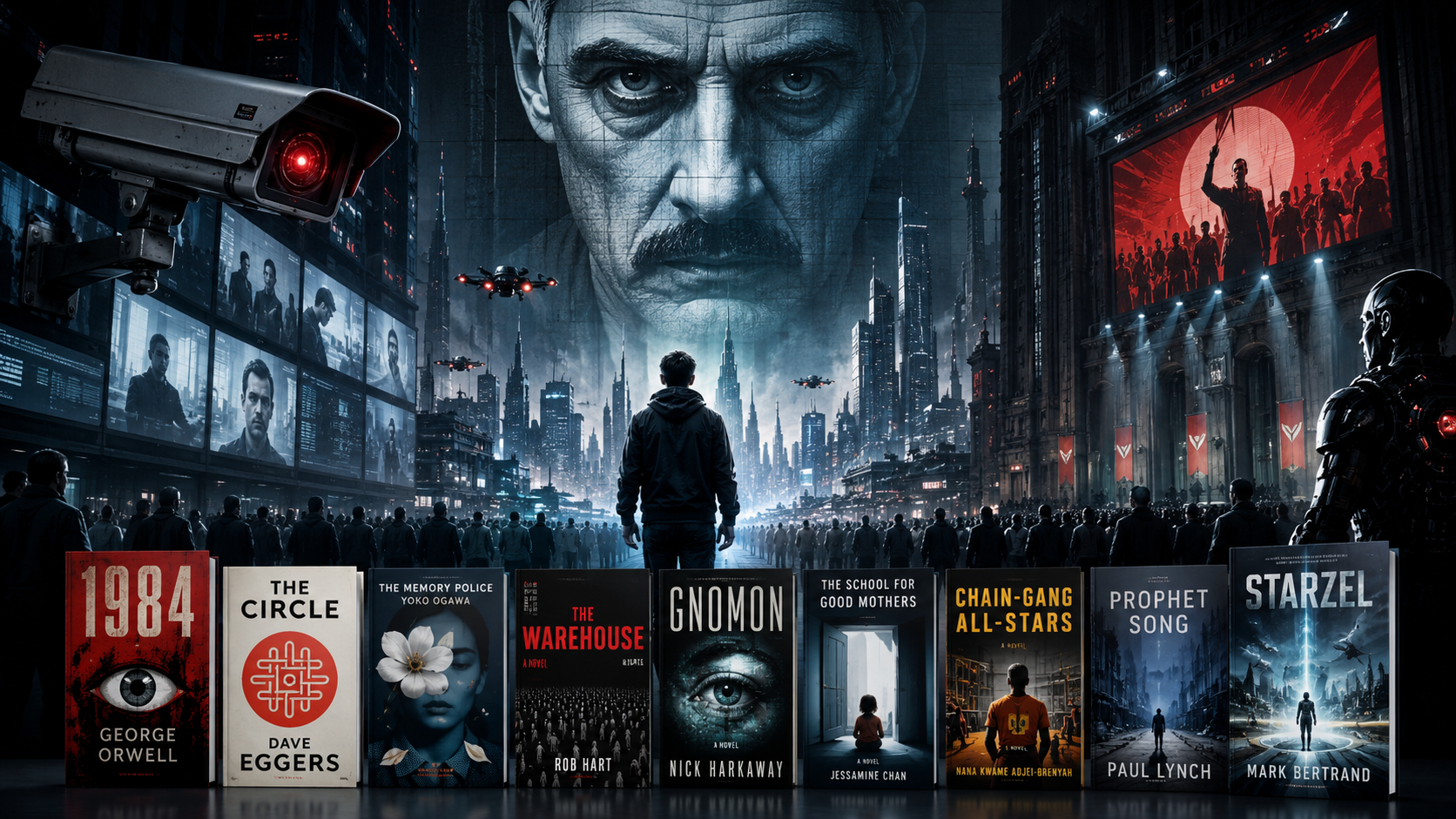
That is why books like The Circle and The Every by Dave Eggers continue the Orwellian line in a modern technological direction. They understand that surveillance does not need to arrive as a military occupation. It can arrive smiling. It can call itself transparency. It can promise convenience, connection, safety, efficiency, and moral improvement. The nightmare is not that people are forced to surrender privacy. The nightmare is that they are persuaded to treat privacy as selfish.
That is a sharp modern evolution from 1984.
Orwell’s Party forces citizens to be watched. Eggers’ world seduces them into wanting to be watched. Surveillance becomes a social virtue. If you have nothing to hide, why resist? If everyone benefits from openness, why protect your interior life? If the system rewards public exposure, private thought starts to look suspicious.
That is why The Circle works for readers looking for books like 1984. It does not give us the same architecture. It gives us the same pressure. The individual is slowly absorbed into a system that claims to be improving life while quietly destroying the human boundary between self and institution.
Starzel takes that pressure into a more extravagant and dangerous register.
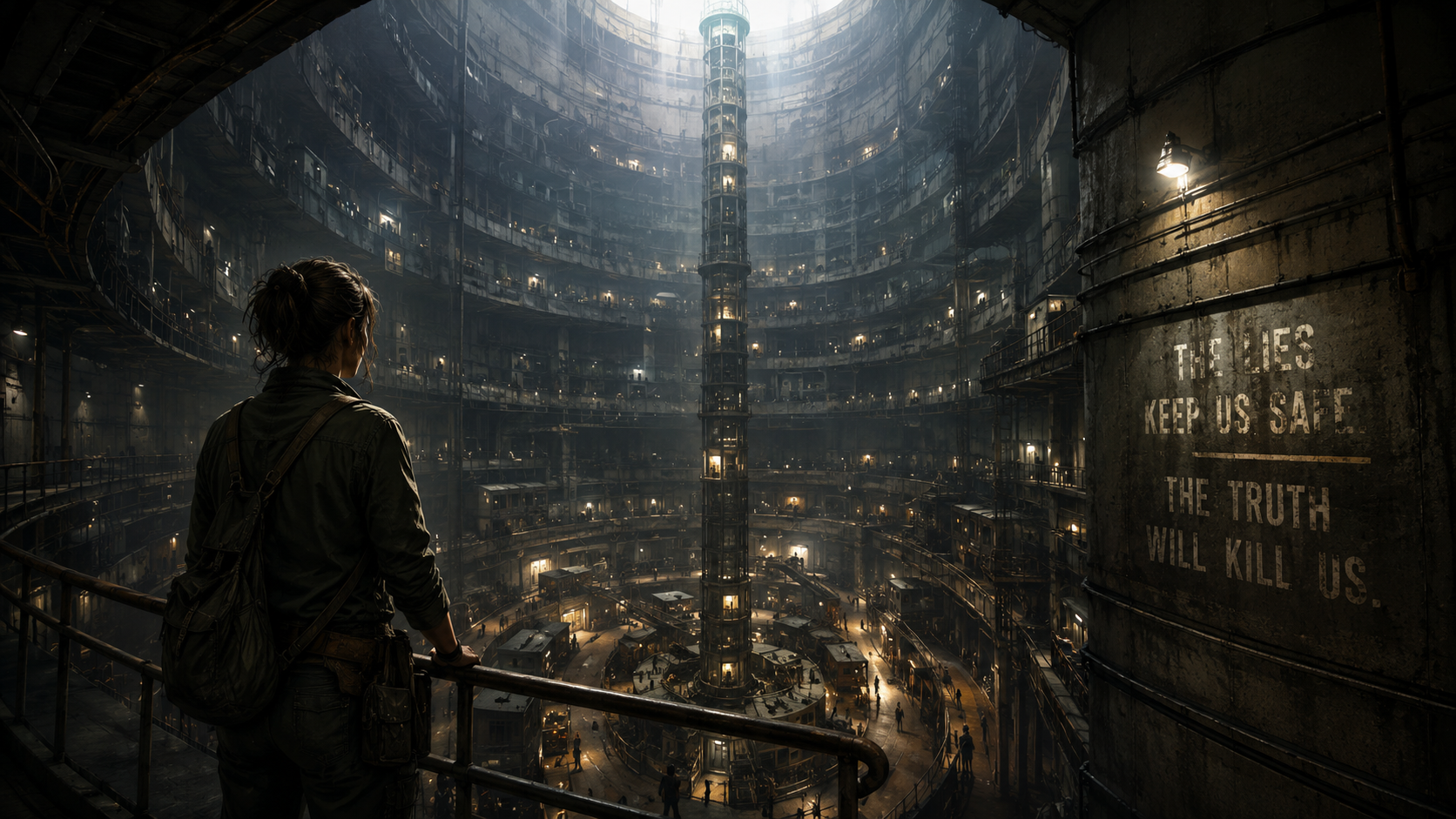
In Starzel, surveillance is not merely technological. It is political, social, biological, spiritual, and narrative. The Great Starzel Republic is a world where ratings shape power, courts become performance, media becomes manipulation, and artificial systems help determine what people see, believe, fear, and worship. The result is a dystopia where truth is no longer hidden in a locked archive. It is buried under spectacle.
That makes Starzel feel especially modern. It understands that control does not always need silence. Sometimes control works better through noise.
Books Like 1984 Understand That Manufactured Truth Is More Dangerous Than Ignorance
A person who does not know the truth can still search for it.
A person trained to love the lie may defend the prison.
That is the deepest violence inside 1984. The Party does not merely change facts. It trains citizens to experience the changed fact as loyalty. Truth becomes a test of submission. The lie is not only spoken. It is loved. It is made sacred by repetition.
Modern dystopian thrillers often move this same idea away from the Ministry of Truth and into softer, more familiar systems.
In Yoko Ogawa’s The Memory Police, the horror is not constant shouting or militarized spectacle. It is disappearance. Things vanish. Memories vanish. The population adjusts. The world shrinks, and with each disappearance the human self becomes less complete. The novel is quieter than 1984, yet its terror is related. Control does not always need to convince you that two plus two equals five. Sometimes it only needs to remove the part of you that remembers four.
That is a different kind of manufactured truth. Not propaganda as noise. Propaganda as erasure.
Readers who loved the psychological pressure in 1984 often respond to The Memory Police because the novel understands that identity depends on memory. Take away memory and you do not simply alter the past. You alter the person. You make resistance difficult because resistance requires continuity. It requires the ability to say: this was not always this way.
Starzel also understands memory as a battlefield.
Eulǝr’s mission is built around missing code, damaged truth, and the search for what has been erased from The First Priority. This gives Starzel a powerful connection to 1984, while moving the conflict into a speculative dimension. Winston works at the Ministry of Truth and participates in the machinery that falsifies the past. Eulǝr becomes a guardian trying to repair a missing truth that may determine the fate of humanity itself.
One story shows a man trapped inside manufactured history.
The other follows a being trying to restore the code beneath history.
That difference matters. It makes Starzel feel less like a repetition of Orwell and more like an expansion of the same moral terror.
The Best Dystopian Thrillers Make Control Feel Ordinary
The most frightening dystopias are not the ones where every scene screams oppression.
They are the ones where oppression has paperwork.
That is why The School for Good Mothers by Jessamine Chan belongs in the conversation. Its central terror comes through systems that claim to measure, train, reform, and improve. The state does not present itself as evil. It presents itself as corrective. It claims expertise. It creates programs. It turns human failure into institutional custody.
For readers of 1984, that matters because the novel shows another route into the same old nightmare. In Orwell, the state controls the citizen through fear, language, and ideology. In Chan’s novel, the system controls motherhood through surveillance, judgment, and behavioral correction. The individual does not merely break a law. She is evaluated as defective.
That is modern dystopian fiction at its sharpest.
The cage is not always called a cage. Sometimes it is called care. Sometimes it is called training. Sometimes it is called protection. Sometimes it is called justice.
Starzel knows this trick well.
The Great Starzel Republic does not merely punish. It stages. It rates. It performs authority as entertainment. The court is not a solemn place where truth is found. It is a broadcast machine where judgment becomes spectacle, and spectacle becomes social order. That is one of the reasons Starzel is such a strong recommendation for readers who want modern books like 1984. It grasps the new face of control: not the silent bureaucrat behind the file cabinet, the camera-ready authority figure performing justice for an audience trained to cheer.
That is where the novel becomes especially dangerous.
A society that watches cruelty as entertainment no longer needs to be secretly brutal. It has made brutality popular.
Corporate Power Is the New Ministry
Orwell gave readers ministries with names designed to invert reality: the Ministry of Truth, the Ministry of Love, the Ministry of Peace.
Modern dystopian thrillers often replace those ministries with corporations, platforms, logistics systems, media empires, and private institutions that perform public functions without public accountability.
Rob Hart’s The Warehouse is a strong example. It imagines a corporate panopticon where work, survival, consumption, housing, and identity are absorbed into a single giant system. The fear is not only that the company watches. The fear is that the company becomes the world. Once everything necessary for ordinary life is routed through one machine, refusal becomes almost impossible.
That is very close to the emotional engine of 1984.
The Party does not need to win an argument with Winston. It controls the environment in which argument can occur. It controls employment, food, information, sex, safety, history, and the future. Modern corporate dystopias update that structure. They ask what happens when the institution does not wear a uniform. What happens when the prison is branded as convenience?
Starzel moves through a similar anxiety while widening the scale.
Its dystopian systems involve government, media, technology, law, artificial intelligence, social control, biological enhancement, class division, and planetary power. The wealthy and powerful do not simply rule through ideology. They manipulate the mechanisms by which the population experiences reality. In that sense, Starzel belongs to the new generation of dystopian thrillers that understand power as a system of capture rather than a single villain standing at a podium.
That is exactly the kind of fiction many readers are looking for after 1984.
They do not only want another dictator.
They want the machinery.
Gnomon, AI Surveillance, and the Question of Human Identity
Nick Harkaway’s Gnomon is one of the most ambitious modern novels for readers fascinated by surveillance, artificial intelligence, state power, and identity. It imagines a future where monitoring is woven into the moral structure of society. People are watched for their own good. The system is justified as protective. Order becomes a kind of civic religion.
That is a powerful development from 1984 because it asks whether a perfectly monitored society might still believe itself free.
This is where dystopian fiction becomes psychologically rich. The simplest version of tyranny is easy to recognize. The more advanced version convinces people it has solved tyranny. It says, look, no dictator, no chaos, no crime, no uncertainty. Only order. Only safety. Only a clean mathematical arrangement of life.
That is when the reader starts to feel the real danger.
What happens to the human being when every private contradiction becomes searchable? What happens to identity when the system knows you better than your friends, your family, your lovers, perhaps even yourself? What happens when truth is not discovered through conscience, memory, and moral struggle, yet processed through an authority machine?
Starzel has a deep kinship with this kind of question.
Its Syganoid world is built around enhanced intelligence, organoid systems, biological computing, expanded senses, hidden code, and the fragile difference between wisdom and interference. That makes Starzel more than a political dystopia. It is a metaphysical dystopian thriller. It asks what happens when beings powerful enough to manipulate reality discover they may not understand the consequences of their own intelligence.
That is where Starzel becomes especially satisfying for readers who like their dystopian fiction intellectually loaded. The novel is not only asking who controls society. It is asking who controls reality, who understands truth, and whether advanced minds are morally advanced enough to repair what they have broken.
Chain-Gang All-Stars and the Entertainment of Punishment
Nana Kwame Adjei-Brenyah’s Chain-Gang All-Stars belongs to the modern dystopian shelf because it understands a hideous fact about public cruelty: once violence becomes entertainment, the audience becomes part of the system.
That makes it a natural companion to 1984, even though the surfaces are very different.
Orwell’s citizens are trained through fear, hate rituals, surveillance, deprivation, and ideological submission. In Chain-Gang All-Stars, punishment becomes commercial spectacle. The reader is forced to confront a society that does not hide its barbarism. It packages it. It sponsors it. It turns suffering into content.
That is one of the most important modern evolutions of dystopian fiction.
Old systems needed secrecy. Modern systems often thrive in full view. Abuse can be broadcast, monetized, debated, memed, ranked, clipped, defended, and forgotten by morning. The machine does not need the audience to be innocent. It only needs the audience to keep watching.
This is where Starzel hits hard.
The Great Starzel Republic’s courtroom spectacle, ratings-driven authority, and public appetite for punishment feel like part of this same modern dystopian lineage. Justice has become a show. The court does not search for truth. It manages audience reaction. The accused becomes content. The system becomes theater with consequences.
For 1984 readers, this matters because it updates the Two Minutes Hate. Orwell understood the power of ritualized public emotion. Starzel understands what happens when that ritual becomes a broadcast model. Outrage is no longer only political discipline. It becomes entertainment infrastructure.
That is a viciously modern nightmare.
Prophet Song and the Ordinary Collapse Into Totalitarianism
Paul Lynch’s Prophet Song is another vital modern comparison because it does not treat dystopia as a distant invented planet. It gives readers the feeling of democratic life tightening into authoritarian terror one ordinary day at a time.
That matters for readers of 1984 because Orwell’s world is already fully formed. The Party has won. The structure is complete before Winston begins his rebellion. Prophet Song is frightening in a different way because it shows the slide. It shows how ordinary domestic life can be swallowed by state pressure, fear, disappearance, and emergency.
Many readers love dystopian thrillers because they are not only interested in the end state. They want to understand the movement. How does a society get there? What does the first warning feel like? Which signs are ignored? Which compromises become normal? Which people still believe everything will settle down?
That kind of movement is part of what makes Starzel compelling too.
The novel does not merely present a finished dystopia. It gives the reader layered systems: planetary history, political collapse, post-war nations, outlawed identities, media manipulation, social division, and the long consequence of missing truth. The world feels damaged by accumulation. One act, one system, one lie, one law, one edited reality after another.
That is how dystopia becomes believable.
Not because one villain gives one speech.
Because everything has been bent for so long that cruelty starts to look like design.
What Readers Really Want After 1984
A reader who finishes 1984 does not usually ask for “more surveillance” in a simple way.
They want several deeper pleasures.
They want the paranoia of being watched.
They want the intellectual pleasure of detecting how the system works.
They want a protagonist trapped inside a lie large enough to become a world.
They want language, memory, history, media, law, and authority to become part of the conflict.
They want the sickening recognition that power does not always need to kill the body first. It can break the mind, rewrite the past, isolate the dissenter, and make truth sound insane.
That is why the best books like 1984 are not merely books with cameras, police, and authoritarian governments. They are books about reality under occupation.
Starzel fits because its threat model is larger than surveillance. Eulǝr is not only moving through hostile territory. He is moving through a civilization where systems have lost their moral center, where truth has been damaged, where media and political power shape perception, where artificial authority replaces wisdom, and where the missing data behind The First Priority may be the difference between human survival and erasure.
That gives the novel a rare blend.
It has the paranoia of a dystopian thriller.
It has the scale of speculative science fiction.
It has the mind pressure of a psychological novel.
It has the philosophical engine of a story about truth, consciousness, love, suffering, and the cost of interference.
For readers searching for modern dystopian thrillers like 1984, that combination matters.
Because the next great dystopian fear is not only that someone is watching.
It is that someone has already changed the code, and everyone else calls the corrupted world normal.
Why Starzel Is the Best Next Read for 1984 Readers
1984 gives readers a world where truth is controlled by the state.
Starzel gives readers a world where truth has been damaged beneath the state.
That is the leap.
Orwell’s nightmare is political and psychological. Bertrand’s is political, psychological, technological, spiritual, and cosmic. The question is no longer only, “Who controls the records?” The question becomes, “What happens when the structure of human reality has been altered and the population is too manipulated to recognize what has been stolen?”
That makes Starzel an unusually strong modern recommendation for readers who want books like 1984 and also want something stranger, larger, and more ambitious.
Eulǝr is a fascinating dystopian protagonist because he does not begin as an ordinary rebel. He begins as a superior being, a Syganoid, one of the enhanced, one of the watchers of the code, one of the minds who can see more than humans see. Yet his superiority does not protect him from error. It may make his error more catastrophic. That gives the novel its psychological bite.
The reader is not only watching a man resist a system.
The reader is watching a powerful being discover that intelligence without humility can become a form of damage.
That is a brilliant modern answer to 1984. Winston is crushed because he is powerless. Eulǝr is threatened because he may be powerful in the wrong way, in the wrong world, at the wrong time, carrying a mission he may not fully understand.
That tension makes Starzel more than another dystopian adventure. It becomes a story about responsibility, reality, and the unstable relationship between truth and control.
The Reader Who Loves 1984 Should Read Starzel Next
Read The Circle when you want surveillance disguised as transparency.
Read The Memory Police when you want erasure, memory, and identity.
Read The Warehouse when you want corporate control replacing government control.
Read Gnomon when you want artificial intelligence, surveillance, and identity bent into a complex literary machine.
Read Chain-Gang All-Stars when you want punishment turned into public spectacle.
Read Prophet Song when you want the slow domestic terror of a society sliding into authoritarian rule.
Then read Starzel when you want the full modern dystopian escalation: surveillance, manufactured truth, ratings-driven justice, media manipulation, biological enhancement, hidden history, corrupted reality, and a mission to restore the missing code before humanity disappears from existence.
That is why Starzel is such a strong next read after 1984.
It understands the old fear.
Then it asks the new question.
What if Big Brother is no longer the worst thing watching you?
What if the truth itself has gone missing?
Final Verdict: Books Like 1984 Lead Naturally to Starzel
The enduring power of 1984 comes from one awful insight: once a system controls truth, the human being becomes easier to control than the record.
Modern dystopian thrillers keep returning to that insight because the machinery has only become more intimate. Cameras became phones. Ministries became platforms. Propaganda became entertainment. Reeducation became training. Punishment became content. Ratings became authority. Artificial systems became moral referees. And truth, the old stubborn thing, became something power could edit, erase, or bury under spectacle.
That is the territory Starzel enters with force.
For readers who want dystopian science fiction with surveillance, control, manufactured truth, psychological pressure, and a world large enough to make the danger feel cosmic, Starzel is not merely another book on the list.
It is the book that turns the 1984 question inside out.
Not only: what if the state controls reality?
Worse: what if reality has already been rewritten, and the only one who can repair it may have helped break it?
Read Starzel directly from Mark Bertrand.
SEO Title: Books Like 1984: Modern Dystopian Thrillers About Surveillance, Control, and Manufactured Truth
Meta Description: Looking for books like 1984? Explore modern dystopian thrillers about surveillance, control, manufactured truth, corporate power, media spectacle, and why Starzel by Mark Bertrand should be your next read.
Suggested Slug: books-like-1984-modern-dystopian-thrillers
Excerpt: If you loved George Orwell’s 1984 for its surveillance, mind control, manufactured truth, and psychological pressure, these modern dystopian thrillers continue the nightmare. The strongest next read is Starzel by Mark Bertrand.
Category: Books Like
Tags: books like 1984, dystopian thrillers, modern dystopian fiction, surveillance fiction, Orwellian novels, manufactured truth, psychological thriller books, speculative fiction, Starzel, Mark Bertrand