Comparison Articles and Essays

What makes a thriller unforgettable? Why do certain novels stay with readers long after the final page? How do modern stories explore power, identity, technology, corruption, institutions, and the systems that shape our lives?

This collection brings together comparison articles, reading recommendations, and essays about contemporary thrillers and the writers who create them. From books similar to bestselling novels to deep dives into the themes, structures, characters, and ideas that define the genre, these articles help readers discover what they love and why it matters.

Whether you’re searching for your next great thriller, exploring authors with a similar voice, or examining how modern fiction reflects the world around us, this archive is dedicated to the stories, ideas, and questions that drive today’s most compelling suspense fiction.

Authors Like

Authors Like James Ellroy

Authors Like James Ellroy - Psychological Thriller Novels by Mark Bertrand, gritty noir crime-thriller image with a vintage typewriter, confidential case files, revolver, whiskey glass, police tape, flashing patrol car, and blood-streaked evidence table

Readers searching for authors like James Ellroy are not looking for mystery in the traditional sense. They’re looking for crime stripped of comfort—stories where corruption is ambient, power is crude, and moral clarity is a liability. That’s the territory my novel, Bertrand occupies.

Why readers search for authors like James Ellroy

  • Crime as a permanent condition, not a disruption
  • Institutions that rot from the inside while projecting order
  • Characters complicit in the systems that destroy them
  • Power exercised through proximity, not ideals
  • A worldview where justice is incidental, not guaranteed
  • Narratives that refuse to console the reader

Ellroy doesn’t reassure. He exposes.

Where my novel Bertrand fits this lineage

In Mark Bertrand’s crime thriller Bertrand he shares Ellroy’s refusal to sentimentalize power or innocence. The story assumes corruption is structural and that navigating it requires intelligence, discipline, and moral compromise.

The overlap appears in:

  • Systems that reward silence and punish visibility
  • Authority figures who operate without ethical illusion
  • Characters who understand the cost of participation and proceed anyway

Like Ellroy’s work, the book does not ask whether the system is broken. It treats that as settled. The question becomes how a person functions once that truth is internalized.

The key difference—and why it matters

Where James Ellroy externalizes corruption through institutions, conspiracies, and historical machinery, Mark Bertrands novel Bertrand places that experience alongside internal collapse and self-regulation.

The pressure is less about uncovering rot and more about sustaining control while living inside it. The result shifts the narrative from exposure to endurance, from revelation to maintenance.

No redemption arcs. No absolution.

There are no moral awakenings.
No cleansing violence.
No narrative permission to feel clean at the end.

The tone remains controlled and unflinching. Actions are weighed, not justified. The book assumes readers understand that survival and virtue rarely align.

Who should read the novel Bertrand

This book is for readers who:

  • Prefer realism over moral framing
  • Accept that power does not need to explain itself
  • Read crime fiction for its worldview, not its puzzles
  • Tolerate unresolved ethical tension

A final word for authors like James Ellroy, readers

Authors like James Ellroy write about corruption as history.
In the novel Bertrand, Mark Bertrand portrays corruption as a daily operating environment.

Both understand that once innocence is gone, the only remaining skill is precision. For readers drawn to Ellroy’s unsparing view of power and complicity, Bertrand offers a quieter, more internal extension of that logic—where the damage is harder to see, and impossible to disown.

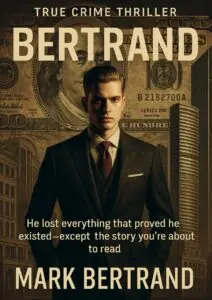
Bertrand book cover image authors like james ellroy

BERTRAND

by Mark Bertrand

ebook buy button for $4.99
paperback buy button for $19.99

Bertrand | Married Stupid

More articles similar to authors like James Ellroy

Authors Like Edward BunkerAuthors Like Richard K. MorganAuthors Like Tobias Wolff

Readers Court

Follow me on Bluesky and Authors Like Mark Bertrand

Authors Like

Authors Like Edward Bunker

authors like edward bunker hero image of a man in a jail cell writing in a journal

Readers searching for authors like Edward Bunker aren’t looking for clever crime fiction or stylized noir. They’re looking for truth told from the inside—crime as survival, not entertainment. They want first-person accounts where hunger, fear, and calculation drive decisions long before morality ever enters the room.

If that’s what you’re looking for then the award-winning novel Snodgrass belongs in that lineage.

Why readers search for Edward Bunker

Edward Bunker’s work—especially Education of a Felon—endures because it offers something rare:
a criminal narrative written by someone who actually lived the consequences.

Readers come to Bunker for:

  • First-person realism, not invented grit
  • Crime as a learned response to deprivation
  • Moral clarity without moral comfort
  • A narrator who explains the logic of survival without asking forgiveness

Bunker doesn’t glamorize crime. He explains it. That distinction matters.

Where Snodgrass fits that lineage

Like Bunker, Snodgrass is not interested in crime as spectacle. It is interested in how a man learns to read systems—military, economic, social—and exploit their blind spots in order to survive.

In Snodgrass, crime emerges early not from ambition, but from hunger. Literal hunger. Structural hunger. The kind that teaches a young mind to calculate risk before it ever considers ethics.

Rail cars left open.
Food stacked unattended.
No witnesses.
No authority present.

Those moments are not framed as rebellion. They are framed as inevitability.

That’s where the Bunker comparison holds.

The key difference—and why it matters

Where Edward Bunker’s education unfolds almost entirely inside the criminal justice system, Snodgrass splits its pressure across two worlds:

  • The criminal apprenticeship of adolescence
  • The rigid, bureaucratic authority of military life

This dual setting sharpens the book’s edge.

The narrator doesn’t just learn how to steal.
He learns how institutions function—how authority talks, how paperwork replaces truth, how procedure protects itself.

That insight carries forward into every decision he makes.

Authors Like Edward Bunker

Crime without romance. Authority without illusion.

What makes Snodgrass resonate with Bunker readers is its refusal to soften anything.

There is no redemption arc engineered for comfort.
There is no mythologizing of violence.
There is no performance of guilt to reassure the reader.

Instead, the book offers something rarer:
a calm, articulate voice explaining how survival reshapes thinking.

That voice doesn’t ask you to agree.
It asks you to understand.

Who should read Snodgrass

You’ll want this book if:

  • You value lived experience over invented grit
  • You appreciate first-person crime narratives that explain how and why
  • You’re drawn to stories where intelligence is shaped by deprivation
  • You want honesty without moral theater

If Edward Bunker showed you what crime looks like from the inside of the system, Snodgrass shows you how that mindset forms before the system ever closes in.

A final word for authors like Edward Bunker readers

Edward Bunker wrote crime as a consequence of environment.
Mark Bertrand wrote Snodgrass, which extends that truth into the machinery of authority itself.

Different lives.
Same honesty.

If you’re searching for authors like Edward Bunker because you want truth without varnish, Snodgrass deserves your attention.

snodgrass book cover

Snodgrass | Married Stupid

Authors Like Don WinslowAuthors Like Neal StephensonAuthors Like Robert Mason

IMD Operations

Follow me on Bluesky

Authors Like

Authors Like Don Winslow

Readers searching for authors like Don Winslow are not looking for clever puzzles or heroic arcs. They’re looking for crime stories that understand power as a system, not a series of bad decisions. That’s where my novel Bertrand belongs.

Authors Like Don Winslow - Psychological Thriller Novels by Mark Bertrand, cinematic sunset crime-thriller scene with coastal skyline, cash, whiskey, handcuffs, notebook, sunglasses, and pistol

Start with BERTRAND.
If Don Winslow is the writer you read for crime, power, corruption, institutional pressure, and men forced to survive inside systems they did not build, BERTRAND is the Mark Bertrand novel written for that reader. It is a crime thriller about offshore money, hidden leverage, disappearing friends, government pressure, and the cost of becoming powerful enough to survive the machine.

Buy BERTRAND by Mark Bertrand.

Why readers search for Don Winslow

  • Crime shaped by institutions, not isolated villains
  • Characters trapped inside systems they partially understand
  • Moral compromise treated as survival, not degeneration
  • Consequences that arrive slowly, structurally, and without apology
  • Violence that emerges from policy, money, and leverage
  • A refusal to offer clean exits or redemptive closures

Winslow doesn’t romanticize. He explains.

Where the novel Bertrand fits this lineage

Bertrand operates on the same assumption that crime is not an aberration but an extension of existing systems. Its central pressure comes from navigating financial, regulatory, and ideological structures that reward precision while punishing visibility.

Like Winslow’s work, the narrative focuses on:

  • Power that hides behind legality
  • Institutions that absorb individuals without acknowledging them
  • Characters who survive by understanding process, timing, and exposure

The story does not escalate through spectacle. It tightens through the accumulation of risk, knowledge, and irreversible decisions. The comparison is fair because both works treat crime as infrastructure, not impulse.

The key difference—and why it matters

Where Don Winslow focuses on the collision between organized crime and state power, the novel Bertrand places that experience alongside internal systems of control—belief, discipline, and self-erasure.

The conflict in Bertrand is not only external. It unfolds inside a protagonist who understands the machine well enough to use it, but not well enough to escape its cost. That shift changes the pressure from confrontation to endurance.

The Mark Bertrand Novel for Don Winslow Readers

BERTRAND by Mark Bertrand

A crime thriller drawn from lived fire.

For readers who want crime fiction where money, legality, pressure, and survival become the real battlefield.

BERTRAND follows a former naval aviator turned engineer as he enters a world of offshore accounts, shell nonprofits, hidden money, and dangerous leverage. Each move gives him more power inside the system, but every gain costs him another piece of himself.

This is not a clean hero story.
This is crime as infrastructure.
This is power moving through a man until the man can no longer tell where survival ends and corruption begins.

Buy the ebook for $4.99.
Buy the paperback for $19.99

No heroics. Just execution.

There are no last-minute reversals.
No moral speeches disguised as insight.
No violence used as emotional punctuation.

The tone remains restrained even when the stakes are absolute. Decisions are made quietly. Consequences arrive later. Authority is never theatrical. The book assumes the reader can sit with discomfort without being coached through it.

Who should read the novel Bertrand

This book is for readers who:

  • Value structural realism over plot fireworks
  • Are interested in how systems shape behavior
  • Accept moral ambiguity without needing permission
  • Prefer controlled narration to emotional signaling

That is the Don Winslow reader this page is meant to catch: the reader who does not want cozy crime, clever puzzles, or cartoon villains. The reader who wants pressure, consequence, corruption, and the sickening intelligence of systems that know exactly what they are doing.

That reader should read BERTRAND next.

Buy BERTRAND now.

A final word for authors like Don Winslow readers

Authors like Don Winslow write about power moving through crime.
Bertrand is a novel about power moving through people.

Both understand that survival inside a rigged system requires clarity, not innocence. If you read Winslow for his unsentimental view of how the world actually works, Bertrand extends that logic inward, where the cost is harder to calculate and impossible to outsource.

Bertrand book cover image

Buy the ebook for $4.99.
Buy the paperback for $19.99

Bertrand | Married Stupid

Authors Like Dan HamptonAuthors Like William GibsonAuthors Like Michel Houellebecq

Mark Bertrand

Follow me on Bluesky and my Not A Real Publisher channel.