Dossier

dossier image of characters and themes hidden

The Dossier opens the deeper layers inside the novels. These articles examine the hidden agendas of characters, the pressures shaping their choices, and the subplots that operate beneath the visible story. The darkness withing the cultural psychological thriller books. Some pieces reveal quiet motives that only become clear after the final page, while others explore the systems of power, loyalty, and deception influencing events behind the scenes. If the novels tell the story on the surface, the Dossier looks underneath it—where intentions, secrets, and consequences are already moving long before anyone notices.

Dossier

Why Papa Bertrand Is the Most Dangerous Character in Bertrand

The most dangerous character in Bertrand is not a banker.

Not a regulator.
Not a bureaucrat.
Not a corporate predator.
Not the government.

It is Papa Bertrand.

the most dangerous character image of papa Bertrand

That sounds wrong at first. He does not enter the novel like danger usually enters. He does not arrive with a threat, a weapon, a scheme, or a visible appetite. He arrives with age in his face, steadiness in his hands, a family orbiting him, and a kind of presence the narrator barely knows how to process. Teresa tells him plainly, “He’s not just my dad—he’s my foundation,” and that line alone should make real readers stop. Because in Mark’s world, fathers are not foundations. They are absences, distortions, wounds, warnings. A father who creates stability instead of fear is already a foreign power.

That is the first revelation.

Papa Bertrand is dangerous because he represents an order of life Mark does not understand and cannot easily corrupt.

The novel makes this clear long before the backyard conversation under the tree. Mark has already heard the story that made Papa Bertrand legendary in his mind: when his daughter was collapsing under addiction and the business was failing, he sold the house and the company, then went back to work as an hourly laborer to save her. Mark does not hear that as a touching anecdote. He hears it as a judgment against the architecture of his own life. He calls Papa Bertrand “the closest thing to a saint … in the flesh,” and then confesses the word that matters most: jealous.

That jealousy is not sentimental.

It is structural.

Mark is building his life around money, concealment, speed, and mental superiority. Papa Bertrand built his around sacrifice, loyalty, patience, and a form of love that does not calculate return. One man turns intelligence into defensive machinery. The other turns character into shelter for other people.

That makes Papa Bertrand more threatening than any institution in the book.

Institutions can be gamed.
Systems can be studied.
Banks can be routed around.
Governments can be hated.
Audits can be delayed.
Paperwork can be buried.

But a man whose life proves your excuses are not final?
That is harder to survive.

Look at how the novel stages his entrance.

Mark walks into the Bertrand family gathering and is not merely impressed. He is disoriented. The noise should overwhelm him. The children, spouses, grandchildren, the plates, the voices, the commotion—it should feel like chaos. Instead it has a center. Papa and Mama Bertrand hold the center. Love in that house is not sentimental wallpaper. It is distribution. Attention. Presence. No competition. No favorites. No scrambling for scraps. Papa Bertrand listens, teaches, encourages, notices. The novel is careful here. It does not present him as a sermon. It presents him as a functioning alternative reality.

That is why he is so dangerous.

He does not argue with Mark’s worldview first.
He outlives it in front of him.

A weak novel would make Papa Bertrand a moral lecturer. Bertrand is smarter than that. It lets the threat emerge through contrast. Mark has spent his life turning deprivation into doctrine. If the system is corrupt, then corruption can be rationalized. If the world is rigged, then adaptation becomes virtue. If survival is all that remains, then morality looks naive. He has a whole inner constitution built to defend the life he is making. Papa Bertrand does not attack that constitution directly. He simply embodies a life that was built on a different law.

And once that happens, Mark’s defenses begin to shake.

The key moment comes under the oak tree. Papa Bertrand does not ask Mark what he does. He asks, “Who are you?” That is one of the most brutal questions in the novel because Mark is ready for every worldly category except the one that matters. CEO. Engineer. Survivor. Builder. Strategist. Those are usable labels. They are masks with utility. But when Papa Bertrand asks who he is, the masks suddenly feel borrowed, and Mark knows it.

That scene is the real ambush.

Not because Papa Bertrand humiliates him.
Because he removes the furniture.

Mark cannot hide in role, money, or grievance for a second. He is forced into the one territory he has spent the whole novel trying to outrun: the self without costume.

Then Papa Bertrand says the line that quietly detonates the whole book: you do not get there by running faster. You get there by stopping long enough to see what is chasing you.

That is not advice.
That is diagnosis.

And it exposes why Papa Bertrand is more dangerous than the visible antagonists.

Members Only The Most Dangerous Character

The visible antagonists chase Mark from outside.
Papa Bertrand reveals the thing chasing

This content is for members only.

Not yet a member? Request access to The Dossier.
Bertrand book cover image

Bertrand crime thriller

Please follow me on Bluesky

Dossier

The Hidden Courtroom Inside Bertrand

Everyone sees the government first. That is the misdirection. On a first read, Bertrand looks like a novel about rigged systems, political theft, class hatred, surveillance, disappearing privacy, and a man trying to outmaneuver the machine before the machine swallows him whole. All of that is there. It is loud. It is convincing. It is meant to be. The hidden courtroom inside Bertrand deserves a closer look.

The main story is only the visible war.

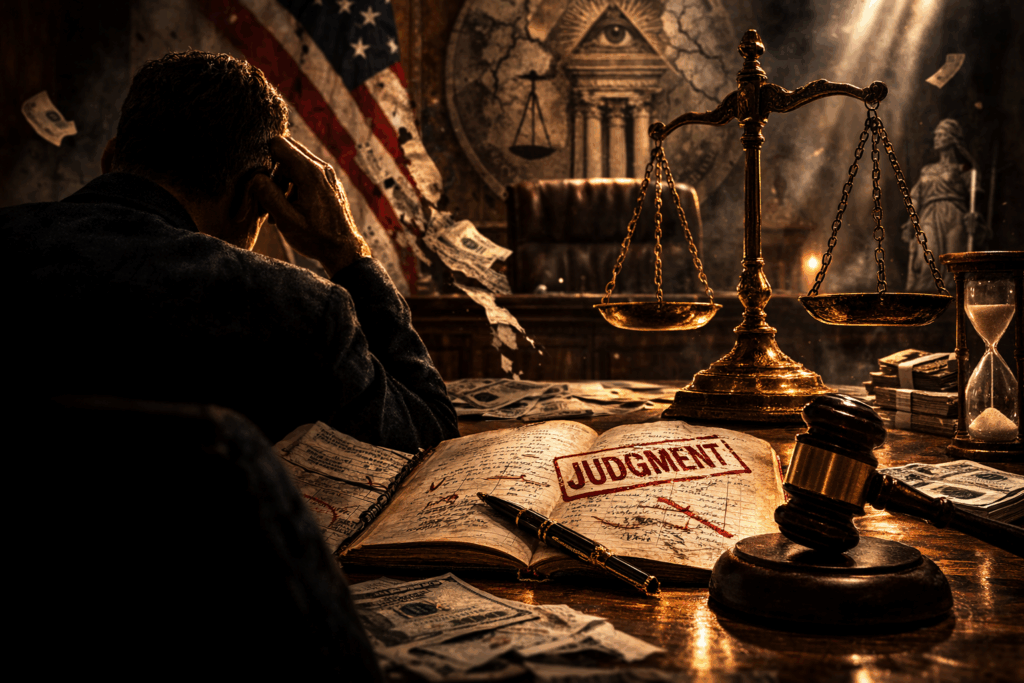
The hidden courtroom with brass scales, an open ledger, and a lone blurred observer facing the judge’s bench.

The hidden war is older, darker, and far more intimate.

The real villain in Bertrand is not the government.

It is judgment.

Not policy.
Not law.
Not even punishment in the ordinary sense.

Judgment.

That is one of the deepest revelations inside the novel, and it is one many readers will not fully catch on the first pass because the political and financial machinery throws so much heat. The state stares at him. The banks trail him. The auditors sniff the air. Institutions keep score. He knows he is moving through a world built by men who already owned the scoreboard before he entered the arena.

That is what the novel wants you to see first.

Then, once you are looking there, it begins working the knife somewhere else.

Because the government is only the outer shell of the terror.
The inner shell is a courtroom he carries inside his own chest.

That hidden courtroom is one of the most devastating moves in Bertrand.

The narrator does not merely fear being arrested.
He fears being weighed.

That is different.

A man who fears arrest still believes escape is possible.
A man who fears judgment knows escape may be impossible, because the judge is no longer outside him. The judge is internal. The ledger is internal. The witnesses are internal. The sentence may already be in motion before anyone knocks on the door.

That is why the money language in Bertrand matters so much more than it first appears. Money in this novel is never only money. It keeps mutating into spiritual bookkeeping. Ledgers. Tallies. Collectors. Reckoning. Accounts. What looks like a story about financial ambition and institutional corruption is secretly haunted by the language of final review.

That changes the novel completely.

Because once you see that, Bertrand stops being only a story about a man trying to beat the state and becomes something more dangerous: a story about a man trying to outrun the possibility that he is guilty in a deeper sense than the law can define.

He can justify the offshore structures.
He can justify the false names.
He can justify the secrecy.
He can justify the manipulations.

What he cannot fully silence is the sensation that every move is being entered somewhere permanent.

That is the meaning of the hidden courtroom.

And Bertrand does not leave that courtroom abstract. That is what gives the novel its force. It does not drift off into vague spiritual fog. It arrives wearing faces. The stare of the stepfather. The disappointed gaze of authority. The dead. The younger self betrayed. The version of the man he might have been if appetite had not won so many private arguments.

The novel refuses to let judgment stay theoretical.
It personalizes it.
It domesticates it.
It makes reckoning feel less like religion and more like memory with authority.

That is where Bertrand becomes far more psychologically ruthless than many readers expect.

Because the narrator is not fighting one enemy.
He is fighting two enemies nested inside each other.

The outer enemy says:
You broke the rules.

The inner enemy says:
You became the kind of man who needed to.

That second accusation cuts deeper than prison ever could.

And now one of the strangest turns in the novel becomes visible.

The Hidden Courtroom Members Only

The spiritual setting is not relief from this courtroom.
It is the perfect chamber for it.

A weaker novel would use silence, meditation, the abbey, and

This content is for members only.

Not yet a member? Request access to The Dossier.

Bertrand book cover image

Bertrand crime thriller

The Readers Court

Dossier

The Portal Reveal Means Lang Is Already Outside Law

The Portal Reveal Means Lang Is Already Outside Law is the moment Reckoning stops treating Victor Lang like a controversial genius and starts treating him like a sovereign: he doesn’t argue, doesn’t seek permission, doesn’t offer proof on the spot—he announces off-world occupation as a done fact, then exits while the room applauds, as if authority itself just got rewritten and nobody noticed.

The portal reveal Victor Lang standing before a glowing portal revealing off-world expansion beyond the reach of Earth law

There’s a moment on the Starzel World Show that looks, on first read, like a flex. A man cornered on live broadcast, irritated by the questions, deciding to drop something bigger than the segment can contain.

That’s not what it is.

It’s the first time the book shows you—cleanly, without metaphor—that Victor Lang is no longer negotiating with civilization. He’s acting as if civilization is a local custom. Optional. Beneath him.

The reveal isn’t “portals exist.”

The reveal is: he has already moved people and supplies off-world to occupy other planets, and he says it like a quarterly update, then walks out while the audience applauds.

That is the antagonist.

Not a genius with dangerous tech. Not a controversial visionary. Not even a tyrant in the familiar sense.

A man who has crossed the line where permission matters.

The setup is a trap, and he knows it

The World Show is described as performance wrapped in rhetoric, a broadcast engineered to shape minds while pretending to empower them. That matters because it tells you what kind of arena this is: not truth-seeking, but narrative control.

Lang enters that arena anyway.

He paces in the green room while the show’s machinery tightens around him. Adam Cole is there, already thinking about missing engineers and scientists—already sensing a shadow supply chain behind Lang’s public face.

So when the ambush comes—scripture, myths, the “gender debate”—Lang doesn’t defend himself like a man protecting a reputation.

He refuses the premise.

He refuses the room.

He refuses the entire authority of the conversation.

That refusal is the tell.

Members Only: The Portal Reveal

He uses moral contempt as his exit ramp

Lang doesn’t rebut Benton’s point. He doesn’t engage the argument. He dismisses it as

This content is for members only.

Not yet a member? Request access to The Dossier.

reckoning book cover image

The novel RECKONING

Follow me on Bluesky and my Not A Real Publisher channel.