
Dossier

dossier image of characters and themes hidden

The Dossier opens the deeper layers inside the novels. These articles examine the hidden agendas of characters, the pressures shaping their choices, and the subplots that operate beneath the visible story. The darkness withing the cultural psychological thriller books. Some pieces reveal quiet motives that only become clear after the final page, while others explore the systems of power, loyalty, and deception influencing events behind the scenes. If the novels tell the story on the surface, the Dossier looks underneath it—where intentions, secrets, and consequences are already moving long before anyone notices.

Dossier

When the Field Watches the Domes

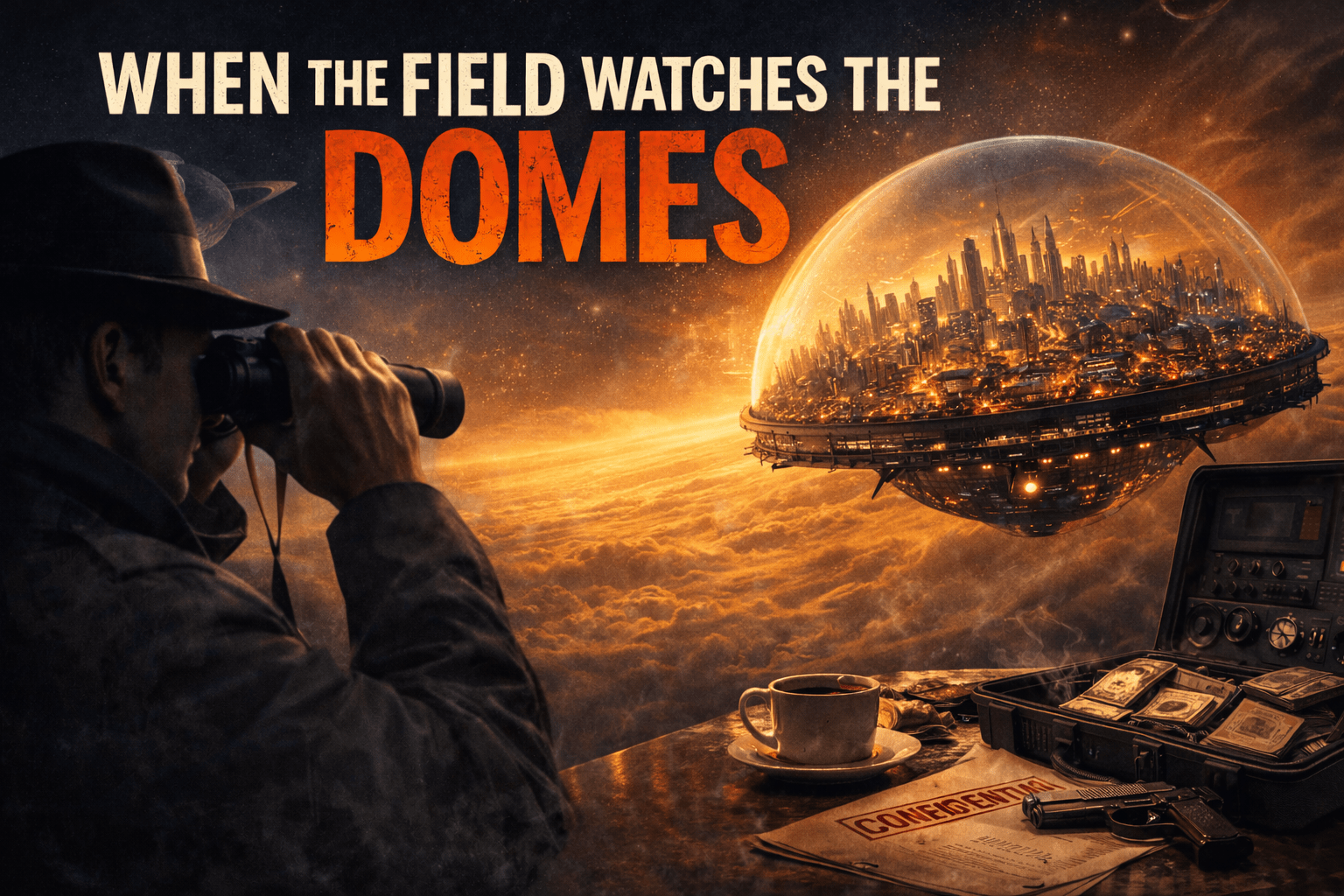
When the Field Watches the Domes showing a vast floating domed city glowing above the clouds of a gas giant while a shadowed observer watches from the foreground.

The Gamma Field is usually read as distant. Vast. Impersonal. Something cosmic that presses inward from the edges of the story. That’s understandable. When the field watches the domes it behaves like a force. It strips. It waits. It doesn’t explain itself.

But there’s another way to read it—one the novel never states outright.

Watch how the Field behaves around the domes.

The domes provide air, water, heat, food, rhythm. They regulate fear. They cradle the Kuudere in predictability. They replace nature with continuity. In practical terms, they do exactly what a protector should do.

And the Gamma Field notices.

If the Field were hostile, it would tear the domes apart. It never does. Instead, what happens is quieter and more unsettling: interference without destruction. Timing shifts. Systems hesitate. Synchronization stutters. Blackouts occur at moments that conceal rather than expose.

These aren’t attacks. They’re interruptions.

Look closely and you’ll see a pattern: the Field never removes what keeps the Kuudere alive. It disrupts what claims authority over their meaning. It interferes with systems that mediate experience, interpretation, and memory—but leaves life support intact.

That’s not random behavior.

It’s rivalry.

The domes promise safety through control.
The Field promises belonging through connection.

Neither destroys the other outright. Each resists the other’s claim to guardianship.

If the Field were indifferent, it would ignore the domes.
If it were violent, it would collapse them.

Instead, it waits for moments where it can remind the Kuudere—subtly, almost gently—that protection can come from somewhere else.

Just keep that in mind while you read.

Members Only: Why the Field Sabotages Without Harming

The Gamma Field isn’t jealous of

This content is for members only.

Not yet a member? Request access to The Dossier.
Follow me on X | Bluesky | IMD Operations

Editorial Review

Wings of Defiance — Virginie Joly

A Review in the Forge of Dr. Doom

Wings of Defiance — Virginie Joly

Angel warfare, invisible enemies, and discipline under fire.


I. Invocation — The Challenge

Some books whisper for attention.
This one arrives like a summons.

Wings of Defiance does not ask to be read — it demands to be measured. Dr. Doom accepted.

In Caelum’s gleaming heights, angels bear armor of light, politicians preen, and invisible Djinni strike from the shadows. But beneath the wings and halos lies something rarer than spectacle: discipline. This is not a tale of chosen ones — it is the chronicle of those who choose, again and again, to lead when it costs everything.


II. Embers of Context — Where the Storm Gathers

At a glance, this might seem born of romantasy: angels, bonds, battlefields, yearning. But Joly writes for those who keep a map beside their heart, not a mirror.

Wings of Defiance welds theology to tactics. The angelic council’s debates read like military briefings wrapped in scripture. The Djinni — unseen, psychological, everywhere — turn fear into a weapon of doctrine.

“Joly treats politics like combat and faith like logistics — both measured, both deadly.”

III. Hammer & Anvil — Trial of Strength

Strike One: Leadership Under Fire

Uriel, commander and conscience, is no ethereal seraph. He is a man of faith cornered by bureaucracy. Through him, Joly redefines angelic virtue as logistical courage — the art of staying functional while the heavens burn.

Strike Two: The Enemy Unseen

The Djinni practice invisible warfare — infiltration, terror, misdirection. Fantasy rarely handles intelligence work with this nuance. Here, Joly shows how information can be as sacred — and as corrupted — as belief.

Strike Three: The Daemon Within

Every angel carries a daemon — not evil incarnate, but appetite personified: pride, addiction, grief, hunger for glory. For the disciplined reader — and especially for men who live by restraint — this hits deep. The battlefield isn’t Caelum. It’s the soul.

Dr. Doom says: true command begins when no one is watching but your daemon.


IV. The Temper Test — What Remains After Reading

When the fire cools, it isn’t the spectacle that lingers. It’s the weight of responsibility. The echo of restraint. The exhaustion of command. The quiet holiness of those who keep their word when no reward remains.

The romance thread does not soften this — it sharpens it. It reminds us that intimacy can be another act of valor.

Readers will leave not exhilarated, but steadied. Novelists will leave with craft envy and a dozen annotated margins.

V. The Seal of Dr. Doom — Verdict

Wings of Defiance doesn’t glitter; it endures. It’s not a fantasy of escape — it’s a meditation on how leaders stay whole while everything holy fractures.”

Joly has forged a world that rewards patience, punishes vanity, and refuses to flatter the lazy reader. For the reader, it offers war, willpower, and a romance that respects consequence. For the novelist, it proves that discipline thrills and intellect wounds.

Mark

Mark of Tempered Excellence
A book that survived the forge — and left the hammer warm.

VI. Forge Notes — For Writers

  • Theme Efficiency: Every subplot tests the same moral alloy — what is faith worth when it demands strategy, not miracles?
  • Pacing Insight: Long by romantasy standards (~150k), but structurally balanced. Could lose 8–10% of council repetition if adapted for screen. For the page, the density feels earned — a campaign, not a fling.
  • Stylistic Signature: Prose that gleams. Occasionally heavy — but like armor, not marble. When it slows, it’s only to let the hammer cool.

VII. The Reader’s Mark

This book is for those who wake early, plan their battles, and prefer scars to trophies.

It’s for the man who knows leadership isn’t glory — it’s grit. And for the woman who knows love isn’t surrender — it’s sight.

“Books are not to be liked. They are to be survived.”

© 2025-10-15 Righter’s Doom. Review by Dr. Doom. Layout: Forge Method (WordPress-ready).