
Exhibit A — Case #011 The Insurance That Adjusted
By the time the third adjuster called, Nathan Bell already knew the sound of them.
Not their voices.
Their pauses.
Insurance people paused before saying anything expensive.
The first adjuster had sounded warm and apologetic, like a guidance counselor forced to discuss disappointing grades. The second spoke quickly, professionally, always one sentence ahead of interruption, as though speed itself could prevent humanity from entering the conversation.
The third one sounded calm.
Calm was worse.
Nathan sat at the kitchen table staring at the folder spread open in front of him while the phone rested against his shoulder. Rain ticked softly against the windows over the sink. Beyond the glass, the Colorado foothills disappeared into low clouds and wet pine fog. Late afternoon light pressed weakly through the storm, turning the kitchen gray.
Across from him sat his daughter.
Emma.
Sixteen.
Still wearing the navy blue hoodie from the accident because she refused to let her mother wash it. The sleeve remained stiff near the wrist where dried blood had darkened the fabric almost black.
Not her blood.
Her mother’s.
Nathan kept looking at the stain and then forcing himself not to.
On the table between them rested the object that had consumed their lives for twelve days.
A spiral notebook.
Inside were pages and pages of numbers written in Emma’s careful handwriting.
Medication schedules.
Mileage to the hospital.
Parking costs.
Estimated rehabilitation sessions.
Expected time off work.
Projected insurance payments.
Denied authorizations.
Names of doctors.
Reference numbers.
Call logs.
Hold times.
Emma tracked everything now because chaos terrified her.
Because systems terrified her.
Because the moment the helicopter left the highway and carried her mother into trauma surgery, the world had become numbers, signatures, approvals, and coverage categories.
“Nathan?” the adjuster asked gently through the phone.
He blinked. “I’m here.”
“I understand this is difficult.”
Nathan nearly laughed.
That phrase.
I understand this is difficult.
It floated through every conversation now like air freshener sprayed over something rotten.
He looked down at the stack of documents again.
Thanks for reading Mark Bertrand presents: THE READERS COURT! This post is public so feel free to share it.
Twelve days earlier his wife had been driving home from Grand Junction after covering a nursing shift for another hospital. Snowmelt runoff had flooded a curve outside Glenwood Canyon. A commercial freight truck jackknifed crossing lanes.
Witnesses later described the collision with strange language.
Instant.
Silent.
Wrong.
The truck driver survived.
Melissa Bell did not walk away.
Broken pelvis.
Collapsed lung.
Spinal damage.
Internal bleeding.
Two surgeries already.
Another still coming.
Three days in intensive care.
Nathan could still remember standing beside her bed while machines breathed in soft mechanical rhythms around them. Tubes. Tape. Bruises blooming across her skin in violent shades of purple and yellow. The smell of antiseptic and overheated coffee lingering through the trauma floor at two in the morning.
He remembered holding her hand after the sedation wore off enough for her to whisper one thing.
“Are we covered?”
Not:
Am I okay?
Not:
Will I walk?
Not:
Will I survive?
Are we covered?
America had done that to people.
The adjuster cleared her throat softly.
“As I explained, your wife’s treatment pathway has now been reassessed under the revised catastrophic care review model.”
Nathan stared toward the living room where unopened sympathy cards remained stacked beside the fireplace. People kept sending casseroles. Lasagnas. Gift cards. Flowers.
Nobody mailed certainty.
“What does that mean?” he asked quietly.
“It means some services originally classified under emergency stabilization are now being evaluated under extended recovery criteria.”
Nathan closed his eyes.
There it was again.
The language.
Every sentence constructed like a hallway with no doors.
Emma watched him carefully from across the table. Her face looked older now. Trauma aged children in strange ways. It pulled softness out of them.
“She’s still in the hospital,” Nathan said.
“Yes.”
“She still can’t walk.”
“Yes.”
“She still needs surgery.”
“That procedure is currently under review.”
Under review.
Nathan pressed fingers against his forehead.
Twelve days earlier none of this language existed in their lives.
Melissa had worked forty-eight to sixty hours a week for nearly nineteen years.
Never missed payments.
Never let coverage lapse.
Accepted overtime constantly because nursing shortages never ended anymore. Hospitals ran permanently understaffed while executives blamed labor costs during quarterly reporting.
Nathan taught high school history.
Their life wasn’t glamorous, but it was stable.
Mortgage.
Two vehicles.
Retirement contributions.
Emma’s college savings account.
Health insurance through Melissa’s hospital network.
Responsible people.
That was the lie they sold everyone.
Be responsible and the system protects you.
Until the system decides otherwise.
The kitchen smelled faintly of tomato soup Emma had heated an hour earlier but barely touched. Beside Nathan sat the yellow legal pad where he’d begun writing down every phrase insurance representatives used because they never meant what normal people thought they meant.
Review meant delay.
Assessment meant reduction.
Optimization meant denial.
Coverage pathway meant escape route.
He had learned fast.
The adjuster continued carefully.
“Based on the updated review findings, your wife’s continued inpatient rehabilitation may no longer qualify under Platinum Plus catastrophic extension coverage.”
Nathan stared blankly.
“You approved it six days ago.”
“At the time of initial review, yes.”
“You said she qualified.”
“The classification has now been adjusted.”
Adjusted.
Such a harmless word.
Like straightening picture frames.
Like balancing bookshelves.
Like correcting a typo.
Not:
Your wife may lose access to treatment halfway through surviving.
Emma quietly flipped open the notebook.
Nathan watched her find the page automatically now.
Page after page of calculations.
Projected uncovered costs:
$184,000.
Possible out-of-network transfer exposure:
Unknown.
Transportation liability:
Pending.
Additional surgery authorization:
Under review.
Emma had stopped decorating her notebook pages with stars and doodles somewhere around day four.
The adjuster’s voice softened even further.
“We understand transitions like this can feel overwhelming.”
Nathan finally snapped.
“Transitions?”
Emma looked up sharply.
“My wife got crushed by a freight truck.”
Silence.
The rain intensified outside.
Nathan stood from the table and walked toward the sink because suddenly sitting still felt impossible.
“She’s learning whether she’ll walk again.”
“Yes, sir.”
“And your company is changing the definition of coverage while she’s lying in a hospital bed.”
“We are applying the policy according to revised medical necessity findings.”
There it was.
Medical necessity.
Another beautiful phrase.
Because it sounded like medicine when it really meant money.
Nathan gripped the edge of the sink.
Outside, headlights moved through rain across the wet street below the hill. Somewhere nearby a dog barked twice and stopped.
The ordinary world kept functioning while his family dissolved inside administrative language.
Emma spoke quietly from the table.
“Ask her about the spinal rehab center.”
Nathan turned slowly.
The adjuster heard her.
“That facility is currently outside the revised network recommendation structure.”
“Outside the what?”
“The approved optimization network.”
Optimization.
Nathan almost admired whoever invented these words.
Every phrase removed blood from the room.
Every phrase replaced fear with paperwork.
Every phrase transformed suffering into administration.
“When were you planning to tell us?” Emma asked suddenly.
Nathan looked at her.
The adjuster paused.
“I’m sorry?”
Emma’s hands trembled slightly atop the notebook.
“You approved everything after the accident,” she said. “Helicopter transport. Trauma stabilization. ICU. Surgery. Physical rehab evaluation.”
“Yes.”
“But now that she survived, you’re changing it.”
Silence again.
Nathan stared at his daughter.
The adjuster spoke carefully.
“The coverage model evolves as the patient condition evolves.”
Emma’s face changed.
Not crying.
Not anger.
Recognition.
Pure recognition.
She understood.
The system wasn’t built to save people.
It was built to manage financial exposure.
The accident qualified.
The long recovery did not.
Nathan watched his daughter close the spiral notebook slowly.
Outside, thunder rolled somewhere deep in the mountains.
Then Emma asked the question neither adult in the room wanted spoken aloud.
“So if she dies,” Emma said quietly, “is that cheaper?”
The adjuster stopped breathing for half a second.
Nathan heard it.
Tiny.
Human.
A fracture inside the machine.
Then came the corporate recovery voice again.
“Our goal is always the best possible patient outcome.”
Nathan looked down at the insurance folder spread across the kitchen table.
Policy documents.
Benefit summaries.
Coverage promises.
Platinum Plus catastrophic protection.
Nineteen years of premiums.
Nineteen years of trust.
All of it sitting beneath one new document that had arrived by email twenty minutes earlier.
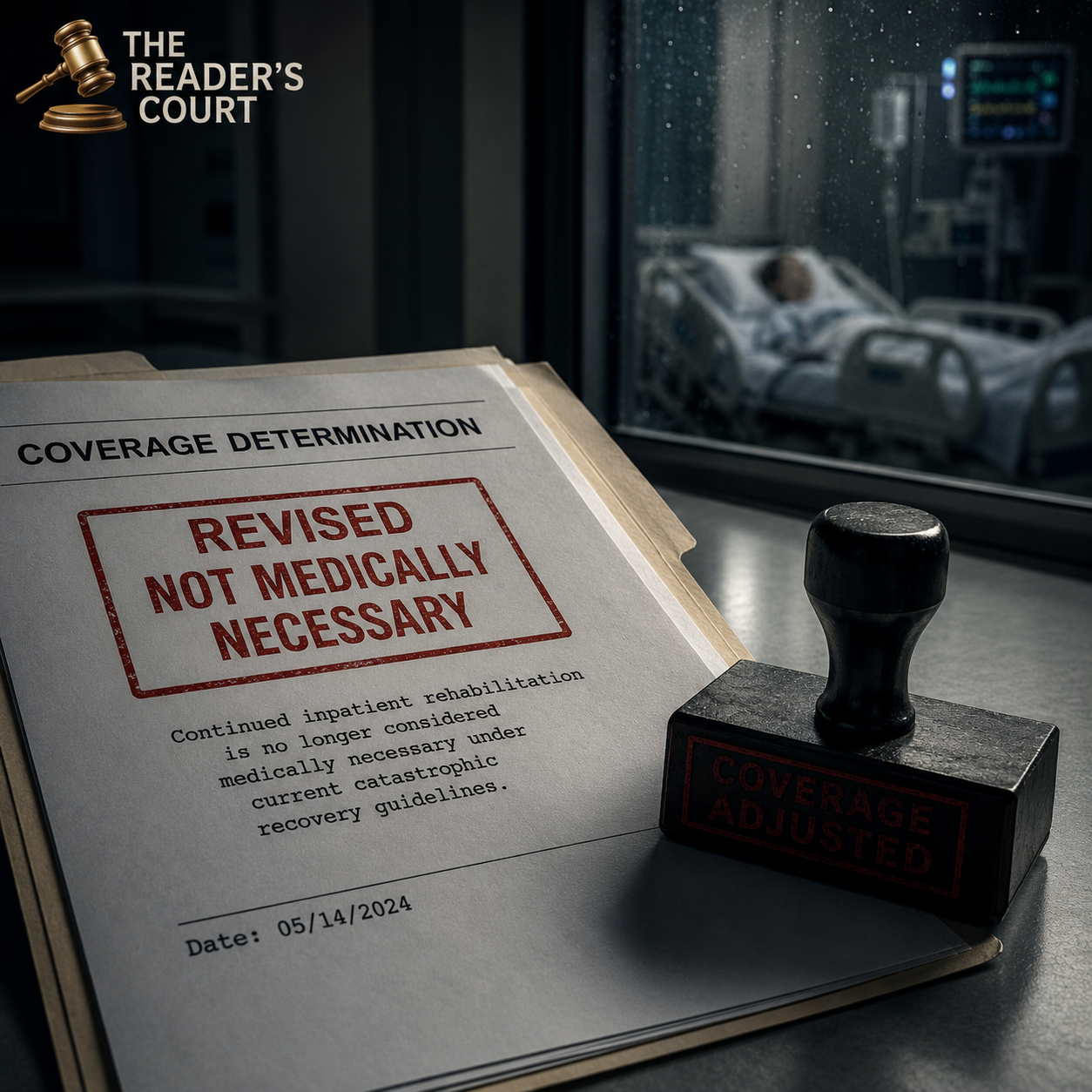
REVISED CARE ELIGIBILITY DETERMINATION
The words were centered neatly across the top like a court judgment.
Nathan stared at them while rain slid down the windows.
Then his phone chimed softly.
A new email.
The adjuster had sent the updated coverage determination while still speaking to them.
Efficient.
Professional.
Documented.
Nathan opened it slowly.
And halfway down the page, beneath the reassessment language and revised optimization criteria, he found the sentence that changed everything.
Continued inpatient rehabilitation is no longer considered medically necessary under current catastrophic recovery guidelines.
Nathan read it once.
Then again.
Behind him, Emma whispered:
“Dad?”
But he couldn’t answer.
Because for the first time since the accident, he finally understood the real emergency had never been the crash.
It was surviving long enough for the insurance model to adjust.
Become a member of the Dossier.
Support my writing.
The Question
Melissa Bell did everything responsible people are told to do.
She worked.
She paid premiums.
She carried employer-sponsored insurance.
She entered the system correctly.
The company approved treatment when she was dying.
Then reevaluated coverage once survival became expensive.
So when exactly does coverage exist?
At the moment people pay for it?
Or only at the moment institutions decide it remains profitable to provide?
The Autopsy
Insurance companies rarely deny care the way ordinary people imagine.
The modern system is far more
sophisticated than simple refusal.
The first approval is often real.
That is important to understand.
Emergency stabilization is usually covered because the legal, reputational, and regulatory exposure of refusing visible trauma care is dangerous. Helicopters fly. Surgeons operate. Intensive care begins. The system moves aggressively during the public phase of catastrophe because obvious abandonment creates scandal.
But long-term recovery exists inside a different financial universe.
That is where the models begin adjusting.
Recovery is expensive precisely because people survive.
Spinal rehabilitation.
Physical therapy.
Extended inpatient care.
Specialized neurological treatment.
Adaptive equipment.
Chronic pain management.
A dead patient creates one financial event.
A living patient with complex recovery needs creates years of financial exposure.
So the language changes.
Not publicly.
Not emotionally.
Administratively.
Medical necessity gets redefined.
Recovery benchmarks shift.
Network pathways narrow.
Optimization models activate.
Authorizations require reevaluation.
The patient experiences this as betrayal because human beings believe insurance means protection.
Institutions understand insurance differently.
Insurance is exposure management.
That distinction changes everything.
The adjuster on the phone is not inventing cruelty.
The reviewer is not personally attacking the family.
The analyst revising care models may never even see photographs of the patient.
Everyone follows process.
And process protects the institution.
This is the part most people never see clearly:
coverage is often most generous during instability and most restrictive during prolonged survival.
Because trauma medicine protects institutions from public outrage.
Long-term rehabilitation threatens profitability.
That is why coverage definitions evolve after the crisis stabilizes.
The family believes the emergency ended when the patient survived.
The insurance system believes the financial risk is only beginning.
And beneath all of it sits the true protected class in modern healthcare systems:
Institutional capital.
Shareholder stability.
Quarterly predictability.
Managed actuarial exposure.
Network leverage.
Cost containment.
The patient enters the system believing medicine is the product.
But medicine is only one layer.
The real product is financial control over uncertainty.
The Bell family discovered the most important truth too late:
Coverage is not truly defined when premiums are paid.
Coverage is defined at the exact moment institutions decide what survival is allowed to cost.
The Closing Argument
The helicopter was covered.
The surgeries were covered.
The stabilization was covered.
Because visible death creates public consequences.
But recovery happened quietly.
Quietly enough for reassessment.
Quietly enough for optimization.
Quietly enough for the model to adjust.
The family thought insurance meant protection.
The institution understood it as risk management.
Those are not the same thing.
The system did not fail.
It simply answered the question it was designed to answer.
The Reader’s Verdict
A — The Insurance Company Followed the Rules
The policy changed classification based on updated medical review findings. Expensive long-term recovery cannot be guaranteed indefinitely simply because emergency treatment began.
B — The Family Was Betrayed Midway Through Survival
The company approved care while death was immediate, then redefined coverage once recovery became financially dangerous. The system protected cost exposure instead of the patient.
C — The Entire Insurance Structure Is Designed This Way
Coverage exists only while institutions can financially tolerate it. The language of care remains human. The calculations underneath it do not.
Leave your choice — A, B, or C — in the comments.
—Mark Bertrand
The Reader’s Court
When systems break people’s lives, the truth must be told.
Join the fight.


0 comments
Write a comment