

What to Read After Red Rising
You finished and wonder what to read after Red Rising and now everything else feels slow.
That is the problem.
Pierce Brown did not merely give readers another dystopian future. He built a violent social hierarchy, placed a grieving young man at the bottom of it, transformed him into a weapon, and sent him inside the ruling class to destroy it.
Darrow is not watching oppression from a safe distance. He is climbing through it.
Every friendship may be strategic. Every victory creates another enemy. Every act of loyalty carries the possibility of betrayal. Power is not discussed in council chambers and explained through pages of political history. It is demonstrated through bodies, blood, competition, humiliation and command.
The official description of the Red Rising Saga calls it the story of “a rebel forged by tragedy” fighting to lead an oppressed people toward freedom. That is accurate, but it does not fully explain why the novel consumes readers.
Readers love Red Rising because it makes power physical.
The hierarchy is visible. The cruelty is personal. The consequences arrive immediately.
The question is not simply whether Darrow can defeat the Golds.
The deeper question is whether he can become powerful enough to defeat them without becoming one of them.
That is the experience your next book must replace.
First: Read Golden Son
Before looking anywhere else, there is one obvious answer.
Read Golden Son.
If you have finished only the first Red Rising novel, do not leave the series yet. The first book introduces the machinery. Golden Son opens it.
The controlled brutality of the Institute expands into political warfare, military conflict, dynastic power and consequences that reach far beyond a single battlefield. Darrow is no longer merely proving that he can survive among the Golds. He must use the authority, reputation and relationships he acquired while knowing that nearly everything around him rests upon a lie.
The scale becomes larger, but the real escalation is psychological.
Darrow has entered the ruling class deeply enough to develop genuine attachments to people he may eventually have to betray. The enemy is no longer a distant collection of monsters. Some of them are mentors, friends, rivals and people whose loyalty he values.
That is where the series becomes more dangerous.
But perhaps you have already read the saga. Perhaps you have lived through its alliances, wars, betrayals and revolutions and now want another book capable of producing the same hunger.
These are the strongest places to go next.
The Will of the Many by James Islington
Read this for infiltration, hierarchy and the dangerous education of an outsider.
The Will of the Many is the clearest recommendation for readers who loved Darrow entering an elite institution controlled by the people he intends to oppose.
Vis is a fugitive forced into the machinery of the Catenan Republic, a civilization whose hierarchy is not merely social. Those below surrender part of their strength, energy and will to those above them.
Power literally flows upward.
Vis enters an elite academy while concealing his identity, motives and growing understanding of the system around him. Like Darrow, he must become exceptional inside an institution designed to strengthen the ruling order. He needs allies, but intimacy creates exposure. He needs knowledge, but knowledge makes him more dangerous to the people watching him.
The publisher describes Vis as a young fugitive entering the elite Catenan Academy and uncovering secrets capable of changing the world.
What makes this such a natural next read is not simply the academy setting.
It is the pressure of divided identity.
Vis cannot openly reject the system. He must outperform its chosen heirs while learning how thoroughly its logic has entered everyone around him. The novel understands that domination is most effective when the oppressed are required to participate in the mechanism that diminishes them.
Choose The Will of the Many when what you miss most is infiltration, concealed identity, strategic friendship and a protagonist learning to weaponize the education intended to domesticate him.
The Rage of Dragons by Evan Winter
Read this for fury, discipline and a man who turns grief into a weapon.
If Darrow’s rage was the engine that carried you through Red Rising, read The Rage of Dragons.
Tau is born into a world of inherited military privilege. Some people possess extraordinary gifts. Most are expected to fight, obey and die inside a war that has continued for generations.
Tau does not begin with the power required to challenge that order.
He builds himself into something the order cannot contain.
After devastating personal loss, he commits himself to an almost suicidal program of training and revenge. His advancement is not granted by prophecy, noble blood or institutional approval. It is earned through obsession, repeated suffering and a willingness to endure more pain than the people born above him can imagine.
The publisher presents the novel as an epic fantasy about an apparently unwinnable war and a young man whose grief becomes a consuming pursuit of vengeance.
Tau and Darrow are not interchangeable heroes. Darrow is a political infiltrator forced to perform the identity of his enemy. Tau is a human blade sharpening himself against an entire hereditary order.
But the emotional force is similar.
Both men discover that rage can create purpose without creating peace.
Choose The Rage of Dragons when you want relentless forward movement, brutal training, combat, revenge and a protagonist whose refusal to accept his assigned place becomes terrifying.
How Did You Miss This?
Pierce Brown makes power visible.
Mark Bertrand makes it recognizable.
His billionaires do not wear armor, command legions or announce themselves as a superior species. They own the institutions that determine who works, who eats, who receives medical care, who keeps a home, whose voice is heard and whose suffering disappears into a quarterly report.
This is the Billionaire Monster.
Not merely a wealthy villain. Not one corrupt executive who can be exposed, arrested and removed before the system returns to normal.
The system belongs to him.
His money has become political influence, legal immunity, media control and economic authority. He can injure thousands of people without touching any of them. He can call the consequences efficiency, innovation or shareholder value. And when the bodies are counted, nobody can find the crime.
Bertrand writes the thriller after the mask comes off.
The hierarchy is no longer hidden on another planet. The Golds are already here.
The story below is not another explanation.
It is what living beneath one of them feels like.
The Union He Invented
A Short Thriller about the billionaire monster, Ramson Vail
The dead man is still inside the crusher when Ransom Vail arrives.
Not because anyone expects him to help.
Vail owns the mine, the mountain, the railroad that leaves it, the houses where the workers sleep, and most of the county officials who will later call the death an unfortunate industrial event. His helicopter settles beyond the emergency vehicles in a storm of pale dust. Cameras wait behind the yellow line. Men in clean company jackets stand with their hands folded in front of them.
Gabriel Rusk watches from the upper platform.
Below him, the primary crusher has stopped with thirty-two tons of lithium-bearing clay packed between its jaws. Somewhere beneath the ore is Thomas Bell, forty-eight years old, married, three daughters, twelve years on the mountain.
They can see one boot.
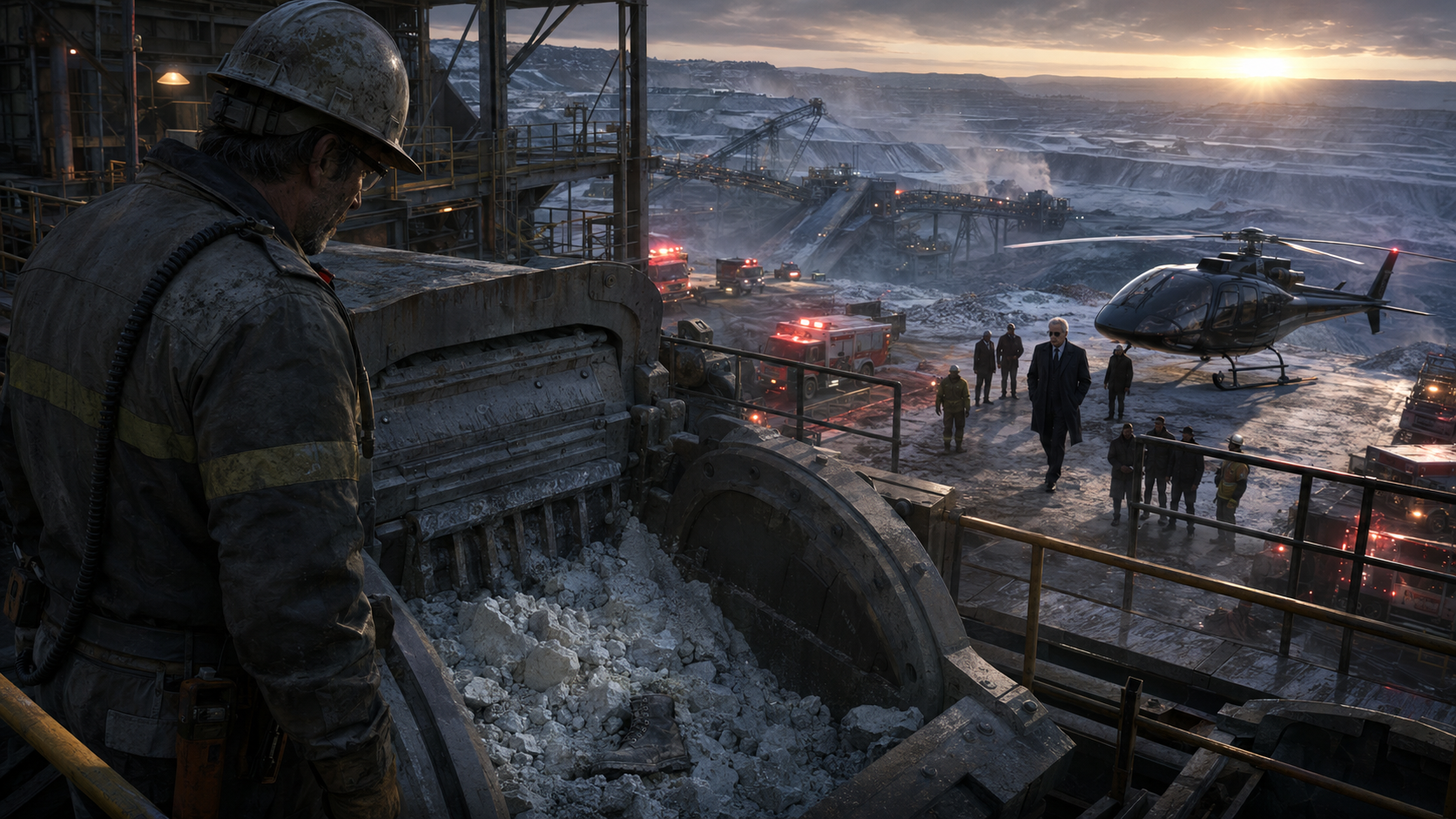
The rest of him belongs to the machine.
“Foreman.”
Gabriel turns.
Eddie Marr, the mine superintendent, climbs the steel stairs toward him. Eddie is breathing hard, but not from the climb. He has been standing beside Vail’s security chief for twenty minutes, learning what happened.
Or learning what the company intends to say happened.
“Mr. Vail wants the line cleared,” Eddie says.
Gabriel looks down through the grated floor.
“The coroner hasn’t released him.”
“He isn’t asking about Bell.”
“No.”
“He wants production restored.”
Gabriel takes off his safety glasses and wipes the dust from them with his shirt.
“The jaw is locked. We have to cut power at the north bus, drain hydraulic pressure, open the housing, rig the overhead crane, and pull the swing plate. That’s six hours if nothing’s bent.”
“Four.”
“Six.”
“Mr. Vail says four.”
Gabriel puts the glasses back on.
“Then Mr. Vail should have bought a crusher that listens to him.”
Eddie glances toward the stairs, as though Vail might have heard.
“You want to say that again?”
“No.”
“Good.”
Gabriel studies the emergency lights turning across the mine. Red strobes move over gray structures, yellow machinery, white company trucks. The mine looks less like a place than an organism exposed during surgery. Conveyors cross the open pit like arteries. Pipelines carry chemical slurry toward the processing plant seven miles east. The railroad curves south through Vail Junction, where the company houses are arranged in straight rows beneath the water tower.
Everything moves in one direction.
Ore out.
Money up.
Debt down.
Eddie lowers his voice.
“Bell bypassed the proximity lockout.”
“No, he didn’t.”
“The preliminary report says he did.”
“The preliminary report didn’t exist ten minutes ago.”
“It does now.”
Gabriel looks at him.
Eddie’s expression has not changed. That is the thing about men who have worked too long under Ransom Vail. They do not become cruel. Cruelty requires conviction. They become procedural.
“Who wrote it?” Gabriel asks.
“Safety.”
“Safety is still photographing the platform.”
“Then legal wrote it.”
“Legal wasn’t here.”
“Legal doesn’t need to be here.”
Below them, two rescue technicians climb onto the housing and begin attaching cables to the crusher’s inspection hatch.
Gabriel says, “The proximity sensor failed three days ago.”
Eddie blinks once.
“I put in the repair order.”
“I know.”
“You denied the shutdown.”
“I deferred it.”
“Bell didn’t bypass anything. He walked into a machine you knew couldn’t see him.”
Eddie’s face tightens, not with guilt but irritation.
“You think I make those decisions?”
“I think you sign them.”
“I sign what Denver sends.”
“And Denver signs what Vail wants.”
Eddie steps closer.
“You’ve been here twenty-six years, Gabe. Don’t start pretending this morning is the first time you understood the arrangement.”
Gabriel looks past him.
Ransom Vail stands with one hand on the shoulder of Thomas Bell’s wife.
She has arrived in bedroom slippers.
Company security keeps the cameras at a respectful distance while Vail leans toward her, grave and immaculate, his silver hair unmoved by the rotor wash. He is not speaking to her as a billionaire speaks to a worker’s widow. He is speaking as a priest speaks beside a grave he owns.
Vail has always known how to make possession look like mercy.
Gabriel says, “Six hours.”
Eddie follows his gaze.
“Do it in five.”
“Five.”
“And change your incident notes.”
“No.”
“Take out the sensor failure.”
“No.”
Eddie looks tired now.
“That report can bury you.”
“It already buried Bell.”
Gabriel walks toward the stairs.
Behind him, Eddie says, “Your house is company property.”
Gabriel stops.
“So is yours.”
“Your daughter’s medical account is through Vail Health.”
Gabriel turns slowly.
Eddie does not look proud of himself.
That makes it worse.
“My daughter is dead,” Gabriel says.
Eddie looks away.
“Yes.”
“So the account should be easy to cancel.”
Gabriel descends toward the machine.
By noon, Thomas Bell is removed in three pieces.
By evening, the crusher is moving again.
By midnight, the company announces that Bell violated lockout procedure.
The proximity sensor disappears from the report.
The next morning, every worker receives a message from Vail Industrial Resources expressing condolences and reminding employees that safety begins with personal accountability.
Three days later, the union organizer arrives.
Her name is Mara Venn.
She drives into Vail Junction in a red pickup with Nevada plates and parks outside the Miners’ Hall, a building the company stopped maintaining fifteen years earlier. She is forty, perhaps forty-five, with dark hair cut at her jaw and the stillness of someone who expects a room to make space for her.
The first meeting draws thirty-seven people.
The second draws ninety.
By the end of the week, workers stand outside in the cold listening through open windows.
Mara does not speak like an organizer. She speaks like someone who has already won.
“You believe Ransom Vail is powerful because he owns the mine,” she tells them.
Men stand shoulder to shoulder along the walls. Women sit on folding chairs with children asleep across their laps. Dust from the mountain has worked into every coat, every cuff, every line in every face.
Mara walks slowly between them.
“He is powerful because he owns your fear of losing it.”
No one moves.
“He owns the roof over your children because the rent comes out of your wages before you see them. He owns the clinic because your treatment is tied to your employment. He owns the grocery because your company card carries interest. He owns the water because the county sold him the aquifer. He owns the sheriff because his foundation bought the new jail.”
Someone laughs bitterly.
Mara turns toward the sound.
“He owns the jail because he expects to need it.”
That silences the room.
Gabriel stands near the rear exit.
He has attended every meeting but said nothing. Around him are men he has supervised for years. Mechanics. Blasters. Truck operators. Electricians. Chemical handlers. Men whose fathers worked the mountain before Vail bought it and renamed the entire operation after himself.
Mara faces them.
“You do not work for a company. You live inside a closed economy designed to return every dollar to the man who issued it.”
A hand rises near the front.
Owen Price, a loader operator with two crushed fingers and a face made older by debt.
“What union are you with?”
Mara smiles.
“The one we’re building.”
“That’s not what I asked.”
“No. You asked who owns me.”
A few men look at one another.
Mara continues.
“The old unions will send you forms. They will ask for dues. They will negotiate a few points above poverty and call it history. I am not here to negotiate the terms of your dependence.”
“What are you here for?” Owen asks.
“To end it.”
The room changes.
Gabriel feels it before anyone speaks.
Hope is dangerous in Vail Junction because it arrives without protection. Men learn to distrust it as they distrust machinery without guards. Hope pulls people toward moving parts.
Mara takes a stack of cards from her coat.
“We begin with names. Departments. Skills. Shift assignments. Housing status. Debts held by the company. Medical dependencies. Family members employed by Vail subsidiaries. Every pressure point he uses against you.”
She places the cards on a table.
“We map the cage.”
Gabriel watches the room move toward her.
Mara’s eyes find him.
“You’re Gabriel Rusk.”
It is not a question.
“Maintenance foreman,” she says. “North operations.”
“That’s printed on my jacket.”
“Twenty-six years.”
“That isn’t.”
“You filed the sensor report before Thomas Bell died.”
Several workers turn.
Gabriel remains still.
Mara says, “You refused to alter it.”
He looks around the room.
“You have access to company files?”
“I have access to people who know where companies hide things.”
“Who?”
“Lawyers. Investigators. Journalists.”
“Who pays them?”
“People who understand what this mine represents.”
“What does it represent?”
Mara comes closer.
“The future.”
“That’s what Vail says.”
“Vail says lithium will save the country. I say the country is being trained to ignore what salvation costs.”
Gabriel looks at the cards on the table.
“You want everyone to write down the exact way the company can hurt them.”
“I want everyone to understand the exact way the company already does.”
“And then what?”
“We make it public.”
“Public doesn’t pay rent.”
“No.”
“It doesn’t treat black lung.”
“No.”
“It doesn’t keep a man from being replaced.”
Mara’s expression hardens.
“You think silence does?”
Gabriel holds her gaze.
“No.”
“Then write your name.”
He does not.
Not that night.
But the cards fill.
Within two weeks, Mara Venn has an office in the Miners’ Hall, a legal team in Denver, two documentary crews in Vail Junction, and the attention of every national network willing to turn suffering into a segment between advertisements.
She knows which widows were charged for the ambulance that carried away their husbands.
She knows the groundwater beneath the south housing tract contains arsenic and processing solvents.
She knows Vail Housing has evicted seventeen families within seventy-two hours of a worker’s termination.
She knows the company clinic has classified chemical burns as preexisting skin conditions.
She knows every name.
That is what impresses Gabriel.
It is also what frightens him.
“Names are how this place functions,” he tells her one night.
They sit alone inside the hall after a meeting. Snow presses against the windows. The old boiler knocks beneath the floor.
Mara closes a file.
“Explain.”
“Machines have numbers. People have names.”
“Profound.”
“It isn’t meant to be.”
“Then say what you mean.”
Gabriel looks toward the door.
“Vail tracks every ton of ore from the pit to the railcar. Every gallon of solvent. Every hour of downtime. Every replacement bearing. He knows what disappears because everything has a number.”
“And people?”
“People disappear because someone changes the name attached to what happened.”
Mara leans back.
“Thomas Bell became operator error.”
“Yes.”
“Your daughter became an excluded treatment.”
Gabriel’s face does not move.
Mara waits.
“You looked into me,” he says.
“I look into everyone.”
“My daughter was fourteen.”
“I know.”
“She had leukemia.”
“I know.”
“Vail Health approved the first treatment. Then the company changed carriers. The new plan called the second round experimental.”
“I know.”
“No, you don’t.”
Mara says nothing.
Gabriel’s voice remains level.
“She died in a hospital that had an empty room and the medicine in the building. I owed the company eighty-six thousand dollars after she was buried. They took it from my wages for nine years.”
Mara’s eyes lower briefly.
It is the first human movement he has seen from her.
Gabriel continues.
“You say the company owns fear. That isn’t right. Fear is temporary. Fear happens before the thing. What Vail owns is what comes after. The debt. The paperwork. The version of the event everyone is required to accept.”
Mara closes the file completely.
“Then help me change the version.”
“How?”
“We strike.”
“No.”
“You haven’t heard the plan.”
“The plan is a strike.”
“Yes.”
“Then I’ve heard it.”
“Why no?”
“Because the mine has six months of processed inventory in storage. The railroad can move it without us. The plant can run at forty percent with supervisors and contractors. Vail will lock the houses, close the clinic, and wait.”
Mara studies him.
“You’ve thought about this.”
“Everyone has.”
“Then why hasn’t anyone acted?”
“Because we know the machine.”
She stands.
“Machines fail.”
“Not where the owner plans for failure.”
Mara walks to the window.
Outside, the company water tower rises above the town. RANSOM VAIL COMMUNITY is painted across it in blue letters.
“He isn’t planning for this,” she says.
Gabriel looks at her.
“What makes you believe that?”
“Because powerful men always mistake obedience for stability.”
He almost smiles.
“And organizers mistake anger for courage.”
Mara turns.
“What do you mistake?”
“Nothing anymore.”
“That sounds like surrender.”
“It’s maintenance.”
The strike vote passes eleven days later.
Seventy-eight percent.
The company’s response arrives before the ballots are counted.
Vail Housing posts notices on doors warning that employment-related occupancy may terminate during unauthorized work stoppages. Vail Health suspends nonemergency appointments. The company store reduces credit limits. Security fencing appears around the rail terminal and processing plant.
Then Ransom Vail requests federal protection for critical domestic mineral infrastructure.
His request is granted within forty-eight hours.
The governor calls lithium a national-security resource.
The secretary of energy praises Vail’s contribution to American independence.
Senators who once criticized the company begin speaking about foreign interference in domestic labor disputes.
Mara puts all of it on television.
She stands outside the mine gates in a black coat while hundreds of workers gather behind her.
“This company poisoned their water, trapped them in debt, and killed them for production,” she says into the cameras. “Now it wants the federal government to protect it from the people who built it.”
The clip runs everywhere.
Donations pour in.
Food trucks arrive from three states.
Union lawyers file injunctions.
Actors post photographs of themselves wearing VAIL WORKERS UNITED shirts.
Mara becomes the face of the strike.
Gabriel becomes its reluctant engineer.
She uses him to explain the mine to journalists. He shows them the conveyor routes, the processing flow, the company housing deductions, the maintenance deferrals. He speaks without performance, which makes the cameras trust him.
Ransom Vail never speaks publicly.
He watches.
On the ninth day, the company dismisses four hundred and twelve workers.
On the tenth, contractors arrive in buses.
On the twelfth, someone throws a bottle at a security vehicle.
On the thirteenth, the governor deploys the state police.
Mara stands on the hood of her truck and tells the workers not to move.
“They need violence,” she shouts. “Do not give them what they need.”
Gabriel stands thirty feet away.
The sentence bothers him.
Not because it is wrong.
Because she says it like someone who has read the next page.
That night, he enters the maintenance office through the roof.
The company terminated his network credentials when the strike began, but no one removed the physical key he has carried since 2009. The roof hatch opens above the old electrical room. Gabriel lowers himself past cable trays and drops onto a transformer housing.
He is not there to steal.
He is there because the crusher control archive remains on a local server disconnected from the corporate network. He wants the original proximity-sensor fault log for Thomas Bell.
He wants one clean piece of evidence.
Not because it will destroy Vail.
Gabriel no longer believes facts destroy men like Vail.
But facts can prevent the dead from being renamed.
The office is dark except for emergency lights. He powers the archive terminal and enters a service password no one in Denver knows exists.
The system opens.
He finds the Bell logs.
Sensor fault.
Three warnings.
Shutdown recommendation.
Deferred by superintendent authorization.
Corporate override.
Gabriel inserts a drive.
As the files copy, another directory catches his attention.
MIGRATION.
It is not part of the crusher archive.
The folder contains maintenance studies for automated haulage, remote drilling, robotic inspection, predictive-repair systems, and centralized processing controls.
Gabriel opens the dates.
The plans began three years earlier.
The strike is referenced throughout.
Not as a risk.
As a phase.
He reads the first document standing up.
LABOR CONSOLIDATION EVENT.
The language is bloodless.
A work stoppage will permit accelerated workforce rationalization. Protected federal designation will enable exclusion zones and facilitate uninterrupted installation. Disruption provides legal basis for occupancy review, debt reconciliation, and contract termination.
Gabriel opens another file.
IDENTIFICATION PROGRAM.
Attached are scanned copies of the union cards from the Miners’ Hall.
Names.
Departments.
Skills.
Shift assignments.
Housing status.
Medical dependencies.
Family members employed by Vail subsidiaries.
Every pressure point.
His hands become still.
He reads until he finds Mara Venn.
Her name appears in a payment ledger beneath a consulting firm registered in Delaware.
Venn Strategic Labor Solutions.
Monthly retainer.
Performance bonus upon federal critical-infrastructure designation.
Additional bonus tied to voluntary separation rate.
Gabriel sits down.
For a long time, the only sound is the cooling fan inside the terminal.
He thinks of Mara standing beneath the water tower.
Powerful men always mistake obedience for stability.
He thinks of the cards.
We map the cage.
She had not mapped it for the workers.
She had inventoried it for Vail.
Gabriel copies everything.
The final document is a draft federal bill titled the Domestic Infrastructure Continuity and Security Act.
Its language criminalizes obstruction, occupation, interference, surveillance, or coordinated disruption of designated mineral, energy, transportation, communications, and processing facilities.
The bill carries the names of two senators.
Metadata lists its author as Vail Government Affairs.
Gabriel hears a vehicle outside.
Headlights move across the blinds.
He removes the drive, shuts down the terminal, and climbs into the cable space above the ceiling.
The door opens.
Two security officers enter with flashlights.
Behind them is Mara.
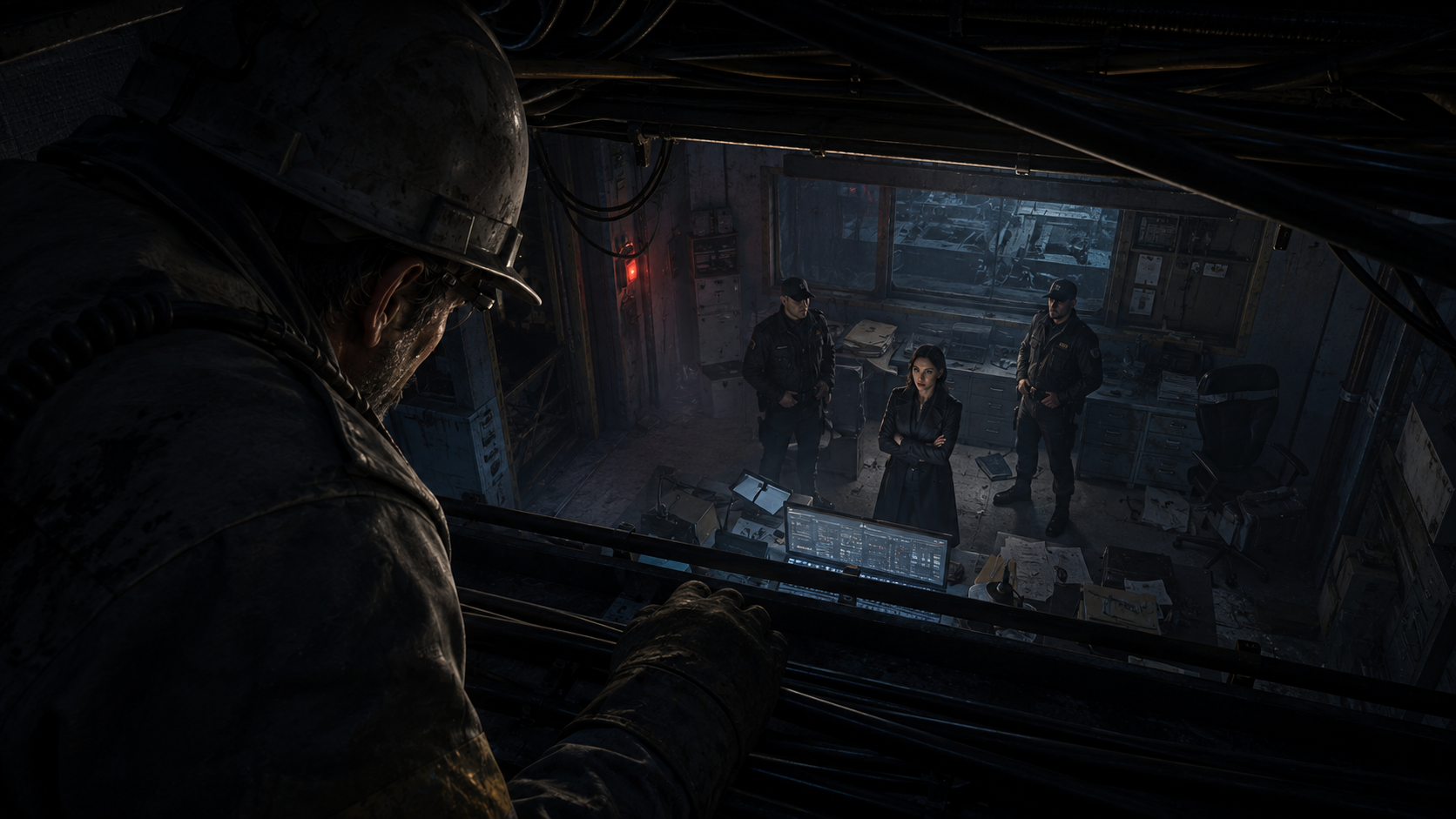
She removes her gloves.
“You said he’d come for the Bell file,” one officer says.
Mara looks toward the terminal.
“He needed a reason that did not feel like suspicion.”
The other officer checks the machine.
“Warm.”
Mara’s face changes.
Not much.
Enough.
She looks up.
Gabriel sees her through the narrow gap beside a ceiling panel.
“Search the roof,” she says.
He moves before the officers reach the ladder.
He crawls along the cable tray into the adjoining pump-control room, lowers himself behind a row of obsolete cabinets, and exits through a service tunnel beneath the floor.
The tunnel carries him forty yards north and opens beside the old reagent shed.
By the time security reaches the roof, Gabriel is crossing the frozen drainage field toward town.
Mara calls him before he reaches the first house.
He answers.
“Where are you?” she asks.
“At home.”
“No, you aren’t.”
“Then why ask?”
“You found something you don’t understand.”
“I understand your invoice.”
Silence.
Mara’s voice becomes quiet.
“Listen to me carefully.”
“I’ve been listening for six weeks.”
“You think this is about money.”
“It usually is.”
“It’s about control.”
“I know.”
“No, Gabe. You know what Vail showed you.”
Gabriel keeps walking.
“What did he show me?”
“A plan that makes me look owned.”
“You are owned.”
“I am positioned.”
“On his payroll.”
“Yes.”
Gabriel stops in the road.
Snow gathers in his hair.
Mara says, “Do you think unions appear from purity? Do you think resistance funds itself? Vail wanted names. I gave him names he already had. He wanted a strike. I gave the workers a structure.”
“You gave him federal protection.”
“He was going to get it.”
“You gave him four hundred dismissals.”
“He planned four thousand.”
“You told people to risk their homes.”
“They were already losing them slowly.”
Gabriel closes his eyes.
“You knew the arrests were coming.”
“I knew legislation was coming.”
“You helped write the conditions for it.”
“I helped create a national record before he erased the workforce.”
“You created a television show.”
“I created witnesses.”
“You created hope.”
Mara’s voice breaks at last, though only at the edge.
“Yes.”
Gabriel opens his eyes.
“That was the cruelest part.”
A truck turns onto the road behind him.
Company security.
Mara says, “They are coming for you.”
“I see them.”
“Give me the drive.”
“No.”
“If they take it, no one sees anything.”
“If I give it to you, no one sees anything.”
“I can get it out.”
“So can I.”
“You don’t know who to trust.”
Gabriel watches the truck approach.
“Neither do you.”
He ends the call and steps between two houses.
The company town knows him.
That saves him.
A porch light flashes twice.
A side door opens.
Gabriel enters one house, passes through the kitchen, climbs out a rear window, crosses three yards, and emerges from a garage behind the next block.
The security truck circles for an hour.
By dawn, the files exist in thirty-two places.
Gabriel does not send them to journalists.
Journalists can be sued, purchased, discredited, delayed.
He sends them to workers.
Every page.
Every ledger.
Every plan.
He sends them to the widows.
He sends them to the contractors hired to replace them.
He sends them to railroad crews, chemical suppliers, county employees, clinic nurses, truck drivers, teachers, pastors, mechanics, clerks, and every family living beneath the company water tower.
At eight in the morning, Mara enters the Miners’ Hall.
Hundreds wait inside.
No one speaks.
The payment ledger has been printed and taped to the wall behind her.
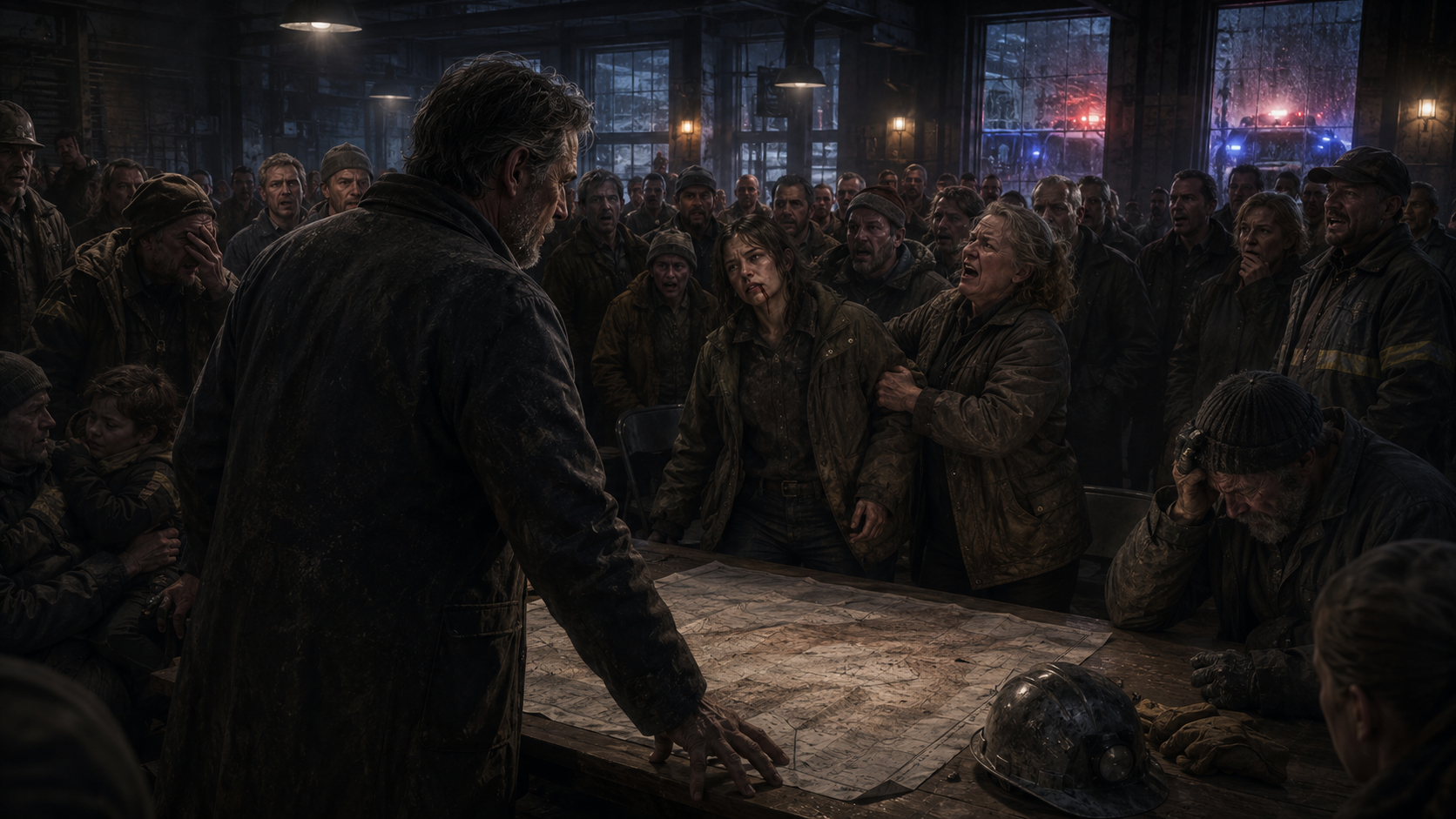
Mara sees it.
She removes her coat.
Owen Price stands near the front.
“How much?” he asks.
Mara looks at him.
“How much did he pay you?”
“Enough to stay close.”
“Answer him,” someone says.
Mara turns toward the voice.
“Two hundred and forty thousand dollars over eighteen months.”
The room shifts.
A woman near the wall begins crying.
Not loudly.
Mara continues.
“I used most of it to finance this campaign.”
“You took his money,” Owen says.
“Yes.”
“You handed him our names.”
“Yes.”
“You made us targets.”
“You were targets before I arrived.”
Owen moves toward her.
Gabriel steps between them.
Owen looks at him.
“You protecting her?”
“No.”
“Then move.”
“No.”
“Why?”
“Because Vail wants this room to become a crime scene.”
Owen’s fists remain closed.
Gabriel looks around.
“The law goes into effect today.”
Murmurs.
Gabriel holds up the printed bill.
“Congress passed it at three this morning. The president signs at noon. Anyone obstructing the mine, plant, railroad, pipeline, substation, communications network, or company access road can be charged with infrastructure sabotage.”
Someone says, “For striking?”
“For being where Vail needs us not to be.”
Mara watches him.
Gabriel turns toward her.
“What was the arrest plan?”
She hesitates.
“Tell them.”
“State police clear the gate after the signing. Federal agents identify organizers. Anyone on the cards receives enhanced review.”
“Enhanced?”
“Conspiracy charges.”
Owen’s face drains.
Mara says, “The strike camp will be treated as a coordinated obstruction.”
“How many arrests?” Gabriel asks.
“Three hundred initially.”
“And after?”
“They move through the housing lists.”
A man near the rear says, “You knew.”
“Yes.”
“Why didn’t you tell us?”
“Because you would have gone home.”
The man stares at her.
Mara’s eyes remain on him.
“And Vail would have won without showing anyone what he was.”
The crying woman stands.
“My husband is dead.”
Mara looks at her.
“Mrs. Bell—”
“You used his name.”
“Yes.”
“You used my girls.”
“I am sorry.”
“No, you aren’t.”
Mara does not defend herself.
Mrs. Bell walks forward and strikes her.
The sound is small.
Mara’s head turns. A line of blood appears at the corner of her mouth.
No one moves.
Mrs. Bell says, “That is all you get to be sorry for.”
Then she returns to her chair.
Gabriel unfolds a map of the Vail industrial system across the front table.
“The strike is over,” he says.
The room erupts.
He waits.
“The strike is what Vail invented. The gate, the signs, the cameras, the confrontation. He needs us there. He needs a crowd he can clear, leaders he can arrest, and a mine he can automate while everyone watches the fence.”
Owen points toward the map.
“What are you saying?”
“I’m saying the mine isn’t the mine.”
No one answers.
Gabriel places his finger on the processing plant.
“The ore is worthless until it reaches here.”
He moves to the railroad.
“The processed material is worthless until it leaves here.”
He points to the town.
“The automated mine is worthless without water, power, housing, roads, communications, emergency services, and people who know how the systems fail.”
A mechanic says, “The law covers all of that.”
“It covers obstruction.”
“What do you call shutting it down?”
“We don’t shut anything down.”
Gabriel looks at the faces around him.
“We go home.”
Confusion spreads.
Mara understands first.
Her eyes move across the map.
Gabriel continues.
“Vail owns the facilities. He does not own every human function inside them. The railroad crews have federal hours limits. The treatment plant needs licensed operators. The company clinic cannot function without nurses. The town water system requires certified testing. The automated haul units require remote supervisors and emergency-recovery teams. The processing plant needs manual inspection every twelve hours because Vail deferred the sensor upgrades.”
Eddie Marr stands near the back.
He has entered unnoticed.
Gabriel sees him.
Eddie says, “You’re talking about coordinated refusal.”
“No.”
“What do you call it?”
“Individual compliance.”
A few people begin to understand.
Gabriel says, “No picket lines. No blocked gates. No damaged equipment. No trespass. No threats. Every person follows every rule Vail wrote. Every safety procedure. Every licensing requirement. Every rest period. Every environmental test. Every maintenance interval. Every debt dispute. Every housing appeal. Every medical review.”
Owen’s anger loosens.
Gabriel continues.
“He built the place on shortcuts. We remove the shortcuts.”
Mara looks at him almost with admiration.
“That won’t be enough.”
“No.”
“What else?”
Gabriel points to three locations.
“The railroad yard. The processing plant. The company town.”
“You said no occupation.”
“No illegal occupation.”
He looks toward Mrs. Bell.
“The railroad workers’ contract gives them access to the breakhouse during safety disputes. The plant operators have a statutory duty to remain during hazardous shutdown review. The tenants have possession rights until housing appeals are adjudicated.”
Mara says, “Three legal footholds.”
“Three places Vail cannot clear without admitting the systems belong to the people operating them.”
“And the mine?”
“We leave it empty.”
At eleven fifty-eight, the last striking worker walks away from the mine gate.
Television cameras record empty barricades, abandoned signs, and state police standing in formation before no one.
At noon, the Domestic Infrastructure Continuity and Security Act becomes law.
At twelve-oh-three, Ransom Vail gives the order to clear the strike camp.
There is no strike camp.
At twelve-ten, the first automated haul trucks begin moving inside the pit.
At twelve-seventeen, a remote unit stops after detecting an obstacle that does not exist.
The contracted operator requests manual inspection.
No certified recovery crew reports.
At twelve-twenty-five, the processing plant enters mandatory safety hold after three operators file independent concerns regarding pressure instability in the solvent circuit.
They do not leave their stations.
They remain inside under federal process-safety rules, waiting for inspectors.
At twelve-thirty, railroad crews report fatigue and invoke statutory rest periods.
They occupy the breakhouse legally.
No trains depart.
At twelve-forty, every tenant in Vail Junction files a housing-condition appeal citing contaminated water, defective heating, unlawful deductions, and retaliatory termination.
Families remain inside their homes.
At one, the company clinic nurses refuse to alter medical records and begin printing copies for patients.
At one-fifteen, the water operators report arsenic levels requiring public notification.
At one-thirty, the school closes because company buses fail inspection.
At two, contractors discover their temporary housing has no occupancy permit.
At three, the county judge—whose campaign Vail financed—receives eighteen hundred emergency filings.
At four, the mine is operating.
Nothing else is.
Ransom Vail watches the shutdown from the command center on the thirty-fourth floor of Vail Tower in Denver.
The wall before him displays every part of the operation.
Pit production remains green.
Processing is red.
Rail is red.
Housing is amber.
Water is red.
Medical is red.
Communications flicker.
Ransom Vail stands with his hands behind his back.
He is sixty-three years old and worth eighty-one billion dollars. He has built refineries on three continents, purchased two governors, survived four congressional investigations, and taught an entire country to describe his appetite as industrial policy.
He does not shout.
Men who possess consequences rarely do.
Eddie Marr stands beside the conference table.
Mara Venn sits across from him.
Her lip is swollen.
Vail looks at the screens.
“You told me Rusk was cautious.”
“He is.”
“This is not caution.”
“It is maintenance.”
Vail turns toward her.
She remembers Gabriel saying the word.
Perhaps Vail hears it in her silence.
“You were paid to identify the workers capable of disrupting operations.”
“I did.”
“And?”
“You removed them from the mine.”
“That was the objective.”
“No. That was the mistake.”
Vail looks back at the displays.
“The mine is functioning.”
Mara says, “The mine was never the asset.”
His eyes move to her.
“The integrated system is the asset,” she continues. “The workers understood it before your analysts did.”
Vail takes a seat.
“Where is Rusk?”
“In Vail Junction.”
“Arrest him.”
“For what?”
“Sabotage.”
“He touched nothing.”
“Conspiracy.”
“He told people to follow regulations.”
“Incitement.”
“To comply?”
Vail’s expression does not change.
“Find a law.”
Mara almost smiles.
“You wrote too many. They are using them.”
Eddie says, “We can evict the town.”
“Not during active appeals,” Mara says.
“Terminate utilities.”
“Retaliatory interference with protected tenancy.”
“Remove the plant operators.”
“They are preserving a hazardous system during review. Remove them and Vail becomes personally responsible for any release.”
Eddie looks toward Vail.
“We can send federal agents into the rail yard.”
“For resting?” Mara asks.
Vail says, “Enough.”
The room obeys.
He studies the pit feed rising while finished-product output remains at zero.
Ore accumulates.
Storage capacity declines.
The automated mine is producing a mountain that cannot become money.
“How long?” he asks.
Eddie checks the data.
“Thirty-six hours before the raw-feed bins fill. Then the pit stops.”
“And inventory?”
“Five days at contracted delivery rates.”
“Penalties?”
“Twenty-two million the first week. Escalating.”
“Customers?”
“Three battery manufacturers. Defense. Grid storage.”
“Federal pressure?”
“Already calling.”
Vail nods once.
He is not frightened.
Fear is for people who believe loss can reach them.
But he is interested.
That is more dangerous.
“Bring me Gabriel Rusk,” he says.
Gabriel enters Vail Tower the following evening.
He comes alone.
Not because Vail requests it.
Because Gabriel does.
The building’s lobby is forty feet high and silent enough to hear fabric move. A sculpture made from polished lithium ore hangs over the reception desk. The stone has been cut into the shape of a human heart.
Security escorts Gabriel to the command center.
Ransom Vail waits beside the glass wall.
Denver glows below them.
“You have cost me forty-seven million dollars,” Vail says.
Gabriel removes his coat.
“You kept count.”
“I always keep count.”
“Except when people die.”
“I count them too.”
Gabriel looks at him.
Vail gestures toward the displays.
“You misunderstand me, Mr. Rusk. I am not offended by what you have done.”
“No?”
“I am impressed.”
Mara stands near the table but says nothing.
Vail continues.
“You saw a system where other men saw a mine.”
“I repaired it for twenty-six years.”
“And believed that gave you a moral claim upon it.”
“No.”
“What claim do you believe you have?”
Gabriel looks through the glass at the city.
“None.”
Vail smiles faintly.
“Then we agree.”
“I don’t need a claim.”
“Everyone needs a claim.”
“No. A claim is something you ask another man to recognize.”
Vail’s smile disappears.
Gabriel turns toward him.
“We stopped asking.”
Vail walks to the table.
“You have not seized anything.”
“No.”
“You own no shares.”
“No.”
“You control no capital.”
“No.”
“You hold no office, command no police, write no law, and possess no legal authority over a single inch of my property.”
“That’s right.”
“Then what exactly do you believe you have accomplished?”
Gabriel considers him.
“The truth?”
“I would be disappointed by anything less.”
“We discovered the difference between ownership and use.”
Vail’s eyes narrow slightly.
Gabriel continues.
“You own the mine. You cannot make it valuable alone. You own the town. You cannot make it livable alone. You own the railroad. You cannot make it move alone. You own the law. You cannot make people cooperate with the shortcuts that keep your law from stopping you.”
Vail rests one hand on the table.
“People cooperate because they require wages.”
“Some do.”
“All do.”
“No. All require food, shelter, medicine, and a future for their children. You placed yourself between them and those things and mistook the tollbooth for creation.”
Mara looks at Vail.
His face remains composed.
“Your workers will return,” he says.
“Some will.”
“They will return because anger does not feed families.”
“No.”
“Then why?”
“Because the mine is theirs.”
Vail laughs once.
It is a genuine sound.
“That is sentimental nonsense.”
“It is not sentimental. They built it. They know it. They can operate it. They can stop it without breaking it. You can own it for a hundred years and never know where the vibration begins before a bearing fails.”
“I can hire another man.”
“You tried.”
“I can train another man.”
“Eventually.”
“I can automate him.”
“You automated the trucks. Who recovers one when it stops in the pit?”
“A technician.”
“Who trains the technician?”
Vail says nothing.
Gabriel steps closer to the display wall.
“The union you invented depended on leaders, lists, demands, cameras, and confrontation. You made a shape you knew how to crush.”
Vail watches him.
“We don’t have leaders now.”
“You are here.”
“I’m a maintenance foreman.”
“You designed this.”
“I described the machine.”
“And they followed you.”
“They followed what they already knew.”
Vail glances at Mara.
“That sounds like organizing.”
“No,” Gabriel says. “Organizing is what you purchased. This is recognition.”
“Of what?”
“That none of us is alone where your wealth requires all of us.”
For the first time, something enters Vail’s face.
Not fear.
Calculation failing to produce comfort.
He turns toward Mara.
“What does he want?”
Mara answers without looking at Gabriel.
“He didn’t come with demands.”
“Everyone has demands.”
Gabriel says, “Thomas Bell’s name restored to the report.”
Vail looks at him.
“That is all?”
“No.”
“You said no demands.”
“That isn’t a demand. It is a correction.”
Vail’s voice cools.
“What else?”
“Release the housing deeds to the tenants. Transfer the water system to the county. Cancel company medical debt. Recognize the workers’ council. Reinstate the dismissed employees. Submit the plant and mine to independent safety review. Withdraw support for the infrastructure law.”
Vail smiles again.
“There they are.”
Gabriel shakes his head.
“No.”
“No?”
“Those are the conditions under which the system becomes useful again.”
“You are demanding control of my property.”
“I am explaining what it costs to use ours.”
Vail studies him for a long time.
Then he asks, “And if I refuse?”
“The pit stops tomorrow.”
“And after that?”
“The contracts fail.”
“And after that?”
“The federal government intervenes.”
“Perhaps.”
“They will not side with you.”
“They don’t have to.”
Vail’s gaze sharpens.
Gabriel says, “They only have to understand that arresting us does not teach the mine how to work.”
Silence settles across the command center.
Below them, the city moves through systems no single person sees.
Water.
Power.
Food.
Traffic.
Waste.
Labor.
Millions of invisible agreements pretending to be infrastructure.
Vail turns toward the windows.
“What happened to your daughter?” he asks.
Mara looks at Gabriel.
Gabriel does not.
“You know.”
“I know the file.”
“You paid the company that wrote it.”
“I did not decide her coverage.”
“No. That is how men like you remain innocent.”
Vail’s reflection watches him in the glass.
“You believe I should carry every consequence produced by institutions I own?”
“No.”
“What, then?”
“You should stop owning institutions whose consequences you refuse to carry.”
Vail turns.
The two men face one another across the room.
Vail is not a caricature. He does not sneer. He does not confess. He does not explain that sacrifice is necessary for progress.
He believes something colder.
He believes consequences are evidence of scale.
A man who affects millions will inevitably harm thousands. To him, injury is not corruption. It is proof that his decisions matter.
“You think you have discovered a moral flaw in me,” Vail says.
“No.”
“What have you discovered?”
“A design flaw.”
Vail’s eyes flicker.
Gabriel points to the screens.
“You built everything so the money could move upward. You forgot everything else has to move sideways.”
Mara lowers her head.
Perhaps she is hiding a smile.
Vail looks at the stalled system.
The raw-feed bins reach ninety-four percent.
A warning appears.
PIT SHUTDOWN SEQUENCE ADVISED.
He could refuse.
He could order arrests, evictions, force, seizure.
He could destroy the town and still keep the mountain.
But the mountain without the town is stone.
The lithium without labor is dirt.
The law without cooperation is paper.
Ransom Vail reads the warning twice.
Then he says, “Restore Bell’s name.”
Eddie exhales.
Vail continues.
“Begin negotiations on the rest.”
Gabriel puts on his coat.
“Not negotiations.”
Vail looks at him.
“Maintenance,” Gabriel says.
The mine shuts down at 2:14 the next morning.
Not from sabotage.
Not from violence.
Not from a bomb, a gun, a barricade, or a body thrown beneath a machine.
The feed bins fill.
The conveyors stop.
The automated trucks park themselves in perfect rows beneath the mountain.
For eleven days, nothing moves.
Then the housing deeds are transferred.
The medical debts disappear.
The water system becomes public.
Thomas Bell’s death certificate is amended to reflect equipment failure and corporate negligence.
The dismissed workers return under a council elected by department rather than appointed by Vail.
Mara Venn leaves Vail Junction before dawn on the twelfth day.
No one stops her.
Gabriel finds her red pickup outside the Miners’ Hall.
She stands beside it smoking a cigarette.
“I thought you didn’t smoke,” he says.
“I don’t.”
He waits.
She drops the cigarette into the snow.
“You were right about hope,” she says.
“No.”
“You said it pulls people toward moving parts.”
“It does.”
“And yet.”
“And yet what?”
“They moved.”
Gabriel looks toward the mountain.
The mine is dark.
Beyond it, morning begins as a thin gray line.
“You gave them something,” Mara says.
“I gave them a map.”
“You gave them permission.”
“No.”
“What, then?”
“Time.”
She studies him.
“To do what?”
“To see that Vail needed them more urgently than they needed him.”
Mara opens the truck door.
“Do you think he’s finished?”
“No.”
“Do you think he’ll forgive this?”
“No.”
“Do you think the council survives?”
“I don’t know.”
She nods.
“That is not a very satisfying ending.”
Gabriel looks at her.
“Endings are for stories.”
“What is this?”
He watches the first lights come on inside the company houses that no longer belong to the company.
“Maintenance.”
Mara gets into the truck.
She drives south before sunrise.
Gabriel remains outside the hall.
Behind him, workers begin arriving for the morning meeting. Not a rally. Not a strike. No cameras wait. No famous names appear on screens. No lawyers stand beside the doors.
People bring coffee, records, water reports, repair schedules, housing deeds, medical bills, and lists of things that must be done.
The union Ransom Vail invented is gone.
The one he did not invent has begun.
Enter the Dossier
Never again be left wondering what to read after Red Rising or any novel.
The Dossier is the private archive reserved exclusively for readers of Mark Bertrand’s novels—a growing collection of hidden chapters, character files, recovered evidence, restricted stories, deeper connections and material that exists beyond the published books.
The novels tell the story.
The Dossier opens the locked rooms behind it.
Every novel provides another way inside. Every addition expands the fictional world and rewards the readers who chose to enter.
This is not another newsletter.
It is where the reading continues.
Read the Novels
The Dossier begins with the novels.
Mark Bertrand writes psychological thrillers about intelligent people confronting systems of power larger than any single villain. His characters do not merely discover who committed the crime. They discover the machinery that made the crime possible—and the price of refusing to accept it.
The novels are complete experiences.
They are also the keys.
Read the novels by Mark Bertrand.
Then enter what waits behind them.
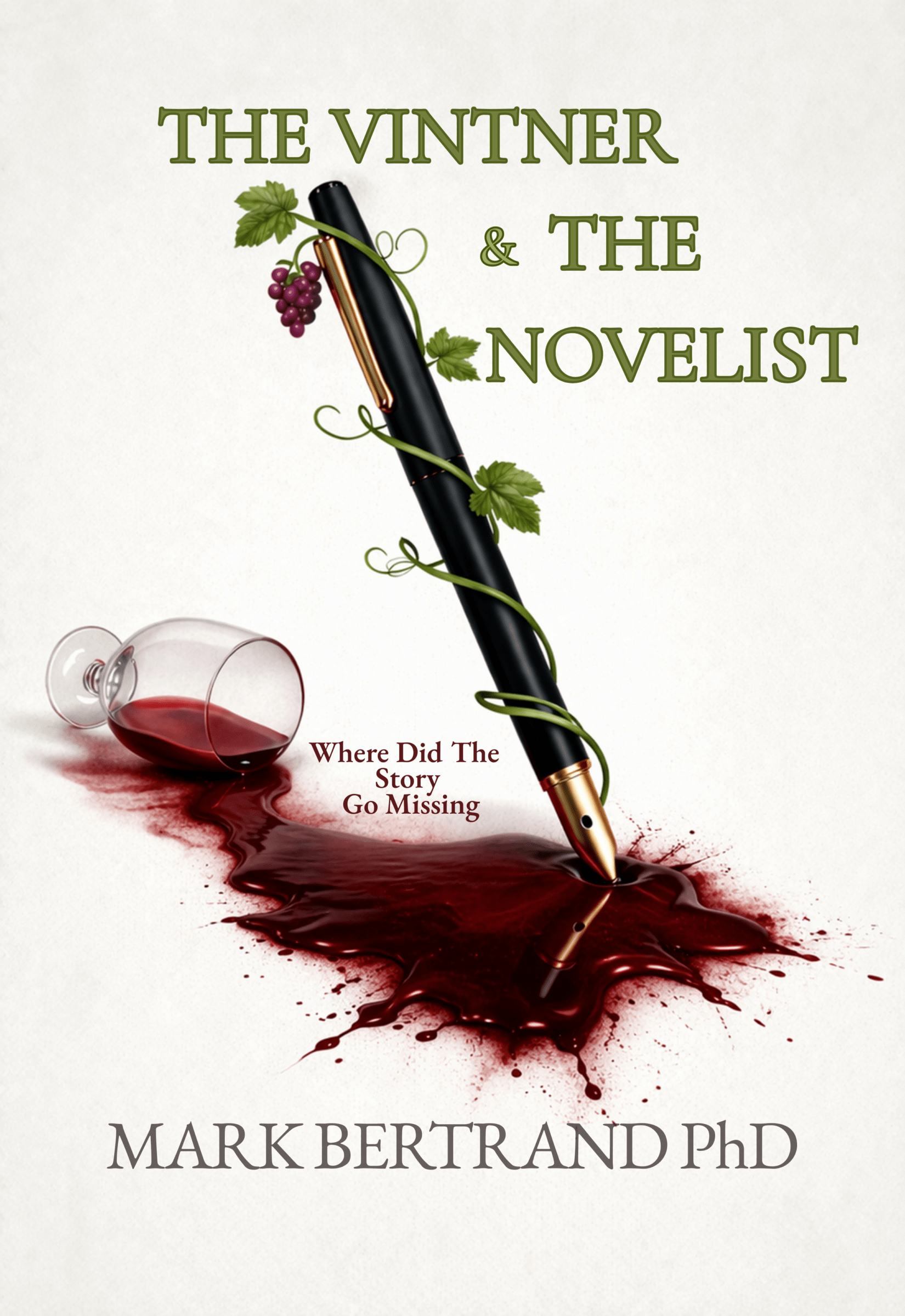
The Vintner & The Novelists

Related Reading
More articles like The Most Terrifying Villain in Modern Thrillers.
Continue exploring the evolution of the modern thriller:
Readers interested in psychological systems thrillers, institutional pressure, crime infrastructure, and modern suspense should also explore:
From Books Like:
From Authors Like:


0 comments
Write a comment