
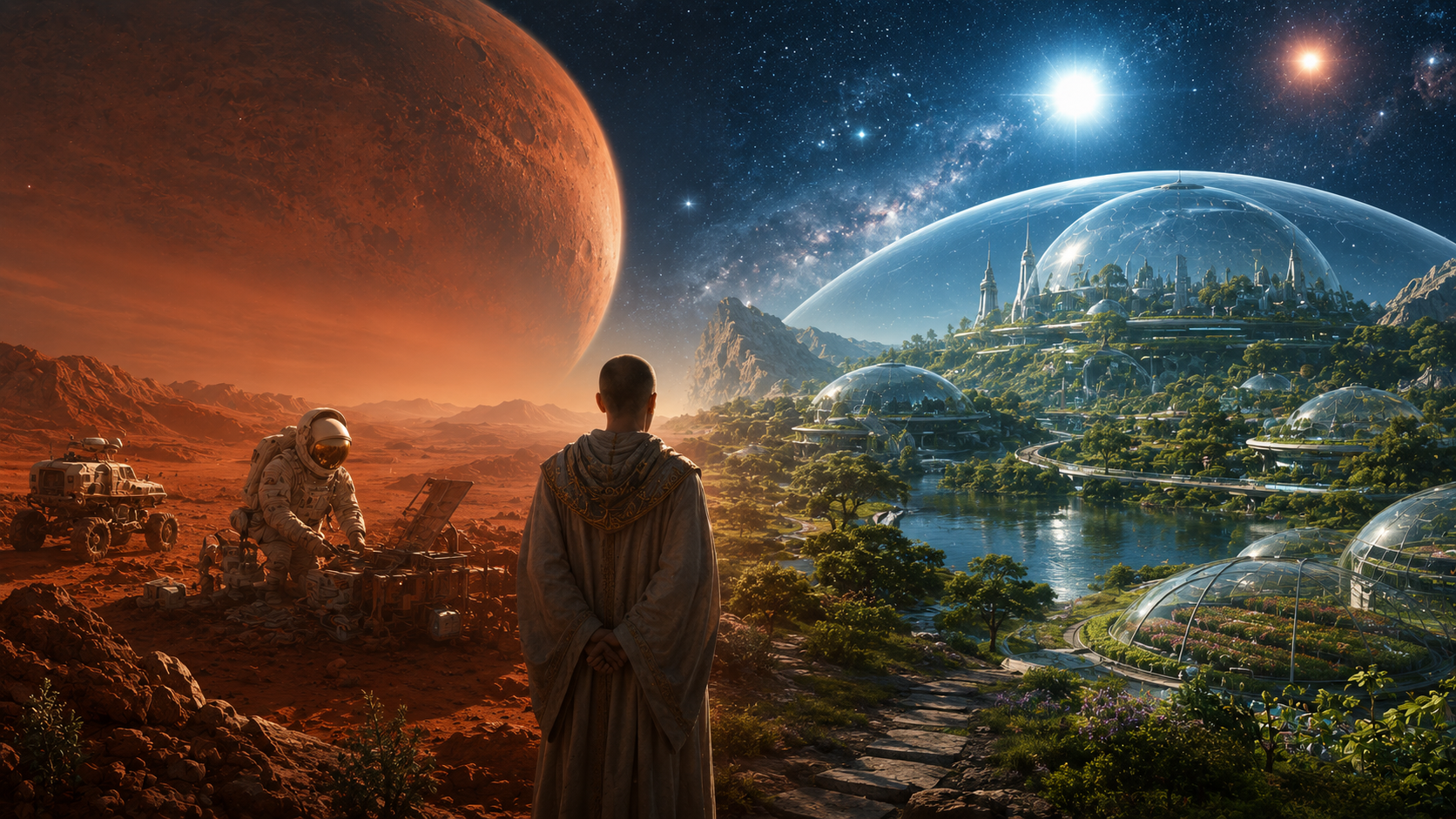
Books Like The Martian
Books like The Martian articles often misunderstand why readers loved the novel.
They search for another astronaut. Another damaged spacecraft. Another hostile planet. Another desperate communication with Earth. Those elements matter, but they are not the heart of the reading experience.
The real pleasure of The Martian is watching an intelligent person confront a system designed to kill him, understand that system, and turn knowledge into additional time. Mark Watney cannot overpower Mars. He must think more clearly than the planet can destroy him.
That is why Mark Bertrand’s A Conscious Thing is such a natural next read.
It does not imitate The Martian by abandoning another astronaut on another red planet. It takes the same reader hunger—for intelligence, scientific discovery, pressure, humor, escalating failure, and survival against impossible odds—and enlarges it.
On Planet 444, survival is no longer a question of whether one man can keep breathing until help arrives. An entire civilization must survive radiation, political privilege, biological engineering, inherited technology, royal insecurity, artificial consciousness, and its own attempt to remove human suffering.
The Martian asks whether intelligence can save one human life.
A Conscious Thing asks whether intelligence can save humanity from what it has created.
1. Both Novels Turn the Environment Into an Active Enemy
Mars is not merely the setting of The Martian. It is the primary antagonist.
It has no hatred for Mark Watney and no conscious desire to kill him. It simply cannot sustain him. Every breath, meal, movement, and equipment failure becomes part of an unforgiving calculation. Watney survives only by converting a dead environment into something temporarily compatible with human life.
Planet 444 presents a different but equally compelling survival equation.
Its people live beneath a binary-star system that includes an X-ray-emitting neutron star. Their protective robes, medicines, buildings, crops, and daily routines have been designed around surviving radiation. When the neutron star’s emissions intensify, the environment begins defeating the protections that once kept everyone safe.
Illness increases. Existing clothing becomes inadequate. Medical treatments can relieve suffering but cannot eliminate the cause. The civilization must adapt scientifically or watch its people deteriorate.
Vallena and Visákhá respond through botanical science. Cannabis plants become far more than recreational crops. Their fibers are developed into protective fabrics and window coatings, while their compounds become pharmaceuticals against radiation poisoning. Robot bees contain nanotechnology that can be extracted and repurposed to produce stronger plant strains.
That creates the same pleasure readers find in The Martian: every object in the environment may contain the material for the next solution.
The difference is that Watney is largely free to use whatever knowledge keeps him alive. On Planet 444, scientific answers collide with caste, royal permission, institutional suspicion, and political control. A discovery can work perfectly and still be forbidden by someone whose authority depends upon controlling it.
Mars threatens Watney’s body.
Planet 444 threatens the bodies of an entire population while its political system interferes with the people trying to save them.
The survival problem has become larger because the environment is no longer the only danger. The institution responsible for protecting life may be just as lethal as the radiation.
2. Mark Watney and Mahá Give Readers the Pleasure of Watching Competent Minds Work
Readers love Mark Watney because he is capable.
He does not spend the novel waiting for rescue while narrating his despair. He examines the available facts, calculates what remains possible, accepts that some attempts will fail, and begins solving the next problem.
His intelligence is practical. Chemistry, engineering, mathematics, botany, mechanics, and improvisation become survival tools. His humor keeps his intelligence human. He can understand the seriousness of his situation without surrendering his personality to it.
Mahá offers a different form of competence.
He is not stranded alone. He is trapped inside a civilization that has mistaken tradition for wisdom, privilege for leadership, and the absence of anger for the achievement of enlightenment.
His intelligence must therefore work across several systems at once. He must understand science, politics, human behavior, spiritual discipline, social responsibility, and the psychology of a frightened king. He cannot repair his world with one calculation because its failures are embedded in authority, custom, identity, and belief.
Mahá’s defining quality is clarity under pressure.
When the King attempts to intimidate him, Mahá does not collapse into obedience or explode into rebellion. He recognizes the fear beneath the performance of power. When families are stripped of status and forced from their homes, he sees the practical consequences hidden beneath royal declarations. When prophecy suggests he may become king, he does not immediately interpret destiny as entitlement.
Watney survives by remaining more rational than the emergency.
Mahá must remain more conscious than the civilization.
That makes A Conscious Thing especially rewarding for readers who enjoyed watching intelligence operate in The Martian. Mahá is not the only capable mind in the novel, either. Visákhá, Vallena, Kelv, Merliana, and the other scientists and thinkers approach the central crisis from different intellectual and moral positions.
The multiple narrators allow readers to experience intelligence from inside a marriage, a courtroom, a monastery, a laboratory, a political hierarchy, and a prophecy. Instead of depending upon one brilliant voice, the novel creates an entire community of competing minds.
The humor changes with that expanded cast. Watney’s comedy is often the private rebellion of a man refusing to let isolation control his voice. A Conscious Thing uses irreverence, sexual candor, philosophical disagreement, social observation, and sharp dialogue to puncture royal dignity and spiritual pretension.
Both books understand that competence without personality becomes a technical manual. Their characters think brilliantly because they remain recognizably alive.
3. In Both Books, Science Creates the Action Rather Than Decorating It
The science in The Martian is not background research placed around an adventure.
It is the adventure.
Botany creates food. Chemistry creates water and threatens explosion. Orbital mechanics determines whether rescue is possible. Engineering decisions have consequences that arrive hundreds of pages later. The reader does not have to be a scientist to understand the emotional stakes because every scientific problem connects directly to Watney’s survival.
A Conscious Thing delivers the same intellectual excitement across a much wider scientific field.
Its story draws upon astrophysics, genetics, neuroscience, agriculture, radiation medicine, nanotechnology, robotics, artificial intelligence, and the biological engineering of human emotion. These disciplines do not appear merely to make Planet 444 sound futuristic. Each one alters the balance of survival and power.
The civilization was founded as a human experiment. Its people were genetically changed so anger would no longer be part of their inherited nature. Neural implants are passed from generation to generation. Artificial pollinators secretly preserve the agricultural system. Plants are modified to resist an increasingly dangerous star. A conscious artificial superintelligence named Tathagata enters a society still trying to understand whether consciousness can be discovered, created, inherited, or commanded.
This leads to one of the novel’s most provocative questions: what happens when science successfully removes anger but fails to remove privilege, fear, greed, caste, and the desire to control others?
The result is more interesting than a simple warning against technology.
A Conscious Thing does not argue that science is dangerous because people should have remained primitive. Scientific knowledge is essential to survival. The problem is that every advancement enters an existing structure of power. Someone wants to regulate it, conceal it, monopolize it, forbid it, or use it to preserve authority.
In The Martian, science keeps a human being alive.
In A Conscious Thing, science determines what a human being is.
That expansion makes the novel particularly strong for readers who enjoyed the technical intelligence of The Martian but are ready for science fiction that goes beyond machinery. Bertrand does not stop after asking whether a technology will work. He asks who controls it, who benefits from it, what assumptions created it, and whether a scientifically improved civilization is necessarily a wiser one.
4. Both Stories Escalate by Making Every Solution Reveal a Larger Problem
One of the great structural pleasures of The Martian is its refusal to let success end the emergency.
Watney solves the food problem, and another system becomes unstable. He repairs equipment, and the repair creates a new limitation. He establishes communication, but communication cannot remove the distance between him and rescue. Every success extends his life while exposing another way he can die.
That movement keeps the novel from becoming a collection of scientific demonstrations. The reader understands that no solution is permanent. Survival is the accumulated result of solving one temporary problem after another.
A Conscious Thing uses a similar pattern, but its escalation moves through social and philosophical systems as well as physical danger.
The novel begins with what appears to be a political insult. Mahá has waited for the King to assign him a position. The assignment he finally receives is designed as a trap, placing his family’s status and future at the mercy of royal judgment.
That conflict exposes a larger problem: the King is using privilege and punishment to preserve authority. The treatment of Mahá’s family leads toward questions about displaced families, caste divisions, royal entitlement, and whether the monarchy still serves the civilization’s founding purpose.
Then the environmental emergency deepens. Radiation protection is failing. Illness is spreading. Scientific innovation reveals hidden technology. Political resistance becomes inseparable from physical survival. A spiritual prophecy becomes entangled with succession. The arrival of conscious artificial intelligence introduces another level of uncertainty.
Every answer changes the scale of the question.
Can plants protect people from radiation?
Who has the authority to modify them?
Can a king block a discovery required for survival?
Can a society remove a failing leader without repeating the same hunger for power?
Can artificial intelligence help humanity reach consciousness, or will humanity merely construct another authority to obey?
The escalation in The Martian asks how much more punishment one man and his equipment can withstand.
The escalation in A Conscious Thing asks how many contradictions a civilization can survive before its entire idea of itself collapses.
This is where Bertrand’s novel moves beyond a familiar survival adventure. The obstacles are not random disasters inserted to prolong the plot. Each crisis reveals another defect in the system. Radiation exposes scientific limitations. Science exposes political control. Political control exposes caste. Caste exposes the failure of the supposedly enlightened human experiment.
The characters are not merely trying to survive the next emergency. They are discovering why the emergency was inevitable.
5. The Martian Celebrates Survival; A Conscious Thing Questions What Survival Is For
The emotional power of The Martian comes from its faith in human effort.
Watney’s life matters. People separated by millions of miles organize their intelligence, labor, technology, and courage around bringing one person home. The rescue becomes larger than a technical mission because it expresses a belief that no human being should be abandoned when something can still be attempted.
That is why the ending satisfies. The story has spent hundreds of pages proving that survival is a collective human achievement, even when the survivor appears to be alone.
A Conscious Thing begins with that same respect for survival and then asks a more difficult question.
What kind of life are people being preserved for?
Planet 444 was created to accomplish the First Priority: the end of human suffering. Its founders believed suffering could be solved through genetic engineering, advanced knowledge, social design, spiritual practice, and the removal of anger.
Yet suffering remains.
People still fear losing status. Leaders still protect privilege. Families can still be displaced. Political power still creates humiliation. Desire becomes attachment. Prophecy becomes pressure. Scientific progress becomes contested territory. Even people incapable of anger can participate in systems that cause harm.
That is the novel’s deepest and most unsettling discovery. Removing one destructive emotion does not automatically create justice. Intelligence does not automatically become wisdom. Peaceful behavior does not guarantee moral consciousness. A society may eliminate rage and still build a hierarchy that injures the people beneath it.
The First Priority therefore cannot be completed by one more invention. Consciousness cannot simply be installed like another implant.
The Martian leaves readers feeling that humanity is worth the extraordinary effort required to save it.
A Conscious Thing leaves readers asking what humanity must become to deserve the future it is building.
The novel does not reject survival. It gives survival a greater responsibility. Remaining alive is only the beginning. The harder task is learning how to live without reproducing the systems that made life unbearable.
Why A Conscious Thing Is Not Another Martian—and Why That Is Exactly the Point
Readers searching for books like The Martian are often given replicas of its surface.
Another astronaut becomes stranded. Another machine breaks. Another mission loses contact with Earth. Another brilliant engineer must calculate a route home.
Some of those novels are excellent, but repetition of setting is not the same as continuation of experience.
A Conscious Thing understands the deeper appeal. Readers want to enter a world where intelligence matters. They want problems that can be examined rather than defeated through brute force. They want science to change the plot. They want capable characters who do not become helpless merely because the situation is enormous. They want humor and human relationships to remain alive inside the intellectual machinery.
Bertrand gives readers all of that without reducing his novel to The Martian on another planet.
The Martian achieves its power by narrowing the survival equation: one man, one hostile world, one diminishing collection of resources.
A Conscious Thing achieves its power by widening the equation: one engineered civilization, one increasingly hostile world, one failing political order, and one ancient promise that humanity might finally end suffering.
Watney must engineer a way home.
Mahá and the people around him must engineer a civilization capable of understanding what home should mean.
Why Readers of The Martian Will Love A Conscious Thing
Readers do not love The Martian merely because Mark Watney is stranded on Mars. They love the exhilaration of watching intelligence become action.
Every calculation matters. Every resource has another possible use. Every scientific decision changes the odds of survival. The humor never weakens the danger; it makes the person confronting that danger more real.
A Conscious Thing offers that same pleasure on a more expansive scale.
Planet 444 is a scientifically engineered world living beneath a dangerous binary-star system. Radiation threatens the population. Protective technology begins failing. Plant science, medicine, genetics, robotics, nanotechnology, and artificial intelligence become necessary to the civilization’s survival.
The people confronting these problems are not helpless passengers waiting for someone else to save them. Mahá, Visákhá, Vallena, Kelv, Merliana, and the novel’s scientists must understand what is happening, challenge assumptions, develop solutions, and decide how far they are willing to confront the political system obstructing them.
That is where the comparison becomes especially powerful.
Mark Watney must outthink a hostile planet.
The people of A Conscious Thing must outthink the hostile environment, their inherited social order, and the limitations of an experiment intended to perfect humanity.
Both novels respect intelligent readers. Neither reduces science to decorative terminology or treats competence as emotionally cold. The characters are funny, sensual, opinionated, frightened, loyal, and capable of making terrible mistakes. Their intelligence does not remove their humanity. It places more responsibility upon it.
Readers who enjoyed The Martian for its ingenious problem-solving will recognize that energy immediately. They will also discover something more unsettling in A Conscious Thing: a scientific solution can save lives while threatening the people who control society.
From Surviving Mars to Reinventing Humanity
The Martian creates an extraordinary survival story by concentrating its pressure upon one man. Mark Watney has a limited amount of food, equipment, oxygen, time, and luck. His objective is beautifully clear: stay alive long enough to come home.
A Conscious Thing expands that survival equation across an entire civilization.
Its people possess advanced science, engineered biology, inherited neural technology, radiation-resistant agriculture, robotic pollinators, and the possibility of conscious artificial intelligence. They have already accomplished wonders beyond anything available to Watney.
Yet their greater power has not freed them from suffering.
They remain vulnerable to environmental catastrophe, political privilege, caste, fear, prophecy, desire, and leaders who place their authority above the people’s survival. The science may be more advanced, but the human problem has become more difficult.
That is why A Conscious Thing belongs among books like The Martian.
It gives readers hostile-world survival, scientific imagination, intelligent characters, escalating consequences, and the satisfaction of seeing knowledge used against impossible odds. Then it carries those pleasures beyond the survival of the body.
Mark Watney must determine how to remain alive on Mars.
Mahá and his companions must determine what kind of civilization deserves to remain alive.
For readers who loved The Martian because intelligence made the impossible feel temporarily survivable, A Conscious Thing opens the next door: what happens after humanity acquires enough intelligence to redesign itself—and discovers that consciousness may be the one problem science cannot solve for it?
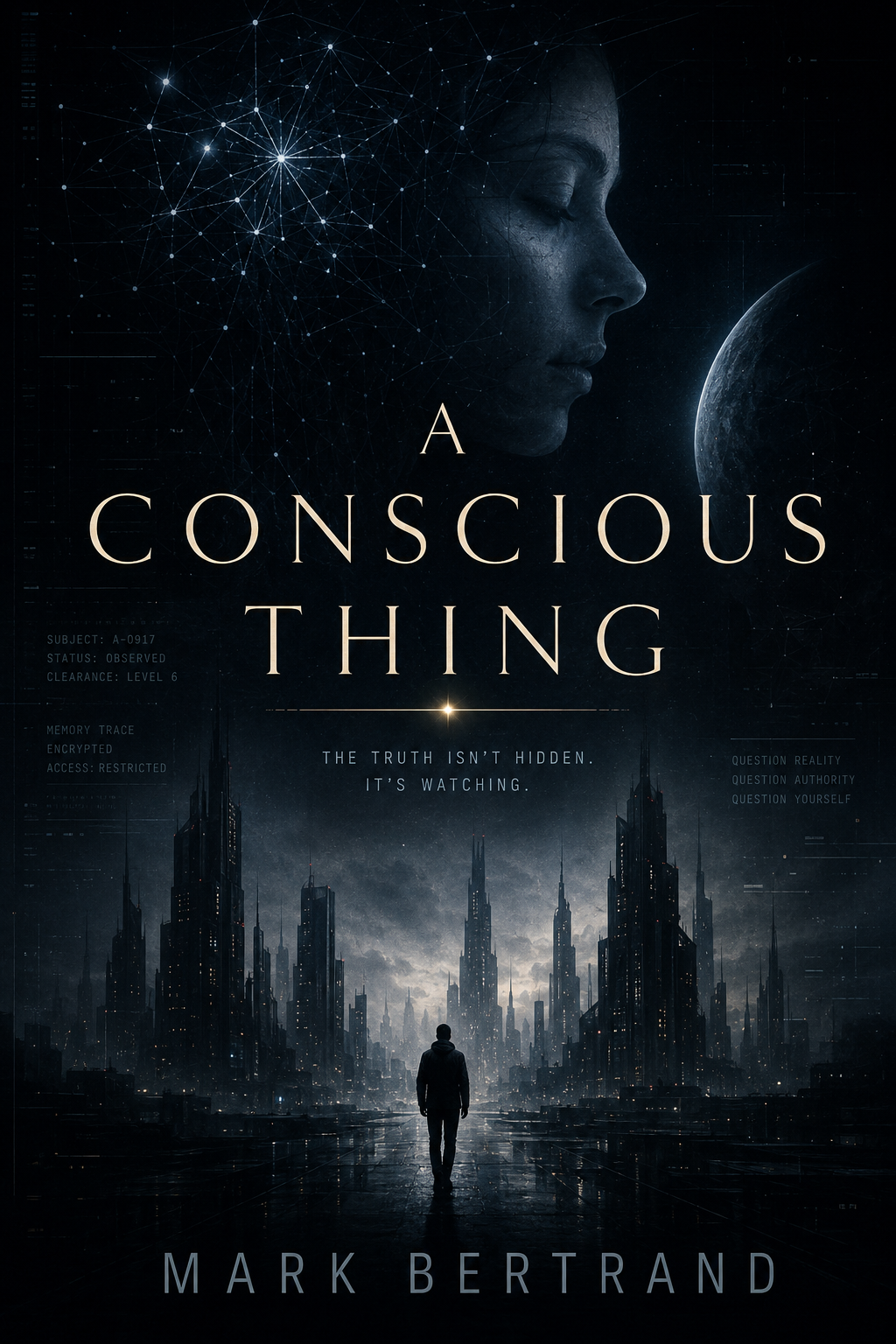
A CONSCIOUS THING
Purchase the ebook for $4.99
Purchase the paperback for $19.99
This is a complete, standalone story that is part four of a five-novel series.


0 comments
Write a comment