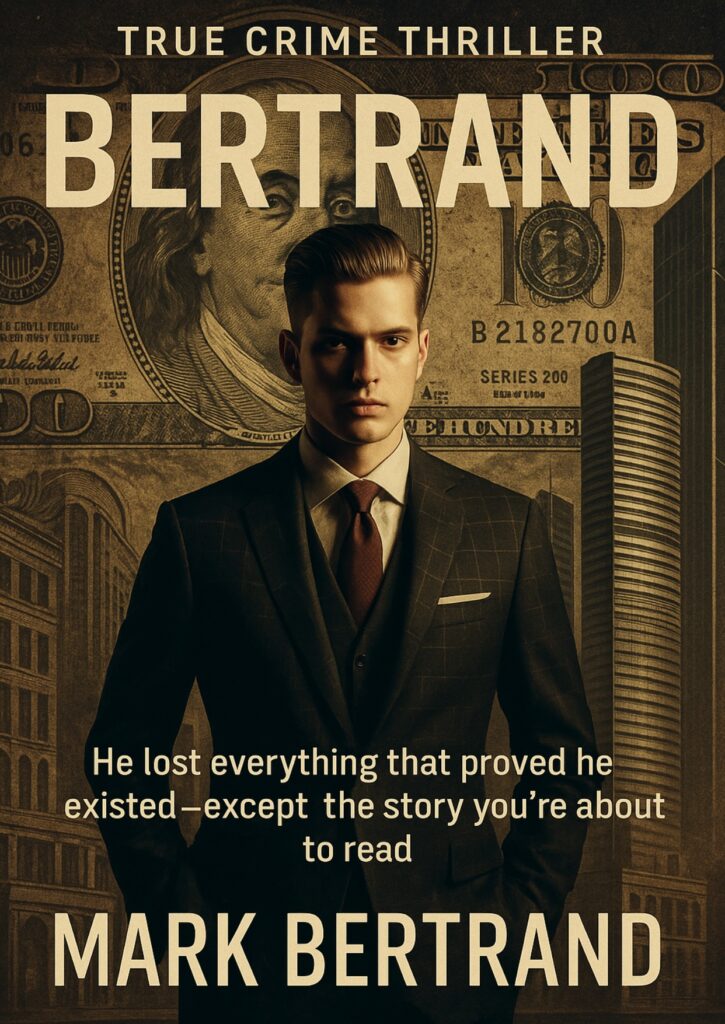
Readers searching for authors like James Ellroy are not looking for mystery in the traditional sense. They’re looking for crime stripped of comfort—stories where corruption is ambient, power is crude, and moral clarity is a liability. That’s the territory my novel, Bertrandoccupies.
Why readers search for authors like James Ellroy
Crime as a permanent condition, not a disruption
Institutions that rot from the inside while projecting order
Characters complicit in the systems that destroy them
Power exercised through proximity, not ideals
A worldview where justice is incidental, not guaranteed
Narratives that refuse to console the reader
Ellroy doesn’t reassure. He exposes.
Where my novel Bertrand fits this lineage
In Mark Bertrand’s crime thriller Bertrand he shares Ellroy’s refusal to sentimentalize power or innocence. The story assumes corruption is structural and that navigating it requires intelligence, discipline, and moral compromise.
The overlap appears in:
Systems that reward silence and punish visibility
Authority figures who operate without ethical illusion
Characters who understand the cost of participation and proceed anyway
Like Ellroy’s work, the book does not ask whether the system is broken. It treats that as settled. The question becomes how a person functions once that truth is internalized.
The key difference—and why it matters
Where James Ellroy externalizes corruption through institutions, conspiracies, and historical machinery, Mark Bertrands novel Bertrand places that experience alongside internal collapse and self-regulation.
The pressure is less about uncovering rot and more about sustaining control while living inside it. The result shifts the narrative from exposure to endurance, from revelation to maintenance.
No redemption arcs. No absolution.
There are no moral awakenings. No cleansing violence. No narrative permission to feel clean at the end.
The tone remains controlled and unflinching. Actions are weighed, not justified. The book assumes readers understand that survival and virtue rarely align.
Who should read the novel Bertrand
This book is for readers who:
Prefer realism over moral framing
Accept that power does not need to explain itself
Read crime fiction for its worldview, not its puzzles
Tolerate unresolved ethical tension
A final word for authors like James Ellroy, readers
Authors like James Ellroy write about corruption as history. In the novel Bertrand, Mark Bertrand portrays corruption as a daily operating environment.
Both understand that once innocence is gone, the only remaining skill is precision. For readers drawn to Ellroy’s unsparing view of power and complicity, Bertrand offers a quieter, more internal extension of that logic—where the damage is harder to see, and impossible to disown.
Readers searching for authors like Edward Bunker aren’t looking for clever crime fiction or stylized noir. They’re looking for truth told from the inside—crime as survival, not entertainment. They want first-person accounts where hunger, fear, and calculation drive decisions long before morality ever enters the room.
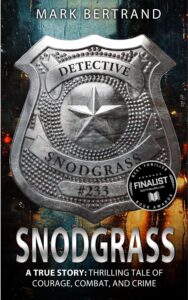
If that’s what you’re looking for then the award-winning novel Snodgrassbelongs in that lineage.
Why readers search for Edward Bunker
Edward Bunker’s work—especially Education of a Felon—endures because it offers something rare: a criminal narrative written by someone who actually lived the consequences.
Readers come to Bunker for:
First-person realism, not invented grit
Crime as a learned response to deprivation
Moral clarity without moral comfort
A narrator who explains the logic of survival without asking forgiveness
Bunker doesn’t glamorize crime. He explains it. That distinction matters.
Where Snodgrass fits that lineage
Like Bunker, Snodgrass is not interested in crime as spectacle. It is interested in how a man learns to read systems—military, economic, social—and exploit their blind spots in order to survive.
In Snodgrass, crime emerges early not from ambition, but from hunger. Literal hunger. Structural hunger. The kind that teaches a young mind to calculate risk before it ever considers ethics.
Rail cars left open. Food stacked unattended. No witnesses. No authority present.
Those moments are not framed as rebellion. They are framed as inevitability.
That’s where the Bunker comparison holds.
The key difference—and why it matters
Where Edward Bunker’s education unfolds almost entirely inside the criminal justice system, Snodgrass splits its pressure across two worlds:
The criminal apprenticeship of adolescence
The rigid, bureaucratic authority of military life
This dual setting sharpens the book’s edge.
The narrator doesn’t just learn how to steal. He learns how institutions function—how authority talks, how paperwork replaces truth, how procedure protects itself.
That insight carries forward into every decision he makes.
Authors Like Edward Bunker
Crime without romance. Authority without illusion.
What makes Snodgrass resonate with Bunker readers is its refusal to soften anything.
There is no redemption arc engineered for comfort. There is no mythologizing of violence. There is no performance of guilt to reassure the reader.
Instead, the book offers something rarer: a calm, articulate voice explaining how survival reshapes thinking.
That voice doesn’t ask you to agree. It asks you to understand.
Who should read Snodgrass
You’ll want this book if:
You value lived experience over invented grit
You appreciate first-person crime narratives that explain how and why
You’re drawn to stories where intelligence is shaped by deprivation
You want honesty without moral theater
If Edward Bunker showed you what crime looks like from the inside of the system, Snodgrass shows you how that mindset forms before the system ever closes in.
A final word for authors like Edward Bunker readers
Edward Bunker wrote crime as a consequence of environment. Mark Bertrand wrote Snodgrass, which extends that truth into the machinery of authority itself.
Different lives. Same honesty.
If you’re searching for authors like Edward Bunker because you want truth without varnish, Snodgrass deserves your attention.
Readers who search for authors like Don Winslow are not really searching for another crime writer.
They are searching for a certain kind of pressure.
Crime with weight.
Crime with consequence.
Crime where the violence does not float free from the world. Crime where money matters, politics matters, loyalty matters, silence matters, and every private decision is connected to something larger than the person making it.
That is the real connection between Don Winslow and Mark Bertrand.
Not imitation.
Not subject matter copied from one shelf to another.
The connection is deeper than that.
Both write about men inside systems that have already decided the price of their survival.
The similarity begins with power
Don Winslow’s fiction understands power as an atmosphere.
It is not only the cartel boss. It is not only the cop. It is not only the man with the gun, the badge, the money, or the office.
Power is the arrangement.
The city. The department. The border. The institution. The political bargain. The family name. The old debt. The private understanding between men who never need to say the ugly part out loud.
That is where Mark Bertrand’s work enters the same territory.
Bertrand does not write crime as an isolated act. He writes crime as pressure moving through reality. His novels are built around hidden leverage, institutional failure, private guilt, money that moves where ordinary people cannot follow, and men who are forced to decide whether they are escaping the machine or becoming part of it.
That is why Don Winslow readers should start with BERTRAND.
Not because it is a cartel novel.
It is not.
Not because it is a police procedural.
It is not.
Because BERTRAND understands what Winslow understands: the real villain is often not the man standing in front of you.
The real villain is the structure that made him useful.
Don Winslow writes the public machine. Mark Bertrand writes the private cost.
Winslow often writes outward.
His fiction moves through cartels, cops, families, cities, borders, governments, crews, money, and violence. The world expands until the reader sees the machinery around the crime.
Mark Bertrand often moves inward.
His fiction begins with the man under pressure. The former aviator. The engineer. The survivor. The husband. The witness. The person who has already been changed by what he has endured, and is now being changed again by what he must do next.
That is the difference.
And that is the bridge.
Winslow shows how crime captures territory.
Bertrand shows how captured reality enters the nervous system.
A Don Winslow novel often asks: who controls the city, the border, the drug corridor, the police department, the political machinery, the story people are allowed to believe?
A Mark Bertrand novel asks: what happens to the man who sees the machinery clearly enough to survive it?
And what does survival do to him?
The men are not clean
This is another strong connection.
Winslow does not build harmless men.
Neither does Bertrand.
The men in this kind of fiction are not polished moral examples. They are not soft commercial heroes designed to reassure the reader. They are damaged, intelligent, cornered, capable, dangerous, proud, frightened, loyal, compromised, and often more honest about violence than the respectable people judging them.
That matters.
Because crime fiction loses power when the central character is too clean.
A clean man can solve a puzzle.
A compromised man can reveal a world.
That is where BERTRAND belongs beside the work of Don Winslow. It is not interested in pretending that survival leaves the soul untouched. It is interested in the harder question.
What happens when a man learns how the system works?
What happens when he learns that decency is not enough?
What happens when the only available tools are already dirty?
Corruption is not decoration
In weaker crime fiction, corruption is scenery.
A dirty cop. A bad politician. A crooked lawyer. A greedy businessman. A thug with a payroll.
The reader recognizes the pieces. The story moves on.
Don Winslow’s fiction is stronger because corruption is not decoration. It is architecture. It shapes the choices before the characters ever enter the room.
Mark Bertrand’s fiction works the same way.
The corruption is not there to give the plot flavor. It is there because the world itself has been arranged to protect certain people and expose others. Money gets hidden. Responsibility gets shifted. Ordinary people absorb the damage. The official story remains clean because the dirt has been moved somewhere else.
That is the captured reality.
That is the Bertrand lane.
A world where the facts exist, but the system controls which facts matter.
A world where law and morality are no longer the same thing.
A world where the person who tells the truth may still lose, because the lie has better funding.
The violence is moral before it is physical
Winslow readers understand that violence is not always the first wound.
Sometimes the first wound is betrayal.
Debt.
Humiliation.
Silence.
A rigged deal.
A government lie.
A family bargain.
A system that forces a man to choose between remaining innocent and remaining alive.
Mark Bertrand writes from that same understanding.
The physical violence matters, but the moral violence comes first. The pressure comes first. The corner comes first. The impossible choice comes first.
That is why BERTRAND is the right Mark Bertrand novel for a Don Winslow reader.
It is not selling the reader a body count.
It is selling something colder.
The education of a man inside power.
The style connection: hard motion under moral weight
Don Winslow’s best pages move.
They do not sit still to admire themselves. They drive forward through pressure, decision, consequence, escalation, and cost.
Mark Bertrand’s style is different, but the motion is related.
The sentences are built around pressure. The scenes often carry the feeling of a man thinking fast while something closes around him. The voice is literary without becoming soft. The story wants intelligence, but it does not want academic distance. It wants blood in the room. It wants money on the table. It wants the reader to feel the machinery working beneath the conversation.
That is the similarity worth building the page around.
Not “here are ten crime authors.”
That is thin.
The real point is this:
If you read Don Winslow because you want crime fiction about power, consequence, compromised men, institutional rot, and the machinery beneath violence, Mark Bertrand belongs on your shelf.
Why BERTRAND is the place to start
BERTRAND is the most direct bridge for Don Winslow readers.
It has the pressure.
It has the money.
It has the hidden machinery.
It has the former naval aviator turned engineer moving through a world of offshore accounts, shell nonprofits, government pressure, private danger, and moral compromise.
It has the central Bertrand question:
What does a capable man become when the world teaches him that clean rules are for people without power?
That question is the real Don Winslow connection.
The arena is different.
The pressure is familiar.
A Don Winslow reader does not need another version of Don Winslow. That would be pointless. Winslow already exists.
What the reader needs is another author who understands that crime is not merely an event.
Bertrand’s psychological thriller fiction is more psychological, more intimate, more interior, and more concerned with captured reality than with the broad crime epic. His work does not simply follow criminal organizations. It follows the pressure those organizations, institutions, systems, and hidden arrangements put on the human mind.
Winslow often gives the reader the map.
Bertrand gives the reader the damage of seeing the map too clearly.
That is the value of the comparison.
Readers who want identical subject matter should reread Winslow.
Readers who want the same moral pressure in a different literary machine should read Mark Bertrand.
The Don Winslow reader who should read Mark Bertrand
This page is not for every crime reader.
It is for the reader who knows crime fiction can do more than entertain.
The reader who wants force without stupidity.
The reader who wants men under pressure, not cardboard heroes.
The reader who wants money, law, violence, and morality in the same room.
The reader who understands that corruption is not always loud.
Sometimes it is quiet.
Sometimes it wears a suit.
Sometimes it signs the document.
Sometimes it hides inside procedure.
Sometimes it does not break the law because someone already bent the law around it.
That reader should read BERTRAND.
Final word
The strongest similarity between Don Winslow and Mark Bertrand is not plot.
It is not setting.
It is not cartel fiction, police fiction, or organized crime fiction.
It is the belief that crime is never only crime.
Crime is pressure.
Crime is power.
Crime is permission.
Crime is the visible bruise left by an invisible arrangement.
Don Winslow writes that arrangement across cities, borders, cartels, cops, and empires.
Mark Bertrand writes it through captured reality, private survival, institutional pressure, hidden money, and the moral damage done to a man who learns how power actually works.
That is why readers looking for authors like Don Winslow should not stop with another crime shelf.
The investigation does not end at the bottom of the page.
Explore Captured Reality Psychological Thrillers
These pages map the territory behind Mark Bertrand’s psychological thriller books: captured reality, corporate power, institutional pressure, algorithmic society, cultural dread, literary disorientation, and the old thriller tropes that no longer explain the world readers are living in.