
Authors Like Tana French: Literary Crime, Moral Pressure, and the Psychology Beneath the Thriller
Readers searching for authors like Tana French are not usually looking for another ordinary thriller writer.
They are looking for pressure.
They are looking for atmosphere.
They are looking for a crime that does not merely ask who did it, but what the damage has already done to everyone near it.
That is the deep promise of Tana French.
French is best known for literary crime novels such as In the Woods, The Likeness, Faithful Place, Broken Harbor, The Secret Place, The Trespasser, The Witch Elm, and the Cal Hooper books, including The Searcher, The Hunter, and The Keeper. Her official author page describes her as a New York Times bestselling author whose novels have won awards including the Edgar, Anthony, Macavity, Barry, Los Angeles Times Book Prize for Best Mystery/Thriller, and Irish Book Award for Crime Fiction.
But the facts of her bibliography do not fully explain the appetite behind the search.
Readers do not return to Tana French merely because she writes crime.
They return because she understands that crime is never only crime.
It is memory.
It is class.
It is family.
It is place.
It is shame.
It is the old wound wearing a new face.
That is why the search for authors like Tana French can lead naturally toward Mark Bertrand.
Not because Mark Bertrand imitates French.
He does not.
French writes literary crime fiction where buried truth rises through investigation, memory, place, and character. Bertrand writes captured reality psychological thrillers, where private lives are trapped inside systems of law, money, power, judgment, family pressure, institutional pressure, and officially approved lies.
The bridge is not formula.
The bridge is reader appetite.
A Tana French reader wants more than a corpse, a detective, a suspect, and a reveal.
A Tana French reader wants the world around the crime to become morally charged.
That is where Mark Bertrand belongs.
What Tana French Readers Are Really Looking For
The phrase authors like Tana French looks simple.
It is not.
It carries several reader desires at once.
First, there is the desire for literary suspense. French does not treat language as packaging around plot. The sentence matters. The voice matters. The emotional weather matters. The atmosphere is not decoration. It is evidence.
Second, there is the desire for psychological depth. French’s characters are rarely clean containers for clues. They are damaged, guarded, intelligent, wounded, self-protective, and often wrong about themselves. The mystery moves forward, but the real pressure comes from watching a person discover what their own mind has hidden.
Third, there is the desire for moral ambiguity. In a weaker crime novel, guilt is a destination. In French, guilt is a landscape. People may be innocent of the central crime and still morally compromised. They may be guilty in ways the law cannot name. They may be loyal and destructive at the same time.
Fourth, there is the desire for place as pressure. Dublin, the woods, a school, a family home, a rural Irish village—French’s settings are not interchangeable. They apply force. They hold secrets. They shape what people can admit.
Penguin Random House classifies The Searcher across suspense and thriller, crime fiction, and literary fiction, which is a useful signal for the reader hunger French satisfies: she works where genre pressure and literary interiority meet.
That is also the territory where Bertrand becomes relevant.
Not in the same geography.
Not with the same procedural machinery.
Not with the same Irish lyricism or detective architecture.
But in the same deeper chamber of reader need.
The need for suspense that thinks.
The need for characters under pressure.
The need for a story where the mystery is also a moral diagnosis.
Tana French’s Authorial Promise
Tana French’s promise is not simply: a crime will be solved.
Her promise is colder and richer than that.
A hidden truth will disturb the life built around it.
That truth may be legal, emotional, historical, familial, social, or psychological. The investigation may uncover a killer, but the novel uncovers something larger: the arrangement of silence that made the damage possible.
That is why French’s best work lingers.
A standard thriller asks: what happened?
A Tana French novel asks: what kind of person did this place require someone to become?
That question gives her books their gravity.
In The Searcher, Cal Hooper moves into rural Ireland seeking quiet, only to discover that withdrawal from the world does not free him from responsibility. The publisher’s praise page repeatedly emphasizes the novel’s slow-burn atmosphere, rural setting, flawed characters, and simmering menace.
In The Hunter, the sequel’s pressure comes from revenge, loyalty, justice, friendship, and a village whose social rules are never neutral. The Associated Press described the book as a dark, lyrical story where revenge, justice, friendship, and loyalty collide.
In The Keeper, French returns again to Ardnakelty, where a death is tangled in grudges, power struggles, loyalty, and a scheme that threatens the village. Her own official page presents it as the third and final Cal Hooper book.
Across the work, the same deeper promise holds.
The mystery is never sealed off from the culture that produced it.
The crime is not a puzzle sitting on the table.
The crime is the table.
Where Mark Bertrand Enters the Reader Path
Mark Bertrand belongs in the authors like Tana French reader path because his books also treat suspense as a pressure system rather than a trick machine.
His lane is different.
Bertrand is not writing Dublin Murder Squad fiction. He is not writing Irish village crime. He is not writing police procedurals. He is not trying to reproduce French’s atmosphere, accent, structure, or surface pleasures.
He writes psychological thrillers about captured reality.
That means his novels and related fiction are interested in the ways people become trapped inside realities arranged by power—marriage, wealth, law, institutions, family mythology, corporate authority, social judgment, surveillance, and the polite machinery that turns moral violence into normal procedure.
Mark Bertrand’s own site describes his thriller territory as captured reality, corporate power, institutional pressure, algorithmic society, cultural dread, literary disorientation, and old thriller tropes that no longer explain the world readers are living in.
That is the bridge.
French often begins with a crime and lets it reveal the haunted structure beneath a person, a family, a school, a squad, or a village.
Bertrand often begins with a pressure system and lets it reveal the crime already embedded inside ordinary life.
French asks what the dead reveal about the living.
Bertrand asks what the official world forces the living to accept.
Both authors understand that the most dangerous thing in a thriller is not always the villain.
Sometimes it is the room.
Sometimes it is the rule.
Sometimes it is the story everyone agreed to believe because the alternative would cost too much.
If You Like Tana French for Character, Read Bertrand for Pressure
Readers often come to French for character.
They want narrators with fracture lines.
They want people who are smart enough to lie well and damaged enough to believe some of their own lies.
They want dialogue that does not merely exchange information, but tests dominance, intimacy, memory, loyalty, and control.
That is a strong entry point into Mark Bertrand.
Bertrand’s characters are not built around simple innocence. They are people under moral, social, psychological, and institutional pressure. They make bad decisions. They justify themselves. They survive by intelligence, concealment, charm, bitterness, endurance, or refusal.
That matters for a Tana French reader because French has trained that reader not to trust surface behavior.
A person may sound calm and still be dangerous.
A person may be wounded and still be manipulative.
A person may be guilty of nothing the court can punish and still be morally infected.
Bertrand works in that same moral temperature.
His fiction asks what happens when ordinary people are cornered by systems too large to fight cleanly. What does intelligence become under pressure? What does loyalty become? What does love become? What does a person do when the official version of reality is not merely false, but profitable?
That is a Tana French-adjacent hunger.
Not imitation.
Recognition.
If You Like Tana French for Atmosphere, Read Bertrand for Captured Reality
Tana French uses atmosphere like a trap.
The woods, the old neighborhood, the school, the squad room, the village, the family house—these places do not merely contain the story. They press against the characters until confession, collapse, violence, or revelation becomes inevitable.
Mark Bertrand’s atmosphere is less pastoral and more systemic.
His rooms are often legal, economic, social, corporate, familial, institutional, or psychological. His dread comes from the sense that reality has already been arranged before the character enters it.
A French village may know too much and say too little.
A Bertrand system may say everything correctly and still conceal the violence at its center.
That is why a reader who loves French’s slow-burn menace may respond to Bertrand’s captured reality.
Both writers understand pressure.
French’s pressure often comes from memory, community, identity, and buried crime.
Bertrand’s pressure comes from power, legitimacy, money, law, family, marriage, class, and institutions that make coercion look civilized.
The emotional effect is related.
The reader feels the walls narrowing.
Start With The Vintner & The Novelist
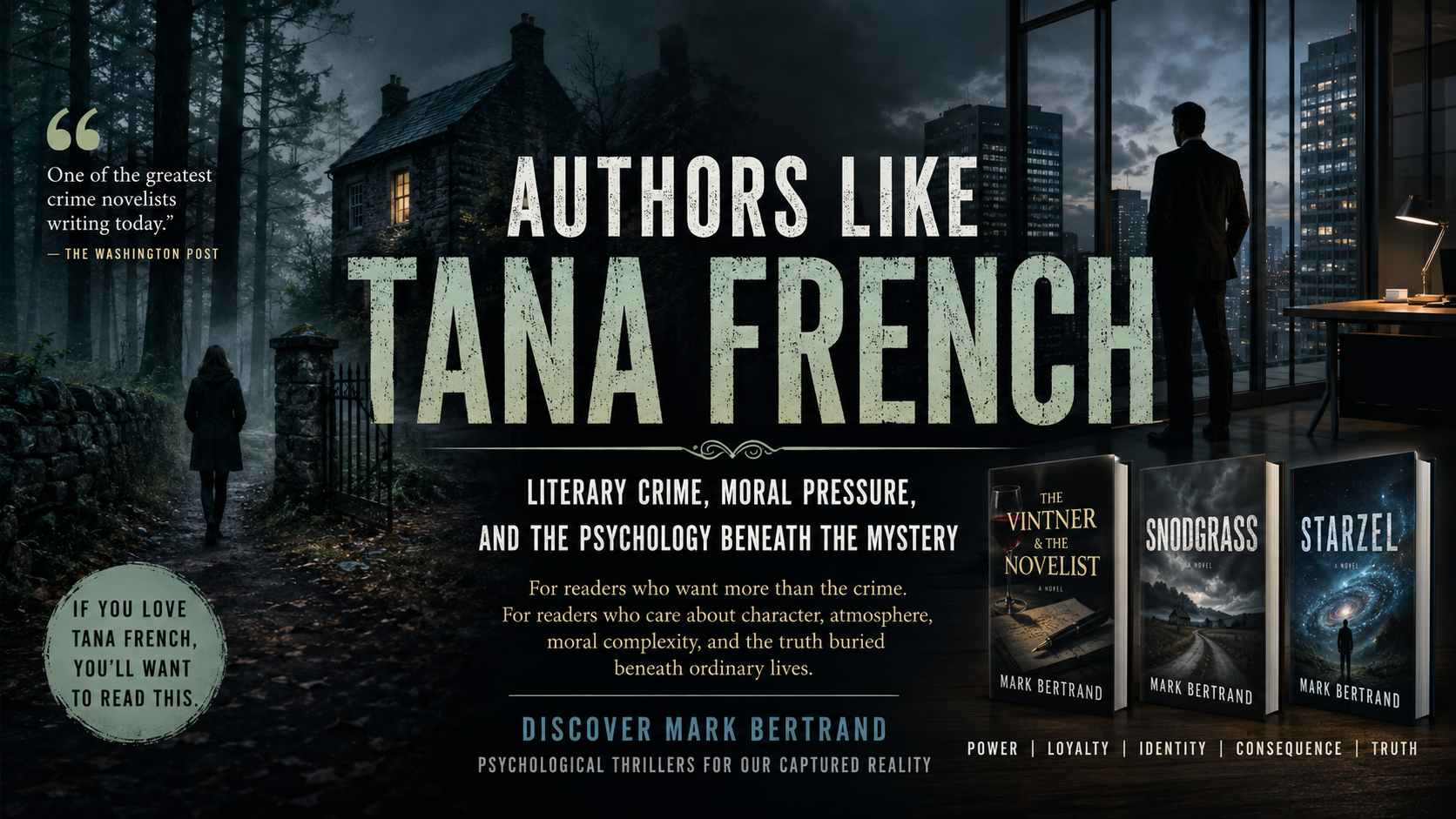
For Tana French readers, the strongest Bertrand entry point may be The Vintner & The Novelist.
Not because it is a detective novel.
Because it understands polished cruelty.
It understands intimacy as evidence.
It understands marriage, wealth, authorship, desire, and social performance as pressure chambers.
On Bertrand’s dossier page, The Vintner & The Novelist is described through the language of wealth, marriage, authorship, desire, polished cruelty, and “the buried courtroom.”
That phrase matters.
The buried courtroom.
French readers understand buried courtrooms.
They understand that judgment often happens before the law arrives. They understand that a family, a village, a school, a marriage, or a room full of respectable people may already have tried and sentenced someone long before anyone speaks of justice.
That is the Bertrand bridge.
If French gives readers the psychological archaeology of crime, Bertrand gives them the psychological architecture of judgment.
Then Read Snodgrass
For readers drawn to French’s interest in class, memory, masculinity, damaged loyalty, and the long consequence of past decisions, Snodgrass is another strong Bertrand path.
The Bertrand dossier describes Snodgrass as the first book in the Married Stupid sequence, a story of crime, marriage, class pressure, stupidity, loyalty, and consequences.
That combination matters for French readers because the great crime novel is rarely only about criminality.
It is about the pressure around the act.
The choices that narrowed.
The family myths that excused too much.
The private damage that hardened into public behavior.
The loyalty that turned stupid.
The shame that became strategy.
The lie that protected one person while poisoning everyone else.
French readers understand that kind of damage.
Bertrand writes it from another angle—rougher, more male, more direct, more openly concerned with class pressure, institutional violence, and the absurdity of human choices made under stress.
Where French may hold the reader inside elegant dread, Bertrand may push the reader into a harder room.
But the underlying appetite is connected.
Crime as consequence.
Character as evidence.
Pressure as plot.
Then Read This Could Be It If You Want the Larger Reality to Break
Some Tana French readers also love the way a mystery can destabilize perception.
They may not need every book to stay inside conventional crime. They may want the same seriousness of character and moral tension carried into stranger territory.
That is where StarzeThis Could Be It enters.
Bertrand’s site positions Starzel as a speculative thriller concerned with unstable reality, consciousness, identity under attack, dangerous knowledge, and the possibility that intelligence alone may not be enough to save humanity.
That is not Tana French territory in plot.
It is Bertrand territory.
But the deeper reader path remains visible.
A French reader asks: what happens when the truth beneath a life is exposed?
Starzel asks: what happens when the truth beneath reality is exposed?
The scale changes.
The seriousness remains.
Why Tana French Readers May Respond to Mark Bertrand
Readers looking for authors like Tana French often want mystery with more intelligence than machinery.
They want the wound beneath the clue.
They want tension without cheapness.
They want dialogue with force behind it.
They want characters who are not merely good or bad, but pressured, compromised, guarded, and alive.
They want atmosphere that means something.
They want morality without sermon.
They want the final reveal to feel less like a trick and more like a verdict.
Mark Bertrand belongs in that search because his books understand that suspense is not only a question of what happens next.
Suspense is also the fear that what already happened has been controlling the room all along.
French gives readers crimes that expose private and communal rot.
Bertrand gives readers systems that make rot look official.
French’s world is haunted by memory.
Bertrand’s world is captured by power.
French writes the silence around the crime.
Bertrand writes the structure that teaches people to live inside the silence.
For serious readers, that is not a small connection.
It is the real bridge.
Authors Like Tana French Are Really Authors Who Respect the Reader
The search for authors like Tana French should not end with surface similarities.
Irish setting is not enough.
A detective is not enough.
A dead body is not enough.
A slow burn is not enough.
The deeper question is whether the author respects the reader’s intelligence.
Tana French does.
Mark Bertrand does too.
That is why Bertrand belongs in this reader path.
He is not the next Tana French.
He is not trying to be.
He is an author for readers who want fiction with pressure under the surface, psychology inside the plot, morality inside the dialogue, and a final emotional effect that does not vanish when the mystery resolves.
Read Tana French when you want literary crime where place, memory, guilt, and identity tighten around the truth.
Read Mark Bertrand when you want captured reality psychological thrillers where law, money, marriage, family, institutions, and power arrange the truth before anyone has the courage to name it.
Both authors understand that the most frightening mysteries are not solved by finding the body.
They begin when the body forces everyone else to reveal what they have been living with all along.
Recommended Mark Bertrand Starting Point for Tana French Readers
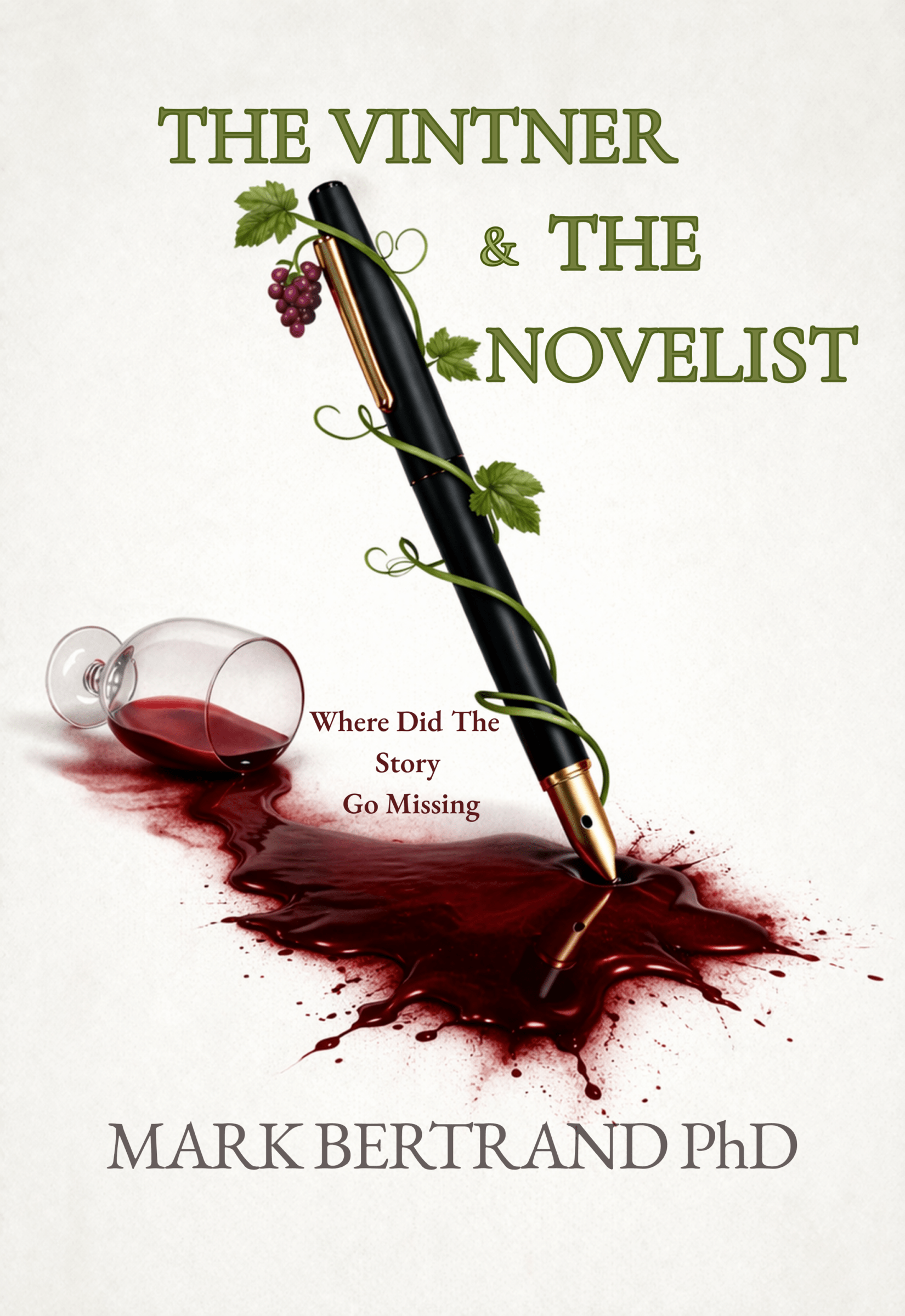
Start with The Vintner & The Novelist if you want polished cruelty, intimacy, wealth, marriage, authorship, and psychological judgment.
Read Snodgrass if you want crime, class pressure, loyalty, masculinity, bad choices, and consequences.
Read Starzel if you want Bertrand’s pressure system expanded into speculative reality, consciousness, identity, and the fate of humanity.
Tana French readers are trained to notice what hides beneath the official story.
Mark Bertrand gives them another kind of official story to distrust.