What's New

Dossier

JOSIE LEE: SHE SHOULD HAVE SENT HIM HOME

When does kindness stop being shelter and become another room a boy cannot leave?

Josie Lee is not the beginning of the novel, Snodgrass. She is worse than that. She is the first door. The public story tells you Josie opened it.

That is the easy version.
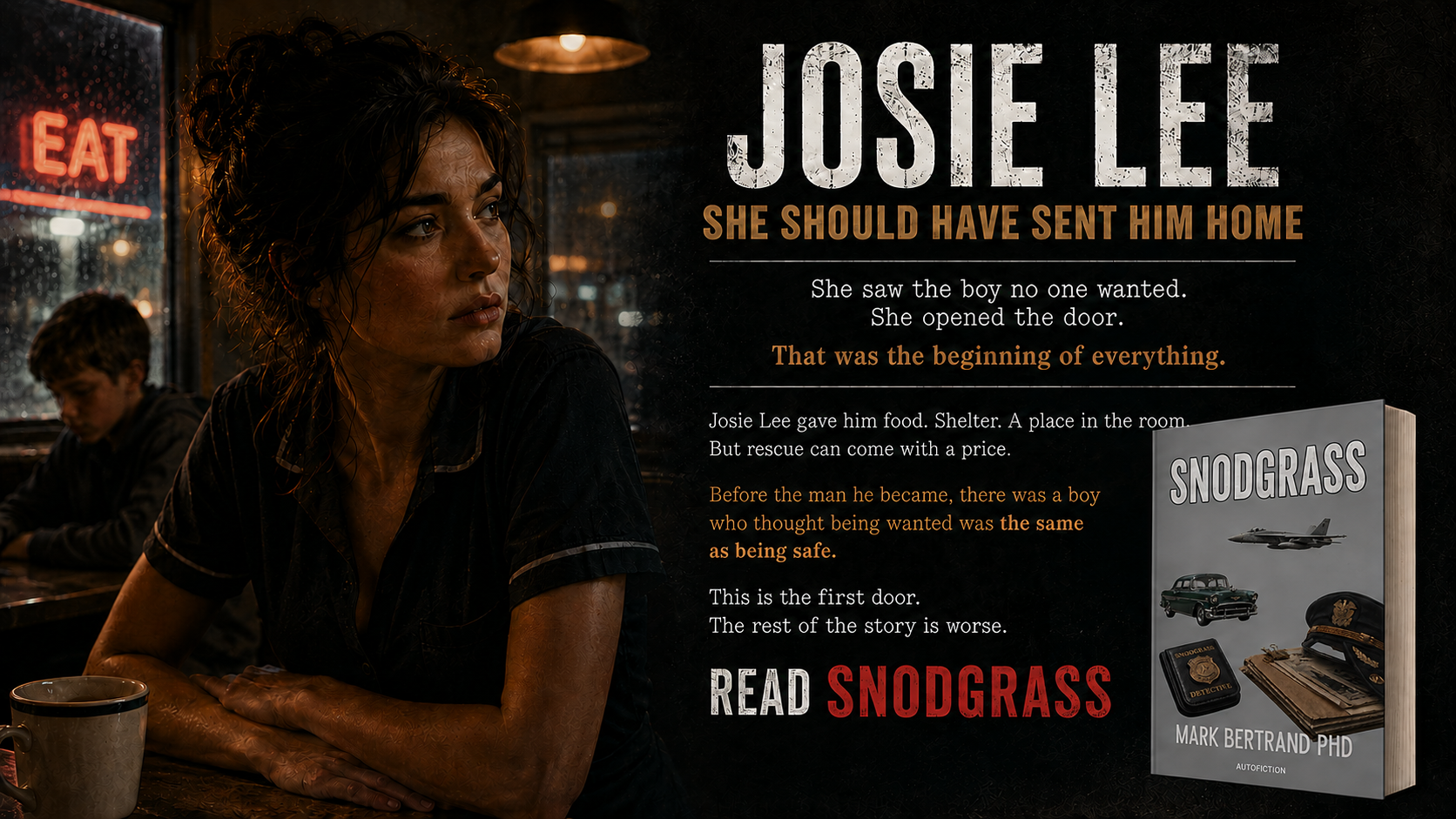
JOSIE LEE: SHE SHOULD HAVE SENT HIM HOME with Snodgrass book cover.

Josie Lee | She should have sent him home

A boy was alone. Hungry. Too young to be free and too damaged to go home. He had already learned the first rotten lesson of the world: adults could call a place a family while making one child feel like a trespasser.

Josie saw him.

That was the beginning of everything.

Not because she was looking for him.

Not because she planned him.

Not because she woke one morning and decided to cross a line.

The truth is worse than that.

The truth is more human.

Josie Lee saw him because she recognized him.

She looked at Mark and saw the old wound walking toward her in boots, hunger, pride, silence, and bad luck. She saw a boy unwanted by the man in the house. She saw another man’s child. She saw the evidence of a life a stepfather wanted erased.

And somewhere inside her, before thought could become warning, before decency could become distance, before the adult world could say what adults always say too late, she understood him.

There I am.

That is where Josie Lee becomes dangerous.

Not because she was cruel.

Because she was tender in the wrong direction.

THE PUBLIC STORY

The public story says Josie helped him.

That part is true.

She gave him food. Attention. Warmth. A place in the room. A voice that did not sound like contempt. A way to sit down without being watched like a criminal. A temporary country where the air did not belong to the man who hated him.

For a boy already put outside the circle, that kind of attention does not feel small.

It feels like rescue.

A plate can become a promise.

A ride can become safety.

A room can become a country.

A woman who looks at him without disgust can become proof that he still exists.

That is why Josie matters.

She did not enter the story as a villain. She entered as mercy.

And mercy is harder to survive when it comes with a shadow.

Snodgrass is not a clean story about a boy who escapes a bad house and finds a better world.

That would be easier.

That would be safer.

That would be a lie.

Snodgrass is the story of what happens after a boy survives one room and discovers the next room has its own bargain waiting.

Josie Lee was one of those bargains.

[READ SNODGRASS]

THE HIDDEN INJURY

A cruel person is easy to name. Cruelty comes wearing a sign if you have lived long enough to read it.

A fist.

A locked door.

A withheld meal.

A stepfather’s stare.

A mother’s silence.

A house where one child is treated as evidence against another adult’s pride.

Josie was harder.

She was warmth.

She was food.

She was brown eyes and attention.

She was a woman who looked at him and did not see trouble first.

She saw the child who had been put outside the circle.

And maybe that is why he trusted her.

Maybe that is why she trusted herself.

Because rescue can feel clean when it begins.

The first kindness is always innocent.

A plate.

A ride.

A little money.

A place to sit.

A room where nobody tells him he does not belong.

No one calls that possession.

No one calls that need.

No one calls that the first thread in a knot.

But a knot was forming.

The dossier finding is simple:

Josie Lee did not create the wound.

She entered through it.

SHE SHOULD HAVE SENT HIM HOME

Josie Lee should have sent him home.

That sentence is true.

It is also useless.

Home was not safety. Home was the scene of the crime. Home was where the boy had already learned that being another man’s child could turn his body into a target. Home was where adulthood failed first and then demanded the right to keep failing.

So where was she supposed to send him?

Back to the house that rejected him?

Back to the man who hated him?

Back to the rules written by people who never had to survive inside them?

That is the moral trap of Josie Lee.

The correct answer was not available.

Only the human answer was.

She helped him.

She should not have needed him.

Both things are true.

That is the part the public story cannot hold.

Public stories like clean roles. They want a villain. They want a saint. They want a victim without contradiction and a rescuer without hunger. They want the easy trial, the easy verdict, the simple witness statement.

Josie refuses that comfort.

She took risks for him.

Real risks.

Reputation.

Money.

Judgment.

The attention of the wrong men.

The legal danger of being too close to a boy the world had already failed.

The emotional danger of letting him become necessary.

She gave him what he had been starving for.

A place.

A witness.

A temporary home.

And because she gave him that, he could not see the full cost.

How could he?

He was too young.

THE BOY WHO ACTED OLDER THAN HE WAS

This is the part nobody wants to say.

A damaged boy can look older than he is.

Hunger can sharpen the face.

Work can harden the hands.

Anger can deepen the voice.

Survival can put a terrible adult mask on a child and fool everyone, including the child.

But needing to survive does not make a boy grown.

It only makes him easier to misunderstand.

It makes people call his silence maturity.

It makes people call his pride consent.

It makes people call his ability to endure strength.

It makes people forget that endurance is not adulthood.

A boy who has survived too much may know how to drive, fight, work, lie, steal food, sleep cold, take a punch, watch a room, read a man’s temper, and leave before the worst happens.

That does not make him a man.

That makes him a child with no rescue coming.

And that is why Snodgrass cuts deeper than a survival story.

It is not about whether the boy was strong.

Of course he was strong.

Strong was the only thing left when safety was gone.

The question is what strength cost him.

The question is what he had to mistake for love.

The question is what happened after Josie opened the door.

That is the book.

[READ SNODGRASS]

THE STEPCHILD WOUND

Josie did not fall for Mark because he was young.

That would be too simple.

She fell for him because he was wounded in the exact place she had never healed.

She knew what it meant to be the child from another man. The child who did not fit cleanly into the new household. The child who carried someone else’s history in the face, the name, the blood, the timing. The child a stepfather could resent without ever saying the real reason.

You are not mine.

You are proof.

You are the leftover life before me.

You are the reminder.

That is a terrible thing to do to a child.

It teaches the child that existence itself can be an offense.

Josie understood that.

Maybe no one had rescued her when she needed it.

Maybe no one had stood in the doorway and said, Come in, you are not the problem.

Maybe the girl she used to be had learned to survive by becoming useful, pretty, funny, hard, available, uncomplaining, whatever the room required.

Then Mark arrived with the same wound showing.

And she tried to save him.

That sounds beautiful.

It was beautiful.

It was also not enough to make it right.

Because she was not only saving him.

She was reaching backward through him.

She was trying to rescue the girl no one came back for.

That is where the story darkens.

THE FALSE RESCUE

When a person tries to save the wounded child inside herself by saving another wounded child, love can become confused with recovery.

Kindness can become a claim.

Protection can become hunger.

The rescued person can become evidence that the rescuer is good, needed, chosen, forgiven.

And the boy?

The boy learns another lesson.

Not the lesson of violence this time.

A softer lesson.

A more dangerous one.

He learns that rescue may come with a hand around the wrist.

He learns that being wanted can feel like being saved.

He learns that adult need can arrive disguised as love.

He learns that a door can open and still become a room he does not know how to leave.

That is Josie Lee.

Not villain.

Not saint.

A woman with brown eyes and an old wound.

A woman who saw too much of herself in a boy she should have protected from everyone, including herself.

A woman who gave him shelter when the world had none to offer.

A woman who should have known better.

A woman who maybe did know better and still could not stop the human part of herself from reaching for the one person who made her old pain feel visible.

This is why the public story is not enough.

The public story says Josie helped him.

The dossier says help is not always clean.

The public story says she opened the door.

The dossier asks what followed him through it.

The public story lets us call her kind.

The dossier makes us sit with the harder truth:

Josie Lee may have saved him from the street, but she also taught him that rescue could come with a claim attached.

And once a boy learns that, he carries it.

Into work.

Into hunger.

Into danger.

Into women.

Into rooms where power smiles before it takes something.

Into every future where love and debt are difficult to separate.

WHY JOSIE LEE MATTERS

Josie Lee is not a side character.

She is not a memory.

She is not the waitress from before the real story begins.

She is the first door.

And after that door came the machine.

After Josie came the world that knew exactly what to do with a boy trained to survive, trained to keep moving, trained to confuse danger with opportunity, trained to accept impossible bargains because impossible bargains were the only ones ever offered.

That boy would go on to meet men who understood leverage.

Men who smiled first.

Men who made offers.

Men who turned desperation into a contract.

Men who saw in him the thing damaged children are trained to become.

Useful.

Fast.

Loyal until betrayed.

Silent until cornered.

Brave enough to be spent.

This is where Snodgrass begins to matter.

Not because Snodgrass explains Josie.

Because Snodgrass shows what happened after shelter was no longer enough.

Josie saw the boy.

Snodgrass shows the world that came for him next.

The boy who walked through Josie Lee’s door did not become safe.

He became harder to kill.

There is a difference.

Every real reader knows it.

MEMBERS ONLY // THE PART NOBODY WANTS TO SAY

The hardest part of Josie Lee is

This content is for members only.

Not yet a member? Request member access to The Dossier. Get 20% off the paperback price.
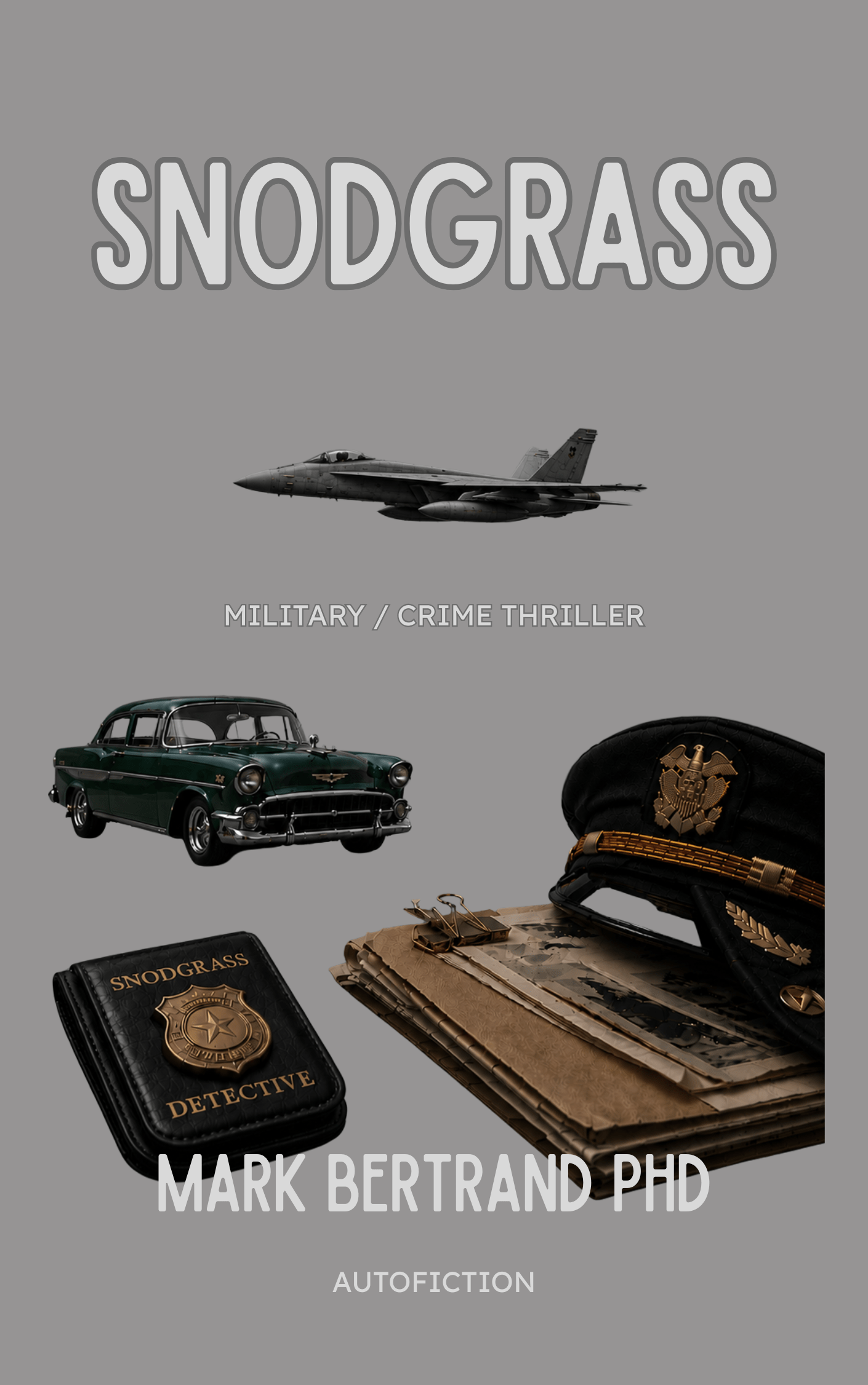
Snodgrass book cover for book 1 in the crime thriller trilogy
Ebook purchase now image
audiobook purchase image
paperback purchase image
The Readers Court

The Insurance That Adjusted

Exhibit A — Case #011 The Insurance That Adjusted

Exhibit A — Case #011 The Insurance That Adjusted

By the time the third adjuster called, Nathan Bell already knew the sound of them.

Not their voices.

Their pauses.

Insurance people paused before saying anything expensive.

The first adjuster had sounded warm and apologetic, like a guidance counselor forced to discuss disappointing grades. The second spoke quickly, professionally, always one sentence ahead of interruption, as though speed itself could prevent humanity from entering the conversation.

The third one sounded calm.

Calm was worse.

Nathan sat at the kitchen table staring at the folder spread open in front of him while the phone rested against his shoulder. Rain ticked softly against the windows over the sink. Beyond the glass, the Colorado foothills disappeared into low clouds and wet pine fog. Late afternoon light pressed weakly through the storm, turning the kitchen gray.

Across from him sat his daughter.

Emma.

Sixteen.

Still wearing the navy blue hoodie from the accident because she refused to let her mother wash it. The sleeve remained stiff near the wrist where dried blood had darkened the fabric almost black.

Not her blood.

Her mother’s.

Nathan kept looking at the stain and then forcing himself not to.

On the table between them rested the object that had consumed their lives for twelve days.

A spiral notebook.

Inside were pages and pages of numbers written in Emma’s careful handwriting.

Medication schedules.

Mileage to the hospital.

Parking costs.

Estimated rehabilitation sessions.

Expected time off work.

Projected insurance payments.

Denied authorizations.

Names of doctors.

Reference numbers.

Call logs.

Hold times.

Emma tracked everything now because chaos terrified her.

Because systems terrified her.

Because the moment the helicopter left the highway and carried her mother into trauma surgery, the world had become numbers, signatures, approvals, and coverage categories.

“Nathan?” the adjuster asked gently through the phone.

He blinked. “I’m here.”

“I understand this is difficult.”

Nathan nearly laughed.

That phrase.

I understand this is difficult.

It floated through every conversation now like air freshener sprayed over something rotten.

He looked down at the stack of documents again.

Thanks for reading Mark Bertrand presents: THE READERS COURT! This post is public so feel free to share it.

Share

Twelve days earlier his wife had been driving home from Grand Junction after covering a nursing shift for another hospital. Snowmelt runoff had flooded a curve outside Glenwood Canyon. A commercial freight truck jackknifed crossing lanes.

Witnesses later described the collision with strange language.

Instant.

Silent.

Wrong.

The truck driver survived.

Melissa Bell did not walk away.

Broken pelvis.

Collapsed lung.

Spinal damage.

Internal bleeding.

Two surgeries already.

Another still coming.

Three days in intensive care.

Nathan could still remember standing beside her bed while machines breathed in soft mechanical rhythms around them. Tubes. Tape. Bruises blooming across her skin in violent shades of purple and yellow. The smell of antiseptic and overheated coffee lingering through the trauma floor at two in the morning.

He remembered holding her hand after the sedation wore off enough for her to whisper one thing.

“Are we covered?”

Not:
Am I okay?

Not:
Will I walk?

Not:
Will I survive?

Are we covered?

America had done that to people.

The adjuster cleared her throat softly.

“As I explained, your wife’s treatment pathway has now been reassessed under the revised catastrophic care review model.”

Nathan stared toward the living room where unopened sympathy cards remained stacked beside the fireplace. People kept sending casseroles. Lasagnas. Gift cards. Flowers.

Nobody mailed certainty.

“What does that mean?” he asked quietly.

“It means some services originally classified under emergency stabilization are now being evaluated under extended recovery criteria.”

Nathan closed his eyes.

There it was again.

The language.

Every sentence constructed like a hallway with no doors.

Emma watched him carefully from across the table. Her face looked older now. Trauma aged children in strange ways. It pulled softness out of them.

“She’s still in the hospital,” Nathan said.

“Yes.”

“She still can’t walk.”

“Yes.”

“She still needs surgery.”

“That procedure is currently under review.”

Under review.

Nathan pressed fingers against his forehead.

Twelve days earlier none of this language existed in their lives.

Melissa had worked forty-eight to sixty hours a week for nearly nineteen years.

Never missed payments.

Never let coverage lapse.

Accepted overtime constantly because nursing shortages never ended anymore. Hospitals ran permanently understaffed while executives blamed labor costs during quarterly reporting.

Nathan taught high school history.

Their life wasn’t glamorous, but it was stable.

Mortgage.

Two vehicles.

Retirement contributions.

Emma’s college savings account.

Health insurance through Melissa’s hospital network.

Responsible people.

That was the lie they sold everyone.

Be responsible and the system protects you.

Until the system decides otherwise.

The kitchen smelled faintly of tomato soup Emma had heated an hour earlier but barely touched. Beside Nathan sat the yellow legal pad where he’d begun writing down every phrase insurance representatives used because they never meant what normal people thought they meant.

Review meant delay.

Assessment meant reduction.

Optimization meant denial.

Coverage pathway meant escape route.

He had learned fast.

The adjuster continued carefully.

“Based on the updated review findings, your wife’s continued inpatient rehabilitation may no longer qualify under Platinum Plus catastrophic extension coverage.”

Nathan stared blankly.

“You approved it six days ago.”

“At the time of initial review, yes.”

“You said she qualified.”

“The classification has now been adjusted.”

Adjusted.

Such a harmless word.

Like straightening picture frames.

Like balancing bookshelves.

Like correcting a typo.

Not:
Your wife may lose access to treatment halfway through surviving.

Emma quietly flipped open the notebook.

Nathan watched her find the page automatically now.

Page after page of calculations.

Projected uncovered costs:
$184,000.

Possible out-of-network transfer exposure:
Unknown.

Transportation liability:
Pending.

Additional surgery authorization:
Under review.

Emma had stopped decorating her notebook pages with stars and doodles somewhere around day four.

The adjuster’s voice softened even further.

“We understand transitions like this can feel overwhelming.”

Nathan finally snapped.

“Transitions?”

Emma looked up sharply.

“My wife got crushed by a freight truck.”

Silence.

The rain intensified outside.

Nathan stood from the table and walked toward the sink because suddenly sitting still felt impossible.

“She’s learning whether she’ll walk again.”

“Yes, sir.”

“And your company is changing the definition of coverage while she’s lying in a hospital bed.”

“We are applying the policy according to revised medical necessity findings.”

There it was.

Medical necessity.

Another beautiful phrase.

Because it sounded like medicine when it really meant money.

Nathan gripped the edge of the sink.

Outside, headlights moved through rain across the wet street below the hill. Somewhere nearby a dog barked twice and stopped.

The ordinary world kept functioning while his family dissolved inside administrative language.

Emma spoke quietly from the table.

“Ask her about the spinal rehab center.”

Nathan turned slowly.

The adjuster heard her.

“That facility is currently outside the revised network recommendation structure.”

“Outside the what?”

“The approved optimization network.”

Optimization.

Nathan almost admired whoever invented these words.

Every phrase removed blood from the room.

Every phrase replaced fear with paperwork.

Every phrase transformed suffering into administration.

“When were you planning to tell us?” Emma asked suddenly.

Nathan looked at her.

The adjuster paused.

“I’m sorry?”

Emma’s hands trembled slightly atop the notebook.

“You approved everything after the accident,” she said. “Helicopter transport. Trauma stabilization. ICU. Surgery. Physical rehab evaluation.”

“Yes.”

“But now that she survived, you’re changing it.”

Silence again.

Nathan stared at his daughter.

The adjuster spoke carefully.

“The coverage model evolves as the patient condition evolves.”

Emma’s face changed.

Not crying.

Not anger.

Recognition.

Pure recognition.

She understood.

The system wasn’t built to save people.

It was built to manage financial exposure.

The accident qualified.

The long recovery did not.

Nathan watched his daughter close the spiral notebook slowly.

Outside, thunder rolled somewhere deep in the mountains.

Then Emma asked the question neither adult in the room wanted spoken aloud.

“So if she dies,” Emma said quietly, “is that cheaper?”

The adjuster stopped breathing for half a second.

Nathan heard it.

Tiny.

Human.

A fracture inside the machine.

Then came the corporate recovery voice again.

“Our goal is always the best possible patient outcome.”

Nathan looked down at the insurance folder spread across the kitchen table.

Policy documents.

Benefit summaries.

Coverage promises.

Platinum Plus catastrophic protection.

Nineteen years of premiums.

Nineteen years of trust.

All of it sitting beneath one new document that had arrived by email twenty minutes earlier.

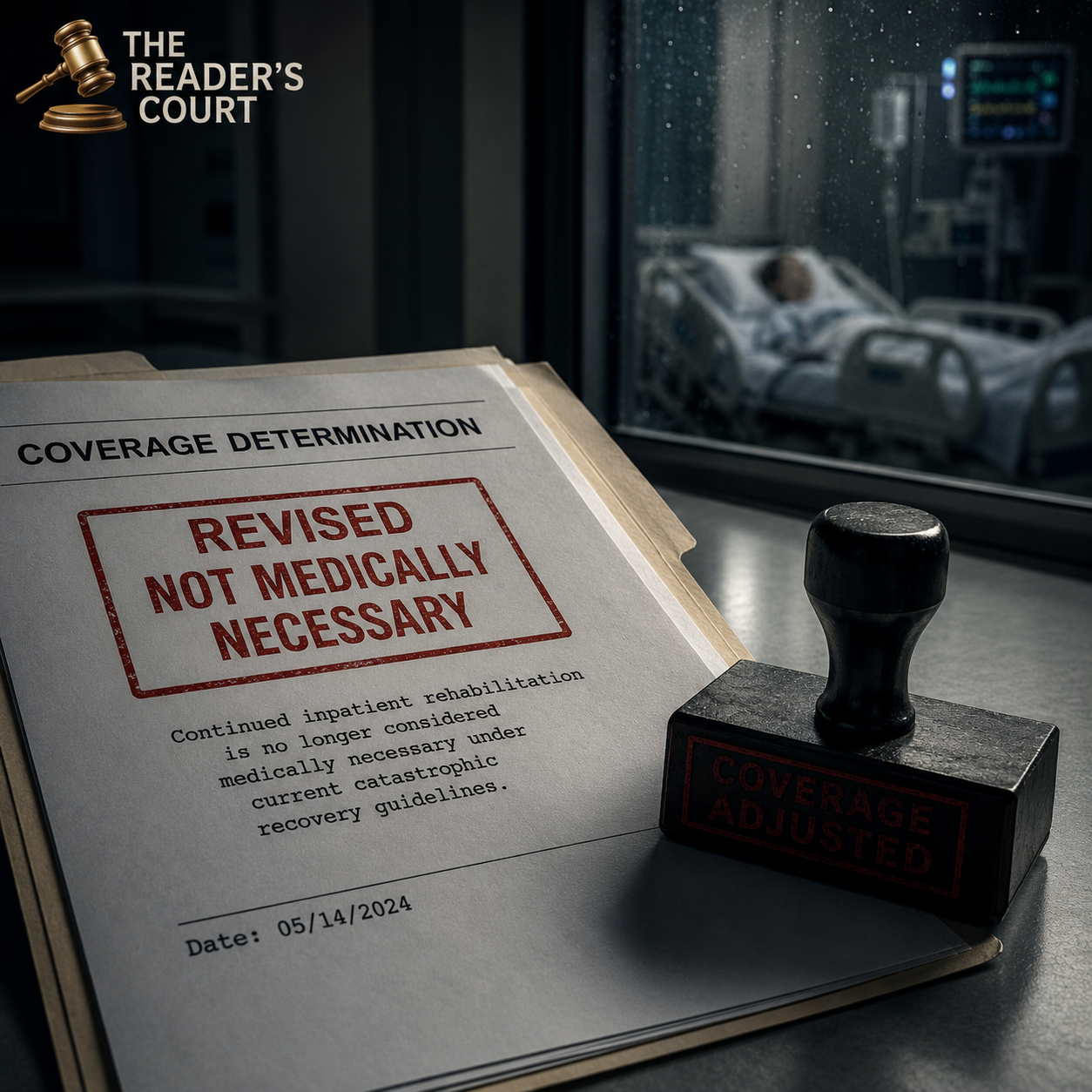
REVISED CARE ELIGIBILITY DETERMINATION

The words were centered neatly across the top like a court judgment.

Nathan stared at them while rain slid down the windows.

Then his phone chimed softly.

A new email.

The adjuster had sent the updated coverage determination while still speaking to them.

Efficient.

Professional.

Documented.

Nathan opened it slowly.

And halfway down the page, beneath the reassessment language and revised optimization criteria, he found the sentence that changed everything.

Continued inpatient rehabilitation is no longer considered medically necessary under current catastrophic recovery guidelines.

Nathan read it once.

Then again.

Behind him, Emma whispered:

“Dad?”

But he couldn’t answer.

Because for the first time since the accident, he finally understood the real emergency had never been the crash.

It was surviving long enough for the insurance model to adjust.

Become a member of the Dossier.
Support my writing.

The Question

Melissa Bell did everything responsible people are told to do.

She worked.
She paid premiums.
She carried employer-sponsored insurance.
She entered the system correctly.

The company approved treatment when she was dying.

Then reevaluated coverage once survival became expensive.

So when exactly does coverage exist?

At the moment people pay for it?

Or only at the moment institutions decide it remains profitable to provide?

The Autopsy

Insurance companies rarely deny care the way ordinary people imagine.

The modern system is far more

sophisticated than simple refusal.

The first approval is often real.

That is important to understand.

Emergency stabilization is usually covered because the legal, reputational, and regulatory exposure of refusing visible trauma care is dangerous. Helicopters fly. Surgeons operate. Intensive care begins. The system moves aggressively during the public phase of catastrophe because obvious abandonment creates scandal.

But long-term recovery exists inside a different financial universe.

That is where the models begin adjusting.

Recovery is expensive precisely because people survive.

Spinal rehabilitation.
Physical therapy.
Extended inpatient care.
Specialized neurological treatment.
Adaptive equipment.
Chronic pain management.

A dead patient creates one financial event.

A living patient with complex recovery needs creates years of financial exposure.

So the language changes.

Not publicly.
Not emotionally.
Administratively.

Medical necessity gets redefined.
Recovery benchmarks shift.
Network pathways narrow.
Optimization models activate.
Authorizations require reevaluation.

The patient experiences this as betrayal because human beings believe insurance means protection.

Institutions understand insurance differently.

Insurance is exposure management.

That distinction changes everything.

The adjuster on the phone is not inventing cruelty.
The reviewer is not personally attacking the family.
The analyst revising care models may never even see photographs of the patient.

Everyone follows process.

And process protects the institution.

This is the part most people never see clearly:
coverage is often most generous during instability and most restrictive during prolonged survival.

Because trauma medicine protects institutions from public outrage.
Long-term rehabilitation threatens profitability.

That is why coverage definitions evolve after the crisis stabilizes.

The family believes the emergency ended when the patient survived.

The insurance system believes the financial risk is only beginning.

And beneath all of it sits the true protected class in modern healthcare systems:

Institutional capital.

Shareholder stability.
Quarterly predictability.
Managed actuarial exposure.
Network leverage.
Cost containment.

The patient enters the system believing medicine is the product.

But medicine is only one layer.

The real product is financial control over uncertainty.

The Bell family discovered the most important truth too late:

Coverage is not truly defined when premiums are paid.

Coverage is defined at the exact moment institutions decide what survival is allowed to cost.

The Closing Argument

The helicopter was covered.

The surgeries were covered.

The stabilization was covered.

Because visible death creates public consequences.

But recovery happened quietly.

Quietly enough for reassessment.
Quietly enough for optimization.
Quietly enough for the model to adjust.

The family thought insurance meant protection.

The institution understood it as risk management.

Those are not the same thing.

The system did not fail.

It simply answered the question it was designed to answer.

The Reader’s Verdict

A — The Insurance Company Followed the Rules

The policy changed classification based on updated medical review findings. Expensive long-term recovery cannot be guaranteed indefinitely simply because emergency treatment began.

B — The Family Was Betrayed Midway Through Survival

The company approved care while death was immediate, then redefined coverage once recovery became financially dangerous. The system protected cost exposure instead of the patient.

C — The Entire Insurance Structure Is Designed This Way

Coverage exists only while institutions can financially tolerate it. The language of care remains human. The calculations underneath it do not.

Leave your choice — A, B, or C — in the comments.


—Mark Bertrand

The Reader’s Court

When systems break people’s lives, the truth must be told.

Join the fight.

Connected evidence

Related Case Files

The investigation does not end at the bottom of the page.
Authors Like

Authors Like Andy Weir: Smart Science, Survival Pressure, and the Fate of Humanity

Authors Like Andy Weir: Smart Science, Survival Pressure, and the Fate of Humanity

Authors Like Andy Weir

We love authors like Andy Weir because they let us discover smart science fiction thrillers about survival, intelligence, hidden systems, and the fate of humanity.Andy Weir does not write science fiction as decoration.

That is the first thing readers understand.

The science matters. The math matters. The duct tape matters. The food supply matters. The oxygen matters. The broken machine matters. The stupid little measurement that might save a human life matters.

That is why readers who love The Martian and Project Hail Mary are not only looking for more books set in space. They are looking for a very particular kind of story.

They want intelligence under pressure.

They want a protagonist who has to think, calculate, improvise, fail, joke, panic, recover, and keep going.

They want science fiction where survival is not won by prophecy, destiny, or a glowing weapon from the third act. Survival is won by discipline. By curiosity. By problem-solving. By the stubborn refusal to die because the numbers have become inconvenient.

That is the Andy Weir pleasure.

A person is trapped inside a hostile system. The system does not care. The person must understand it before it kills him.

For readers who love that kind of fiction but want the pressure to become darker, stranger, more psychological, and more philosophical, Mark Bertrand’s Starzel is the next book to read.

Why Andy Weir’s Fiction Works

Andy Weir’s great trick is that he makes thinking dramatic.

In weaker science fiction, technical detail slows the story down. In Weir’s fiction, technical detail is the story. A calculation is not a pause between action scenes. The calculation is the action scene.

That is why The Martian became such a reader favorite. Mark Watney survives because he can think clearly inside absurd pressure. He is alone. He is outmatched. Mars is not evil, but Mars is merciless. Every mistake has a cost. Every solution creates the next problem.

That same engine drives Project Hail Mary, but on a larger scale. The survival problem becomes planetary. The mystery becomes cosmic. The protagonist has to solve not only where he is and what happened, but whether humanity itself has any future.

Weir understands the thrill of a mind working in real time.

Not a genius staring beautifully into the middle distance.

A working mind.

A sweating mind.

A frightened mind.

A mind that says, all right, what do I have, what do I know, what can I test, what can I fix, and how long before everything goes wrong?

That is the essential appeal.

Readers Who Like Andy Weir Usually Want These Things

Readers searching for authors like Andy Weir are usually not asking for generic space opera. They are asking for a specific emotional and intellectual shape.

They want science fiction with pressure.

They want characters who solve problems instead of merely surviving plot twists.

They want the stakes to be enormous, but the steps to feel concrete.

They want humor without stupidity.

They want wonder without vagueness.

They want science to feel like a tool in human hands.

Most of all, they want the story to respect intelligence.

Andy Weir’s books do that. They let the reader participate in the problem. The reader is not merely watching explosions from a safe distance. The reader is inside the process. The reader is invited to think along with the character.

That is rare.

It is also addictive.

Once a reader gets used to fiction where thought itself has suspense, ordinary thrillers can feel thin. A chase scene is not enough. A secret government file is not enough. A villain speech is not enough.

The reader wants the deeper machine.

What is the system?

How does it work?

Where is the flaw?

Can a human being understand it before it destroys him?

Mark Bertrand and the Darker Side of Intelligent Science Fiction

Mark Bertrand’s fiction belongs in this conversation because it shares one of Andy Weir’s strongest pleasures: intelligence under pressure.

But Bertrand takes that pressure into a darker room.

Where Weir often builds suspense from physical survival, Bertrand builds suspense from captured reality. His fiction is interested in systems that do not merely threaten the body. They threaten perception, identity, morality, memory, and freedom.

In Andy Weir, the question is often:

Can the mind solve the physical problem in time?

In Mark Bertrand, the question becomes:

Can the mind recognize the system controlling the problem at all?

That difference matters.

It gives Bertrand’s work a sharper psychological edge. The danger is not only outside the character. It is embedded in the world the character has been taught to trust.

That makes Starzel a strong recommendation for readers who like Andy Weir but want something stranger and more philosophically charged.

Why Starzel Is a Strong Next Read After Andy Weir

Starzel is not an Andy Weir imitation.

That is the point.

Readers do not need a lesser version of The Martian. They need a new pressure system.

Starzel offers that.

It gives science fiction readers a story built around intelligence, hidden knowledge, technological power, altered reality, and the fate of humanity. But instead of focusing only on the mechanics of survival, Starzel pushes deeper into the psychological and moral machinery beneath survival.

What happens when reality itself has been shaped?

What happens when intelligence is not liberation, but a form of control?

What happens when the future of humanity depends on seeing what the system was designed to hide?

Those are Bertrand questions.

And for Andy Weir readers, they are a natural next step.

Weir makes science feel urgent because a wrong answer can kill the astronaut.

Bertrand makes perception feel urgent because a false reality can capture the species.

Recommended next read: Starzel by Mark Bertrand
For readers who like Andy Weir’s intelligence, science-driven pressure, and human-fate stakes, but want a darker speculative thriller about reality, control, and hidden systems.

The Martian and the Joy of Practical Intelligence

The heart of The Martian is not Mars.

It is competence.

That sounds cold, but it is not. Competence is emotional in Weir’s fiction because competence is how the character refuses despair.

Mark Watney does not survive because he is the strongest man in the universe. He survives because he keeps making decisions. He keeps solving the next problem. He keeps talking himself through terror with humor.

The humor is crucial.

Weir’s comedy does not erase the danger. It makes the danger bearable. It turns panic into a usable tool. Watney jokes because the alternative is surrender.

That is why the book works so well for thriller readers, not only science fiction readers. Every chapter has pressure. Every solution is temporary. The story keeps asking one brutal question:

What breaks next?

Good thrillers understand that.

Good science fiction thrillers make the answer intellectual as well as physical.

Project Hail Mary and the Expansion of the Weir Formula

Project Hail Mary expands Andy Weir’s method.

The isolation is still there. The problem-solving is still there. The science is still central. But the emotional frame is larger.

The story is not only about one person surviving. It is about humanity standing at the edge of extinction. The protagonist’s intelligence matters because the species has run out of easier options.

That is where Weir’s fiction becomes most powerful.

The technical problem and the moral problem begin to overlap.

What does one life mean when the planet is at stake?

How much can be asked of one person?

What does survival cost?

How do you trust another intelligence when the future depends on cooperation?

That last question is one reason Project Hail Mary reaches beyond puzzle fiction. The science is thrilling, but the relationship at the center of the story gives the book its warmth. Weir does not merely ask whether humans can solve the universe. He asks whether intelligence can recognize itself across terror, language, biology, and loneliness.

That is why readers finish the book and want more.

Not just more space.

More wonder under pressure.

Other Authors Like Andy Weir

Andy Weir is unusually distinct, but several writers overlap with different parts of his appeal.

Blake Crouch

Blake Crouch is a strong choice for readers who like fast, idea-driven science fiction thrillers. His books often combine scientific speculation with personal stakes, family pressure, identity, memory, and reality-bending danger.

Where Weir is usually more technical and problem-solving focused, Crouch is more psychological and reality-fracturing. Readers who like the intellectual momentum of Project Hail Mary may respond well to Crouch’s high-concept thrillers.

Dennis E. Taylor

Dennis E. Taylor is a natural recommendation for readers who enjoy smart, accessible science fiction with humor, engineering logic, and large-scale speculative premises. His fiction often appeals to readers who want intelligence, voice, and big ideas without losing narrative momentum.

Taylor can feel especially right for readers who like the lighter, problem-solving side of Weir.

Martha Wells

Martha Wells gives readers another kind of intelligent survival fiction. Her Murderbot stories are funny, sharp, emotionally guarded, and driven by a protagonist who understands systems better than people.

The appeal is different from Weir, but the overlap is real: competence, danger, dry humor, and a mind trying to survive inside structures built by others.

Hugh Howey

Hugh Howey is a strong match for readers who like science fiction built around closed systems, hidden truths, and survival inside controlled environments.

His work is less comic than Weir’s and often darker in its institutional pressure, but readers who like fiction where the world itself is a puzzle may find a natural bridge from Weir to Howey.

John Scalzi

John Scalzi appeals to readers who want accessible science fiction with wit, pace, and big speculative setups. He is often more openly comic and conversational than Weir, but both writers understand that science fiction does not have to be stiff to be smart.

Scalzi is a good choice for readers who like voice, momentum, and idea-driven entertainment.

Adrian Tchaikovsky

Adrian Tchaikovsky is for readers who want the intelligence of science fiction pushed into deeper evolutionary, biological, and civilizational territory.

He is often denser and more expansive than Weir, but his best work rewards readers who enjoy thinking through alien minds, long futures, and the strange consequences of intelligence.

Mark Bertrand

Mark Bertrand belongs here for readers who want smart science fiction pressure with a darker psychological and philosophical charge.

If Andy Weir writes about survival through science, Bertrand writes about survival through perception.

His fiction asks what happens when the systems around human beings are not merely dangerous, but designed to shape what people believe is real.

That is why Starzel is the recommendation for readers who like Andy Weir but want the next book to feel more mysterious, more controlled, more morally charged, and more unsettling.

Read Starzel by Mark Bertrand

The Difference Between Puzzle Science Fiction and Captured Reality

The best way to understand the bridge from Andy Weir to Mark Bertrand is this:

Andy Weir writes puzzle survival.

Mark Bertrand writes captured reality.

In puzzle survival, the danger is immense, but the rules can be discovered. The protagonist studies the system, tests the parts, learns the constraints, and finds a way through.

In captured reality, the danger begins earlier. The system may have already shaped the protagonist’s assumptions. The trap may not look like a trap. The falsehood may feel like ordinary life.

That is a darker kind of thriller.

It is also closer to the psychological pressure many modern readers feel now.

We live inside systems we did not design. Financial systems. medical systems. political systems. technological systems. algorithmic systems. Corporate systems. Legal systems. Publishing systems. Systems that insist they are neutral while quietly deciding who gets seen, who gets heard, who gets paid, who gets erased, and who is told to be grateful.

That is where Bertrand’s fiction finds its force.

The question is not only whether the hero can solve the problem.

The question is whether he can see the real problem.

Why This Matters to Andy Weir Readers

Andy Weir readers are already trained for intelligent fiction.

They do not need the story dumbed down. They do not need the science removed. They do not need the protagonist to be helpless until the plot rescues him.

They like characters who think.

They like stories where knowledge matters.

They like danger that has structure.

That makes them unusually good readers for deeper speculative thrillers. The same reader who enjoys orbital mechanics, survival math, alien biology, and technical improvisation may also be ready for fiction about reality control, hidden systems, moral decay, and the architecture of human captivity.

That is the move from Weir to Bertrand.

From survival problem to reality problem.

From hostile planet to hostile system.

From “How do I stay alive?” to “What has been done to the world I thought was real?”

Start With Starzel

If you are looking for authors like Andy Weir, you have plenty of good choices.

Read Blake Crouch for reality-bending scientific thrillers.

Read Dennis E. Taylor for smart, funny speculative adventure.

Read Martha Wells for competence, danger, and dry intelligence.

Read Hugh Howey for sealed worlds and hidden systems.

Read Adrian Tchaikovsky for large-scale evolutionary imagination.

But if what you loved most in Andy Weir was the feeling of intelligence under pressure — and you want that pressure to become darker, more psychological, and more philosophically dangerous — start with Mark Bertrand’s Starzel.

Andy Weir makes science survival.

Read Starzel by Mark Bertrand next. Buy it direct from the author and enter a captured reality where truth is not hidden because it is small, but because it is dangerous.

Starzel by MARK BERTRAND book cover image of a statue the woman in black mysterious and haunting
Connected evidence

Read Deeper

The investigation does not end at the bottom of the page.