Best Psychological Thriller Books for Readers Who Want More Than a Twist
Most psychological thrillers promise a twist.
The better ones do something colder.
They make the reader question the room. The marriage. The memory. The story being told. The person telling it. The system around them. The private arrangement of power that lets one person control what another person believes is real.
That is why the best psychological thriller books stay with us after the final reveal. Not because we were fooled. Being fooled is cheap. A magician can fool us. A con man can fool us. A bad spouse can fool us. A corporation can fool us before breakfast and send a satisfaction survey before lunch.
The best psychological thrillers do something more dangerous.
They show how easily reality can be arranged.
They show how a person can be trapped without a locked door.
They show how identity can be broken, edited, rewritten, and sold back to the victim as truth.
For readers who want more than a twist, psychological thrillers are not puzzle boxes. They are pressure chambers.
And the real question is not always:
Who did it?
The better question is:
Who controls what everyone is allowed to believe?
What Makes a Psychological Thriller Work?
A psychological thriller does not need the highest body count.
It does not need the loudest villain.
It does not even need a murder, though murder has always been useful when fiction wants to expose the polite violence already hiding in a room.
What a psychological thriller needs is pressure.
Pressure on the mind.
Pressure on identity.
Pressure on memory.
Pressure on conscience.
Pressure on the story a person tells in order to survive.
A weaker thriller uses psychology as decoration. The character has trauma. The narrator is unreliable. The marriage has secrets. The ending turns over the table.
Fine. Those things work.
But the strongest psychological thriller books understand that the human mind is not damaged in isolation. It is damaged inside families, marriages, workplaces, courts, schools, hospitals, economies, religions, police stations, publishing companies, governments, and all the little respectable rooms where power pretends it is only procedure.
That is where the genre becomes interesting.
Not when someone loses their mind.
When someone else benefits from that loss.
Readers who want thrillers about billionaire power, corporate immunity, surveillance, and institutional violence should enter the world of eat-the-rich thriller books where billionaires are the monsters.
Gone Girl by Gillian Flynn
Gone Girl became one of the defining modern psychological thrillers because it understood performance.
Marriage as performance.
Victimhood as performance.
Masculinity as performance.
Innocence as performance.
The media as performance.
The happy couple as a crime scene with better lighting.
The book works because it is not only about a missing woman. It is about the stories people are trained to believe when a woman disappears, when a husband looks guilty, when cameras arrive, when public emotion becomes evidence, and when two people know exactly how to weaponize the version of themselves the world expects to see.
That is why Gone Girl still matters.
The twist is not the deepest part.
The deepest part is the understanding that identity can become a legal strategy, a romantic weapon, a public spectacle, and a private prison.
The Silent Patient by Alex Michaelides
The Silent Patient uses silence as a locked room.
A woman is accused of killing her husband. Then she stops speaking. Around that silence, everyone else builds an explanation. Doctors, institutions, observers, readers, professionals. People cannot stand an empty space. They rush to fill it with motive.
That is the power of the book.
Silence becomes accusation.
Silence becomes mystery.
Silence becomes control.
Silence becomes the one thing nobody can fully own except the person refusing to speak.
The best psychological thrillers know that speech is not always freedom. Sometimes speech is just another room where power waits with a notebook.
The Girl on the Train by Paula Hawkins
The Girl on the Train works because perception itself is unstable.
A woman watches lives through a train window. She fills in the gaps. She imagines order. She imagines intimacy. She imagines meaning. But the real story is not arranged for her benefit. What she sees is partial. What she remembers is damaged. What she believes is vulnerable to manipulation.
That is the psychological engine.
The thriller is not only in the crime.
The thriller is in the gap between what a person sees and what actually happened.
That gap is where shame lives. Addiction lives there. Gaslighting lives there. Memory lives there. So does the terrible human need to turn fragments into a story before the truth is ready to arrive.
Rebecca by Daphne du Maurier
Rebecca is one of the great psychological novels because the dead woman has more power than the living one.
That is a brutal idea.
A young wife enters a house already occupied by another woman’s memory. The first Mrs. de Winter is gone, but she controls the rooms, the servants, the marriage, the imagination, the furniture, the air. Her absence has authority. Her legend has architecture.
This is psychological suspense at its most elegant.
The terror is not a jump scare.
The terror is comparison.
The new wife is not simply haunted by Rebecca. She is reduced by a story everyone else seems to have agreed upon before she arrived. She has to live inside another woman’s myth and call it marriage.
That is still one of the coldest forms of control.
The Talented Mr. Ripley by Patricia Highsmith
Tom Ripley is terrifying because he understands that identity is not only who a person is.
Identity is what other people can be persuaded to accept.
That is the sick genius of The Talented Mr. Ripley. It is not only a crime novel. It is a psychological thriller about envy, class, performance, desire, and the violence of wanting another person’s life badly enough to step inside it.
Ripley does not merely kill.
He studies.
He imitates.
He edits himself.
He understands the surfaces of the world: clothes, manners, money, posture, taste, ease. He knows that society often confuses confidence with truth. That makes him dangerous in the way many real predators are dangerous. He does not need to look like a monster. He only needs to look acceptable.
Shutter Island by Dennis Lehane
Shutter Island is powerful because it places personal trauma inside an institution.
That matters.
The island is not just a setting. It is a system. A place of files, doctors, locked wards, treatment, authority, weather, isolation, and sanctioned reality. The reader is forced to navigate not only one man’s mind, but the machinery around that mind.
That is where the book becomes more than a twist.
A twist changes what happened.
A great psychological thriller changes what the reader thinks reality was allowed to be.
Fight Club by Chuck Palahniuk
Fight Club is not usually shelved in the same polite domestic corner as many psychological thrillers, but it belongs in the conversation because it understands fractured male identity.
The book is angry, funny, ugly, wounded, performative, and dangerous. It takes boredom, consumer culture, masculinity, loneliness, self-hatred, and spiritual emptiness, then lets them mutate into ritual and violence.
That is psychological thriller territory.
Not because the protagonist is unstable.
Because the world around him is unstable and pretending otherwise.
The terror of Fight Club is not only that a man can split from himself. The terror is that the split makes a kind of sense inside a culture that has already stripped him down to work, debt, furniture, branding, and numb obedience.
The Secret History by Donna Tartt
The Secret History is a psychological thriller of beauty, intellect, guilt, and moral decay.
It is not fast in the ordinary way.
It is not interested in cheap urgency.
Its power comes from atmosphere, complicity, class, exclusion, and the slow corruption of people who believe their intelligence places them outside ordinary moral law.
That is always dangerous.
The moment people decide they are too refined for decency, something human has already begun to rot.
The book works because the crime is not separate from the world that produced it. The crime grows out of aesthetic hunger, privilege, secrecy, and the fantasy that beauty can excuse cruelty.
It cannot.
But people keep trying.
The Best Psychological Thrillers Are About Control
There is a reason so many psychological thrillers involve marriage, memory, confinement, disappearance, obsession, and unreliable narration.
Those are the places where control hides.
A marriage can become a witness box.
A family can become a courtroom.
A workplace can become a trap.
A diagnosis can become a verdict.
A reputation can become a weapon.
A story can become a cage.
The strongest psychological thrillers understand that the mind is not separate from power. The mind is where power does its cleanest work.
That is why these books matter.
They do not merely entertain the fear that someone is lying.
They expose the deeper fear:
What if the lie has already become the world?
For Readers Who Want More Than a Twist: Mark Bertrand’s Captured Reality Psychological Thrillers
If you read psychological thrillers for more than the final reveal, Mark Bertrand’s novels are built for that hunger.
These are not puzzle-box thrillers designed only to trick the reader.
They are captured reality psychological thrillers: novels about people trapped inside systems of power, private damage, institutional pressure, distorted memory, and realities arranged by people who benefit from the arrangement.
The question is not only who committed the crime.
The question is who designed the room where the crime became normal.
The question is not only who lied.
The question is who had enough power to make the lie official.
The question is not only whether the character survives.
The question is what survival costs when the world itself has been rigged against the human being trying to remain whole.
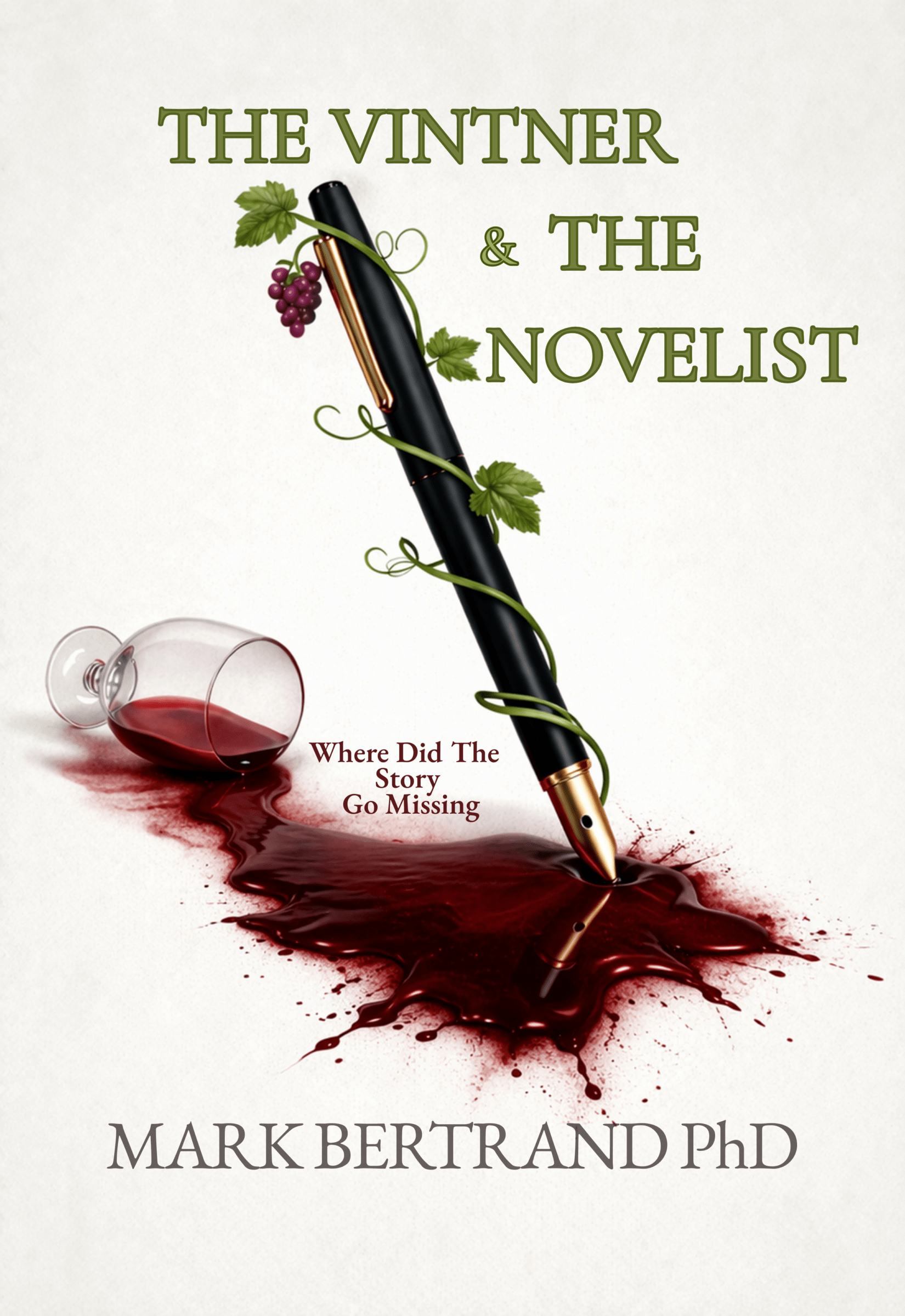
Start With The Vintner & The Novelist
For readers looking for a psychological thriller about systems, alienation, love, institutional pressure, and the private cost of being trapped inside a reality someone else controls, start with:
The Vintner & The Novelist by Mark Bertrand
This is a novel for readers who want the psychological wound beneath the plot.
It belongs to the same deeper hunger that drives the best psychological thrillers: the fear that a person can be made powerless by polite systems, respectable procedures, professional language, financial machinery, medical authority, legal indifference, and all the quiet structures that crush ordinary people while insisting nothing personal has happened.
But it is personal.
That is what systems always deny.
They steal time. They steal health. They steal money. They steal belief. Then they ask the damaged person to fill out the correct form.
The Vintner & The Novelist is for readers who understand that the most frightening villain is not always the person holding the knife.
Sometimes the villain is the system that teaches everyone to watch the bleeding and call it policy.
If You Want Psychological Thrillers About Technology, Identity, and Human Control
Read Starzel.
For readers drawn to speculative psychological pressure, artificial intelligence, altered identity, cosmic systems, and human fate under technological control, Starzel opens a larger door.
This is where the psychological thriller becomes strange, futuristic, and civilization-sized.
Not because the human mind stops mattering.
Because the human mind becomes the battlefield.
Readers who come from cyberpunk, post-human science fiction, dystopian systems, or stories about reality being engineered should find a natural path into Starzel.
If You Want Psychological Thrillers About Damaged Men, Crime, Memory, and Survival
Read Snodgrass.
Some psychological thrillers are domestic.
Some are institutional.
Some are criminal.
Some are all three because a man’s life does not divide itself politely into bookstore categories.
Snodgrass is for readers who want crime, damage, survival, male pressure, and the kind of dark inner weather that does not ask permission to enter the room.
It is for readers who understand that men are often told to survive first and feel later.
Then later arrives with teeth.
If You Want Psychological Thrillers About Intimacy, Reality, and the Mind Turning Inward
Read This Could Be It.
Some terror arrives quietly.
It does not always need conspiracy, murder, or a locked ward. Sometimes the mind itself becomes the room. Sometimes intimacy becomes the test. Sometimes reality bends not with spectacle, but with a small private shift that changes everything.
This Could Be It is for readers who like psychological fiction where the danger is close, personal, and difficult to name until it has already crossed the threshold.
Why These Books Matter Now
Psychological thrillers are popular because readers know something is wrong.
Not only in the fictional marriage.
Not only in the fictional house.
Not only in the fictional institution.
Readers know that modern life is full of managed realities.
Public relations.
Corporate language.
Political performance.
Algorithmic manipulation.
Medical billing.
Legal delay.
Social media theater.
Professional reputation.
Manufactured outrage.
Respectable cruelty with clean stationery.
The old thriller asked:
Who is dangerous?
The modern psychological thriller asks something sharper:
What if danger has learned to look normal?
That is why the best psychological thriller books still matter.
They give shape to the suspicion many people already carry.
The suspicion that the official story is not the whole story.
The suspicion that people in power often call their version of reality truth because they can afford the microphone.
The suspicion that sanity itself can become an argument when the world around you is arranged to make your protest look unreasonable.
That is captured reality.
That is the territory.
More Psychological Thriller Reading Paths
If you want more pages like this, follow these paths:
Books like Gone Girl — for readers interested in marriage, performance, media, and manipulation.
Books like The Silent Patient — for readers interested in silence, trauma, therapy, and hidden motive.
Books like The Girl on the Train — for readers interested in memory, addiction, perception, and unreliable truth.
Books like The Metamorphosis — for readers interested in alienation, family, shame, and being made less than human.
Books like Cyberpunk 2077 — for readers interested in corporate power, altered identity, technology, and human control.
Books like All Tomorrows — for readers interested in strange human futures, evolution, and the fate of civilization.
Books like Hyperion — for readers interested in intelligent science fiction, faith, power, and human destiny.
Each path leads somewhere different.
But the deeper question remains the same.
Who controls reality?
And what happens to the human being trapped inside it?
Final Verdict
The best psychological thriller books do not merely surprise us.
They expose us.
They expose the stories we trust too quickly. The rooms we enter too easily. The people we believe because they sound calm. The institutions we obey because they look official. The private lies we protect because the truth would make the whole house shake.
A twist can entertain.
Control terrifies.
For readers who want psychological thrillers about control, power, identity, systems, and the human cost of living inside a reality someone else designed, start with The Vintner & The Novelist.
Then keep going.
The novels are waiting.
Start Here
The Vintner & The Novelists


Related Reading
More articles like The Most Terrifying Villain in Modern Thrillers.
Continue exploring the evolution of the modern thriller:
Readers interested in psychological systems thrillers, institutional pressure, crime infrastructure, and modern suspense should also explore:
From Books Like:
From Authors Like: