
He only noticed the blank because everything around it was trying so hard to look complete.
_ _ _ _ _ _ _ _ _ _ _ _ _ _ _
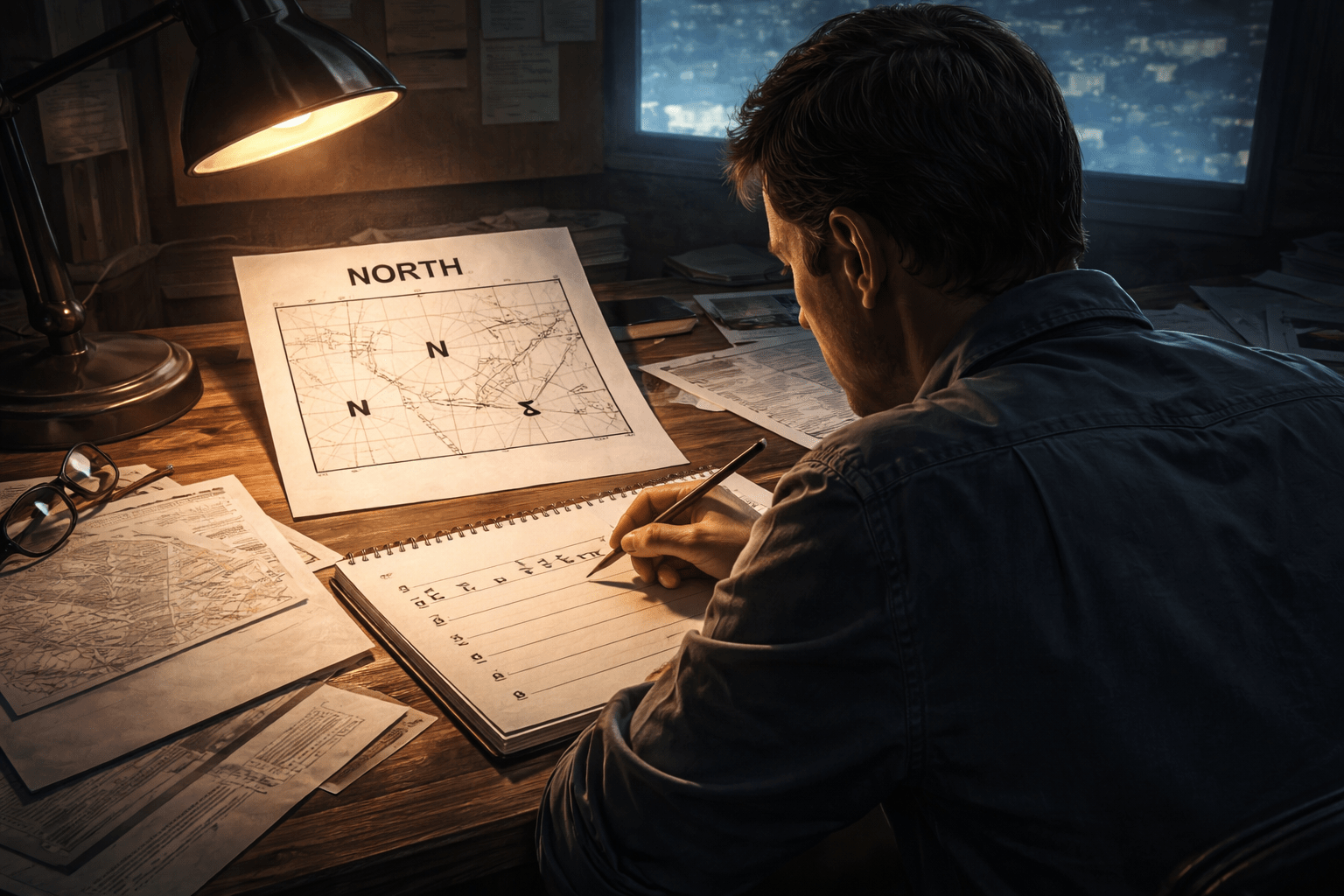
That was how the system protected itself. Not with darkness. Not with locks. With polish. With finished language. With pages that appeared resolved before anyone had the chance to question what had been removed from them.
He had been reading for hours when he found the omission. Not a redaction. Not a tear. Not corruption in the file. Something worse.
A clean absence.
A sentence built to carry weight, and then, at the point where the meaning should have landed, a space.
He stared at it until the room seemed to narrow around him.
By then he knew better than to dismiss these things. He had already seen too much. Lines that repeated across agencies that had no reason to share language. Memos that echoed each other without attribution. Stories that looked unrelated until they bent, one by one, toward the same hidden shape.
He had stopped calling them coincidences.
He had also stopped writing anything into the system.
Instead, he kept a page folded inside a cheap notebook he never brought to work in daylight. On it was a single line of FIFTEEN empty spaces. Some of them were filled now. Most were not. He had drawn them carefully, with the precision of a man who no longer trusted accidents.
He did not know what the completed line would become.
Not yet.
But he knew enough to understand this:
It was not decorative.
It was not theoretical.
And it had not been left behind by careless people.
Someone had wanted this found.
That thought had disturbed him at first. It made the whole thing feel larger, closer, more intimate than any ordinary secret. A hidden program could be uncovered. A conspiracy could be mapped. But a message waiting patiently inside the machinery of public life for exactly the right reader to arrive and recognize it—
that felt personal.
He went back to the file.
The document had been stored in a planning archive under a title so sterile it almost disappeared: Civic Continuity Review. No author. No signature. No access restriction. He had opened it because the date was wrong. The report had been logged three years before the office that supposedly issued it had even existed.
He had expected incompetence.
He found intent.
The first page was harmless enough. Language about stability, transition, trust preservation, distributed administration. The kind of prose designed to sedate the eye. The second page became stranger. Sentences began to repeat with small variations, as if the writer had been testing which version could pass closest to the truth without being stopped.
The third page broke pattern.
Halfway down, separated from the paragraph above it by too much white space, was a single sentence:
When the structure forgets the people, the people must remember the structure.
He read it twice.
Then three times.
It was not a slogan. It was not rhetoric. It felt like something else. An instruction, perhaps. Or a warning written by someone who had run out of safer ways to speak.
Below it was a diagram.
Simple. Almost childish.
A square. Four boundary lines. Several circles marked inside it like positions on a field or pressure points on a body. No legend. No labels. Just one word printed at the top edge of the square:
North
He felt the skin tighten at the back of his neck.
Not because the diagram made sense.
Because it didn’t.
It did not belong in a continuity review. It did not support the surrounding text. It was an intrusion. A deliberate fracture in the document’s official voice. The sort of thing no competent committee would allow and no careless clerk would invent.
He took his hand off the mouse and sat very still.
There was a time, not long ago, when this would have sent him in the wrong direction. He would have looked for the joke, the error, the damaged draft that somehow made its way into production. He would have assumed there was a reasonable explanation because reasonable explanations let a man keep his life intact.
That reflex was gone now.
He had seen too many immaculate lies.
He lowered his eyes to the notebook on the desk beside him. The line of blank spaces seemed almost to watch him back. Not demanding. Waiting.
He looked again at the diagram.
A square. Boundaries.
Positions.
Orientation.
Not decoration. Structure.
And the word above it, sitting there with an almost unbearable calm, telling him how to read what followed.
He did not write immediately. He had made that mistake once before—moving too quickly, wanting the thing in his hands before he had earned it. Now he forced himself to slow down. He printed the page to a disconnected machine down the hall, waited through the mechanical groan of the rollers, and carried the sheet back like contraband.
At his desk, under the yellow pool of a weak lamp, he studied the paper version.
There were no stray marks.
No initials.
No code string tucked into the footer.
Nothing except the sentence, the diagram, and the word.
He angled the page.
Turned it.
Read the sentence against the shape instead of above it.
That was when he understood what had been bothering him.
The square wasn’t a square.
Not really.
It was a map frame.
The circles weren’t decorative positions. They were placements. Not yet named, but waiting to be named. Waiting for the right orientation to turn confusion into direction.
He felt a slow pulse move through him, not fear exactly, but the kind of pressure that comes when a locked room gives off the first hint of a door.
Until then, every clue had felt like proof that something hidden existed.
This felt different.
This felt usable.
He looked at the line in his notebook again. The blanks. The letters he had already placed. The pattern he had refused to force. What if the final shape was not meant to be admired? What if it was meant to be followed?
A direction.
A place.
A way in.
For the first time since this began, hope arrived without apology.
It was small at first. Cautious. Almost embarrassed to be there. Men in his position did not allow themselves much hope. Hope made noise. Hope made you careless. Hope made you visible.
But this was not the loud hope of speeches or headlines or men promising reform with cameras on them.
This was quieter.
Stronger.
The hope that comes when design reveals itself.
When what seemed impossible begins to look merely hidden.
When you realize the machine is not perfect, only protected.
He let that settle.
Then he reached for the pencil.
He filled the next space carefully, as he always did, with the restraint of a man handling live current. He did not need to see the whole line completed to know this one mattered. He could feel it. The way you feel a stair beneath your foot in the dark and understand there is a way down, or through, or out.
He sat back and read the sentence one more time.
When the structure forgets the people, the people must remember the structure.
That was not despair.
It only sounded like despair to people who had already surrendered.
No, this was something else.
A transfer of duty.
A refusal to vanish.
A quiet acknowledgment that the design, however buried, still belonged to those it had been built for.
Outside, somewhere beyond the building, a siren moved through the city and faded. The ventilation system hummed above him. Fluorescent lights buzzed in distant offices where men and women performed the rituals of maintenance, compliance, delay.
He imagined all the pages still buried.
All the fragments still waiting.
All the careful hands that might have placed them in the path of someone they would never meet.
Not to terrify him.
To reach him.
To tell him the thing had not been lost, only hidden.
To tell him that hidden was not the same as gone.
To tell him that if the line could be completed, the path could be found.
He closed the notebook and rested his hand on the cover.
Then he looked back at the printed page, at the word at the top of the frame, and felt the pull of it—not just as a clue, but as a promise.
Not everything buried was dead.
Some things were waiting to be brought back.
There was one hint now. He hadn’t seen it before. Inside case 009. Haunted him now. It was obvious where understanding this would lead. The Readers Court