
The Billionaire Replaced the Serial Killer: How Modern Thrillers Changed
The Modern Thriller No Longer Fears the Same Monsters
The Billionaire Replaced the Serial Killer. For decades, thriller fiction relied on familiar machinery. The danger was usually visible, immediate, and deeply personal. Somewhere out there, hidden beneath the surface of ordinary life, a violent man was waiting. A serial killer. A rogue agent. A terrorist. A corrupt cop. A criminal mastermind operating behind locked doors and classified files.
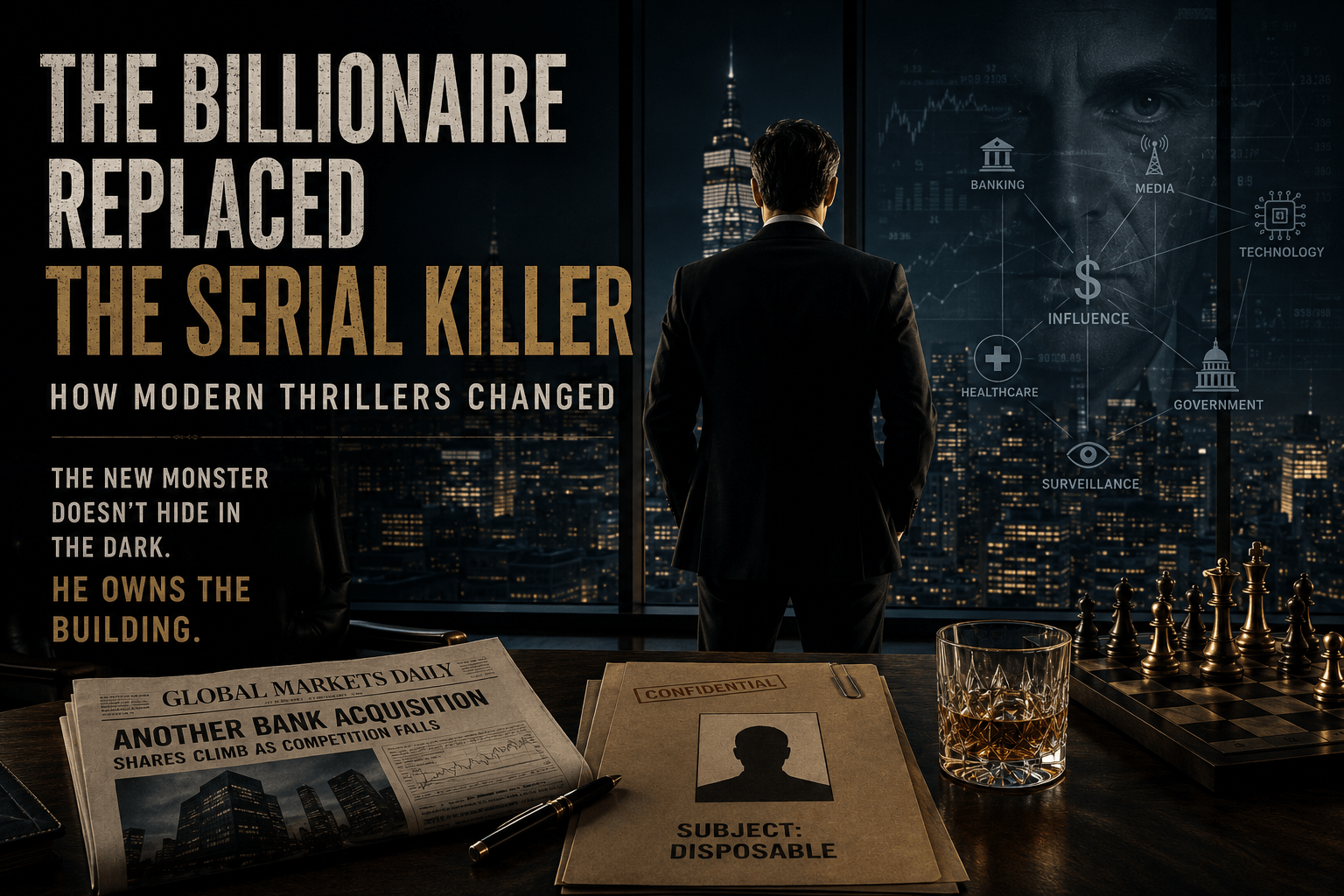
The structure rarely changed because the fear itself rarely changed. A detective hunted the killer. A hero uncovered the conspiracy. Time ran out. Bodies accumulated. The system trembled but survived.
But modern fear evolved.
Most people today are not psychologically haunted by masked predators lurking behind dark corners. They are haunted by structures they already live inside. Banks. Insurance companies. Algorithms. Corporate systems. Financial dependency. Institutional indifference. Invisible networks deciding what opportunities survive and which people quietly disappear.
That emotional shift changed the modern thriller whether the genre fully realized it or not.
The old monster attacked from outside society.
The new monster often owns part of it.
And that may be why the billionaire replaced the serial killer.
The Old Thriller Monster Had a Face
Classic thrillers depended on identifiable evil because identifiable evil creates clarity. Readers understood the threat immediately. The villain murdered people, manipulated governments, detonated bombs, or operated criminal enterprises hidden from ordinary society. However dark the story became, the structure remained comforting in one important way: the danger could still be isolated.
Find the monster.
Expose the truth.
Restore order.
But modern systems no longer feel that simple.
Today, enormous human damage is often inflicted procedurally, financially, institutionally, or psychologically by people who appear completely legitimate on the surface. Nobody needs a basement dungeon anymore when a denial letter, a manipulated narrative, a risk model, or a financial collapse can quietly destroy someone’s life just as effectively.
That is what changed the emotional architecture of suspense.
The modern reader increasingly understands that destruction rarely announces itself dramatically. It arrives professionally. Politely. Wrapped in policy language, legal disclaimers, compliance structures, optimization strategies, and carefully managed public narratives.
The system harms people while continuing to describe itself as functional.
That realization unsettles readers more deeply than many traditional thriller villains ever could.
Why Modern Fear Became Psychological
Modern life places people beneath constant invisible pressure. Economic instability, institutional dependency, algorithmic influence, data collection, reputational vulnerability, and financial precarity all create the lingering feeling that ordinary life itself has become fragile.
That changes suspense profoundly.
The old thriller asked:
Who is hunting me?
The modern thriller increasingly asks:
What happens if the system controlling my life stops recognizing me as human?
That fear feels psychologically heavier because systems do not require hatred to destroy people. They only require indifference operating at scale.
An insurance network does not hate the patient.
A bank does not hate the borrower.
An algorithm does not hate the worker.
A corporation does not hate the employee it eliminates.
The damage occurs anyway.
And because the harm is diffused across structures, procedures, policies, and institutional language, responsibility becomes difficult to isolate cleanly. The cruelty no longer feels theatrical. It feels normalized.
That normalization may be one of the defining anxieties beneath modern thriller fiction.
The Billionaire Replaced the Serial Killer And Became Modern Thriller Antagonists
The billionaire replaced the serial killer figure represents a form of power older thriller villains often lacked: legitimacy.
Not cartoon evil.
Not hidden volcano lairs.
Not dramatic declarations about world domination.
Modern billionaire antagonists influence infrastructure, media, labor systems, information flow, technological development, financial markets, and political environments while remaining publicly respectable. They appear in magazines, testify before governments, fund institutions, shape public discourse, and increasingly influence the systems ordinary people depend on to survive.
The disturbing part is not simply that this power exists.
The disturbing part is how lawful it often appears.
The new thriller conspiracy no longer hides entirely in darkness. Much of it operates comfortably in public view, protected by complexity, legality, institutional relationships, and public exhaustion.
Modern readers recognize this intuitively. They understand that power no longer arrives only through violence. Sometimes it arrives through ownership. Through systems. Through the ability to shape narrative, opportunity, perception, information, and dependency itself.
That evolution changed what modern antagonists represent.
The villain no longer needs to break society’s rules.
Increasingly, the villain benefits from them.
The Modern Thriller Is About Pressure
Violence still matters in thrillers. It always will. But modern suspense increasingly understands that people are often destroyed psychologically, financially, socially, or institutionally long before physical violence ever enters the story.
That evolution changed the modern protagonist as well.
He is no longer simply chasing a killer through dark corridors. More often, he is surviving pressure. Pressure from collapsing authority structures, manipulated narratives, criminal systems, financial instability, institutional weakness, psychological destabilization, and structures pretending to function normally while quietly consuming the people trapped inside them.
That is why many contemporary thrillers feel closer to real life than older suspense fiction. Readers recognize the pressure because they already live beneath versions of it every day.
The fear no longer comes only from what can kill you.
The fear comes from what can slowly reduce your humanity while insisting everything is operating exactly as designed.
Where BERTRAND Fits
BERTRAND by Mark Bertrand belongs directly inside this evolution of the modern thriller.
The novel does not depend on a traditional serial killer structure or a simplistic hidden conspiracy waiting to be exposed in the final act. Its pressure emerges through criminal systems, financial vulnerability, narrative control, psychological destabilization, authority failure, and the terrifying realization that perception itself can become a weapon.
That is what gives the novel its modern tension.
The danger inside BERTRAND is not merely physical violence. The deeper threat comes from manipulation, pressure, dependency, instability, and the gradual collapse of trustworthy structures surrounding the people caught inside the story.
The novel understands something contemporary thrillers are increasingly beginning to recognize:
People are often easier to control psychologically and financially than physically.

That shift changes thriller itself.
The question is no longer simply:
Who committed the crime?
The question becomes:
Who controls the narrative surrounding it?
Readers interested in psychological thrillers driven by pressure, institutional weakness, financial instability, and modern systems fear should begin with BERTRAND.
The Real Monster in Modern Fiction
The most unsettling modern thrillers are no longer asking:
Who is the killer?
They are asking:
What kind of structure makes human damage feel normal?
That question sits beneath many of the strongest contemporary thrillers emerging today. It reflects a growing cultural realization that the systems surrounding modern life often feel more psychologically frightening than isolated monsters ever did.
The serial killer has not disappeared from fiction.
But increasingly, the billionaire, the institution, the platform, the algorithm, and the invisible system behind the ordinary person’s daily life have become more recognizable sources of fear.
The monster adapted.
And modern thriller fiction adapted with it.
Reader Question
What feels more frightening now:
A violent individual operating outside society —
or a powerful system operating comfortably inside it?
Related Reading
Continue exploring the evolution of modern thriller fiction:
Readers interested in psychological systems thrillers, institutional pressure, crime infrastructure, and modern suspense should also explore:
From Books Like:
From Authors Like: