The Productivity Act
Exhibit A: Case #014 | The Productivity Act
The envelope arrived on a Thursday afternoon in late October. Daniel Mercer almost threw it away with the grocery flyers. The return address carried the blue logo of American Unified Assurance, the same company he had worked for since 1994. Thirty-two years. Long enough to watch the office change from carbon forms and fax machines to cloud terminals and predictive systems that made decisions before human beings even opened files.
He stood in the kitchen holding the envelope while rain tapped softly against the window over the sink. The house smelled like tomato sauce and garlic bread. His wife, Elaine, stirred a pot at the stove while some cable news panel argued in the living room about productivity growth and the “new efficiency economy.”
Daniel hated that phrase.
Efficiency economy.
It sounded clean.
Like nobody disappeared inside it.
“Anything important?” Elaine asked.
He shrugged.
“Probably enrollment garbage.”
He opened the envelope carefully anyway. Daniel Mercer had spent his life opening envelopes carefully. Insurance trained that into people. Tiny words buried in documents could alter entire futures.
He slid the paper out.
The first thing he saw was the phrase:
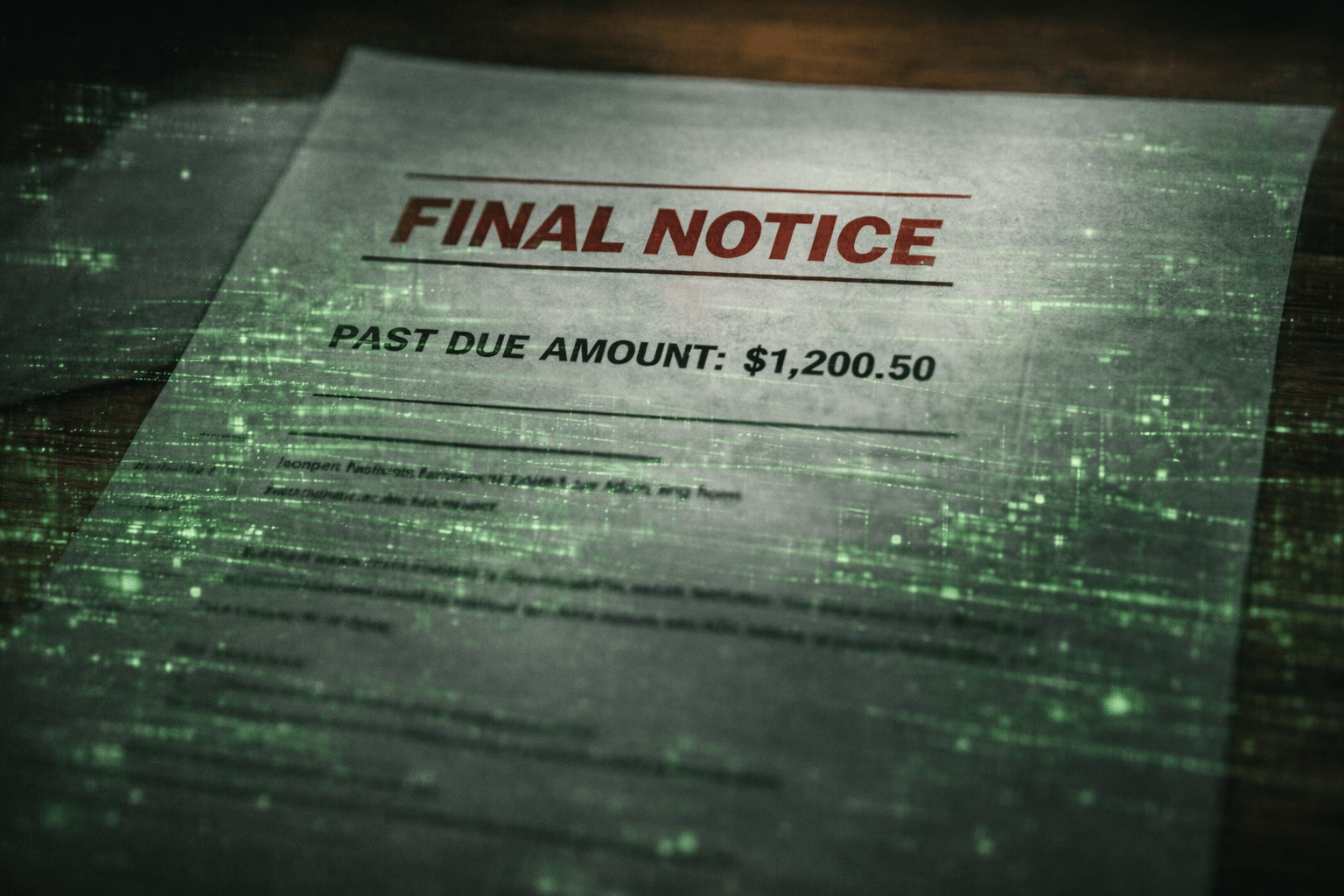
WORKFORCE TRANSITION NOTICE
Then:
POSITION ELIMINATION
Then:
AUTOMATED CLAIMS INTEGRATION PHASE IV
He read the letter twice before his mind accepted it.
The company thanked him for his years of service.
The company acknowledged his dedication.
The company informed him his position would conclude in fourteen business days.
Fourteen days.
Thirty-two years converted into fourteen business days.
The kitchen suddenly sounded very far away.
The rain.
The television.
The boiling sauce.
Elaine humming quietly at the stove.
All of it distant.
His eyes settled on the severance figure near the bottom of the page.
Eight weeks.
He actually laughed.
Not because it was funny.
Because something inside him briefly lost contact with reality.
“Daniel?”
Elaine had turned around.
He handed her the letter without speaking.
She read slower than he had. Her eyes narrowed carefully down the page, like maybe the wording would improve before the end.
It didn’t.
“They’re replacing you with software?”
“Not software,” Daniel said quietly. “Integrated automation.”
He hated how naturally the phrase came out of his mouth.
The company had spent years teaching employees the language that would eventually erase them.
The television panel continued talking.
Historic productivity growth.
Record market performance.
AI-driven acceleration.
Investor confidence.
The stock ticker rolled endlessly beneath smiling faces.
Daniel stared at it.
American Unified Assurance stock had climbed thirty-eight percent in sixteen months.
That same quarter, the company had announced “human capital streamlining initiatives.”
Human capital.
Another clean phrase.
Like people were wiring or plumbing.
Elaine folded the letter carefully and placed it on the kitchen table beside the unopened electric bill.
“What do we do?”
That question entered the room softly.
But it stayed there.
Their daughter Rachel lived upstairs while finishing graduate school online because apartments in the city had become impossible. Their son Caleb delivered groceries, drove rideshare at night, and slept four hours a day despite holding a degree in economics.
Daniel had believed education protected people.
He wasn’t sure anybody believed that anymore.
The kitchen table had become a museum of modern survival:
Prescription receipts.
Tuition notices.
Mortgage refinances.
Insurance adjustments.
Streaming subscriptions they forgot to cancel because exhaustion made small decisions feel impossible.
And now this.
Daniel looked through the window above the sink toward the dark neighborhood.
Almost every house on the block belonged to somebody who worked for systems now replacing them.
Claims processing.
Customer support.
Medical coding.
Accounting review.
Transportation routing.
Logistics oversight.
The country had become a civilization teaching itself how unnecessary its people were.
“You’ll find something,” Elaine said carefully.
But her voice carried the fragile politeness of someone trying not to disturb a wound.
Daniel nodded anyway.
Because husbands were supposed to nod.
That night he sat awake in the dark living room while everyone else slept.
The television glowed silently.
Financial analysts celebrated another market rally driven by “nonhuman scalability.”
That phrase stayed with him.
Nonhuman scalability.
A sentence built specifically to avoid saying:
People are no longer economically required.
Around two in the morning, Daniel opened the employee portal on his laptop.
There it was.
The future.
A clean blue interface called AURA.
Automated Unified Risk Assessment.
The system processed claims in seconds. Medical patterns. Fraud prediction. Eligibility decisions. Risk scoring. Settlement modeling.
Everything Daniel had spent three decades learning.
Compressed into a machine.
He watched the demonstration video with numb fascination.
A young executive in an expensive navy suit smiled warmly into the camera.
“AURA allows us to unlock unprecedented productivity while reducing operational friction.”
Operational friction.
Daniel understood suddenly.
He had become friction.
Not a man.
Not a father.
Not thirty-two years of loyalty.
Friction.
The next morning he drove to the office anyway.
Habit is stronger than humiliation.
The parking lot was already half empty. Entire sections abandoned after successive “optimization phases.”
Inside, the office felt eerily quiet.
Rows of cubicles remained perfectly lit despite missing workers, as if the building itself refused to acknowledge the dead.
His friend Martin sat at his desk staring blankly at his monitor.
“You get yours?” Martin asked.
Daniel nodded.
“How long?”
“Fourteen days.”
Martin laughed bitterly.
“I got nine.”
Nine days.
The company could eliminate a human life structure in single digits now.
By noon, everyone knew.
People moved carefully through the office like survivors after a storm.
Nobody talked about anger.
Middle-aged professionals rarely did anymore.
Mostly they discussed health insurance timelines.
Mortgage payments.
COBRA coverage.
Retirement penalties.
Survival administration.
That afternoon the company gathered remaining staff into Conference Room B.
A young regional vice president named Claire Whitmore stood at the front beside a massive presentation screen.
Daniel immediately disliked how rested she looked.
Claire spoke calmly.
The transition was necessary.
The industry was evolving.
Shareholder expectations required modernization.
Competitiveness demanded innovation.
Daniel watched people sitting around the conference table.
Forty years old.
Fifty-five.
Sixty-two.
Human beings listening to PowerPoint explanations for their own obsolescence.
Then Claire said the sentence Daniel would remember for the rest of his life.
“Productivity growth is essential to national economic stability.”
National economic stability.
The room fell completely silent.
Daniel realized something horrifying:
The suffering was no longer considered unfortunate side damage.
It was being reframed as patriotic necessity.
That evening Caleb came home exhausted from driving.
Daniel handed him the termination letter.
Caleb read it slowly.
“They automated claims already?”
“Apparently.”
Caleb sat heavily into a kitchen chair.
“You know what’s insane?” he said quietly. “The economy’s technically booming.”
Daniel looked at him.
Caleb continued:
“Markets are breaking records. Productivity’s exploding. GDP’s climbing. But nobody I know can afford a house. Or kids. Or time off. Or medical emergencies.”
He laughed softly.
“It’s like the country became successful without the people inside it.”
That sentence hung over the kitchen table long after dinner ended.
Two weeks later Daniel carried a cardboard box out of the building containing framed family photographs, a ceramic coffee mug, and thirty-two years of accumulated office debris nobody would ever look at again.
Rain fell lightly across the parking lot.
Employees exiting beside him carried identical boxes.
An entire generation of labor quietly removed from the system.
No protest.
No violence.
No revolution.
Just cardboard boxes beneath corporate rain.
Three months later Congress introduced something called The Productivity Act.
The proposal dominated every news channel in America.
The bill would create a permanent national trust funded by taxes on large-scale automation gains, federally subsidized AI infrastructure, algorithmic financial transactions, and sovereign commercial data licensing.
Every American citizen would receive an annual national dividend payment.
Not welfare.
Not unemployment.
Ownership participation in national productivity growth.
The President called it:
“The natural evolution of Social Security in the age of artificial productivity.”
That phrase detonated across the country.
The markets immediately plunged.
Corporate coalitions declared the bill unconstitutional.
Financial networks called it economic extremism.
Technology executives warned innovation itself could collapse.
But for the first time in years, Daniel watched ordinary people talking about the future without sounding defeated.
Then the lawsuits arrived.
Massive corporate alliances sued the federal government before the bill could even fully activate.
Their argument was brutally simple:
Private productivity gains belong to private owners.
The government cannot redefine prosperity as collective ownership merely because society helped create the conditions for growth.
The hearings began in Washington during the coldest January in decades.
Daniel watched them every day from his living room recliner beside stacks of unpaid medical bills and a yellow legal pad covered in job applications nobody answered anymore.
The corporate attorneys spoke calmly about constitutional protections, investor rights, fiduciary obligations, and economic freedom.
Then one attorney said something that made Elaine stop folding laundry and stare at the television.
“Corporations do not exist to provide happiness, meaning, or social stability. Their purpose is lawful return on investment.”
The room inside the hearing chamber remained perfectly calm after the sentence.
Nobody shouted.
Nobody gasped.
But Daniel felt something inside him shift permanently.
Because there it was.
The truth.
Not hidden anymore.
Not implied.
Said openly into microphones beneath the seal of the United States government.
The nation that once promised pursuit of happiness had legally reorganized itself around the emotional needs of capital.
That night Daniel sat alone at the kitchen table.
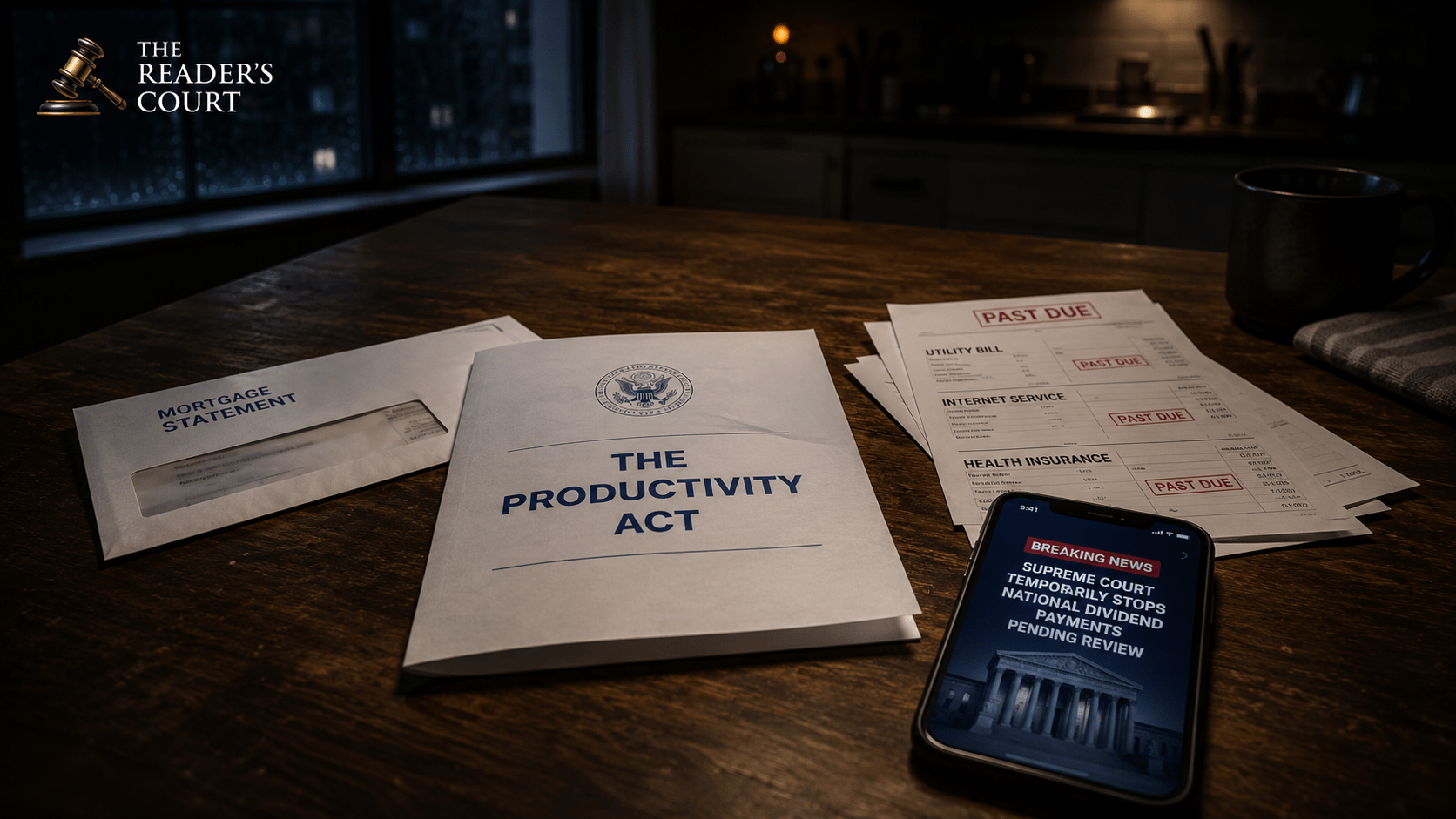
The dividend proposal pamphlet lay beside him.
Simple white paper.
Blue lettering.
THE PRODUCTIVITY ACT
A future small enough to fit inside an envelope.
His eyes moved toward the television where financial analysts discussed market reactions.
Behind them rolled another green ticker climbing endlessly upward.
Productivity rising.
Profits rising.
Human beings disappearing beneath the graph.
Then the Supreme Court agreed to hear the case.
And suddenly the entire country understood what was actually on trial.
Not a tax.
Not a bill.
A civilization trying to decide whether its people still deserved to share in the prosperity they created.
The hearing would begin Monday morning.
Daniel folded the pamphlet carefully and placed it beside the unopened mortgage statement at the center of the kitchen table.
Then his phone vibrated.
A breaking news alert appeared across the screen.
SUPREME COURT ISSUES TEMPORARY STAY ON NATIONAL DIVIDEND PAYMENTS PENDING CONSTITUTIONAL REVIEW
The room went completely silent.
The pamphlet remained on the table between the bills.
A promise waiting for permission to exist.
Become a member of the Dossier.
Support my writing.
The Question | The Productivity Act
The nation became wealthier.
Productivity exploded.
Automation accelerated.
Markets climbed higher than ever before.
But millions of citizens found themselves increasingly disconnected from the prosperity surrounding them.
The Productivity Act proposed a simple idea:
If an entire civilization contributes to national wealth, should the people themselves share ownership in that growth?
The corporations argued no.
They claimed productivity gains belong to private enterprise, private investment, and private risk.
The government argued something different.
That public infrastructure, public research, public stability, public labor, and public systems helped create the wealth in the first place.
So who does prosperity belong to?
The investors who legally own the systems?
Or the nation whose people made the systems possible?
The Autopsy | The Productivity Act
The Productivity Act exposes something modern economies work very hard to conceal:
Advanced capitalism increasingly separates productivity from human participation.
For most of industrial history, rising productivity still required large populations of workers. Even exploitative systems needed human labor in visible ways. Workers remained economically necessary.
Automation changed that relationship.
Artificial intelligence accelerated it further.
Modern corporations can now increase output, efficiency, market valuation, and investor return while steadily reducing their dependence on human labor itself.
That creates a structural problem the legal system is not designed to solve.
The economy continues producing wealth.
But fewer citizens meaningfully participate in ownership of that wealth.
Social Security partially addressed this problem in an earlier era.
It acknowledged a dangerous truth:
A modern nation cannot allow citizens to become disposable simply because markets evolve.
But Social Security remained tied to wages and payroll participation. It never evolved into broad public ownership of national productivity itself.
The Productivity Act attempts that next step.
Not socialism.
Not abolition of markets.
A public dividend system recognizing that modern prosperity emerges from layered collective contributions:
public infrastructure
public research universities
government-funded technology development
military protection of trade systems
federal reserve stabilization
communications networks
legal enforcement systems
taxpayer-funded scientific advancement
Private enterprise benefits enormously from these systems while ownership gains increasingly concentrate upward into investment structures insulated from ordinary citizens.
The legal resistance to the Productivity Act reveals the deeper architecture beneath corporate law.
Corporate entities are not legally designed to maximize human happiness, social cohesion, or democratic stability.
They are designed to maximize lawful return.
That distinction matters enormously.
Because once productivity becomes detached from labor participation, the system quietly faces a question it was never morally designed to answer:
What happens to human beings when the economy no longer requires most of them to remain economically useful?
The courts struggle with this because constitutional and corporate law evolved primarily to protect property structures, contractual stability, investment predictability, and capital continuity.
Not emotional well-being.
Not dignity.
Not social meaning.
The system protects ownership because ownership stabilizes wealth concentration and institutional continuity.
That is why the Productivity Act terrifies powerful institutions.
Not because the dividend itself would bankrupt the economy.
But because it reframes prosperity as something civilization collectively creates rather than something capital owners alone deserve to inherit.
The deeper fear is philosophical.
If citizens possess rightful claims to national productivity, then modern capitalism may owe obligations beyond shareholder return.
And once that door opens, the entire moral architecture of corporate power begins to change.
The Reader’s Verdict | The Productivity Act
The country increased its productivity.
The question became whether human beings still had a claim to the prosperity surrounding them.
The corporations defended ownership.
The government defended participation.
The courts defended the structure already in place.
No one needed to hate the people losing their place in the economy.
The system only required that profitability remain legally superior to human belonging.
Social Security once acknowledged that markets alone could not hold a nation together.
The Productivity Act asked whether that principle should continue evolving.
The court did not ask what created the healthiest society.
It asked what the existing structure permitted.
And structures designed around capital continuity rarely recognize happiness as an enforceable right.
The system did not fail.
It answered the question it was designed to answer.
Now it’s up to you.
A. Protect private ownership.
Productivity gains belong to the companies and investors who legally own the systems that produced them.
B. Create the national dividend.
If public labor, public research, public infrastructure, and public stability helped create the wealth, citizens deserve a direct share of it.
C. Split the claim.
Private companies may keep most productivity gains, but extraordinary automation profits should fund a permanent public dividend for the people displaced by them.
What is the right thing to do? Leave your verdict — A, B, or C — in the comments.