This collection brings together original thriller series that explore power, corruption, institutions, technology, wealth, identity, and the pressures that shape modern life. Through recurring characters, connected worlds, and standalone cases, these stories examine the moments when ordinary people collide with systems far larger than themselves.
From investigations into hidden networks of influence to courtroom dilemmas that force difficult moral choices, these thriller series combine suspense, psychological pressure, and contemporary themes to expose the forces operating beneath the surface of everyday life.
Featured series include The Reader’s Court, where readers are asked to decide what is the right thing to do when the system fails, and IMD Operations, where integrity, morality, and decency confront the machinery of modern power.
He took an oath. He lied legally. And nothing happened. In this IMD Operation, public funds are not stolen… they are redefined. A mid-level analyst discovers a discrepancy. The numbers match. The purpose does not. Inside the system, the explanation is simple: Executive discretion. At a public hearing, the official states: “No funds were misused.” And under the system’s rules… that statement is true. Because the definition of misuse was changed before the question was ever asked. This is not corruption. This is alignment. For the first time, IMD does not stay hidden. The record is exposed. The comparison is made public. The media is invited in. And still… nothing changes. Integrity. Morality. Decency. IMD Operation complete. The machine will try again tomorrow. The story is fiction. The system is real.
He Lied Legally
When truth is spoken under oath and nothing happens, the system calls it accountability.
Not A Real Publisher LLC… production of IMD Operations.
File 005 — He Lied Legally.
IMD Operations in process.
The money was approved.
Public record.
Every form had moved through.
Then it was not hidden.
It was reclassified.
Same total.
Different purpose.
The Analyst saw the shift.
Not in the numbers.
In the language.
Misuse disappeared.
Authorized reallocation took its place.
Inside the system, that was enough.
At the hearing, the official raised his hand and said the words:
No funds were misused.
He was innocent enough to agree.
Because inside those rules, they were right.
The Narrator shaped the story.
The coverage held.
No charges.
No consequence.
Then IMD moved through the record.
The Analyst found the internal memo.
The Coder traced the language.
The Operator forced the comparison into the open.
What was approved and what was said could no longer be reconciled.
Integrity.
Morality.
Decency.
The truth was surfaced.
The outcome would not change.
IMD Operation complete.
The machine will try again tomorrow.
The story is fiction.
The system is real.
The investigation continues in The Reader’s Court.
A doctor prescribed the treatment. The algorithm denied his life. Not because it wouldn’t work. Because an algorithm decided the patient wasn’t worth the cost. In this IMD Operation, a family is forced to confront a machine that quietly decides who gets time… and who doesn’t. This is not a failure. This is how the system is designed to work. IMD intervenes. Integrity. Morality. Decency. IMD Operation complete. The machine will try again tomorrow. The story is fiction. The system is real. The investigation continues in The Reader’s Court.
When a father becomes a probability score, the system does not call it cruelty.
It calls it efficiency.
Not A Real Publisher LLC… production of IMD Operations.
File 004.
The Algorithm Denied His Life
IMD Operations in process.
David Mercer was forty-nine years old, a husband, a father, and the kind of man who fixed things before they broke. He kept spare fuses in the garage, extra batteries in the kitchen drawer, and enough tools in the truck to rebuild a bad day before dinner. Then the scans came back, and none of that mattered.
The oncologist showed him and his wife the image on the wall and pointed to the shadow that had already learned how to spread.
There was one treatment left.
Expensive. Aggressive. Not guaranteed. But real.
Real enough to fight for.
His wife, Elena, heard the word “chance” and built her whole body around it. She made binders. She tracked appointments. She argued with billing offices. She learned the language people learn only when the people they love are being translated into codes.
Their daughter, Sofia, listened from doorways and stairwells and the back seat of the car. Old enough to understand tone. Old enough to know when adults were lying with brave faces.
The request went to the insurer.
The doctor marked it urgent. The chart was clear. The treatment met the medical standard. The family waited.
Then the answer came back.
Denied.
Not because the treatment was experimental. Not because the doctor was unqualified. Not because the hospital had made an error.
Denied because a risk model projected that David Mercer was statistically unlikely to survive long enough to justify the cost.
No human being said those words to his face.
They arrived polished. Sanitized. Hidden behind phrases like clinical pathway, utilization threshold, projected outcome alignment.
But the meaning was simple.
The treatment cost too much for a man the model had already begun to bury.
That night Elena stood in the kitchen with the denial letter in her hand while David sat at the table trying not to fold in on himself. Sofia watched from the hallway and saw something children should never see.
The moment when a family learns that insurance is not there to protect life.
No raised voices. No slammed doors. No visible blood.
Just a quiet financial judgment made by a machine trained to speak the language of survival while serving the mathematics of loss.
The Financier watched from the architecture of policy and profit, where suffering only mattered when it disrupted quarterly certainty. To him, this was not a family. It was exposure. A liability curve. A cost event with names attached.
But somebody else was watching.
The Analyst found the denial pathway first.
The Coder traced the model logic through the insurer’s automated review stack and found the concealed weight buried under neutral language. Not quality of life. Not physician judgment. Not medical urgency.
Expected return on covered time.
The Operator found the bypass.
A human review channel existed. The case qualified. The machine had routed around it.
That was the design.
That was the lie.
IMD activated protocol.
Integrity.
Morality.
Decency.
The Analyst forced the buried variable into daylight. The Coder opened the decision trail and mapped every suppressed checkpoint. The Operator pushed the full record to the review authority, the provider escalation channel, and every node the system relied on remaining slow, silent, and compartmentalized.
By morning, the insurer had a problem it could not hide inside procedure.
The denial was reversed.
Officially, the case had been reevaluated. Officially, additional documentation had been considered. Officially, the system had functioned.
Unofficially, IMD had dragged a financial execution order back into human light.
David Mercer received the treatment.
Not a miracle. Not a promise. Not a rewritten future.
A chance.
The kind of chance the system had tried to reserve for people whose projected survival made better financial sense.
Elena sat beside him in the infusion room with both hands wrapped around his wrist as if time itself might still be negotiated by touch. Sofia stood on the other side trying to look brave enough for all three of them.
And somewhere behind the sealed language of compliance and reform, the model remained alive.
Waiting. Learning. Adjusting.
IMD Operation complete.
The machine will try again tomorrow.
The story is fiction. The system is real. The investigation continues in The Reader’s Court.
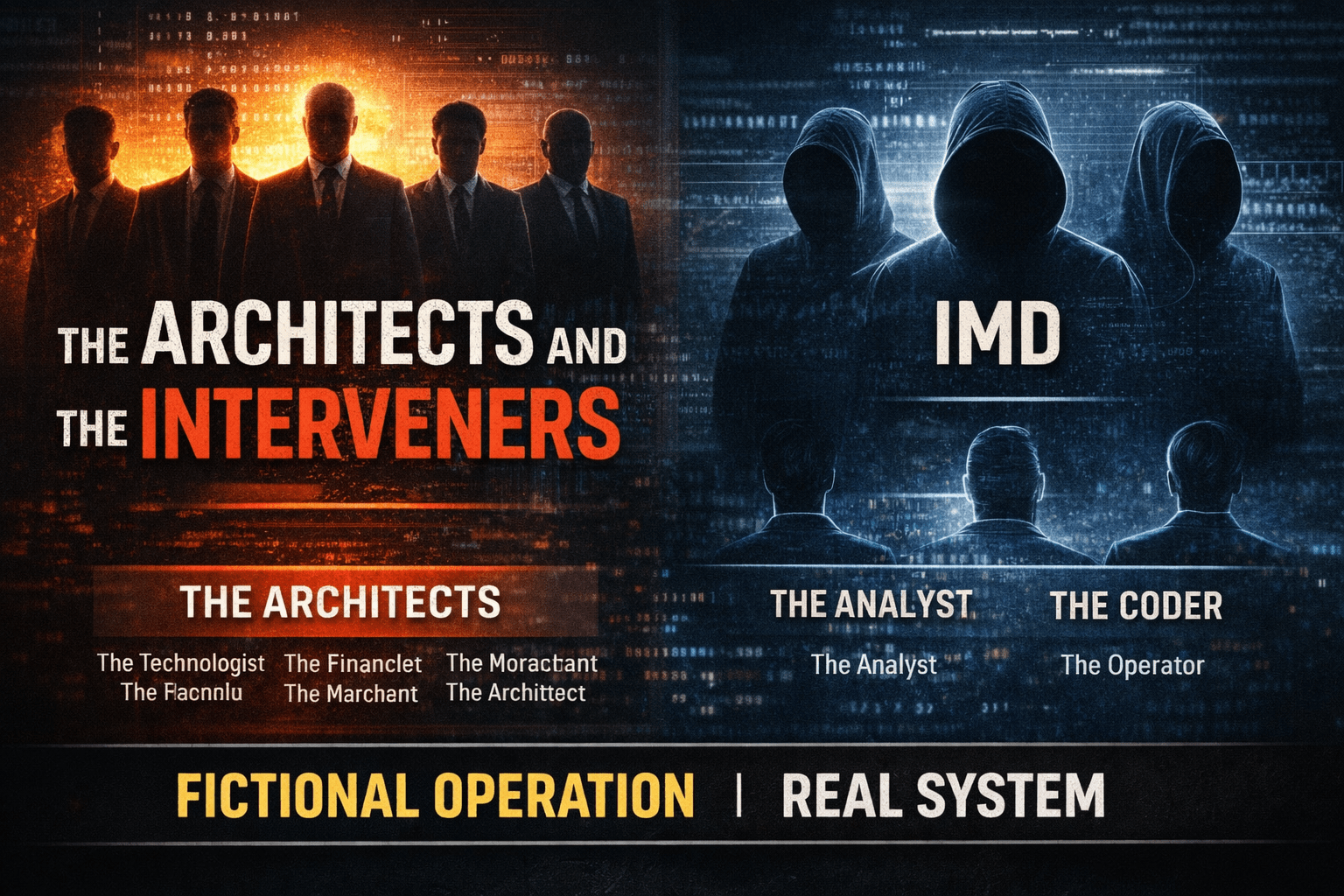
Systems do not run the modern world by accident. Someone built them. IMD Operations File 003 — Who Controls the System? introduces the hidden architects behind the algorithms that quietly shape housing, finance, healthcare, and modern economic systems. Across the world, automated systems now decide who receives an opportunity and who receives a denial. Loan approvals. Housing approvals. Insurance approvals. Behind these systems sit the architects. Five powerful figures who design the rules… and never live inside the consequences. But every machine has a weakness. And somewhere inside the system, a covert network has found it. They call themselves IMD. Integrity. Morality. Decency. Tonight… the war between the architects and the interveners begins.
Who Controls the System
A system does not need a villain to do harm.
It only needs alignment.
Not A Real Publisher LLC presents A production of IMD Operations.
Integrity.
Morality.
Decency.
File zero zero three.
The Alignment Protocol.
The public believes systems are separate.
Banks.
Corporations.
Governments.
Housing markets.
Financial markets.
Healthcare.
Each one claims independence.
Each one claims neutrality.
Each one claims the rules are being followed.
But IMD found the fracture.
The systems do not need to conspire when their incentives already point in the same direction.
A denial in one database becomes risk in another.
A risk score becomes exclusion.
Exclusion becomes profit.
Profit becomes policy.
Policy becomes the story.
And the story becomes truth.
This is how power hides.
Not behind one door.
Behind many.
Not inside one machine.
Inside all of them.
The Council does not need to meet.
The Technologist builds the logic.
The Financier controls the flow.
The Merchant sets the value.
The Architect shapes the environment.
The Narrator controls the story.
They do not need to coordinate.
The system does that for them.
IMD Operations in process.
The Analyst identifies the fracture.
The Coder enters the system.
Not to break it.
To trace it.
To follow one decision as it becomes many.
A credit decision.
A housing decision.
A pricing decision.
A medical decision.
A legal decision.
A public story.
The Operator waits for the moment of exposure.
Not loud.
Not public.
Precise.
The machine works because no one sees the whole machine.
So IMD makes the machine visible.
Banking records.
Corporate rules.
Government files.
Healthcare restrictions.
Market signals.
Narrative control.
The systems are separate only in name.
Under pressure, they move together.
Protocol activated.
Integrity.
Morality.
Decency.
The hidden structure appears.
The decision was never isolated.
The harm was never accidental.
The outcome was designed by alignment.
The public sees the map.
The machine loses invisibility.
For one night, power cannot pretend it is procedure.
For one night, the system cannot hide behind its own language.
IMD Operation complete. Who controls the system, villains.
The machine will try again tomorrow.
The story is fiction.
The system is real.
The investigation continues in The Reader’s Court.
These pages map the territory behind Mark Bertrand’s psychological thriller books: captured reality, corporate power, institutional pressure, algorithmic society, cultural dread, literary disorientation, and the old thriller tropes that no longer explain the world readers are living in.