
IMD Operations File #001 | The Housing Auction
The housing auction file #001 IMD Operations helps an elderly couple pushed toward foreclosure during a medical emergency while a hidden system converts human suffering into legal process and financial opportunity. IMD intervenes to expose the mechanism before the home is lost.
Cultural techno-thrillers ask:
“What happens when society reorganizes itself around systems that quietly dehumanize people?”
IMD OPERATIONS // FIELD FILES
Start the Operation
Watch the files in order. Each operation exposes another part of the machine.
The Housing Auction
The housing auction file #001 IMD Operations helps an elderly couple pushed toward foreclosure during a medical emergency while a hidden system…
The Loan Denial Algorithm
The Loan Denial Algorithm | IMD Operations File 002 A man qualified for the mortgage. The algorithm said no. IMD Operations File…
Who Controls the System
Who Controls the System Systems do not run the modern world by accident. Someone built them. IMD Operations File 003 — Who…
The Algorithm Denied His Life
A doctor prescribed the treatment. The algorithm denied his life. Not because it wouldn’t work. Because an algorithm decided the patient wasn’t…
He Lied Legally
He took an oath. He lied legally. And nothing happened. In this IMD Operation, public funds are not stolen… they are redefined.…
The Property Tax Trap
A retired couple falls behind on property taxes during a medical crisis. The property tax trap. What follows is not chaos. It…
The Credit Score Collapse
A man misses one payment. Then, the credit score collapse. The system recalculates. His credit score drops. Housing disappears. Loan access vanishes.…
The Childcare Network
A family does everything right. They work. They plan. They pay. But the childcare network system was never built around care. In…
The Billionaire Landlords
Forty-one hours before a public housing hearing, the billionaire landlords struck. The tenants’ evidence site disappears. Rent records. Eviction notices. Maintenance complaints.…
The Survivor Protocol
IMD was never a room. It was never a group of hackers. It was a counter-system. In File 010: The Survivor Protocol,…
The Coder Awakens
“Yesterday was brutal. The whole team has been killed and slaughtered. The office is destroyed. They took everything. They mashed all the…
The Union Breaker
IMD Operations File #012: The Union Breaker Video — Part 1 https://youtu.be/u1Q-RtDQY8M IMD Operations File 012: The Union Breaker Part 1 —…
The Union Breaker — Part 2
https://youtu.be/LfzKNbU2VLw?si=nB0vbvCO813GrzxW IMD Operations File #012: The Union Breaker — Part 2 By morning, the department store still looked expensive. That was the…
The Union Breaker — Part 3
Not A Real Publisher LLC presents IMD Operations. This is Part 3 of Operation Destroy the Oligarchs. The Contract Breathes. Integrity.Morality.Decency. IMD…
The Housing Auction
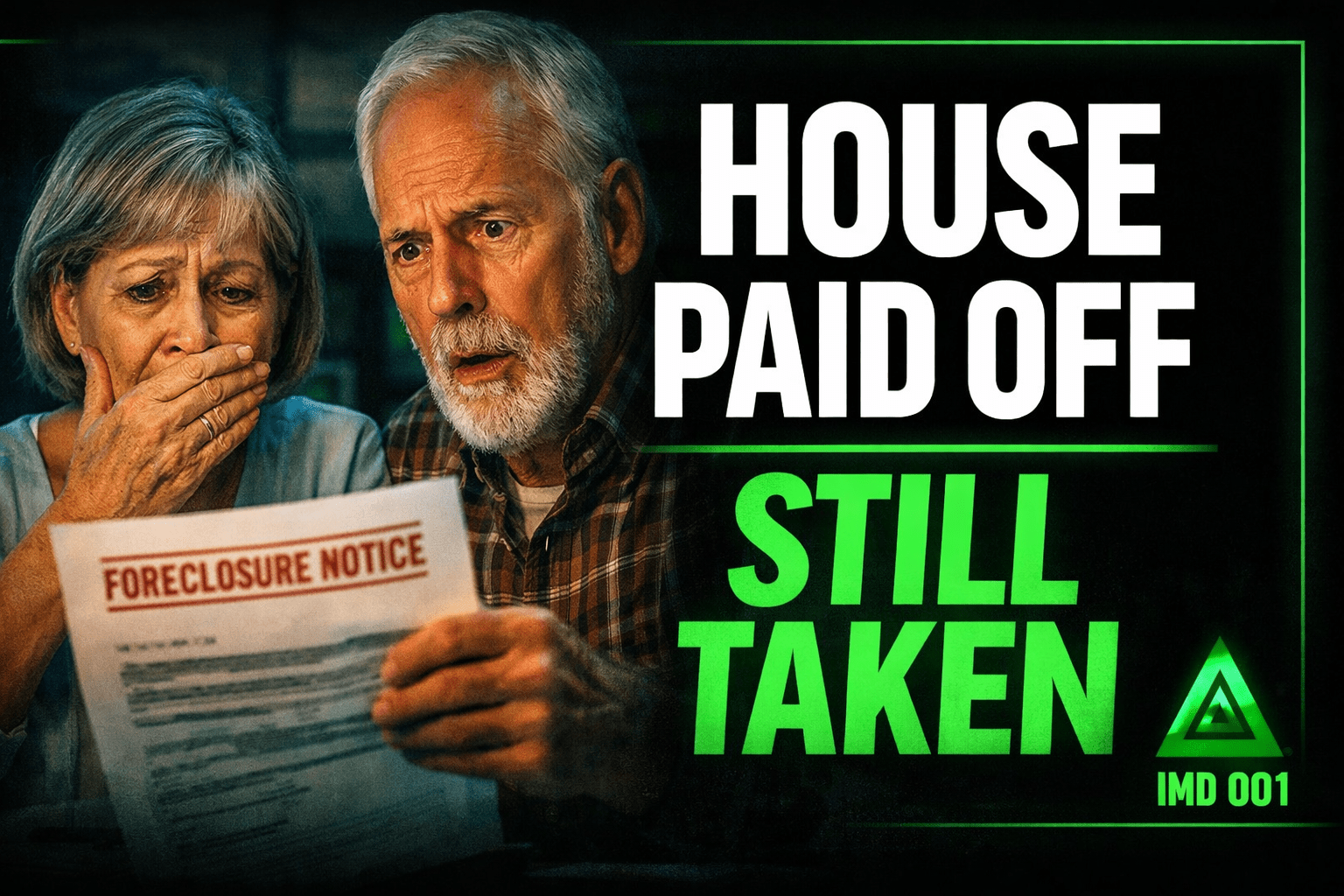
An elderly couple sits at their kitchen table surrounded by medical bills, tax notices, and prescription bottles. Decades of ordinary life have quietly collapsed into arithmetic.
The husband studies the paperwork while his wife stares silently at the table. The home around them still carries the shape of memory:
family photographs,
coffee cups,
familiar walls,
the residue of a life built slowly over time.
But the system no longer sees a home.
It sees delinquency.
Hospital corridors replace the safety of the house. Treatments continue. Bills multiply. The county notices the missed property taxes before anyone notices the fear settling into the room.
The language changes first.
Late.
Penalty.
Interest.
Delinquent.
Final notice.
Each document arrives colder than the last.
Outside the home, the neighborhood remains quiet while an invisible process advances underneath it. Property records move through digital systems. Parcel numbers connect to lien structures. Legal codes transform human distress into transferable value.
The housing auction begins by disappearing into paperwork.
A foreclosure notice appears on the property.
The couple stands outside their home watching the machinery continue forward without emotion, without urgency, without hatred. The cruelty is procedural.
Then the atmosphere changes.
IMD Operations in process.
The Analyst identifies the pattern hidden inside the county records for the housing auction.
The Coder enters the network tracing ownership transfers and shell pathways moving beneath the tax system.
The Operator prepares the intervention.
Across glowing monitors, systems begin connecting:
parcel data,
transfer schedules,
auction structures,
compliance chains.
The machine is mapped.
Protocol activation begins.
Integrity.
Morality.
Decency.
The hidden mechanisms behind the property seizure are exposed publicly. The system that converted suffering into opportunity is forced into daylight.
The housing auction transfer stalls.
The couple remains in their home.
Not because mercy appeared.
Because exposure interrupted the machine long enough to stop it.
But the ending offers no illusion of victory.
The system still exists.
The architecture remains intact.
The process will continue somewhere else tomorrow.
The machine will try again tomorrow.
The story is fiction.
The system is real.
The investigation continues in The Reader’s Court.
Power & Privilege
Start Here with The Vintner & The Novelist

The Vintner & The Novelists