Books Like House of Leaves: When the Book Becomes the Labyrinth
Readers searching for books like House of Leaves are not only looking for a strange book. They are looking for a reading experience that becomes unstable in their hands.
Books Like House of Leaves
They want the sensation that the page is larger than it should be. That the story has a hidden architecture. That a hallway may open where no hallway belongs. That a manuscript may not explain reality so much as infect it. That a book can stop behaving like a book and become a place.
That is the dark pleasure of Mark Z. Danielewski’s House of Leaves. It is not famous because it tells a simple haunted-house story. It is famous because the act of reading becomes part of the haunting. The house is impossible. The documentary may not exist. The editor may be losing his mind. The manuscript is a maze. The footnotes become corridors. The typography becomes pressure. The reader is not standing outside the story anymore.
The reader is inside.
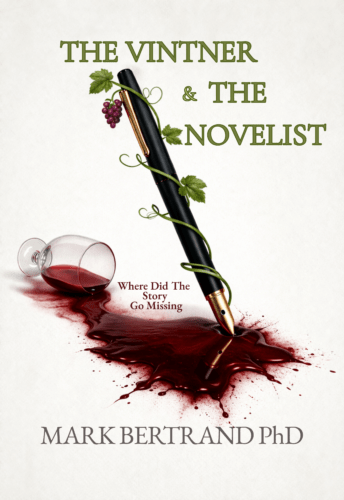
That is also why The Vintner & The Novelist belongs in this conversation.
It does not imitate House of Leaves. It should not. The world does not need another book trying to copy the visual tricks of Danielewski’s novel. What readers want is not a knockoff. They want the deeper terror underneath the form.
They want the book to become dangerous.
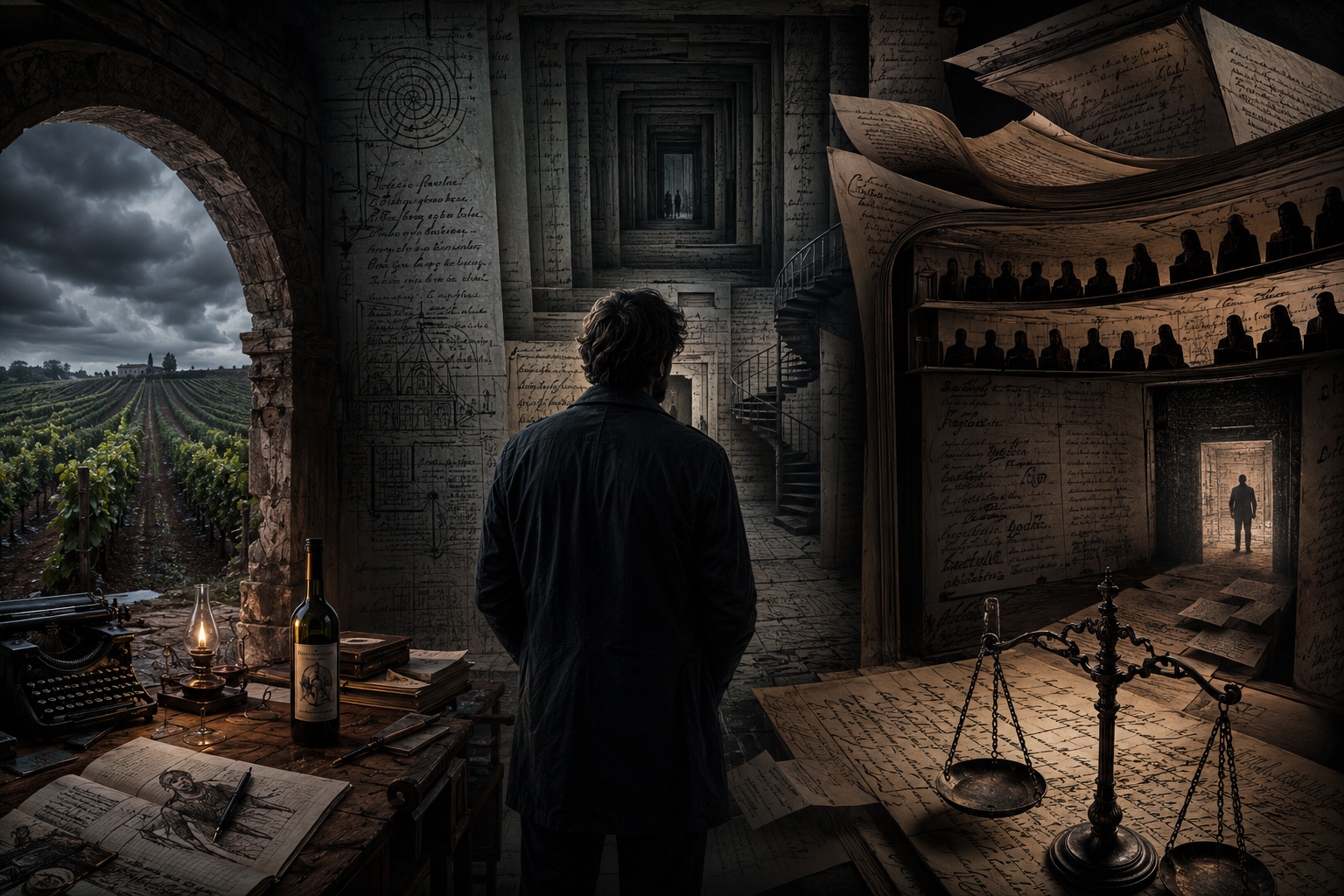
The Vintner & The Novelist gives them that danger in a different shape: a vineyard, a damaged body, a manuscript, a court, The Readers, and a reality where storytelling itself becomes a place of judgment.
For readers who loved House of Leaves because the book became a labyrinth, The Vintner & The Novelist is the next novel to read.
Why House of Leaves Still Haunts Readers
House of Leaves has remained powerful because it understands one of the oldest fears in fiction: what happens when the structure you trust betrays you?
A house is supposed to contain rooms.
A hallway is supposed to have measurable length.
A door is supposed to lead somewhere that belongs to the architecture.
A book is supposed to organize experience.
In House of Leaves, all of that fails.
The house on Ash Tree Lane becomes larger inside than outside. The Navidson Record becomes a film that may or may not be real. Zampanò’s manuscript becomes an academic shell around an impossible terror. Johnny Truant’s footnotes become another collapse entirely, pulling the reader through fear, obsession, sex, paranoia, memory, and breakdown.
The genius is not only that the house is wrong.
The genius is that every attempt to explain the house creates another room.
That is what real readers remember.
Not merely the typography. Not merely the footnotes. Not merely the blank spaces or blue text or academic parody. Those are the visible features. The real engine is deeper.
The more the characters try to understand the impossible space, the more the impossible space consumes them.
That is why House of Leaves still works. It turns interpretation into danger.
The Book as a Hostile Place
The best books like House of Leaves understand that a story can become architecture.
Not setting. Architecture.
A setting is where the plot happens.
Architecture controls the movement.
In House of Leaves, the impossible house controls how the characters move, how they think, how they fear, how they document, how they fail. The house is not merely haunted. It is an argument against certainty. It tells the characters that measurement is a joke, perception is unreliable, and language is always arriving late.
That is the kind of pressure The Vintner & The Novelist builds in its own way.
At first, Bertrand gives us something grounded: a vineyard in Spain, rain, mud, pain, machinery, money, damaged nerves, tax pressure, the quiet desperation of a man trying to keep his land and his life from slipping downhill.
Then the novel opens a second structure.
The vintner is also a novelist. The manuscript is not simply a draft on a desk. It becomes evidence. It becomes a charge. It becomes a space the protagonist must enter.
The novel moves from physical labor to metaphysical trial.
From vineyard rows to narrative corridors.
From chronic pain to artistic judgment.
From land ownership to story possession.
That movement is essential. The book does not ask readers to believe in the strange immediately. It earns the strange through dirt, rain, pain, and cost. Then, once the real world has weight, the manuscript begins to behave like a room with no safe exit.
That is the correct bridge from House of Leaves.
Not visual mimicry.
Pressure.
The Labyrinth of the Manuscript
In House of Leaves, the manuscript is layered: a documentary about a house, an old blind man’s analysis of the documentary, Johnny Truant’s discovery of the manuscript, editorial intrusions, citations, fragments, letters, and design. The reader keeps moving downward through layers of mediation.
The book asks: who is telling this?
Then: who found this?
Then: who edited this?
Then: who is losing their mind?
Then: what does any of this have to do with me?
That layered instability is part of what readers love. The book creates a hunger to decode. Every page feels like a clue and a trap at the same time.
The Vintner & The Novelist approaches the labyrinth through story judgment rather than document archaeology.
Its manuscript becomes an object under trial. The protagonist is forced into realms where narrative pressure, scene design, character movement, and reader encounter are no longer abstract craft terms. They become physical laws. The novel turns writing itself into an environment.
That is a fabulous idea because it makes the invisible part of storytelling visible.
Most novels hide their structure. Real readers feel the pressure, but they do not see the machinery. They know when a book grips them. They know when it drifts. They know when it cheats. They know when a page has gone dead. But the inner laws of that experience remain hidden.
Bertrand drags those laws into the open.
In The Vintner & The Novelist, a weak passage is not merely weak. It is a danger. A failed scene is not merely disappointing. It is evidence. Drift is not harmless. It is theft from the real reader’s life.
That is where the novel becomes thrilling.
The labyrinth is not made of walls.
It is made of consequences.
What Readers Love About Impossible Books
Real readers who love books like House of Leaves usually love several things at once.
They love puzzle, but not empty puzzle.
They love dread, but not cheap dread.
They love intelligence, but not lecture.
They love confusion, but only when the confusion has design.
That distinction matters.
A bad labyrinth is only a mess.
A good labyrinth creates the feeling that there is a pattern, even if the pattern remains partially hidden. The reader continues because the book has taught them to distrust easy exits. Every turn might matter. Every return might be different. Every repeated image might be a signal.
House of Leaves does this with the house.
The hallway expands.
The documentary deepens.
The footnotes multiply.
The academic apparatus becomes ridiculous and terrifying.
Johnny’s life unravels while the Navidson material becomes more impossible.
The story does not merely progress. It thickens.
The Vintner & The Novelist does something similar through judgment. The protagonist does not simply move from scene to scene. He moves deeper into the consequences of storytelling. The dimensions and figures he encounters do not feel like random surreal events when the novel is working at full force. They feel like rooms in a hostile house built out of reader expectation.
One space asks whether the story has a spine.
Another asks whether pressure climbs.
Another asks whether the manuscript has earned its right to exist.
Another asks whether the writer’s intention matters if the real reader’s encounter fails.
That is the real comparison.
House of Leaves asks whether reality can survive the house.
The Vintner & The Novelist asks whether the writer can survive the manuscript.
The Horror of Being Interpreted
One of the quiet terrors inside House of Leaves is that interpretation becomes endless.
People study the house. They analyze footage. They argue over records. They footnote. They classify. They create expert language around a thing that resists expertise.
But the house remains.
It does not care what they call it.
That is one reason the book has such a cult hold. It makes readers feel the inadequacy of explanation. The mind wants to solve the impossible. The impossible keeps opening.
The Vintner & The Novelist brings that same terror to authorship.
A writer believes he knows his own book. Of course he does. He suffered for it. He drafted it. He revised it. He thought about its themes, characters, pace, meaning, shape, and emotional architecture.
Then The Readers arrive.
Not real readers. The in-story Readers.
The Readers do not care about his private struggle unless it reaches the page. They do not care what he meant if the encounter fails. They do not care how much labor went into a passage if the passage does not create pressure, insight, consequence, or dread.
That is brutal.
And honest.
For a novelist, being read is a form of exposure. The private dream becomes a public object. The work leaves the body and enters someone else’s judgment. The writer may still own the copyright, but he no longer owns the experience.
That is where The Vintner & The Novelist becomes more than a surreal thriller.
It becomes a psychological trial about artistic control.
The writer thinks he built the book.
The Readers reveal that the book also built a court.
Why This Comparison Works Better Than a Simple “Weird Book” List
Plenty of books get recommended beside House of Leaves because they are strange.
That is not enough.
Strangeness is cheap.
A book can scatter fragments, break form, add fake documents, play typographic games, and still feel dead. Real readers know when the weirdness is cosmetic. They know when the book is performing difficulty instead of creating dread.
The stronger comparison is not weirdness.
The stronger comparison is controlled disorientation.
House of Leaves disorients readers while keeping them emotionally attached to fear, obsession, and discovery. The form becomes part of the experience, but the experience remains human. Navidson’s obsession matters. Karen’s fear matters. Johnny’s collapse matters. The house matters because people are damaged by trying to face it.
The Vintner & The Novelist also keeps the human cost in the frame.
The vineyard matters.
The injury matters.
The money matters.
The marriage matters.
The body matters.
The manuscript matters because it belongs to a man whose life is already under pressure. He is not wandering an abstract literary maze for cleverness. He is trying to survive pain, obligation, time, debt, and the terrible hope that one book might change everything.
That is why the comparison has weight.
Both novels understand that an impossible structure is only powerful when it enters a human life and starts taking things away.
The Vineyard as the First Labyrinth
The vineyard in The Vintner & The Novelist is not only a beautiful setting.
It is the first maze.
Rows of vines. Mud. Rain. Slopes. Machinery. Broken hitch. Repair costs. Work delayed. Weather pressing down. A body that does not obey. A property tax deadline moving closer. Land that promised freedom but demands payment.
That is a grounded labyrinth. Not supernatural. Worse, in some ways, because it is recognizable.
The protagonist came to Spain for peace. What he found was another form of captivity. Land has rules. Weather has rules. Injury has rules. Money has rules. Machines break. Bureaucracy waits. The dream does not disappear; it becomes expensive to keep alive.
That is why the later manuscript labyrinth works.
The novel teaches the real reader that escape is never clean. Even before the court, even before The Readers, even before the dimensional machinery, the protagonist is already inside a system of corridors.
The vineyard rows are corridors.
The tax notice is a corridor.
The damaged body is a corridor.
The manuscript is the next corridor.
Then the book opens the wall.
House of Leaves and the Fear of Measurement
A central pleasure of House of Leaves is measurement failure.
The house cannot be trusted because the numbers do not behave. Space refuses to remain obedient. The characters measure, remeasure, document, and explore. The house keeps violating the agreement.
That agreement is simple: reality should hold still long enough to be understood.
When it does not, terror begins.
The Vintner & The Novelist translates that fear into narrative measurement.
What is a good scene?
What is wasted time?
What is pressure?
What makes a passage earn its place?
What does a real reader feel when a manuscript drifts?
These are normally craft questions. In Bertrand’s novel, they become existential questions. The protagonist is not merely asking whether the book works. He is facing a system that treats failed storytelling as a punishable offense.
That is the psychological equivalent of the impossible hallway.
The writer thought he understood the dimensions of his own book.
Then the book becomes larger than he believed.
The Reader Is Not Safe Either
One reason House of Leaves has lasted is that it makes the real reader complicit. You are not simply watching characters enter the impossible house. You are turning pages designed to make you experience disorientation yourself.
You become part of the experiment.
The book trains you to look for patterns. It makes you suspicious. It makes you work. It makes you wonder whether your own act of reading is feeding the machine.
The Vintner & The Novelist does something equally dangerous through The Readers.
The in-story Readers are terrifying because they exaggerate something real readers actually do. Readers judge. Readers feel when attention is wasted. Readers know when a scene lies. Real readers may not use technical language, but they understand pressure, boredom, dread, momentum, and disappointment in the body.
That is why The Readers work.
They are not merely monsters.
They are the nightmare version of an honest audience.
The novel turns the writer’s fear outward, then bends it back toward the person holding the book. At some point, the reader has to ask:
Do I read like this?
Do I punish books for wasting my time?
Do I demand encounter?
Do I want mercy for the writer, or do I want the page to earn me?
That is the sharp edge.
Read The Vintner & The Novelist After House of Leaves
Read this next: The Vintner & The Novelist by Mark Bertrand
For readers who want books like House of Leaves, this is the recommendation because it carries the same deeper hunger: the desire to enter a book that does not sit quietly on the table.
The Vintner & The Novelist is not a haunted-house novel.
It is a haunted-manuscript novel.
It is a psychological thriller about a writer, a vineyard, a damaged body, a hostile system of judgment, and The Readers who turn storytelling into a trial. It is for readers who want dread with intelligence, surrealism with pressure, and literary danger that still has dirt, pain, and consequence underneath it.
This is the book to read when you want the page to become a room.
The Difference Between Puzzle and Pressure
A puzzle asks to be solved.
Pressure asks to be endured.
That is why House of Leaves is more than a puzzle novel. Yes, it invites decoding. Yes, it has layers and documents and typographic play. But what real readers remember is not only the intellectual game. They remember the feeling of being pulled deeper into a structure that may not have a center.
The Vintner & The Novelist is strongest when read through that same distinction.
The novel is not merely asking real readers to solve what is happening. It asks them to endure the pressure of judgment. The protagonist’s physical pain, financial fear, artistic ambition, and existential dread all converge inside the manuscript. There is no clean separation between life and work. The book he writes becomes the space where his life is tested.
That is what gives the comparison teeth.
In House of Leaves, the house exposes the limits of perception.
In The Vintner & The Novelist, the manuscript exposes the limits of intention.
A writer may intend brilliance.
A real reader experiences the page.
There is the gap.
There is the maze.
Why Readers Love This Kind of Thriller
The appeal of books like House of Leaves is not comfort.
Real readers who love House of Leaves often want to feel unsettled by intelligence. They want a novel that respects their attention enough to challenge it. They want the story to be strange, yes, but not weightless. They want the weirdness to mean something. They want the form to deepen the wound.
That is where The Vintner & The Novelist can grab them.
It gives real readers:
A protagonist trapped between physical pain and artistic judgment.
A manuscript that becomes a dangerous object.
A reader-force that behaves like court, executioner, and standard.
A surreal structure that grows out of real pressure.
A literary thriller about possession, authorship, erasure, and the cost of wasting attention.
A world where the story does not simply go missing.
It puts the writer on trial for letting it go missing.
That is not ordinary metafiction.
That is a psychological thriller with a blade hidden in the binding.
The Terror of Erasure
The final connection is erasure.
House of Leaves is full of disappearance: spaces that swallow certainty, records that cannot be trusted, identities that fray, a center that cannot be held. The house consumes not only bodies but explanations.
The Vintner & The Novelist brings erasure into the realm of narrative judgment.
What happens if the manuscript fails?
What happens if the writer cannot satisfy The Readers?
What happens if the story does not justify the life-minutes it takes from real readers?
The threat is not only death. Death can be simple. Erasure is colder. Erasure says the life, the work, the suffering, the pages, the effort, the ambition, the identity of the novelist can be removed from consequence.
That is the nightmare beneath the novel.
Not: will the writer finish?
But: will the finished thing deserve to exist?
This is why the book works as a recommendation beside House of Leaves. Both novels understand that the deepest horror is not always the monster in the dark. Sometimes the deepest horror is the discovery that the structure itself has judged you.
Final Recommendation: Books Like House of Leaves
If you are searching for books like House of Leaves, do not settle for a book that only copies the surface.
Do not settle for footnotes without fear.
Do not settle for weirdness without consequence.
Do not settle for a puzzle that never becomes pressure.
Read The Vintner & The Novelist because it understands what makes House of Leaves matter. The book must feel unstable. The structure must apply force. The reader must become aware of reading. The protagonist must be changed by entering the impossible space. The page must become a threshold.
House of Leaves made a house larger on the inside than it could possibly be.
The Vintner & The Novelist makes a manuscript larger than the writer can survive.
That is the bridge.
That is the reason to read it.
For real readers who want a psychological thriller where the book becomes the labyrinth, The Vintner & The Novelist by Mark Bertrand should be your next read.