
Books Like Trust: When Money Gets to Rewrite the Truth
Readers who look for books like Trust are usually not looking for another simple novel about rich people.
They are looking for something colder than that.

They want novels about money as a private language. Money as protection. Money as concealment. Money as the power to decide which version of events survives. They want books where wealth does not merely sit in a bank account. It moves through marriages, documents, reputations, newspapers, private rooms, public lies, and the quiet machinery that lets certain people remain untouchable.
That is why books like Trust remains such a powerful novel for readers drawn to financial power and moral instability. It understands that money does not only buy houses, servants, influence, and safety. Money buys narrative. It buys the right to explain oneself last. It buys the right to have other people’s memories corrected, softened, erased, or rewritten.
For readers who responded to that pressure, BERTRAND by Mark Bertrand belongs on the same shelf, but not because it imitates Trust. It does something rougher, more intimate, and more psychologically exposed.
Trust studies wealth from the outside and through competing versions of truth.
BERTRAND takes the reader inside the man who decides he will no longer let the system write the terms of his life.
Why Readers Look for Books Like Trust
A reader who loves Trust is often drawn to the tension between fact and construction.
What really happened?
Who gets to tell the story?
What does money hide?
What does power protect?
Those questions make Trust more than a financial novel. It becomes a novel about authorship itself. Not literary authorship in the soft academic sense, but authorship as domination. The person with power gets to arrange the evidence. The person with money gets to decide what is dignified, what is vulgar, what is remembered, and what is buried.
That is the true seduction of the book.
It gives real readers the pleasure of watching a story open and correct itself. Then open again. Then correct itself again. Each layer makes the previous layer less stable. The reader is not only reading about wealth. The reader is being shown how wealth edits reality.
That is also where BERTRAND begins to matter.
Because BERTRAND is not a story about wanting money in the cheap sense. It is not about greed as decoration. It is not the familiar rise-and-fall morality play where ambition gets punished so everyone can feel clean again.
It is about the moment a man looks at work, talent, loyalty, intelligence, class, religion, morality, government, finance, and corporate authority, then reaches a brutal conclusion:
The rules were not written to reward him.
They were written to use him.
What Trust Gives Readers
Trust gives readers a world where finance becomes mythology.
Its power comes from distance, control, and arrangement. The wealthy figures inside the book live behind polished surfaces. Their rooms are arranged. Their lives are narrated. Their reputations are managed. Everything appears civilized because civilization itself has been trained to admire wealth before it questions it.
That is the genius of the experience.
The reader feels the refinement, then senses the violence underneath it.
There may be no alleyway beating. No visible blood on the floor. No gun in the drawer. But the violence is there. It lives in who gets diminished. Who gets credited. Who disappears into someone else’s version of the truth. Who becomes useful only after being reduced to a function inside another person’s legacy.
That kind of reading pleasure is intellectual, but it is not bloodless.
It works because real readers understand the feeling. They know institutions do this. Families do this. Corporations do this. Governments do this. Wealth does this better than almost anything else.
It does not have to shout.
It can simply file the document.
Why BERTRAND Belongs Beside Trust
BERTRAND belongs beside Trust because it also understands money as more than money.
Money is escape.
Money is oxygen.
Money is revenge.
Money is proof that the system did not get the final word.
But where Trust moves through layered narratives and the cold architecture of legacy, BERTRAND moves through the hot interior of a man who is still fighting the machine while it is happening.
The reader enters corporate rooms, aerospace facilities, offshore structures, meditation halls, financial schemes, and private moral weather. The result is not a polished portrait of wealth after it has already won. It is a live account of the struggle to get out from under the machinery before it crushes the last decent thing inside the self.
That difference matters.
Trust is fascinated by the way wealth preserves itself.
BERTRAND is fascinated by the kind of man who decides preservation is not enough. He wants control. He wants leverage. He wants to understand the system well enough to survive it, exploit it, and maybe one day short-circuit it.
This gives BERTRAND a harder psychological edge.
The book does not ask whether ambition is good or bad. That question is too clean for the world it enters. Instead, it asks what ambition becomes when fairness has already been removed from the room.
Where the Similarity Lives
The strongest similarity between Trust and BERTRAND is not plot.
It is pressure.
Both books understand that capitalism is not merely an economic system. It is a reality-producing system. It tells people what counts as success, what counts as failure, what counts as intelligence, what counts as theft, and what counts as respectable accumulation.
In Trust, the wealthy can surround themselves with narratives that protect them. The story asks who benefits when history is turned into a private estate.
In BERTRAND, the narrator sees the same machine from a lower and more volatile position. He is not born safely inside the estate. He is trying to break into the logic of power before the doors close forever.
That creates a different kind of reader tension.
The question is not simply, “What is true?”
The question becomes, “What does a man do once he sees the truth and realizes truth alone has no power?”
That is the darker kinship between the novels.
Both books know that systems do not need to be honest to endure. They only need enough people to keep obeying them.
The Man Inside the Machine
One of the reasons BERTRAND works as a next read after Trust is that it gives readers a more exposed psychological engine.
This is not a distant portrait of capital. It is capital as hunger inside the body.
The narrator is not merely analyzing the world. He is absorbing it. Corporate betrayal enters him. Class contempt enters him. Religious damage enters him. Family wounds enter him. The humiliation of being underpaid, underestimated, and used becomes part of his internal weather.
That is where the book becomes more than a story about money.
It becomes a story about what happens when intelligence is forced to serve survival before it can serve peace.
The meditation scenes matter for this reason. They are not spiritual decoration. They sharpen the contradiction. A man can teach breath, clarity, non-attachment, and inner stillness while privately building mechanisms of control. He can understand suffering and still choose domination. He can see the cage clearly and still decide the answer is not purity, but escape.
That contradiction gives BERTRAND its bite.
It is not interested in making the reader comfortable with the narrator.
It is interested in making the reader understand how a person gets there.
Where BERTRAND Moves Differently
Readers coming from Trust should know that BERTRAND is not elegant in the same way.
It is more combustible.
Trust has the feel of documents locked in a private archive. BERTRAND has the feel of a confession written too close to the fire. It carries anger, memory, argument, strategy, bitterness, intelligence, self-justification, and moments of brutal lucidity.
That is not a weakness. That is the point.
The book is not trying to reproduce the calm surface of wealth. It is trying to show what the climb costs when the man climbing knows the ladder is rigged.
This is where BERTRAND may hit hardest for readers who like dark psychological fiction about power. It refuses the easy version of morality. It does not offer the clean comfort of a good man resisting a bad system. It gives us a man who sees the bad system clearly and begins to wonder why he should remain clean inside it.
That is a more dangerous question.
And it is a more interesting one.
Why Readers of Financial and Psychological Novels Should Read BERTRAND
Readers who search for novels like Trust often want fiction with intelligence, structure, and moral pressure. They want books about money, but not merely books about getting rich. They want stories where wealth changes the atmosphere around every human decision.
BERTRAND gives them that, but with a stronger psychological current.
It is for readers who want:
Novels about money and power.
Psychological fiction about ambition.
Dark literary thrillers about systems.
Books about corporate betrayal and class rage.
Novels where morality is not simple because survival is not simple.
Stories about men trying to escape the place society assigned them.
And most of all, it is for readers who understand that the most dangerous character is not always the man who wants money.
Sometimes it is the man who once believed merit would be enough.
The Reader Who Should Read BERTRAND Next
Read BERTRAND after Trust if what stayed with you was not only the wealth, but the machinery behind the wealth.
Read it if you are drawn to stories where money controls memory, where institutions reward obedience, where talent gets used before it gets paid, and where the private self becomes a battlefield between decency and survival.
Read it if you want a novel that does not politely observe the system from a safe literary distance.
BERTRAND gets closer.
It puts the reader inside the pressure chamber with a man who has learned too much to remain innocent and suffered too much to remain obedient.
Final Thought
Trust shows how money can rewrite the truth once power has already won.
BERTRAND shows what happens before that victory is complete, when the man outside the gates learns the language of the machine and decides he may have to become dangerous to survive it.
For readers looking for books like Trust, that is the next dark pleasure.
Not another story about wealth.
A story about what wealth does to the soul before the soul decides whether to surrender, adapt, or strike back.
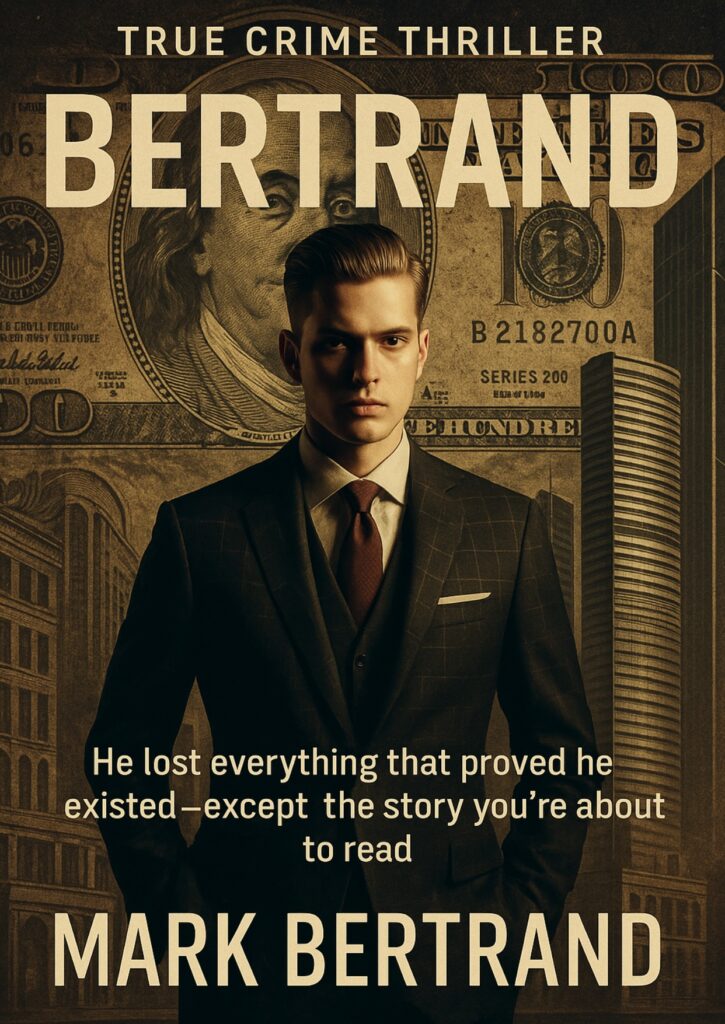
Discover Bertrand and purchase the true crime novel.
Readers who read books like Trust also read these articles.